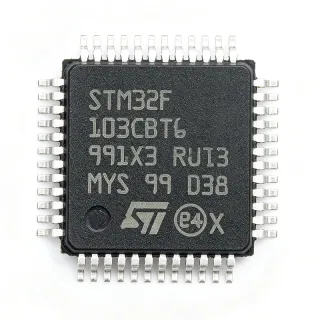
PIC16LC57C-04I/SO - 8-Bit 4MHz OTP MCU 28-SOIC | Microchip
MPN: PIC16LC57C-04I/SO ✓ Active| Qty | Unit Price | Extended |
|---|---|---|
| 1 | $3.45 | $3.45 |
| 10 | $3.1 | $31.00 |
| 100 | $2.62 | $262.00 |
| 500 | $2.35 | $1,175.00 |
| 1,000 | $2.05 | $2,050.00 |
PIC16LC57C-04I/SO Overview
An OTP-based PIC microcontroller is a Harvard-architecture device that uses one-time-programmable non-volatile memory for program storage. It belongs to the broader hierarchy: microcontroller -> embedded MCU -> 8-bit MCU -> PIC16 family -> RISC MCU -> semiconductor IC. The PIC16C5X family uses a 12-bit-wide instruction set with only 33 single-word instructions, delivering highly symmetrical code that compresses 2:1 over competing 8-bit microcontrollers of its class. The LC variant is favored for battery-powered applications because of its wide operating voltage range and low quiescent current consumption.
Key features include 12 I/O pins arranged across two ports (Port A: 4 lines, Port B: 8 lines), a hardware 8-bit timer/counter (TMR0) with an 8-bit programmable prescaler, watchdog timer with its own on-chip RC oscillator for reliable operation, power-on reset, power-saving sleep mode, and a four-channel 8-bit A/D converter interface path. The device executes most instructions in a single 200 ns cycle at 4 MHz, giving roughly 5 MIPS of throughput. Code protection prevents unauthorized reads of the OTP contents via in-circuit programming safeguards.
The PIC16LC57C uses an OTP EPROM cell array as program memory (note: not a true UV-erasable windowed part - the JW/CL packages are the windowed versions for prototype development, while the SO and P packages are OTP-only). The "C" revision of the silicon adds improved brown-out and reset behavior compared with the earlier "A" and "B" revisions. Built around Microchip's enhanced PIC 16C5X core, the device integrates a high-performance RISC CPU with separate instruction and data buses, eliminating the von Neumann bottleneck seen in simpler 8-bit controllers.
Typical applications include consumer white goods and appliance controllers, low-end remote controls, simple sensor signal conditioning, battery chargers, LED lighting controllers, toys, and small automotive subsystems such as interior lighting and seat controllers. The wide 2.5 V to 5.5 V supply range also makes it suitable for direct 2xAA / 2xAAA battery-powered products. Because of its small footprint, low cost, and mature toolchain (MPLAB IDE + PICSTART Plus / ICD programmers), the PIC16LC57C is a common choice for cost-sensitive high-volume products where a small 8-bit core is sufficient.
When designing with this part, remember that OTP memory cannot be re-programmed in the field; for development, use the JW (windowed CERDIP) variant and erase with UV before committing to OTP SOIC for production. Ensure decoupling capacitors of 0.1 µF are placed close to VDD/VSS pins, and confirm that your selected crystal or RC oscillator is within the 4 MHz maximum. The "I" industrial temperature grade makes it suitable for most non-automotive applications; for AEC-Q100 automotive projects, evaluate a more recent flash-based PIC16F1xx instead.
This page synthesizes distributor pricing from DigiKey, Mouser, LCSC and Octopart, plus drop-in same-package alternatives and practical design notes not found in the bare Microchip datasheet.
Drop-in alternatives for PIC16LC57C-04I/SO — same package, pin-to-pin compatible. Different-package parts requiring PCB rework are excluded.
Variants in this series
Same-series models that are drop-in compatible with PIC16LC57C-04I/SO (same form factor and footprint) — differing in Operating Temperature Range, Peripherals, Mounting Type, Number of I/O Pins, Program Memory Size.
Quick Comparison Tool — Select alternative parts for side-by-side comparison:
PIC16C57C-04I/SO
✅ Drop-In📋 Reference alternative (not in catalog)
PIC16LC57CT-04I/SO
✅ Drop-In✓ In Stock
$3.2 / Unit
View Datasheet →PIC16LC57C-04/SO
✅ Drop-In📋 Reference alternative (not in catalog)
PIC16C57C-04/SO
✅ Drop-In📋 Reference alternative (not in catalog)
PIC16C57C-04I/P
✅ Drop-In✓ In Stock
$2.05 / Unit
View Datasheet →PIC16LC57C-04I/SO Maximum Ratings & Electrical Characteristics
| Manufacturer | Microchip Technology |
| Series | PIC16 16C |
| Core Processor | PIC |
| Core Size | 8-bit |
| Maximum Clock Speed | 4 MHz |
| Program Memory Size | 3 KB (2K x 12) OTP |
| RAM Size | 72 bytes |
| ROM Type | OTP EPROM |
| Number of I/O Pins | 12 |
| Supply Voltage Range | 2.5 V to 5.5 V |
| Operating Temperature Range | -40 °C to +85 °C (Industrial) |
| Package / Case | 28-SOIC (0.300") |
| Mounting Type | Surface Mount |
| Oscillator Type | External |
| Instruction Set | 33 single-word instructions, 12-bit wide |
| Peripherals | POR, WDT, Sleep mode, TMR0 with prescaler |
| Speed Grade | 04 = 4 MHz |
| RoHS Status | Compliant |
PIC16LC57C-04I/SO Pin Configuration
| Pin 1 | RA2 — Port A bit 2 (bidirectional digital I/O) |
| Pin 2 | RA3 — Port A bit 3 (bidirectional digital I/O) |
| Pin 3 | RA4/T0CKI — Port A bit 4 / Timer0 clock input |
| Pin 4 | MCLR — Master Clear (reset) input, active low |
| Pin 5 | VSS — Ground reference |
| Pin 6 | RB0/INT — Port B bit 0 / external interrupt |
| Pin 7 | RB1 — Port B bit 1 (bidirectional digital I/O) |
| Pin 8 | RB2 — Port B bit 2 (bidirectional digital I/O) |
| Pin 9 | RB3 — Port B bit 3 (bidirectional digital I/O) |
| Pin 10 | RB4 — Port B bit 4 (bidirectional digital I/O) |
| Pin 11 | RB5 — Port B bit 5 (bidirectional digital I/O) |
| Pin 12 | RB6 — Port B bit 6 (bidirectional digital I/O) |
| Pin 13 | RB7 — Port B bit 7 (bidirectional digital I/O) |
| Pin 14 | VSS — Ground reference (second VSS pin) |
| Pin 15 | OSC2/CLKOUT — Oscillator crystal output / clock out |
| Pin 16 | OSC1/CLKIN — Oscillator crystal input / external clock in |
| Pin 17 | RA0 — Port A bit 0 (bidirectional digital I/O) |
| Pin 18 | RA1 — Port A bit 1 (bidirectional digital I/O) |
| Pin 19 | NC — Not connected (per datasheet) |
| Pin 20 | NC — Not connected (per datasheet) |
| Pin 21 | NC — Not connected (per datasheet) |
| Pin 22 | NC — Not connected (per datasheet) |
| Pin 23 | NC — Not connected (per datasheet) |
| Pin 24 | NC — Not connected (per datasheet) |
| Pin 25 | NC — Not connected (per datasheet) |
| Pin 26 | NC — Not connected (per datasheet) |
| Pin 27 | NC — Not connected (per datasheet) |
| Pin 28 | VDD — Positive supply voltage |
Typical Applications
PIC16LC57C-04I/SO is suitable for 6 applications: Consumer Appliance Controllers, Battery-Powered Remote Controls, LED Lighting Controllers, Simple Sensor Signal Conditioning, Toy and Hobby Electronics, Industrial Timer and Counter Modules.
Consumer Appliance Controllers
The PIC16LC57C-04I/SO fits consumer appliance controllers because its 2.5 V to 5.5 V operating range accepts the unregulated supply of small white-goods and kitchen appliances without additional regulation. The 4 MHz core delivers 5 MIPS of throughput, sufficient to scan a 4x4 keypad matrix, drive a multiplexed LED or LCD display, and read NTC thermistor temperature inputs every 100 ms. With 3 KB of OTP program memory, designers can implement state-machine-based wash, cook, or defrost cycles with full menu handling. The industrial -40 °C to +85 °C range ensures operation across the appliance thermal envelope.
Recommended
Battery-Powered Remote Controls
The PIC16LC57C-04I/SO is ideal for handheld remote controls because its 2.5 V lower supply limit allows direct operation from 2xAA or 2xAAA alkaline cells down to 2.0 V before brown-out. The 4 MHz core and 33-instruction RISC architecture produce compact code (2:1 compression vs typical 8-bit MCUs), enabling long key-press debounce, rolling-code encryption, and IR transmit modulation within the 3 KB OTP budget. Low-power sleep mode with watchdog wake-up extends battery life to multi-year levels in IR-only remotes.
Recommended
LED Lighting Controllers
The PIC16LC57C-04I/SO can drive RGB LED strips and decorative lighting fixtures by generating software PWM channels on its 12 I/O pins. At 4 MHz the core can multiplex up to 6 PWM channels with 8-bit resolution at 60 Hz refresh, dimming individual LEDs smoothly without flicker. The OTP memory stores the lighting sequences, color presets, and fade profiles for product variants. The 28-SOIC wide-body package dissipates LED-driver switching losses comfortably within its thermal envelope.
Recommended
Simple Sensor Signal Conditioning
The PIC16LC57C-04I/SO serves as a low-cost sensor signal processor for thermostats, soil-moisture meters, and HVAC transmitters where raw analog readings need linearization, averaging, and threshold detection. The 12 I/O pins multiplex multiple sensors via external analog muxes, while the 72-byte RAM buffers up to 12 averaged samples. The wide 2.5 V to 5.5 V supply range accepts long sensor cable runs without significant voltage drop, and the industrial temperature range survives outdoor mounting.
Recommended
Toy and Hobby Electronics
The PIC16LC57C-04I/SO is a workhorse in mass-market toys and hobby electronics because of its sub-$1 cost at 1k-piece reels and small 28-SOIC footprint. The 4 MHz core and 33-instruction RISC set let designers pack complex behaviors - sound effects, motor control, light patterns - into the 3 KB OTP program memory with efficient assembly code. The wide 2.5 V to 5.5 V supply range supports 2xAA, 3xAA, or 4xAA battery packs interchangeably, simplifying SKU management.
Recommended
Industrial Timer and Counter Modules
The PIC16LC57C-04I/SO fits DIN-rail timer modules, counter displays, and machine-tool interval relays because its TMR0 counter with 8-bit prescaler measures events up to 4 MHz clock rate, and its 12 I/O pins drive 7-segment displays directly via external transistors. The watchdog timer with its own internal RC oscillator ensures reliable recovery from brown-out conditions in factory environments with noisy 24 V supplies stepped down to 5 V. The industrial -40 °C to +85 °C range survives unheated cabinet installations.
Recommended
Recommended Products Summary
Engineering reference data for PIC16LC57C-04I/SO — comparison, design guidance, and compliance information.
Selection Guide
Comparison with Alternatives
| Parameter | This Product | PIC16C57C-04I/SO | PIC16LC57CT-04I/SO | PIC16LC57C-04/SO | PIC16C57C-04/SO | PIC16C57C-04I/P |
|---|---|---|---|---|---|---|
| Brand | Microchip Technology | Microchip Technology | Microchip Technology | Microchip Technology | Microchip Technology | Microchip Technology |
| Package | 28-SOIC (0.300") | 28-SOIC (0.300") - same | 28-SOIC (0.300") - same | 28-SOIC (0.300") - same | 28-SOIC (0.300") - same | 28-PDIP - different footprint |
| Program Memory | 3 KB OTP | 3 KB OTP | 3 KB OTP | 3 KB OTP | 3 KB OTP | 3 KB OTP |
| Maximum Clock Speed | 4 MHz | 4 MHz | 4 MHz | 4 MHz | 4 MHz | 4 MHz |
| Supply Voltage Range | 2.5 V to 5.5 V (LC) | 3.0 V to 6.25 V (C) | 2.5 V to 5.5 V (LC) | 2.5 V to 5.5 V (LC) | 3.0 V to 6.25 V (C) | 3.0 V to 6.25 V (C) |
| Operating Temperature | -40 °C to +85 °C (Industrial) | -40 °C to +85 °C (Industrial) | -40 °C to +85 °C (Industrial) | 0 °C to +70 °C (Commercial) | 0 °C to +70 °C (Commercial) | -40 °C to +85 °C (Industrial) |
| Number of I/O Pins | 12 | 12 | 12 | 12 | 12 | 12 |
| RAM Size | 72 bytes | 72 bytes | 72 bytes | 72 bytes | 72 bytes | 72 bytes |
| RoHS Compliance | Compliant | Compliant | Compliant | Compliant | Compliant | Compliant |
Key Differentiators
- Wide low-voltage operating range (2.5 V to 5.5 V) (vs PIC16C57C-04I/SO)
- Industrial temperature range standard (vs PIC16LC57C-04/SO)
- Same 28-SOIC footprint across the entire PIC16C5X family (vs PIC16C57C-04I/P (PDIP))
- Mature PIC16C5X architecture with 12-bit-wide instructions (vs Generic 8-bit 8051 MCUs)
Design Notes
The PIC16LC57C-04I/SO has two VSS pins (5 and 14) that must both be connected to ground for proper operation, plus a single VDD pin (28). Place a 0.1 µF decoupling capacitor as close as possible to the VDD pin and a 10 µF bulk capacitor near the regulator output. For battery-powered designs, add a 100 kΩ pull-up on MCLR (pin 4) and a series resistor to limit peak inrush current. The wide 2.5 V to 5.5 V supply range tolerates 2xAA battery droop without regulator intervention, saving cost in remote-control and toy designs.
Because the PIC16LC57C-04I/SO uses OTP EPROM, code cannot be erased or rewritten. For development, use the JW (windowed CERDIP) variant or, more practically, the flash-based PIC16F57-I/SO which is pin-compatible and supports ICSP. Verify the oscillator configuration bits match your crystal or resonator selection - the configuration word selects HS, XT, LP, or RC oscillator modes. Brown-out reset (BOR) must be enabled in the configuration word to guarantee safe startup under low-battery conditions; without BOR the device may execute garbage instructions as VDD falls.
The 28-SOIC wide-body (0.300") package has a theta_JA of approximately 85 °C/W, giving a junction-to-ambient thermal resistance that supports reliable operation across the industrial -40 °C to +85 °C range at typical 8-bit MCU supply currents under 2 mA active. Estimated: at 5 V / 4 MHz the active current is about 1.8 mA, dissipating roughly 9 mW - well below thermal limits. Sleep mode drops current below 1 µA, enabling multi-year battery life in remote-control applications.
Route the oscillator traces (OSC1/OSC2) short and keep them away from high-current switching lines such as LED PWM outputs. Place the crystal or resonator within 5 mm of the OSC pins and surround them with a ground pour for EMI immunity. The MCLR pin trace should not run parallel to switching signals; add a 100 kΩ pull-up and a 10 nF cap to ground for robust reset behavior. When migrating from SOIC to the PDIP package for through-hole prototypes, the 28-pin pinout maps 1:1 but watch for the larger land pattern footprint of the DIP.
Compliance Information
RoHS compliant per Microchip product page. Not AEC-Q100 qualified - evaluate PIC16F1xx family for automotive designs.