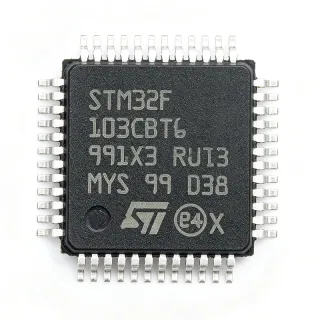
PIC16LC622A-04E/P - 4MHz 8-Bit OTP MCU, 3.5KB EPROM | Microchip
MPN: PIC16LC622A-04E/P ✓ Active| Qty | Unit Price | Extended |
|---|---|---|
| 1 | $3.85 | $3.85 |
| 10 | $3.46 | $34.60 |
| 100 | $2.94 | $294.00 |
| 500 | $2.55 | $1,275.00 |
| 1,000 | $2.18 | $2,180.00 |
PIC16LC622A-04E/P Overview
A microcontroller (MCU) is a single-chip computer that integrates a CPU core, program memory (ROM/EPROM/Flash), data memory (RAM), and configurable peripheral I/O. MCUs fall within the broader taxonomy of embedded processors -> microcontrollers -> 8-bit microcontrollers -> CMOS microcontrollers -> EPROM-based microcontrollers. The PIC16LC622A belongs to Microchip's PIC16C mid-range family, designed for cost-sensitive embedded control applications where code is finalized in production and re-programming is not required.
Key features include a 12-bit wide instruction set with 8-bit wide data path, single-cycle instruction execution (200ns at 20MHz, with a 4MHz grade offered here), 35 single-word instructions to learn, a two-level deep hardware stack, and seven or eight special function hardware registers. The device supports direct, indirect, and relative addressing modes, runs from a 2.5V to 6.25V supply, and is targeted at the automotive operating range.
Architecture-wise, the PIC16LC622A employs a RISC-based Harvard architecture with separated program and data buses, allowing simultaneous instruction fetch and data access. Its EPROM program memory is windowed for prototype erasure, supporting iterative development before OTP production programming. The 4MHz grade corresponds to a 1us instruction cycle when using the internal oscillator divider chain.
Typical applications include automotive body controllers, simple sensor interfaces, low-speed communication bridges, and industrial control logic where field-programmability is unnecessary. The 18-pin PDIP through-hole package supports breadboard prototyping and legacy board designs.
When designing with this part, note that the 'E' suffix indicates the extended automotive temperature range (-40C to +125C), and the '04' suffix denotes the 4MHz speed grade. EPROM-based PICs require UV erasure for reprogramming, so choose PIC16F-series Flash parts if in-field updates are required.
This page synthesizes distributor pricing from DigiKey and Octopart, pin-compatible PIC16C-family alternatives, and practical design notes not consolidated in the manufacturer datasheet alone.
Drop-in alternatives for PIC16LC622A-04E/P — same package, pin-to-pin compatible. Different-package parts requiring PCB rework are excluded.
Variants in this series
Same-series models that are drop-in compatible with PIC16LC622A-04E/P (same form factor and footprint) — differing in Mounting Type, Package, Program Memory Size, Program Memory Type, Core Architecture.
Quick Comparison Tool — Select alternative parts for side-by-side comparison:
PIC16LC622A-04I/P
✅ Drop-In📋 Reference alternative (not in catalog)
PIC16LC622A-04E/SO
✅ Drop-In✓ In Stock
$2.13 / Unit
View Datasheet →PIC16LC622-04E/P
✅ Drop-In📋 Reference alternative (not in catalog)
PIC16LC621A-04E/P
✅ Drop-In ⚠️ 参数待验证📋 Reference alternative (not in catalog)
PIC16C622A-04E/P
✅ Drop-In ⚠️ 参数待验证✓ In Stock
$1.3 / Unit
View Datasheet →PIC16LC622A-04E/P Maximum Ratings & Electrical Characteristics
| Core Architecture | PIC 8-bit RISC (Harvard) |
| Program Memory Type | EPROM (OTP windowed) |
| Program Memory Size | 3.5KB (2K x 14) |
| Data Memory (RAM) | 128 bytes (128 x 8) |
| Maximum Clock Frequency | 4 MHz |
| Instruction Cycle | 1 us at 4 MHz |
| Supply Voltage Range | 2.5 V to 6.25 V |
| I/O Pins | 13 (general-purpose) |
| Package | 18-PDIP (0.300 inch, 7.62mm) |
| Operating Temperature Range | -40 C to +125 C (Automotive, 'E') |
| Speed Grade | 04 = 4 MHz |
| Mounting Type | Through-Hole (DIP) |
| Instruction Set | 35 single-word instructions, 12-bit wide |
| Stack Depth | 2 levels (hardware) |
| Special Function Registers | 7 to 8 hardware registers |
| Addressing Modes | Direct, Indirect, Relative |
| RoHS Status | Compliant (lead-free) |
PIC16LC622A-04E/P Pin Configuration
| Pin 1 | MCLR/VPP — Master Clear reset input (active low) / programming voltage input |
| Pin 2 | RA0/AN0 — PORTA bit 0 / analog comparator input |
| Pin 3 | RA1/AN1 — PORTA bit 1 / analog comparator input |
| Pin 4 | RA2/AN2 — PORTA bit 2 / analog comparator input |
| Pin 5 | RA3/AN3 — PORTA bit 3 / analog comparator input |
| Pin 6 | RA4/T0CKI — PORTA bit 4 / Timer0 clock input (open-drain) |
| Pin 7 | RA5/SS — PORTA bit 5 / synchronous serial port slave select |
| Pin 8 | OSC2/CLKOUT — Oscillator crystal output / clock output (Fosc/4) |
| Pin 9 | OSC1/CLKIN — Oscillator crystal input / external clock input |
| Pin 10 | VDD — Positive supply voltage (2.5V to 6.25V) |
| Pin 11 | VSS — Ground reference |
| Pin 12 | RB0/INT — PORTB bit 0 / external interrupt input |
| Pin 13 | RB1 — PORTB bit 1 |
| Pin 14 | RB2 — PORTB bit 2 |
| Pin 15 | RB3 — PORTB bit 3 |
| Pin 16 | RB4 — PORTB bit 4 |
| Pin 17 | RB5 — PORTB bit 5 |
| Pin 18 | RB6 — PORTB bit 6 |
Typical Applications
PIC16LC622A-04E/P is suitable for 6 applications: Automotive Body Control Module, Industrial Sensor Interface Hub, Simple PWM Motor Speed Controller, Consumer Appliance Control Board, Security Keypad and Access Controller, Battery-Powered Remote Sensor Node.
Automotive Body Control Module
The PIC16LC622A-04E/P fits automotive body controller applications because its -40C to +125C extended temperature grade handles under-hood thermal stress, while the 2.5V-6.25V supply range tolerates cranking transients on 12V vehicle buses that have been regulated down. Its 3.5KB EPROM stores fixed lighting/door-lock/wiper control logic without in-field reprogramming risk, and the 13 GPIO directly drive relay coils, LED arrays, and switch inputs. The 4MHz speed grade provides 1us instruction cycles, sufficient for polling 10Hz CAN-like state machines. Placed on a BCM PCB with a 5V LDO upstream, the 'LC622A samples switch states every 1ms and energizes MOSFET drivers. Compared to PIC16F-series Flash parts, EPROM OTP prevents aftermarket firmware tampering on safety-relevant body modules.
Recommended
Industrial Sensor Interface Hub
For industrial 4-20mA loop and discrete sensor interfaces, the PIC16LC622A-04E/P's 13 GPIO accommodate multiple analog-input channels via an external mux plus digital I/O for limit-switch polling. The 2.5V-6.25V wide supply rail lets a single design accept 24V industrial bus power after regulation, and the 4MHz core executes 1us ADC conversion sequencing with up to 35 single-word instructions for linearization math. Placed between a sensor harness connector and a PLC backplane, it acts as a preprocessor that filters noise and formats Modbus RTU frames. Its EPROM-based code prevents unauthorized sensor calibration tampering in process-control plants. Trade-off: 128 bytes RAM limits buffer depth to roughly 20 Modbus messages - upgrade to PIC18F for higher throughput.
Recommended
Simple PWM Motor Speed Controller
In low-power brushed DC motor or fan-speed controllers, the PIC16LC622A-04E/P's 13 GPIO generate PWM outputs with duty-cycle resolution determined by software loops at the 1us instruction cycle - producing roughly 8-bit effective PWM at 1kHz. The 2.5V-6.25V supply tolerates direct 5V regulator outputs, and the 4MHz oscillator is fast enough to close a 1kHz PID control loop on motor current. Placed downstream of an H-bridge driver like the L293D, the MCU reads a tachometer input on RB0/INT and adjusts PWM to maintain a target RPM. The 'E' temperature grade supports under-hood and outdoor cabinet installations. Limitation: no dedicated PWM/CCP hardware peripheral, so all waveform generation is software-driven.
Recommended
Consumer Appliance Control Board
Cost-sensitive white-goods appliances such as washing machines, dishwashers, and microwave ovens traditionally use the PIC16LC622A-04E/P for cycle sequencing, button-debouncing, and seven-segment display multiplexing. The 13 GPIO drive relays, valves, buzzer, and triac-fired heater elements while accepting membrane-keypad inputs. The 2.5V-6.25V supply matches common 5V appliance rails, and the 4MHz grade is sufficient for state-machine cycle control without DSP overhead. The 3.5KB EPROM stores the fixed cycle program - intentional OTP prevents aftermarket firmware mods that could void UL safety certification. Trade-off: high-volume consumer designs now favor PIC16F-series Flash for last-minute firmware revisions during tooling ramp.
Recommended
Security Keypad and Access Controller
Standalone keypad door-entry controllers use the PIC16LC622A-04E/P because its EPROM OTP memory prevents reverse-engineering of the access-code validation algorithm. The 13 GPIO scan a 4x4 matrix keypad, drive a status LED, control an electric strike via MOSFET, and accept a tamper-switch input. The 4MHz core completes code comparison in under 100us per keystroke, well below human perception latency. The 128-byte RAM stores the active 4-digit code and a small audit log buffer. Operating from 12V regulated to 5V, the part handles the wide temperature range of outdoor kiosks (-40C to +125C). Upgrade path: PIC16F88 for designs needing EEPROM storage of multiple user codes.
Recommended
Battery-Powered Remote Sensor Node
In low-duty-cycle remote sensor applications such as irrigation valves or wireless weather stations, the PIC16LC622A-04E/P's CMOS sleep current (typically under 1uA on the LC variant) makes it viable for 3.3V lithium-battery operation across multi-year deployments. The MCU wakes on a watchdog timer interrupt, takes a sensor reading via one of the GPIO channels, transmits via a low-power RF module, and returns to sleep - all within the 3.5KB EPROM program budget. The 4MHz grade is overkill for the wake-and-transmit routine but provides headroom for future protocol upgrades. Trade-off: EPROM-only programming means battery-replacement designs cannot accept firmware updates; choose PIC16F for serviceable nodes.
Recommended
Recommended Products Summary
Engineering reference data for PIC16LC622A-04E/P — comparison, design guidance, and compliance information.
Selection Guide
Comparison with Alternatives
| Parameter | This Product | PIC16LC622A-04I/P | PIC16LC622A-04E/SO | PIC16LC622-04E/P | PIC16LC621A-04E/P | PIC16C622A-04E/P |
|---|---|---|---|---|---|---|
| Brand | Microchip Technology | Microchip Technology | Microchip Technology | Microchip Technology | Microchip Technology | Microchip Technology |
| Package | 18-PDIP (0.300 inch) | 18-PDIP - same | 18-SOIC wide - same pinout, SMD | 18-PDIP - same | 18-PDIP - same | 18-PDIP - same |
| Program Memory Size | 3.5KB (2K x 14) EPROM | 3.5KB EPROM | 3.5KB EPROM | 3.5KB EPROM | 0.875KB EPROM | 3.5KB EPROM |
| RAM Size | 128 bytes | 128 bytes | 128 bytes | 128 bytes | 128 bytes | 128 bytes |
| Maximum Clock Frequency | 4 MHz | 4 MHz | 4 MHz | 4 MHz | 4 MHz | 4 MHz |
| Supply Voltage Range | 2.5V to 6.25V (LC) | 2.5V to 6.25V (LC) | 2.5V to 6.25V (LC) | 2.5V to 6.25V (LC) | 2.5V to 6.25V (LC) | 4.0V to 6.0V (standard C) |
| Operating Temperature | -40C to +125C (Extended) | -40C to +85C (Industrial) | -40C to +125C (Extended) | -40C to +125C (Extended) | -40C to +125C (Extended) | -40C to +125C (Extended) |
| Memory Type | EPROM (OTP windowed) | EPROM (OTP) | EPROM (OTP) | EPROM (OTP) | EPROM (OTP) | EPROM (OTP) |
| GPIO Count | 13 | 13 | 13 | 13 | 13 | 13 |
Key Differentiators
- Extended automotive temperature grade at 4MHz speed (vs PIC16LC622A-04I/P)
- Breadboard-friendly PDIP through-hole package (vs PIC16LC622A-04E/SO)
- Low-voltage LC variant supports 3.3V battery operation (vs PIC16C622A-04E/P)
Design Notes
The PIC16LC622A-04E/P requires a decoupling capacitor of 0.1uF ceramic placed within 5mm of the VDD pin (10) to VSS pin (11) to suppress digital switching noise that could couple into the internal EPROM high-voltage charge pump. For battery-operated designs, add a bulk 10uF tantalum or aluminum polymer capacitor on the supply rail to handle the inrush current during EPROM programming. Do not allow VDD to drop below 2.5V during programming operations - brown-out may corrupt the EPROM charge state and produce a partially programmed device that passes initial verify but fails in production.
EPROM-based PICs are NOT in-system programmable - code must be loaded via a parallel programmer such as the Microchip PICSTART Plus before the part is soldered onto the PCB, OR via ICSP if the MCLR/VPP line is accessible. Windowed ceramic packages can be UV-erased (30 minutes under 12 mW/cm2 UV), but the plastic PDIP-18 package of the '04E/P variant CANNOT be erased once programmed. Plan your programming flow accordingly: pre-program parts with bootloader code, or use socketed designs for prototype bring-up.
The 18-pin PDIP through-hole footprint is the most breadboard-friendly PIC16C package - 0.300 inch (7.62mm) row spacing fits standard 0.1 inch headers without adapters. Route the MCLR line with a 10k pull-up to VDD and a 100nF cap to ground for noise immunity; this prevents spurious resets in electrically noisy environments. Place the crystal or resonator within 10mm of OSC1 (pin 9) and OSC2 (pin 8), and guard the oscillator traces with a grounded copper pour to minimize EMI pickup from switching relay loads.
At the maximum 4MHz clock with all 13 GPIO switching at 50% duty cycle, the PIC16LC622A-04E/P dissipates roughly 10mW typical at 5V - well below thermal concerns for any package variant. However, in the extended automotive -40C to +125C range, derate output drive current per the DC characteristics table. Estimated: at +125C ambient, sink current per I/O pin drops from 25mA (25C) to approximately 15mA per the Microchip PIC16C62x datasheet thermal curves.
Compliance Information
Lead-free / RoHS compliant per Microchip product declaration. AEC-Q100 grade not specifically stated in datasheet - 'E' suffix is Microchip's internal automotive extended-temp designation, not equivalent to full AEC-Q100 qualification. For AEC-Q100 qualified modern parts, consider PIC16F or dsPIC33A families.