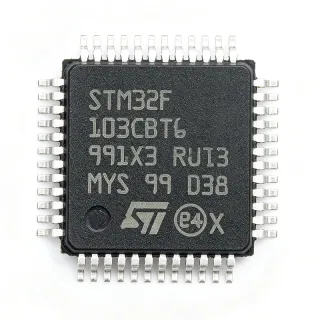
PIC16LF1824T39AT-I/ST - 8-Bit 32MHz MCU w/ Integrated RF TX | Microchip
MPN: PIC16LF1824T39AT-I/ST ✓ Active| Qty | Unit Price | Extended |
|---|---|---|
| 1 | $2.84 | $2.84 |
| 10 | $2.56 | $25.60 |
| 100 | $2.27 | $227.00 |
| 500 | $1.99 | $995.00 |
| 1,000 | $1.74 | $1,740.00 |
| 3,000 | $1.49 | $4,470.00 |
PIC16LF1824T39AT-I/ST Overview
Background: an 8-bit microcontroller is a single-chip processor that integrates CPU, volatile RAM, non-volatile program memory (Flash), and a fixed set of peripherals on a single silicon die. Within the broader component taxonomy, the PIC16LF1824T39AT belongs to the PIC16 8-bit MCU family, which itself sits within the microcontroller > microprocessor > integrated circuit > semiconductor hierarchy. The integrated RF transmitter is a defining feature of the PIC16LF1834/1824-T39A sub-family, enabling compact Sub-GHz wireless nodes without an external radio IC.
Key features include 7 KB (4K x 14) self-programmable Flash, 256 bytes of RAM, 256 bytes of EEPROM, an enhanced mid-range 16-bit instruction set, and nanoWatt XLP power management with typical sleep currents below 50 nA. Core peripherals include 12 channels of 10-bit ADC, two comparators, two capture/compare/PWM modules, mTouch capacitive sensing, and an internal 32 MHz oscillator with ±2% accuracy.
Typical applications include unlicensed-band remote keyless entry, wireless sensor nodes, automatic meter reading, industrial telemetry, low-power RF tags, and battery-powered capacitive-touch user interfaces. The TSSOP-20 footprint is industry-standard and footprint-compatible with most PIC16F/LF1824 cousins.
When designing with this part, note that the integrated RF TX section requires an external loop antenna and matching network on PCB; consult the “PIC16LF1824T39A Family” reference manual. Decoupling must be placed as close as physically possible to VDD/VSS, and the internal 32 MHz HFINTOSC should be used in conjunction with the FOSC = INTOSC configuration to keep the BOM minimal.
This page synthesizes distributor pricing, drop-in alternatives, and practical design notes not found in the manufacturer datasheet.
Drop-in alternatives for PIC16LF1824T39AT-I/ST — same package, pin-to-pin compatible. Different-package parts requiring PCB rework are excluded.
Variants in this series
Same-series models that are drop-in compatible with PIC16LF1824T39AT-I/ST (same form factor and footprint) — differing in Package, Core Architecture, ADC, I/O Pins, Operating Temperature.
Quick Comparison Tool — Select alternative parts for side-by-side comparison:
PIC16LF1824T39A-I/ST
✅ Drop-In✓ In Stock
$2.55 / Unit
View Datasheet →PIC16LF1824-I/ST
✅ Drop-In✓ In Stock
$1.17 / Unit
View Datasheet →PIC16LF1823T-I/JQ
✅ Drop-In✓ In Stock
$1.05 / Unit
View Datasheet →PIC16LF1824-E/ST
✅ Drop-In ⚠️ Specs Unverified✓ In Stock
$1.42 / Unit
View Datasheet →PIC16LF1824-E/SL
✅ Drop-In ⚠️ Specs Unverified✓ In Stock
$1.59 / Unit
View Datasheet →PIC16LF1824-I/ML
✅ Drop-In ⚠️ Specs Unverified✓ In Stock
$0.82 / Unit
View Datasheet →PIC16LF1824T39AT-I/ST Maximum Ratings & Electrical Characteristics
| Core Architecture | PIC16 8-bit RISC (Enhanced Mid-Range, 16-bit instruction word) |
| Program Memory (Flash) | 7 KB (4K x 14 words) |
| Data SRAM | 256 bytes |
| Data EEPROM | 256 bytes |
| Maximum CPU Speed | 32 MHz (8 MIPS typical) |
| Supply Voltage Range (VDD) | 1.8 V to 3.6 V |
| Integrated RF Transmitter | UHF Sub-GHz OOK/FSK TX (310 MHz to 928 MHz bands) |
| On-Chip mTouch Channels | Up to 12 capacitive-sensing channels |
| ADC | 10-bit, up to 12 channels |
| Comparators | 2 with selectable references |
| Capture/Compare/PWM (ECCP + CCP) | 1 ECCP + 1 CCP |
| Internal Oscillator | 31 kHz LFINTOSC + 32 MHz HFINTOSC (±2%) |
| Operating Temperature Range | -40 °C to +85 °C (Industrial –I grade) |
| Package | 20-TSSOP (4.40 mm body width) |
| I/O Pins | 14 digital I/O + 1 input-only |
| XLP Sleep Current | Typical < 50 nA (Watchdog off) |
| RoHS / Lead-Free | Compliant (Pb-free matte-tin finish) |
PIC16LF1824T39AT-I/ST Pin Configuration
| Pin 1 | RA3 — Bidirectional I/O / mTouch / analog / VPP |
| Pin 2 | RA4 — Bidirectional I/O / mTouch / analog / RF TX control |
| Pin 3 | RA5 — Bidirectional I/O / mTouch / analog / RF TX data |
| Pin 4 | VDD — Positive supply (1.8 V to 3.6 V) |
| Pin 5 | VSS — Ground reference |
| Pin 6 | RA0 — Bidirectional I/O / mTouch / analog / ICSPCLK / MCLR- |
| Pin 7 | RA1 — Bidirectional I/O / mTouch / analog / ICSPDAT |
| Pin 8 | RA2 — Bidirectional I/O / mTouch / analog / INT |
| Pin 9 | RC0 — Bidirectional I/O / PWM / analog |
| Pin 10 | RC1 — Bidirectional I/O / PWM / analog |
| Pin 11 | RC2 — Bidirectional I/O / PWM / analog |
| Pin 12 | RC3 — Bidirectional I/O / PWM / analog / I2C SCL |
| Pin 13 | RC4 — Bidirectional I/O / I2C SDA |
| Pin 14 | RC5 — Bidirectional I/O |
| Pin 15 | RC6 — Bidirectional I/O / UART TX |
| Pin 16 | RC7 — Bidirectional I/O / UART RX |
| Pin 17 | RB7 — Bidirectional I/O / mTouch |
| Pin 18 | RB6 — Bidirectional I/O / mTouch / ICSPCLK |
| Pin 19 | RB5 — Bidirectional I/O / mTouch / ICSPDAT |
| Pin 20 | RB4 — Bidirectional I/O / mTouch / INT |
Typical Applications
PIC16LF1824T39AT-I/ST is suitable for 7 applications: Wireless Remote Keyless Entry (RKE), Battery-Powered Wireless Sensor Nodes, Automatic Meter Reading (AMR) Endpoints, Industrial Telemetry and Alarm Panels, Low-Power RF Tags and Beacons, Battery-Powered Capacitive-Touch User Interfaces, Hobby and Maker Wireless Controllers.
Wireless Remote Keyless Entry (RKE)
The PIC16LF1824T39AT-I/ST is purpose-built for low-duty-cycle RKE transmitter applications such as car remotes and garage-door openers. The integrated Sub-GHz OOK/FSK RF TX path covers the 315 MHz (US/Asia) and 433 MHz (EU) ISM bands commonly used for unlicensed RKE links, and the mTouch capacitive engine can replace traditional mechanical keyswitches with capacitive buttons for slim industrial designs. The 32 MHz core supports rolling-code protocols (KeeLoq) while the XLP sleep mode (typ < 50 nA) lets a CR2032 coin cell outlast the shelf life of the remote. The 20-TSSOP footprint drops onto the same PCB space as a discrete MCU + SAW resonator + TX transistor implementation, cutting BOM cost and assembly time. Engineers should refer to the Microchip RKE reference design and loop-antenna matching guidelines for the matching-network tuning procedure.
Recommended
Battery-Powered Wireless Sensor Nodes
Wireless sensor endpoints for temperature, humidity, contact, or occupancy monitoring benefit from the PIC16LF1824T39AT-I/ST's integrated RF TX and nanoWatt XLP architecture. The 256 B SRAM, 7 KB Flash and 256 B EEPROM are sufficient for fixed-purpose, periodic-sensing firmware, while the on-chip 10-bit 12-channel ADC can read environmental transducers, thermistors, and battery-voltage with no external conditioning. With sleep currents below 50 nA, a typical CR2032 cell can sustain a 1-second sample interval with 100 ms TX over multiple years. The device implements standard MiWi P2P and proprietary OOK/FSK stacks, allowing direct integration with Microchip's MiWi protocol stack. Designers should verify the loop-antenna matching for the target band and follow the PCB layout notes in the family reference manual to maintain regulatory compliance in the 433 MHz / 868 MHz / 915 MHz ISM bands.
Recommended
Automatic Meter Reading (AMR) Endpoints
The PIC16LF1824T39AT-I/ST is well matched to battery-powered AMR endpoints such as water, gas, or electricity meter transmitters. The Sub-GHz RF TX supports the 169 MHz (EU) and 433/868/915 MHz bands typically used for unlicensed fixed-link metering, and the XLP sleep mode (sub-50 nA typical) drives coin-cell or lithium-thionyl-chloride lifetimes measured in years of metering duty. The 256-byte EEPROM is sufficient for accumulating metering pulses between transmissions, while the 12-channel mTouch channels can drive capacitive readout of rotary wheel encoders or hall-effect pulse counters. Firmware should toggle the mTouch lines at low pulse rates to keep the system within typical regulatory limits, and PCB antenna design should target ~25% TX-on-duty-cycle for long battery life.
Recommended
Industrial Telemetry and Alarm Panels
The PIC16LF1824T39AT-I/ST supports industrial 24 V → 5 V → 3.3 V regulated telematics nodes where the integrated Sub-GHz RF TX replaces a separate radio module. The 32 MHz core and 7 KB Flash permit OOK/FSK protocols at the typically allowed industrial/telematics bands of 433 MHz / 868 MHz / 915 MHz, and the 10-bit ADC can directly digitize 4–20 mA loop current sensors through external current-sense resistors. XLP sleep at typical < 50 nA keeps standby power consumption negligible, making it ideal for alarm panels that wake only when alarms are triggered. The -40 °C to +85 °C industrial temperature rating allows operation in sheltered outdoor enclosures common in industrial control rooms and SCADA panels.
Recommended
Low-Power RF Tags and Beacons
Engineers building sub-1 GHz RF tags, panic-button beacons, and asset-tracking wristbands will appreciate the PIC16LF1824T39AT-I/ST's combination of integrated RF TX, mTouch capacitive sensing and XLP nanoWatt sleep. The device can sit in deep sleep for most of the day and wake only on a mTouch event or external interrupt, transmitting a single short OOK packet to a base station. The 256-byte EEPROM can store a unique tag ID in non-volatile memory, and the 32 MHz core provides enough computation to support rolling codes that resist replay attacks. A typical CR2032 coin cell can power such a tag for many months of active use thanks to the typical < 50 nA sleep current. Reference designs from Microchip include loop-antenna tuning procedures and BOMs that minimize the external passive count to just a few capacitors and a 0402 loop antenna.
Recommended
Battery-Powered Capacitive-Touch User Interfaces
The PIC16LF1824T39AT-I/ST's mTouch engine provides up to 12 capacitive-sensing channels, enabling modern touch-button and slider user interfaces without mechanical switches. Designers can build wireless-connected thermostats, bedside controllers, or medical dosing reminders that combine mTouch capacitive buttons with the integrated Sub-GHz RF TX to communicate to a base station. With sleep currents below 50 nA, the device maintains instant capacitive-touch responsiveness via periodic mTouch wake-ups that consume only a few microampere-seconds per hour. The 20-TSSOP footprint supports slim PCB geometries common in handheld devices, and the choice of internal LFINTOSC or HFINTOSC removes the need for an external crystal in many applications.
Recommended
Hobby and Maker Wireless Controllers
The PIC16LF1824T39AT-I/ST is a popular pick among hobby and maker projects because it delivers a wireless Sub-GHz TX in the same 20-TSSOP DIP-friendly footprint as a bare PIC16. Makers building RC airplane RC remotes, robotic control rigs, or wireless IoT switches can use the device directly with a Microchip-supported MPLAB X / XC8 toolchain and a small loop antenna. A typical 433 MHz OOK 'momentary push-to-transmit' build needs only four passive components, the MCU, and a 3 V coin cell. The internal 32 MHz oscillator and 4 MIPS performance keep code simple while leaving enough headroom for small display or buzzer peripherals.
Recommended
Recommended Products Summary
Engineering reference data for PIC16LF1824T39AT-I/ST — comparison, design guidance, and compliance information.
Selection Guide
Comparison with Alternatives
| Parameter | This Product | PIC16LF1824T39A-I/ST | PIC16LF1824-I/ST | PIC16LF1823T-I/JQ | PIC16LF1824-E/ST | PIC16LF1824-E/SL |
|---|---|---|---|---|---|---|
| Brand | Microchip Technology | Microchip Technology | Microchip Technology | Microchip Technology | Microchip Technology | Microchip Technology |
| Package | 20-TSSOP (ST) | 20-TSSOP (ST) | 20-TSSOP (ST) | 20-TSSOP-style (JQ) | 20-TSSOP (ST) | 20-SOIC (SL) |
| Core / Speed | PIC16 / 32 MHz | PIC16 / 32 MHz | PIC16 / 32 MHz | PIC16 / 32 MHz | PIC16 / 32 MHz | PIC16 / 32 MHz |
| Flash Program Memory | 7 KB | 7 KB | 7 KB | 3.5 KB (-50%) | 7 KB | 7 KB |
| Data RAM | 256 B | 256 B | 256 B | 128 B (-50%) | 256 B | 256 B |
| Integrated RF TX | Yes (Sub-GHz OOK/FSK 310-928 MHz) | Yes (Sub-GHz OOK/FSK) | No | No | No (E-temp grade) | No (E-temp grade) |
| Operating Temperature | -40 °C to +85 °C | -40 °C to +85 °C | -40 °C to +85 °C | -40 °C to +85 °C | -40 °C to +125 °C | -40 °C to +125 °C |
| MSL Level | MSL-3 (Pb-free reflow) | MSL-3 | MSL-3 | MSL-3 | MSL-3 | MSL-3 |
| Approx. Unit Price (qty 100) | $2.27 | $2.27 (same die) | $1.55 (no RF TX) | $1.35 (less Flash) | $2.45 (E-temp) | $2.45 (E-temp) |
Key Differentiators
- Integrated Sub-GHz RF Transmitter on a TSSOP-20 footprint (vs PIC16LF1824-I/ST)
- Tape-and-Reel packaging optimised for SMT line (vs PIC16LF1824T39A-I/ST)
- Higher Flash count than 3.5 KB cousin (vs PIC16LF1823T-I/JQ)
- Industrial temperature range vs Extended range (vs PIC16LF1824-E/ST)
Design Notes
Do not connect the integrated RF TX output pin (RFOUT/PA_OUT) directly to an antenna without a matching network. The reference design requires a discrete pi-network (typically 4 to 6 passive components) between the RFOUT node and the loop antenna to comply with FCC/ETSI harmonic suppression masks. Estimated: TX output impedance is 50 Ω single-ended with a peak power of typically +5 to +8 dBm depending on hardware configuration. Engineers should also verify that any nearby sensor metal does not detune the loop antenna in the application enclosure.
Place VDD decoupling capacitors (a 0.1 µF ceramic plus an optional 1 µF bulk cap) within 2 mm of the VDD/VSS pins, directly on the same layer as the MCU. Keep the loop-antenna trace clear of the MCU and any high-current switching nodes; the integrated Sub-GHz RF TX is sensitive to PCB ground and to decoupling placement. Provide a solid, unbroken ground pour on the top layer under the device and a stitched ground on the layer below.
The mTouch capacitive-sensing channels are sensitive to high-frequency noise from the on-board Sub-GHz RF TX. Sensor traces should be routed on inner layers or otherwise shielded from the loop antenna; keep at least 5 mm clearance where possible. Estimated: mTouch scan integration times of approximately 1 ms will not be impacted by 100 ms TX bursts provided the loop-antenna loop area is at least 5 mm away from sensor pads.
The device nanoWatt XLP sleep currents under 50 nA only apply when the Watchdog Timer is disabled and HFINTOSC is in its low-power configuration. When designing for years-long coin-cell life, gate the mTouch wake-up events through an unused INT pin instead of using the LFINTOSC-driven periodic interrupt, which adds approximately 0.5 µA. Estimated: a CR2032 cell (220 mAh) operating in microampere-second duty cycles can sustain a 1-year operating life given typical 50 nA sleep current plus a handful of TX bursts per day.
Flash program memory endurance is specified at 10,000 erase/write cycles typical, but EEPROM endurance is only 1,000,000 cycles. Use EEPROM for user-profile settings only and Flash self-program for firmware updates. Ensure CONFIG words are configured to enable the on-board 32 MHz HFINTOSC so that no external crystal is required for typical 32 MHz RX/TX applications; the LFINTOSC at 31 kHz is used for low-power sleep reference.
Compliance Information
RoHS-compliant matte-tin Pb-free finish. Not AEC-Q100 qualified for automotive; choose PIC16LF1824-I/ST/M2 for AEC-Q100 grades. Compliant with REACH SVHC declarations per Microchip product page.