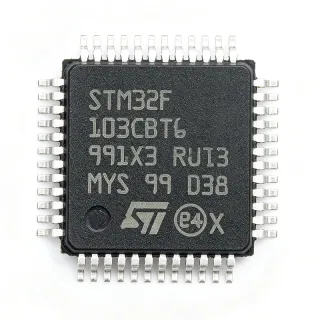
PIC16LF18344-E/GZ - 8-bit XLP MCU, 7KB Flash, 20-UQFN | Microchip
MPN: PIC16LF18344-E/GZ ✓ Active| Qty | Unit Price | Extended |
|---|---|---|
| 1 | $1.62 | $1.62 |
| 10 | $1.49 | $14.90 |
| 100 | $1.28 | $128.00 |
| 500 | $1.11 | $555.00 |
| 1,000 | $0.97 | $970.00 |
PIC16LF18344-E/GZ Overview
A microcontroller (MCU) is a single-chip computer that integrates a CPU core, program and data memory, peripherals, and I/O. The PIC16 family uses a 14-bit instruction word RISC architecture optimized for deterministic interrupt response and very low sleep current, making PIC MCUs especially common in low-power, cost-sensitive embedded designs. The 8-bit PIC16F/LF183xx family extends this with Core Independent Peripherals (CIPs), Peripheral Pin Select (PPS), and enhanced analog capabilities that offload tasks from the core.
Key features of the PIC16LF18344-E/GZ include up to 32 MHz operation, integrated 10-bit ADC with computation, multiple hardware PWM/CCP/CWG/CLC peripherals, EUSART, I2C/SPI, and 256-byte EEPROM. The 'LF' prefix denotes the low-voltage / low-power variant (1.8V to 3.6V VDD range), enabling deep sleep currents in the nanoampere range suitable for battery-powered IoT endpoints. The exposed pad UQFN-20 (4x4) footprint minimizes PCB area while providing an additional thermal path.
The PPS block allows digital peripheral signals (CLC, PWM, communications) to be remapped to a wide range of I/O pins, dramatically easing PCB routing and pin reassignment late in design. Combined with the Core Independent Peripherals, the PIC16LF18344-E/GZ can implement sensor interfaces, motor control loops, and lighting controls without burdening the CPU, which keeps average active current low and extends battery life.
Typical applications include battery-powered sensor nodes, low-power IoT edge devices, consumer remote controls, LED lighting controllers, small motor drivers, and wearable medical accessories. The wide operating voltage range and nanoampere sleep current also make it a strong fit for energy-harvesting designs and wireless sensor transmitters.
When designing with this part, verify that your VDD stays within the LF 1.8V to 3.6V window and that the decoupling network follows Microchip's recommended 100 nF plus bulk capacitor topology. For migration from the non-LF PIC16F18344-E/GZ, account for the lower maximum VDD by reviewing any 5V-tolerant I/O assumptions. This page synthesizes distributor pricing, same-family alternatives (PIC16LF18324, PIC16LF18326, PIC16LF1828-I/GZ) and practical design notes not consolidated in the manufacturer datasheet.
Drop-in alternatives for PIC16LF18344-E/GZ — same package, pin-to-pin compatible. Different-package parts requiring PCB rework are excluded.
Variants in this series
Same-series models that are drop-in compatible with PIC16LF18344-E/GZ (same form factor and footprint) — differing in ADC, Package, Core Architecture, Program Memory (Flash), Operating Temperature.
Quick Comparison Tool — Select alternative parts for side-by-side comparison:
PIC16F18344-E/GZ
✅ Drop-In✓ In Stock
$0.95 / Unit
View Datasheet →PIC16LF18324-E/GZ
✅ Drop-In ⚠️ Specs Unverified📋 Reference alternative (not in catalog)
PIC16LF1828-I/GZ
✅ Drop-In ⚠️ Specs Unverified✓ In Stock
$1.6 / Unit
View Datasheet →PIC16LF1829-I/GZ
✅ Drop-In ⚠️ Specs Unverified✓ In Stock
$0.69 / Unit
View Datasheet →PIC16F18344-I/GZ
✅ Drop-In ⚠️ Specs Unverified📋 Reference alternative (not in catalog)
PIC16F15344-I/GZ
✅ Drop-In✓ In Stock
$1.12 / Unit
View Datasheet →PIC16LF18344-E/GZ Maximum Ratings & Electrical Characteristics
| Core Architecture | PIC16 enhanced mid-range 8-bit RISC |
| Instruction Word | 14-bit |
| Maximum CPU Speed | 32 MHz |
| Program Memory (Flash) | 7 KB (4K x 14 words) |
| Data SRAM | 512 bytes |
| Data EEPROM | 256 bytes |
| Operating Voltage (VDD) | 1.8 V to 3.6 V |
| ADC | 10-bit ADC with computation (channels TBD per package) |
| Timers | Multiple 8/16-bit timers (TMR0, TMR1, TMR2, etc.) |
| Communication Peripherals | EUSART, I2C, SPI |
| Core Independent Peripherals | CLC, CWG, CCP/PWM, NCO, DSM |
| Peripheral Pin Select (PPS) | Yes |
| XLP (eXtreme Low Power) | Yes - nanoWatt XLP technology |
| Package | 20-pin UQFN (4x4) with Exposed Pad |
| Operating Temperature | -40C to +125C (E suffix = Extended) |
| Mounting Type | Surface Mount |
| RoHS Status | Compliant |
PIC16LF18344-E/GZ Pin Configuration
| Pin 1 | RA5 — Bidirectional I/O with PPS; analog-capable |
| Pin 2 | RA4 — Bidirectional I/O with PPS; analog-capable |
| Pin 3 | RA3/MCLR — Master Clear (Reset) input or digital I/O |
| Pin 4 | RA2 — Bidirectional I/O with PPS; analog-capable |
| Pin 5 | RA1 — Bidirectional I/O with PPS; analog-capable |
| Pin 6 | RA0 — Bidirectional I/O with PPS; analog-capable |
| Pin 7 | VSS — Ground reference |
| Pin 8 | RA7 — Bidirectional I/O with PPS; analog-capable |
| Pin 9 | RA6 — Bidirectional I/O with PPS; analog-capable |
| Pin 10 | RC0 — Bidirectional I/O with PPS; analog-capable |
| Pin 11 | RC1 — Bidirectional I/O with PPS; analog-capable |
| Pin 12 | RC2 — Bidirectional I/O with PPS; analog-capable |
| Pin 13 | RC3 — Bidirectional I/O with PPS; analog-capable |
| Pin 14 | RC4 — Bidirectional I/O with PPS; analog-capable |
| Pin 15 | RC5 — Bidirectional I/O with PPS; analog-capable |
| Pin 16 | RC6 — Bidirectional I/O with PPS; analog-capable |
| Pin 17 | RC7 — Bidirectional I/O with PPS; analog-capable |
| Pin 18 | RB7 — Bidirectional I/O with PPS; analog-capable |
| Pin 19 | VDD — Positive supply (1.8 V to 3.6 V) |
| Pin 20 | RB5 — Bidirectional I/O with PPS; analog-capable |
| Pin 21 | EP — Exposed thermal pad - tie to VSS for thermal/electrical performance |
Typical Applications
PIC16LF18344-E/GZ is suitable for 6 applications: Battery-Powered IoT Sensor Node, Wireless Remote Control (BLE/Sub-GHz TX), LED Lighting Controller / Strip Driver, Wearable Health Monitoring Accessory, Small DC Motor / Fan Speed Controller, Industrial Sensor Transmitter (4-20 mA / IO-Link).
Battery-Powered IoT Sensor Node
The PIC16LF18344-E/GZ is well suited for battery-powered IoT sensor nodes thanks to its 1.8 V to 3.6 V operating range and nanoWatt XLP sleep currents in the nA range. With Peripheral Pin Select (PPS) and Core Independent Peripherals (CLC, NCO, CWG), the MCU can wake from sleep on a sensor interrupt, condition the signal via a CLC, and return to sleep - all without CPU intervention - keeping average current below 5 uA for coin-cell longevity.
Recommended
Wireless Remote Control (BLE/Sub-GHz TX)
For handheld remote controls, the PIC16LF18344-E/GZ's XLP technology and integrated CWG peripheral drive PWM/IR or sub-GHz TX carriers without CPU wake-up. The 32 MHz core handles button debouncing and protocol encoding while drawing microamps in active mode, and the 20-UQFN (4x4) exposed-pad package fits inside the cramped enclosure of a remote-control PCB. Pair it with a CC1101 sub-GHz transceiver or BLE SoC for a complete sub-1 mA average-current TX chain.
Recommended
LED Lighting Controller / Strip Driver
The PIC16LF18344-E/GZ drives WS2812B / SK6812 addressable LED strips and high-brightness LED arrays using its built-in CWG and CCP PWM peripherals plus DSM for bit-banging timing-critical protocols. PPS lets designers route LED data to any available GPIO, simplifying PCB layout when changing LED types. The 32 MHz instruction rate generates WS2812 waveforms with sub-100 ns jitter, and the 1.8 V to 3.6 V range lets a single Li-ion battery drive both MCU and LEDs.
Recommended
Wearable Health Monitoring Accessory
Wearable health monitors (heart-rate, SpO2, step-counter) demand uA-range average current and a small PCB footprint - both delivered by the PIC16LF18344-E/GZ in the 20-UQFN (4x4) package. The 10-bit ADC with computation supports direct photodiode readout for optical HR sensors, and the CLC peripheral combines op-amp-like signal chains without waking the CPU. The 256-byte EEPROM stores user calibration data, and the wide -40C to +125C operating range tolerates body-heat environments.
Recommended
Small DC Motor / Fan Speed Controller
Closed-loop fan and small DC motor control benefit from the PIC16LF18344-E/GZ's CWG (Complementary Waveform Generator) and CCP PWM peripherals for generating complementary gate-drive signals. The ADC samples back-EMF or tachometer pulses, and the 14-bit instruction core handles PID computation while the PWM runs autonomously. Operating from 1.8 V to 3.6 V, the part drives small 3 V brushless fans directly from a USB or Li-ion source.
Recommended
Industrial Sensor Transmitter (4-20 mA / IO-Link)
For industrial 4-20 mA / IO-Link sensor transmitters, the PIC16LF18344-E/GZ's EUSART, I2C, and SPI peripherals interface with IO-Link PHY chips and sigma-delta ADCs, while its -40C to +125C operating range tolerates factory-floor temperatures. PPS remaps digital peripheral outputs to free pins when adding IO-Link wake-up circuits, and the 7 KB Flash stores IO-Link IODD descriptors and calibration tables. The exposed-pad UQFN-20 package supports SMT assembly on compact industrial transmitter PCBs.
Recommended
Recommended Products Summary
Engineering reference data for PIC16LF18344-E/GZ — comparison, design guidance, and compliance information.
Selection Guide
Comparison with Alternatives
| Parameter | This Product | PIC16F18344-E/GZ | PIC16LF18324-E/GZ | PIC16LF1828-I/GZ | PIC16LF1829-I/GZ | PIC16F18344-I/GZ | PIC16F15344-I/GZ |
|---|---|---|---|---|---|---|---|
| Brand | Microchip Technology | Microchip Technology | Microchip Technology | Microchip Technology | Microchip Technology | Microchip Technology | Microchip Technology |
| Package | 20-UQFN (4x4) with EP | 20-UQFN (4x4) - same | 20-UQFN (4x4) - same | 20-UQFN (4x4) - same | 20-UQFN (4x4) - same | 20-UQFN (4x4) - same | 20-UQFN (4x4) - same |
| Flash Program Memory | 7 KB (4K x 14) | 7 KB | 7 KB | 7 KB | 14 KB | 7 KB | 7 KB |
| SRAM | 512 bytes | 512 bytes | 512 bytes | 256 bytes | 1024 bytes | 512 bytes | 512 bytes |
| EEPROM | 256 bytes | 256 bytes | 256 bytes | 256 bytes | 256 bytes | 256 bytes | 256 bytes |
| Operating Voltage | 1.8 V to 3.6 V | 1.8 V to 5.5 V | 1.8 V to 3.6 V | 1.8 V to 3.6 V | 1.8 V to 3.6 V | 1.8 V to 5.5 V | 2.3 V to 5.5 V |
| Maximum CPU Speed | 32 MHz | 32 MHz | 32 MHz | 32 MHz | 32 MHz | 32 MHz | 32 MHz |
| Peripheral Pin Select (PPS) | Yes | Yes | Yes | No (older family) | No (older family) | Yes | Yes |
| Operating Temperature | -40C to +125C (E suffix) | -40C to +125C | -40C to +125C | -40C to +85C (I suffix) | -40C to +85C | -40C to +85C | -40C to +85C |
Key Differentiators
- XLP nanoWatt technology for sub-uA sleep (vs PIC16F18344-E/GZ)
- Core Independent Peripherals (CLC, CWG, NCO, DSM) (vs PIC16LF1828-I/GZ)
- 20-UQFN (4x4) footprint with EP for compact PCB (vs PIC16LF1829-I/GZ (also 20-UQFN))
Design Notes
Estimated: at VDD=3.3 V, 32 MHz active, IOUT=typical, the PIC16LF18344 draws approximately 4-6 mA active and <1 uA in sleep with RTC and peripherals disabled. To achieve the lowest deep-sleep current, disable all peripherals via PMD registers, disable the BOR, switch the system clock to LFINTOSC, and configure unused pins as outputs driving low. Place a 100 nF decoupling capacitor within 3 mm of VDD and a 10 uF bulk capacitor on the same rail.
The 20-UQFN (4x4) package has an exposed thermal pad (EP) that MUST be soldered to a PCB pad of at least 1.5 x 1.5 mm connected to VSS. The EP improves thermal dissipation and provides a low-impedance ground return for I/O switching. Recommended land pattern is the Microchip 20-UQFN-EP recommended footprint (per Packaging Specification). Place VDD/VSS decoupling capacitors on the same side as the part to minimize loop inductance.
Do not exceed 3.6 V VDD on the LF variant - even brief 5 V transients will damage the part. If the application uses a 5 V rail elsewhere, level-shift I/O to the PIC and add a series resistor on MCLR with clamping. For migrating from PIC16F18344-E/GZ code, ensure no CONFIG bits reference the extended VDD mode and review PPS assignments because the LF variant has identical PPS peripherals but tighter VDD constraints.
Keep the programming/debug signals PGD (RB7) and PGC (RB6) routed with short, parallel traces and a 4.7 kohm pull-up on MCLR to support In-Circuit Serial Programming (ICSP). Maintain a ground keep-out under the ICSP header to avoid coupling programming noise. PPS allows remapping PGD/PGC to other pins, but Microchip recommends keeping the default ICSP pins for compatibility with all debuggers.
Compliance Information
RoHS and lead-free per Microchip product page. Not AEC-Q100 qualified - this is a general-purpose MCU. For automotive-grade drop-in alternatives, see PIC16F18344-E/GZ Q-1 variants (not listed here as E/GZ).