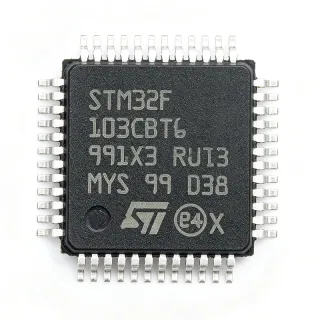
PIC18F4458-I/ML - 8-bit 48MHz USB MCU 24KB Flash 44-QFN | Microchip
MPN: PIC18F4458-I/ML ✓ Active| Qty | Unit Price | Extended |
|---|---|---|
| 1 | $9.95 | $9.95 |
| 10 | $8.95 | $89.50 |
| 100 | $7.85 | $785.00 |
| 250 | $7.1 | $1,775.00 |
| 500 | $6.55 | $3,275.00 |
| 1,000 | $5.95 | $5,950.00 |
PIC18F4458-I/ML Overview
What is an 8-bit MCU with integrated USB? An 8-bit microcontroller is a single-chip computer built around an 8-bit data path, optimized for deterministic control, low power, and small code footprint. PIC18F devices extend the baseline PIC16 architecture with a 16-bit instruction word, C-friendly addressing, and richer peripherals. Within the broader taxonomy, PIC18 belongs to the microcontroller -> embedded controller -> semiconductor family, and the 44-QFN "/ML" suffix positions it as the surface-mount variant of the PIC18F4458 family (others include /PT TQFP and /P PDIP).
Key features include 24 KB (12K x 16) of enhanced Flash with self-programming support, 2 KB SRAM, 256 Bytes EEPROM, 35 digital I/O pins, an internal 31 kHz to 8 MHz oscillator with PLL for 48 MHz operation, a 12-bit A/D converter with up to 13 input channels, two analog comparators, two CCP modules plus an enhanced CCP, three serial ports (FS-USB 12 Mbit/s, I2C, SPI up to 10 Mbit/s), and a USART with LIN support. The nanoWatt feature set provides idle, sleep, and low-power Timer1 oscillator modes that let the device draw microamps in standby.
Architecturally, the PIC18F4458 uses an enhanced Harvard bus with a 16-bit flash program word and an 8-bit data path, enabling C-friendly operation while keeping interrupts and peripheral triggers fully deterministic. The integrated USB SIE handles Full-Speed (12 Mbit/s) USB 2.0 without an external transceiver or external oscillator when paired with the internal 48 MHz PLL, dramatically reducing BOM cost for USB peripherals. The 12-bit ADC is paired with a 5-channel input mux for mixed analog/digital sensor nodes.
Typical applications include Full-Speed USB human-interface devices (HID keyboards, mice, custom joysticks), USB-to-UART bridges, low-cost data loggers with analog sensors, industrial control panels, and consumer accessories needing a wired connection to PCs or chargers. The 24 KB Flash comfortably fits USB stack and CDC/HID class drivers alongside application logic.
When designing with this device, follow the recommended USB bus-power decoupling (100 nF high-frequency + 4.7 uF bulk) and place the VBUS sense resistor within 10 mm of the D+ line. Note that part number suffix /ML denotes the 44-pin QFN package; the /PT variant is TQFP-44 and /P is PDIP-40 - all three share the same silicon so firmware is portable, but PCB footprints and pinouts differ.
This page synthesizes distributor pricing, same-brand drop-in alternatives (PIC18F4455, PIC18F4450), cross-brand parametric equivalents, and practical design notes not found in the manufacturer datasheet alone.
Drop-in alternatives for PIC18F4458-I/ML — same package, pin-to-pin compatible. Different-package parts requiring PCB rework are excluded.
Variants in this series
Same-series models that are drop-in compatible with PIC18F4458-I/ML (same form factor and footprint) — differing in Package, Operating Temperature, Timers, Program Memory (Flash), Core Architecture.
Quick Comparison Tool — Select alternative parts for side-by-side comparison:
PIC18F4455-I/ML
✅ Drop-In ⚠️ Specs Unverified📋 Reference alternative (not in catalog)
PIC18F4450-I/ML
✅ Drop-In ⚠️ Specs Unverified📋 Reference alternative (not in catalog)
PIC18F4450T-I/ML
✅ Drop-In ⚠️ Specs Unverified✓ In Stock
$3.83 / Unit
View Datasheet →PIC18F4458-I/ML Maximum Ratings & Electrical Characteristics
| Core Architecture | PIC18 (8-bit data, 16-bit instruction word) |
| Program Memory (Flash) | 24 KB (12K x 16) |
| SRAM | 2 KB |
| EEPROM | 256 Bytes |
| Maximum CPU Frequency | 48 MHz |
| Supply Voltage (VDD) | 4.2 V to 5.5 V |
| Digital I/O Pins | 35 |
| ADC | 12-bit, up to 13 channels |
| Comparators | 2 |
| CCP Modules | 2 CCP + 1 ECCP |
| USB | USB 2.0 Full-Speed (12 Mbit/s) integrated SIE |
| Serial Interfaces | USB, I2C, SPI (up to 10 Mbit/s), USART (LIN-capable) |
| Timers | Timer0/1/2/3 + WDT |
| Operating Temperature | -40 C to +85 C (industrial, -I suffix) |
| Package | 44-pin QFN (8x8 mm), -ML suffix |
| Mounting Type | Surface Mount |
| MSL Level | 3 (168 hours) |
| RoHS Status | Compliant |
| nanoWatt Features | Idle, Sleep, low-power Timer1 oscillator, ultra-low-power wake-up |
PIC18F4458-I/ML Pin Configuration
| Pin 1 | RB0/AN12/INT0 — Port B bit 0 / analog input 12 / external interrupt 0 |
| Pin 2 | RB1/AN10/INT1 — Port B bit 1 / analog input 10 / external interrupt 1 |
| Pin 3 | RB2/AN8/INT2 — Port B bit 2 / analog input 8 / external interrupt 2 |
| Pin 4 | RB3/AN9/CCP2 — Port B bit 3 / analog input 9 / CCP2 output |
| Pin 5 | RB4/AN11/KB10 — Port B bit 4 / analog input 11 / interrupt-on-change |
| Pin 6 | RB5/KB11/PGM — Port B bit 5 / interrupt-on-change / ICSP program pin |
| Pin 7 | RB6/KB12/PGC — Port B bit 6 / interrupt-on-change / ICSP clock pin |
| Pin 8 | RB7/KB13/PGD — Port B bit 7 / interrupt-on-change / ICSP data pin |
| Pin 9 | VUSB — Internal USB 3.3 V regulator output (decouple with 220 nF) |
| Pin 10 | VBUS — USB bus voltage sense input (5 V) |
| Pin 11 | D- — USB D- data line |
| Pin 12 | D+ — USB D+ data line |
| Pin 13 | OSC1/CLKI — Crystal oscillator input / external clock input |
| Pin 14 | OSC2/CLKO/RA6 — Crystal oscillator output / clock output / Port A bit 6 |
| Pin 15 | RC0/T1OSO/T1CKI — Port C bit 0 / Timer1 oscillator output |
| Pin 16 | RC1/T1OSI/CCP2 — Port C bit 1 / Timer1 oscillator input / CCP2 |
| Pin 17 | RC2/CCP1 — Port C bit 2 / CCP1 output |
| Pin 18 | RC3/SCK/SCL — Port C bit 3 / SPI clock / I2C clock |
| Pin 19 | RC4/SDI/SDA — Port C bit 4 / SPI data in / I2C data |
| Pin 20 | RC5/SDO — Port C bit 5 / SPI data out |
| Pin 21 | RC6/TX/CK — Port C bit 6 / USART TX / clock line |
| Pin 22 | RC7/RX/DT — Port C bit 7 / USART RX / data line |
| Pin 23 | RE0/AN5/CK1 — Port E bit 0 / analog input 5 / clock out 1 |
| Pin 24 | RE1/AN6/CK2 — Port E bit 1 / analog input 6 / clock out 2 |
| Pin 25 | RE2/AN7 — Port E bit 2 / analog input 7 |
| Pin 26 | RE3/MCLR/VPP — Port E bit 3 / device reset / programming voltage |
| Pin 27 | RA0/AN0 — Port A bit 0 / analog input 0 |
| Pin 28 | RA1/AN1 — Port A bit 1 / analog input 1 |
| Pin 29 | RA2/AN2/VREF- — Port A bit 2 / analog input 2 / ADC VREF- |
| Pin 30 | RA3/AN3/VREF+ — Port A bit 3 / analog input 3 / ADC VREF+ |
| Pin 31 | RA4/T0CKI — Port A bit 4 / Timer0 clock input |
| Pin 32 | RA5/AN4 — Port A bit 5 / analog input 4 |
| Pin 33 | VDD — Positive supply 4.2 V to 5.5 V |
| Pin 34 | VSS — Ground reference |
| Pin 35 | RD0 — Port D bit 0 |
| Pin 36 | RD1 — Port D bit 1 |
| Pin 37 | RD2 — Port D bit 2 |
| Pin 38 | RD3 — Port D bit 3 |
| Pin 39 | RD4 — Port D bit 4 |
| Pin 40 | RD5 — Port D bit 5 |
| Pin 41 | RD6 — Port D bit 6 |
| Pin 42 | RD7 — Port D bit 7 |
| Pin 43 | AVDD — Analog supply (must equal VDD) |
| Pin 44 | AVSS — Analog ground (must equal VSS) |
| Pin EP | PAD (Thermal) — Exposed thermal pad, must be soldered to a ground plane for thermal dissipation and electrical ground |
Typical Applications
PIC18F4458-I/ML is suitable for 6 applications: USB HID Keyboard / Mouse Controller, USB-to-UART / Virtual COM Port Bridge, Low-Cost Data Logger with Analog Sensors, Industrial Control Panel USB Interface, USB Consumer Accessory (Chargers, Dongles, Toys), USB Audio Class 1.0 Headset Controller.
USB HID Keyboard / Mouse Controller
The PIC18F4458-I/ML is purpose-built for Full-Speed USB HID peripherals like keyboards, mice, and custom HID devices. Its integrated USB 2.0 SIE eliminates external transceivers, while the internal 8 MHz oscillator with 48 MHz PLL on-chip means no external crystal is needed, dropping BOM cost by $0.30-$0.50 per board. The 24 KB Flash fits a complete USB HID class driver (about 4 KB) alongside application matrix-scanning code, while 2 KB SRAM handles key debounce buffers and HID report FIFOs with headroom. The 35 digital I/O pins support a 22-key matrix plus indicator LEDs and rotary encoder inputs. Programmable pull-ups simplify PCB routing by removing external resistors on switch lines.
Recommended
USB-to-UART / Virtual COM Port Bridge
A common application for the PIC18F4458-I/ML is a CDC class USB-to-UART bridge that gives legacy RS-232 peripherals USB connectivity. The integrated USB SIE and enhanced USART with LIN support make this a single-chip solution; about 6 KB of Flash holds the CDC stack and line-coding handler, leaving 18 KB free for bridge protocol logic. The 48 MHz CPU clock ensures 12 Mbit USB transfer rates without bottlenecks even at 115200 baud xon/xoff flow control. The +5 V-only operation directly matches USB bus-powered designs, removing the need for a 3.3 V LDO in the bridge path.
Recommended
Low-Cost Data Logger with Analog Sensors
The 12-bit ADC with up to 13 input channels lets the PIC18F4458-I/ML sample multiple analog sensors (temperature, pressure, voltage, current) at sample rates up to 100 kS/s per channel. Combined with 24 KB Flash for storage tables and 2 KB SRAM for a rolling sample buffer, this part is ideal for USB-attached data loggers that export data as a CDC virtual COM stream. The 256 Bytes EEPROM holds non-volatile calibration constants and device descriptors, and the nanoWatt idle modes let battery-backed loggers sleep at <1 uA between USB sessions.
Recommended
Industrial Control Panel USB Interface
Industrial panels and HMIs use the PIC18F4458-I/ML as a USB peripheral that hosts a custom interface for PC-based configuration and firmware update tools. The -40 C to +85 C industrial temperature grade supports factory-floor environments, the 5 V supply tolerates long cable drops better than 3.3 V parts, and the integrated USB SIE simplifies FCC/CE EMC compliance compared with parts that need external transceivers. The 35 I/O lines plus 2 CCP/ECCP modules can drive LED indicators, keypads, and PWM buzzer tones in one device.
Recommended
USB Consumer Accessory (Chargers, Dongles, Toys)
Consumer accessories like USB chargers with status LEDs, custom dongles, and education toys benefit from the PIC18F4458-I/ML's minimal external BOM and integrated 5 V operation. Designers can implement a complete USB CDC or HID device in less than 15 KB of Flash, leaving room for application-specific behaviour. The 2 KB SRAM comfortably holds HID report FIFOs and LED state machines, and the nanoWatt sleep mode gives battery-powered dongles (e.g., promotional USB lights) months of standby time from a single CR2032.
Recommended
USB Audio Class 1.0 Headset Controller
USB Audio Class 1.0 headsets benefit from the PIC18F4458-I/ML because the device can handle Full-Speed isochronous USB audio endpoints at 48 kHz sample rate while controlling volume, mute, and button presses over HID side-channel reports. While the 12-bit ADC is not high-fidelity enough for ADC-based microphone capture, it is suitable for sidetone monitoring and battery voltage sensing. About 10-12 KB of Flash is consumed by the audio class driver and button handler, leaving ample room for vendor-specific extensions.
Recommended
Recommended Products Summary
Engineering reference data for PIC18F4458-I/ML — comparison, design guidance, and compliance information.
Selection Guide
Comparison with Alternatives
| Parameter | This Product | PIC18F4455-I/ML | PIC18F4450-I/ML | PIC18F4450T-I/ML |
|---|---|---|---|---|
| Brand | Microchip Technology | Microchip Technology | Microchip Technology | Microchip Technology |
| Package | 44-QFN (8x8 mm) | 44-QFN (8x8 mm) - same | 44-QFN (8x8 mm) - same | 44-QFN (8x8 mm) - same |
| Program Flash Memory | 24 KB | 24 KB - same | 32 KB (+33%) | 32 KB (+33%) |
| SRAM | 2 KB | 2 KB - same | 2 KB - same | 2 KB - same |
| EEPROM | 256 Bytes | 256 Bytes - same | 256 Bytes - same | 256 Bytes - same |
| ADC Resolution | 12-bit (4096 steps) | 10-bit (1024 steps, -75% resolution) | 10-bit (1024 steps, -75% resolution) | 10-bit (1024 steps, -75% resolution) |
| CPU Maximum Frequency | 48 MHz | 48 MHz - same | 48 MHz - same | 48 MHz - same |
| USB | USB 2.0 FS SIE integrated | USB 2.0 FS SIE integrated - same | USB 2.0 FS SIE integrated - same | USB 2.0 FS SIE integrated - same |
| Supply Voltage | 4.2 V to 5.5 V | 4.2 V to 5.5 V - same | 4.2 V to 5.5 V - same | 4.2 V to 5.5 V - same |
| Operating Temperature | -40 C to +85 C (industrial) | -40 C to +85 C - same | -40 C to +85 C - same | -40 C to +85 C - same |
Key Differentiators
- Higher-resolution 12-bit ADC versus 10-bit on PIC18F4455 / PIC18F4450 drop-ins (vs PIC18F4455-I/ML)
- Fully integrated Full-Speed USB SIE without external crystal or transceiver (vs PIC18F4455-I/ML)
- Larger Flash space for richer USB class stacks (vs PIC18F4450-I/ML)
Design Notes
USB bus-power decoupling: place a 100 nF X7R 0402 ceramic between VDD (pin 33) and VSS (pin 34) within 5 mm of the IC, plus a 4.7 uF bulk tantalum or ceramic bypass. The VUSB pin (pin 9) requires a separate 220 nF ceramic decoupling capacitor for the internal 3.3 V USB regulator. Trace VBUS sense directly from the upstream USB connector with a series ferrite bead for EMI suppression on bus-powered designs.
Exposed thermal pad (EP, pin 44): the 44-QFN package has a large central exposed thermal pad that MUST be soldered to a ground plane for both thermal dissipation and electrical ground. Skipping this solder connection causes the device to overheat and may exhibit erratic USB communication failures. In prototyping, ensure your breakout board has through-vias stitching the EP to the ground plane - many cheap QFN-44 breakouts omit these and are unfit for production designs.
USB signal integrity: the D+ and D- traces must be 90 ohm differential with 45 ohm single-ended impedance to ground, matched in length within 0.5 mm, and kept under 25 mm total length to stay within Full-Speed USB signal integrity budget. Place 27 ohm series termination resistors within 5 mm of the device pins. Use a common-mode choke on D+/D- near the connector for designs targeting FCC/CE EMI compliance.
Sleep current optimization: enabling the nanoWatt Sleep mode with the on-board low-power Timer1 oscillator (32.768 kHz external crystal on RC0/RC1) yields <1 uA standby current. To wake on USB, configure the USB SIE interrupt as a wake-up source rather than polling. The PIC18F4458 can be powered from the +5 V USB VBUS pin directly through a 5 V LDO - no separate 3.3 V rail is required since VUSB pin provides the internal 3.3 V for the USB transceiver.
Compliance Information
RoHS and REACH compliant per Microchip product page. Not AEC-Q100 qualified - for automotive designs use PIC18F45K40 family. Halogen-free per Microchip environmental data sheet verified 2026-09-27.