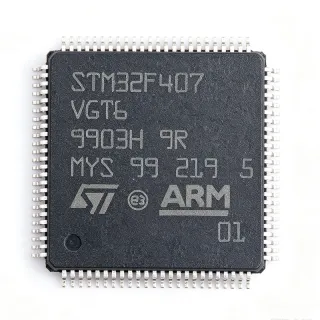
STM32L151VDT6 - Ultra-Low-Power ARM Cortex-M3 MCU | STMicroelectronics
MPN: STM32L151VDT6 ✓ Active| Qty | Unit Price | Extended |
|---|---|---|
| 1 | $8.5 | $8.50 |
| 10 | $7.8 | $78.00 |
| 100 | $6.9 | $690.00 |
| 500 | $6.2 | $3,100.00 |
| 1,000 | $5.6 | $5,600.00 |
STM32L151VDT6 Overview
What is an ultra-low-power microcontroller? An ultra-low-power microcontroller is a type of embedded processor designed to minimize energy consumption while maintaining computational capability. It typically integrates multiple low-power modes, such as sleep, stop, and standby, to reduce power draw during idle periods. In the system hierarchy, an ultra-low-power MCU falls under the category of microcontrollers, which are part of embedded systems and integrated circuits. The STM32L1 series is specifically optimized for applications where battery life is critical, such as portable medical devices, smart sensors, and wireless communication nodes.
Key features of the STM32L151VDT6 include multiple low-power modes (Sleep, Low-power Run, Low-power Sleep, Stop with RTC, Stop without RTC, Standby with RTC, Standby without RTC), a 12-bit ADC with 1 Msps, two 12-bit DACs, and a wide range of communication interfaces including USART, SPI, I2C, USB, and CAN. The device also integrates a real-time clock (RTC) with calendar and alarm functions, and a true EEPROM emulation capability.
Technically, the STM32L151VDT6 is built on a 130nm process technology, which contributes to its low power consumption. The core operates at 1.8V to 3.6V, and the device can run at up to 32 MHz. The Flash memory is organized with 4x64 KB sectors, and the SRAM is 48 KB. The device supports a wide operating temperature range of -40°C to +85°C, making it suitable for industrial applications.
Typical applications include portable medical devices (e.g., glucose meters, pulse oximeters), smart meters, wireless sensor nodes, and industrial control systems. The ultra-low-power modes allow the MCU to operate for years on a single coin cell battery in applications with low duty cycles.
When designing with this device, it is important to consider the power supply decoupling: place a 100nF capacitor close to each VDD pin and a 4.7uF capacitor at the main power input. Additionally, the VBAT pin should be connected to a backup battery or a capacitor to maintain RTC operation during main power loss.
Drop-in alternatives for STM32L151VDT6 — same package, pin-to-pin compatible. Different-package parts requiring PCB rework are excluded.
Variants in this series
Same-series models that are drop-in compatible with STM32L151VDT6 (same form factor and footprint) — differing in Flash Memory, Low-Power Modes, Package, SRAM.
Quick Comparison Tool — Select alternative parts for side-by-side comparison:
STM32L151VET6
✅ Drop-In ⚠️ Specs Unverified📋 Reference alternative (not in catalog)
STM32L151VCT6
✅ Drop-In ⚠️ Specs Unverified✓ In Stock
$4.32 / Unit
View Datasheet →STM32L151VBT6
✅ Drop-In ⚠️ Specs Unverified📋 Reference alternative (not in catalog)
STM32L151V8T6
✅ Drop-In ⚠️ Specs Unverified📋 Reference alternative (not in catalog)
STM32L152VDT6
✅ Drop-In ⚠️ Specs Unverified📋 Reference alternative (not in catalog)
STM32L162VDT6
✅ Drop-In ⚠️ Specs Unverified📋 Reference alternative (not in catalog)
STM32L151VET6
✅ Drop-In ⚠️ Specs Unverified📋 Reference alternative (not in catalog)
STM32L151VCT6
✅ Drop-In ⚠️ Specs Unverified✓ In Stock
$4.32 / Unit
View Datasheet →STM32L151VBT6
✅ Drop-In ⚠️ Specs Unverified📋 Reference alternative (not in catalog)
STM32L151V8T6
✅ Drop-In ⚠️ Specs Unverified📋 Reference alternative (not in catalog)
STM32L152VDT6
✅ Drop-In ⚠️ Specs Unverified📋 Reference alternative (not in catalog)
STM32L162VDT6
✅ Drop-In ⚠️ Specs Unverified📋 Reference alternative (not in catalog)
STM32L151VET6
✅ Drop-In ⚠️ Specs Unverified📋 Reference alternative (not in catalog)
STM32L151VCT6
✅ Drop-In ⚠️ Specs Unverified✓ In Stock
$4.32 / Unit
View Datasheet →STM32L151VBT6
✅ Drop-In ⚠️ Specs Unverified📋 Reference alternative (not in catalog)
STM32L151V8T6
✅ Drop-In ⚠️ Specs Unverified📋 Reference alternative (not in catalog)
STM32L152VDT6
✅ Drop-In ⚠️ Specs Unverified📋 Reference alternative (not in catalog)
STM32L162VDT6
✅ Drop-In ⚠️ Specs Unverified📋 Reference alternative (not in catalog)
STM32L151VET6
✅ Drop-In ⚠️ Specs Unverified📋 Reference alternative (not in catalog)
STM32L151VCT6
✅ Drop-In ⚠️ Specs Unverified✓ In Stock
$4.32 / Unit
View Datasheet →STM32L151VDT6 Maximum Ratings & Electrical Characteristics
| Core | ARM Cortex-M3 |
| Max Clock Frequency | 32 MHz |
| Flash Memory | 384 KB |
| SRAM | 48 KB |
| Supply Voltage Range | 1.8 V to 3.6 V |
| Package | LQFP-100 (14x14 mm) |
| Operating Temperature Range | -40C to +85C |
| ADC Resolution | 12-bit |
| ADC Sample Rate | 1 Msps |
| DAC Resolution | 12-bit |
| Number of DACs | 2 |
| Communication Interfaces | USART, SPI, I2C, USB, CAN |
| Real-Time Clock | Yes (with calendar and alarm) |
| Low-Power Modes | Sleep, Low-power Run, Low-power Sleep, Stop with RTC, Stop without RTC, Standby with RTC, Standby without RTC |
| Process Technology | 130nm |
| RoHS Status | Compliant |
STM32L151VDT6 Pin Configuration
| Pin 1 | VBAT — Backup battery supply for RTC and backup registers |
| Pin 2 | PC13 — GPIO / RTC tamper / RTC wakeup |
| Pin 3 | PC14 — GPIO / OSC32_IN |
| Pin 4 | PC15 — GPIO / OSC32_OUT |
| Pin 5 | PF0 — GPIO / OSC_IN |
| Pin 6 | PF1 — GPIO / OSC_OUT |
| Pin 7 | NRST — Reset (active low) |
| Pin 8 | VSSA — Analog ground |
| Pin 9 | VDDA — Analog power supply |
| Pin 10 | PA0 — GPIO / ADC_IN0 / WKUP1 |
| Pin 11 | PA1 — GPIO / ADC_IN1 |
| Pin 12 | PA2 — GPIO / ADC_IN2 / USART2_TX |
| Pin 13 | PA3 — GPIO / ADC_IN3 / USART2_RX |
| Pin 14 | PA4 — GPIO / ADC_IN4 / DAC_OUT1 |
| Pin 15 | PA5 — GPIO / ADC_IN5 / DAC_OUT2 |
| Pin 16 | PA6 — GPIO / ADC_IN6 / SPI1_MISO |
| Pin 17 | PA7 — GPIO / ADC_IN7 / SPI1_MOSI |
| Pin 18 | PA8 — GPIO / USART1_CK / MCO |
| Pin 19 | PA9 — GPIO / USART1_TX / USB_VBUS |
| Pin 20 | PA10 — GPIO / USART1_RX |
Typical Applications
STM32L151VDT6 is suitable for 6 applications: Portable Medical Devices, Smart Meters, Wireless Sensor Nodes, Industrial Control Systems, Battery-Powered Consumer Electronics, Data Logging Systems.
Portable Medical Devices
The STM32L151VDT6 is ideal for portable medical devices such as glucose meters and pulse oximeters due to its ultra-low-power modes and integrated analog peripherals. The 12-bit ADC with 1 Msps sample rate enables precise sensor measurements, while the low-power Stop and Standby modes extend battery life. In a typical glucose meter, the MCU reads the sensor via the ADC, processes the data, and displays results on an LCD, all while consuming minimal power. The wide supply voltage range (1.8V-3.6V) allows direct operation from two AA batteries or a single lithium cell. The RTC maintains time-stamping for patient records, and the EEPROM emulation stores calibration data. Designers can achieve years of operation on a single battery by utilizing the low-power modes during idle periods.
Recommended
Smart Meters
The STM32L151VDT6 is well-suited for smart meters, including electricity, water, and gas meters, due to its ultra-low-power operation and multiple communication interfaces. The MCU can measure consumption via the ADC, store data in Flash, and communicate via USART, SPI, or CAN to a central system. The low-power modes allow the meter to run for years on a battery or energy harvesting source. The RTC provides accurate time-stamping for usage data, and the EEPROM emulation ensures data retention during power loss. The wide operating temperature range (-40°C to +85°C) ensures reliable operation in outdoor environments. The 384 KB Flash provides ample space for firmware and data logging, while the 48 KB SRAM supports complex data processing.
Recommended
Wireless Sensor Nodes
The STM32L151VDT6 is an excellent choice for wireless sensor nodes in IoT applications, where low power consumption is critical. The MCU can wake up from Stop mode via the RTC or external interrupts, read sensors, process data, and transmit via a wireless module (e.g., LoRa, Zigbee, or BLE) before returning to sleep. The ultra-low-power modes enable battery life of several years on a coin cell. The 12-bit ADC and DACs allow interfacing with various analog sensors and actuators. The communication interfaces (USART, SPI, I2C) connect to wireless modules, and the CAN interface supports industrial sensor networks. The 384 KB Flash and 48 KB SRAM provide sufficient resources for protocol stacks and data buffering.
Recommended
Industrial Control Systems
The STM32L151VDT6 is suitable for industrial control systems, such as PLCs, motor controllers, and process monitors, due to its robust communication interfaces and wide operating temperature range. The CAN interface enables communication with industrial networks, while USART and SPI connect to sensors, actuators, and displays. The 12-bit ADC and DACs allow precise analog control and measurement. The low-power modes are useful for energy-efficient operation in battery-backed or energy-harvesting systems. The 384 KB Flash and 48 KB SRAM support complex control algorithms and data logging. The -40°C to +85°C temperature range ensures reliable operation in harsh industrial environments.
Recommended
Battery-Powered Consumer Electronics
The STM32L151VDT6 is ideal for battery-powered consumer electronics, such as remote controls, wearables, and smart home devices. Its ultra-low-power modes allow the device to operate for months or years on a single battery. The MCU can wake up from Stop mode via external interrupts (e.g., button presses) or the RTC for scheduled tasks. The integrated USB interface enables charging and data transfer, while the I2C and SPI interfaces connect to displays, sensors, and memory. The 12-bit ADC and DACs support analog features like battery monitoring and audio output. The small LQFP-100 package and wide supply voltage range make it easy to integrate into compact designs.
Recommended
Data Logging Systems
The STM32L151VDT6 is well-suited for data logging systems, such as environmental monitors, asset trackers, and scientific instruments. The large 384 KB Flash memory provides ample storage for logged data, and the EEPROM emulation ensures data retention during power loss. The RTC provides accurate time-stamping for each data point. The low-power modes allow the system to operate for extended periods on battery power, waking up periodically to take measurements and store data. The communication interfaces (USART, SPI, I2C, USB) enable data retrieval via wired or wireless connections. The 12-bit ADC and DACs support various sensors and actuators, making the MCU versatile for different logging applications.
Recommended
Recommended Products Summary
Engineering reference data for STM32L151VDT6 — comparison, design guidance, and compliance information.
Selection Guide
Comparison with Alternatives
| Parameter | This Product | STM32L151VET6 | STM32L151VCT6 | STM32L151VBT6 |
|---|---|---|---|---|
| Package | LQFP-100 | LQFP-100 | LQFP-100 | LQFP-100 |
| Brand | STMicroelectronics | STMicroelectronics | STMicroelectronics | STMicroelectronics |
| Core | ARM Cortex-M3 | ARM Cortex-M3 | ARM Cortex-M3 | ARM Cortex-M3 |
| Max Clock Frequency | 32 MHz | 32 MHz | 32 MHz | 32 MHz |
| Flash Memory | 384 KB | 512 KB | 256 KB | 128 KB |
| SRAM | 48 KB | 80 KB | 32 KB | 16 KB |
| Supply Voltage Range | 1.8V to 3.6V | 1.8V to 3.6V | 1.8V to 3.6V | 1.8V to 3.6V |
| ADC Resolution | 12-bit | 12-bit | 12-bit | 12-bit |
| DAC Resolution | 12-bit | 12-bit | 12-bit | 12-bit |
| Communication Interfaces | USART, SPI, I2C, USB, CAN | USART, SPI, I2C, USB, CAN | USART, SPI, I2C, USB, CAN | USART, SPI, I2C, USB, CAN |
| Operating Temperature Range | -40C to +85C | -40C to +85C | -40C to +85C | -40C to +85C |
Key Differentiators
- Higher Flash memory than STM32L151VCT6 (vs STM32L151VCT6)
- Higher SRAM than STM32L151VCT6 (vs STM32L151VCT6)
- Pin-compatible with higher-memory STM32L151VET6 (vs STM32L151VET6)
Design Notes
Ensure proper power supply decoupling: place a 100nF capacitor close to each VDD pin and a 4.7uF capacitor at the main power input. The VBAT pin should be connected to a backup battery or a capacitor to maintain RTC operation during main power loss. This is critical for reliable operation and to prevent noise-induced resets.
For the LQFP-100 package, ensure adequate ground plane and thermal vias under the exposed pad (if present) to improve heat dissipation. Keep analog and digital grounds separate and connect them at a single point to minimize noise coupling. Follow STMicroelectronics layout guidelines for the STM32L1 series.
Avoid exceeding the absolute maximum ratings for supply voltage (3.6V) and I/O pins. Ensure that the NRST pin is properly pulled up with a 100nF capacitor to ground to prevent spurious resets. When using the RTC, ensure the VBAT pin is connected to a backup supply to avoid data loss during main power failure.
Compliance Information
RoHS compliant per STMicroelectronics product page. Not AEC-Q100 qualified - this is a standard-grade MCU.