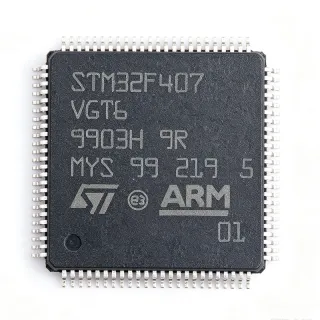
STM32H7A3VGT6 - 280MHz Cortex-M7 MCU, 1MB Flash | STMicroelectronics
MPN: STM32H7A3VGT6 ✓ Active| Qty | Unit Price | Extended |
|---|---|---|
| 1 | $12.5 | $12.50 |
| 10 | $11.25 | $112.50 |
| 100 | $10 | $1,000.00 |
| 500 | $9 | $4,500.00 |
| 1,000 | $8.1 | $8,100.00 |
STM32H7A3VGT6 Overview
What is a microcontroller (MCU)? A microcontroller is a compact integrated circuit that combines a processor core, memory, and programmable input/output peripherals on a single chip. It is the brain of embedded systems, executing firmware to control devices, process sensor data, and communicate with other systems. MCUs are classified within the broader hierarchy of embedded processors, which includes microprocessors, digital signal processors (DSPs), and system-on-chips (SoCs). The STM32H7A3VGT6 sits at the high-performance end of the MCU spectrum, offering near-DSP-level compute capability.
Key features include a 280 MHz Arm Cortex-M7 core with double-precision FPU, 1.4 MB flash, 1.4 MB SRAM, and a rich set of peripherals: multiple 16-bit and 32-bit timers, 12-bit ADCs, 12-bit DACs, and advanced communication interfaces (USART, SPI, I2C, FDCAN, USB OTG, Ethernet MAC). The device also integrates a hardware cryptographic accelerator (AES, DES, 3DES, SHA-1, SHA-256) and a true random number generator (TRNG) for secure applications.
Technically, the STM32H7A3VGT6 is built on a 40nm process, enabling high clock speeds with moderate power consumption. The Cortex-M7 core features a 6-stage pipeline, branch prediction, and a memory protection unit (MPU), supporting real-time deterministic execution. The device supports external memory interfaces (FMC) for SDRAM, NOR, and NAND flash expansion, and a flexible memory controller for parallel and serial interfaces.
Typical applications include industrial automation (PLC, motor control), medical devices (patient monitors, infusion pumps), consumer electronics (smart speakers, wearables), and IoT gateways. The high core speed and rich peripherals make it suitable for real-time control, audio processing, and edge AI inference.
When designing with this device, ensure adequate decoupling on all power pins and a proper crystal oscillator layout for the HSE. The 100-pin LQFP package requires careful thermal management; use a 4-layer PCB with a solid ground plane to dissipate heat effectively.
Drop-in alternatives for STM32H7A3VGT6 — same package, pin-to-pin compatible. Different-package parts requiring PCB rework are excluded.
Variants in this series
Same-series models that are drop-in compatible with STM32H7A3VGT6 (same form factor and footprint) — differing in Flash Memory, Package, Communication Interfaces, Core Processor, SRAM.
Quick Comparison Tool — Select alternative parts for side-by-side comparison:
STM32H7A3VIT6
✅ Drop-In ⚠️ 参数待验证📋 Reference alternative (not in catalog)
STM32H750VBT6
✅ Drop-In ⚠️ 参数待验证✓ In Stock
$8.2 / Unit
View Datasheet →STM32H743VIT6
✅ Drop-In ⚠️ 参数待验证✓ In Stock
$7.98 / Unit
View Datasheet →STM32H753VIT6
✅ Drop-In ⚠️ 参数待验证📋 Reference alternative (not in catalog)
STM32H7A3VGT6 Maximum Ratings & Electrical Characteristics
| Core | Arm Cortex-M7 |
| Max Clock Speed | 280 MHz |
| Flash Memory | 1.4 MB |
| SRAM | 1.4 MB |
| Package | LQFP-100 (14x14 mm) |
| Operating Voltage | 1.62 V to 3.6 V |
| GPIO Pins | 80 |
| ADC | 3x 12-bit, up to 3.6 MSPS |
| DAC | 2x 12-bit |
| Timers | 22 (16-bit and 32-bit) |
| Communication Interfaces | USART, SPI, I2C, FDCAN, USB OTG, Ethernet MAC |
| Cryptographic Acceleration | AES, DES, 3DES, SHA-1, SHA-256 |
| Operating Temperature | -40C to +85C |
| Mounting Type | Surface Mount |
| RoHS Status | Compliant |
STM32H7A3VGT6 Pin Configuration
| Pin 1 | VBAT — Battery backup supply |
| Pin 2 | PC13 — GPIO / RTC output |
| Pin 3 | PC14 — GPIO / OSC32_IN |
| Pin 4 | PC15 — GPIO / OSC32_OUT |
| Pin 5 | PF0 — GPIO |
| Pin 6 | PF1 — GPIO |
| Pin 7 | PF2 — GPIO |
| Pin 8 | PF3 — GPIO |
| Pin 9 | PF4 — GPIO |
| Pin 10 | PF5 — GPIO |
| Pin 11 | VSS — Ground |
| Pin 12 | VDD — Power supply |
| Pin 13 | PF6 — GPIO |
| Pin 14 | PF7 — GPIO |
| Pin 15 | PF8 — GPIO |
| Pin 16 | PF9 — GPIO |
| Pin 17 | PF10 — GPIO |
| Pin 18 | PF11 — GPIO |
| Pin 19 | PF12 — GPIO |
| Pin 20 | PF13 — GPIO |
| Pin 21 | PF14 — GPIO |
| Pin 22 | PF15 — GPIO |
| Pin 23 | VSS — Ground |
| Pin 24 | VDD — Power supply |
| Pin 25 | PG0 — GPIO |
| Pin 26 | PG1 — GPIO |
| Pin 27 | PG2 — GPIO |
| Pin 28 | PG3 — GPIO |
| Pin 29 | PG4 — GPIO |
| Pin 30 | PG5 — GPIO |
| Pin 31 | PG6 — GPIO |
| Pin 32 | PG7 — GPIO |
| Pin 33 | PG8 — GPIO |
| Pin 34 | PG9 — GPIO |
| Pin 35 | PG10 — GPIO |
| Pin 36 | PG11 — GPIO |
| Pin 37 | PG12 — GPIO |
| Pin 38 | PG13 — GPIO |
| Pin 39 | PG14 — GPIO |
| Pin 40 | PG15 — GPIO |
| Pin 41 | VSS — Ground |
| Pin 42 | VDD — Power supply |
| Pin 43 | PH0 — GPIO / OSC_IN |
| Pin 44 | PH1 — GPIO / OSC_OUT |
| Pin 45 | PH2 — GPIO |
| Pin 46 | PH3 — GPIO |
| Pin 47 | PH4 — GPIO |
| Pin 48 | PH5 — GPIO |
| Pin 49 | PH6 — GPIO |
| Pin 50 | PH7 — GPIO |
| Pin 51 | PH8 — GPIO |
| Pin 52 | PH9 — GPIO |
| Pin 53 | PH10 — GPIO |
| Pin 54 | PH11 — GPIO |
| Pin 55 | PH12 — GPIO |
| Pin 56 | PH13 — GPIO |
| Pin 57 | PH14 — GPIO |
| Pin 58 | PH15 — GPIO |
| Pin 59 | VSS — Ground |
| Pin 60 | VDD — Power supply |
| Pin 61 | PI0 — GPIO |
| Pin 62 | PI1 — GPIO |
| Pin 63 | PI2 — GPIO |
| Pin 64 | PI3 — GPIO |
| Pin 65 | PI4 — GPIO |
| Pin 66 | PI5 — GPIO |
| Pin 67 | PI6 — GPIO |
| Pin 68 | PI7 — GPIO |
| Pin 69 | PI8 — GPIO |
| Pin 70 | PI9 — GPIO |
| Pin 71 | VSS — Ground |
| Pin 72 | VDD — Power supply |
| Pin 73 | PA0 — GPIO / ADC |
| Pin 74 | PA1 — GPIO / ADC |
| Pin 75 | PA2 — GPIO / USART |
| Pin 76 | PA3 — GPIO / USART |
| Pin 77 | PA4 — GPIO / DAC |
| Pin 78 | PA5 — GPIO / DAC |
| Pin 79 | PA6 — GPIO / SPI |
| Pin 80 | PA7 — GPIO / SPI |
| Pin 81 | PA8 — GPIO / TIM |
| Pin 82 | PA9 — GPIO / USART |
| Pin 83 | PA10 — GPIO / USART |
| Pin 84 | PA11 — GPIO / USB |
| Pin 85 | PA12 — GPIO / USB |
| Pin 86 | PA13 — GPIO / SWDIO |
| Pin 87 | PA14 — GPIO / SWCLK |
| Pin 88 | PA15 — GPIO / JTAG |
| Pin 89 | VSS — Ground |
| Pin 90 | VDD — Power supply |
| Pin 91 | PB0 — GPIO / ADC |
| Pin 92 | PB1 — GPIO / ADC |
| Pin 93 | PB2 — GPIO |
| Pin 94 | PB3 — GPIO / SPI |
| Pin 95 | PB4 — GPIO / SPI |
| Pin 96 | PB5 — GPIO / I2C |
| Pin 97 | PB6 — GPIO / I2C |
| Pin 98 | PB7 — GPIO / I2C |
| Pin 99 | PB8 — GPIO / FDCAN |
| Pin 100 | PB9 — GPIO / FDCAN |
Typical Applications
STM32H7A3VGT6 is suitable for 6 applications: Industrial Automation, Medical Devices, IoT Gateways, Consumer Electronics, Audio Processing, Edge AI.
Industrial Automation
The STM32H7A3VGT6 is ideal for industrial automation due to its 280 MHz Cortex-M7 core, rich communication interfaces (FDCAN, Ethernet MAC, USART), and advanced timers for precise motor control. It can handle real-time control loops, PLC logic, and HMI interfaces simultaneously. The device's 1.4 MB flash and 1.4 MB SRAM provide ample space for complex firmware, while the cryptographic accelerator ensures secure communication in industrial networks. Its wide operating voltage range (1.62V to 3.6V) and -40C to +85C temperature range make it suitable for harsh factory environments. The FMC interface allows external memory expansion for data logging, and the multiple ADCs enable high-speed sensor acquisition for process monitoring.
Recommended
Medical Devices
In medical devices, the STM32H7A3VGT6 provides the computational power and reliability required for patient monitoring, infusion pumps, and diagnostic equipment. The 280 MHz core enables real-time signal processing for ECG, SpO2, and blood pressure monitoring. The device's low power consumption in sleep modes extends battery life in portable devices. The cryptographic accelerator ensures secure data transmission for patient privacy compliance. The multiple timers and ADCs support precise sensor interfacing, while the Ethernet MAC enables connectivity to hospital networks. The device's robust design, with a wide temperature range and high reliability, meets the stringent requirements of medical applications.
Recommended
IoT Gateways
The STM32H7A3VGT6 is well-suited for IoT gateways, offering a balance of performance and connectivity. The Ethernet MAC and USB OTG interfaces enable wired and wireless connectivity, while the cryptographic accelerator secures data transmission. The 280 MHz core can handle protocol stacks (MQTT, CoAP) and edge processing. The 1.4 MB flash and 1.4 MB SRAM support complex applications and data buffering. The device's multiple UARTs and SPIs allow connection to various sensors and radios (Wi-Fi, LoRa, Zigbee). Its low power modes are beneficial for always-on gateways, and the FMC interface can expand storage for local data logging.
Recommended
Consumer Electronics
For consumer electronics, the STM32H7A3VGT6 delivers high performance for audio processing, smart home devices, and wearables. The 280 MHz Cortex-M7 with FPU enables audio codec processing and voice recognition. The device's rich peripheral set supports touchscreens, displays, and various sensors. The low power consumption in standby mode extends battery life in portable devices. The cryptographic accelerator enables secure firmware updates and data protection. The device's small LQFP-100 package is suitable for compact designs, and the multiple communication interfaces allow connectivity to other devices in the smart home ecosystem.
Recommended
Audio Processing
The STM32H7A3VGT6 is excellent for audio processing applications, including smart speakers, audio interfaces, and voice-controlled devices. The 280 MHz Cortex-M7 with double-precision FPU can handle real-time audio DSP algorithms, such as filtering, equalization, and noise cancellation. The device's multiple I2S interfaces support high-quality audio codecs, and the DMA controllers enable efficient data transfer without CPU intervention. The 1.4 MB SRAM provides ample buffering for audio streams. The cryptographic accelerator can secure audio content, and the low power modes are beneficial for battery-powered audio devices. The device's high performance and rich audio peripherals make it a top choice for audio applications.
Recommended
Edge AI
The STM32H7A3VGT6 supports edge AI inference for applications like predictive maintenance, anomaly detection, and image classification. The 280 MHz Cortex-M7 with FPU can run lightweight neural networks using frameworks like TensorFlow Lite for Microcontrollers. The device's 1.4 MB flash and 1.4 MB SRAM provide space for model storage and inference buffers. The multiple ADCs and communication interfaces enable sensor data acquisition for AI models. The cryptographic accelerator ensures secure model updates. The device's low power consumption is beneficial for battery-powered edge devices, and the high performance enables real-time inference for time-critical applications.
Recommended
Recommended Products Summary
Engineering reference data for STM32H7A3VGT6 — comparison, design guidance, and compliance information.
Selection Guide
Comparison with Alternatives
| Parameter | This Product | STM32H7A3VIT6 | STM32H750VBT6 | STM32H743VIT6 | STM32H753VIT6 |
|---|---|---|---|---|---|
| Package | LQFP-100 | LQFP-100 - same | LQFP-100 - same | LQFP-100 - same | LQFP-100 - same |
| Brand | STMicroelectronics | STMicroelectronics | STMicroelectronics | STMicroelectronics | STMicroelectronics |
| Max Clock Speed | 280 MHz | 280 MHz | 480 MHz | 480 MHz | 480 MHz |
| Flash Memory | 1.4 MB | 2 MB | 128 KB | 2 MB | 2 MB |
| SRAM | 1.4 MB | 1.4 MB | 1 MB | 1 MB | 1 MB |
| Operating Voltage | 1.62V to 3.6V | 1.62V to 3.6V | 1.62V to 3.6V | 1.62V to 3.6V | 1.62V to 3.6V |
| GPIO Pins | 80 | 80 | 80 | 80 | 80 |
| Ethernet MAC | Yes | Yes | Yes | Yes | Yes |
Key Differentiators
- Higher SRAM capacity (1.4 MB) than many competitors (vs STM32H750VBT6)
- Lower power consumption than STM32H743VIT6 (vs STM32H743VIT6)
- Cost-effective balance of performance and memory (vs STM32H7A3VIT6)
Design Notes
The STM32H7A3VGT6 operates from 1.62V to 3.6V. Use a dedicated 3.3V rail with a low-dropout regulator (LDO) for the VDD pins, and a separate 1.8V rail for the VDDA analog supply if high ADC accuracy is required. Place 100nF decoupling capacitors on each VDD pin and a 4.7uF bulk capacitor on the main supply. For the VBAT pin, connect a backup battery or tie to VDD through a diode to maintain RTC operation during power loss.
For the LQFP-100 package, use a 4-layer PCB with a solid ground plane directly under the IC. Route the crystal oscillator (HSE) traces as short as possible with a ground guard ring to minimize noise. Place the 8 MHz crystal and load capacitors (typically 10-20pF) close to the PH0/PH1 pins. For the ADC inputs, use a star-ground topology and separate analog ground (VSSA) from digital ground to reduce noise coupling.
The STM32H7A3VGT6 can dissipate significant power at 280 MHz. The LQFP-100 package has a thermal resistance (theta_JA) of approximately 40-50 C/W. For high-current applications, ensure adequate copper pour on the PCB and consider a thermal via array under the exposed pad (if available). Monitor the junction temperature to stay within the -40C to +85C operating range. For continuous operation at maximum clock, a small heatsink or forced airflow may be necessary.
Compliance Information
RoHS compliant per STMicroelectronics product page. Not AEC-Q100 qualified - this is a general-purpose MCU, not automotive grade.