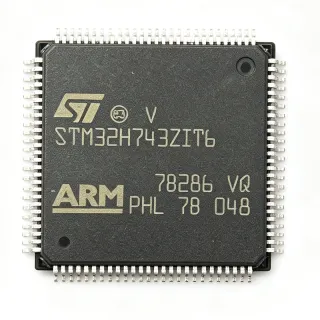
STM32L4R9ZIT6 - 120MHz Cortex-M4, 2MB Flash MCU | STMicroelectronics
MPN: STM32L4R9ZIT6 ✓ Active| Qty | Unit Price | Extended |
|---|---|---|
| 1 | $10.8 | $10.80 |
| 10 | $9.75 | $97.50 |
| 100 | $8.7 | $870.00 |
| 500 | $7.9 | $3,950.00 |
| 1,000 | $7.2 | $7,200.00 |
STM32L4R9ZIT6 Overview
A microcontroller (MCU) is a single-chip computer integrating a processor core, memory, and peripherals on one die. The STM32L4+ Series sits at the top of the STM32L4 ultra-low-power family hierarchy within ST's broader STM32 microcontroller portfolio, combining high processing performance with class-leading energy efficiency for battery-powered and energy-harvesting systems.
Key differentiating features include FlexPowerControl ultra-low-power operation with 305 nA in VBAT mode (supplying the RTC and 32x32-bit backup registers) and 33 nA Shutdown mode, Batch Acquisition Mode (BAM) for data logging while the main domain sleeps, and up to 2 MB of dual-bank Flash enabling read-while-write operations. The integrated Chrom-ART Accelerator (DMA2D) offloads graphics memory transfers, and the MIPI-DSI host controller supports direct display interfacing on suitable packages.
Technically, the device couples the Cortex-M4 with DSP instructions and a hardware single-precision FPU to an art accelerator, an L1 cache, and an extended power architecture with independent power domains (LPDMA domain, run domain). Multiple clock sources, a rich timer set, USB OTG FS, DFSDM (digital filter for sigma-delta modulators), quad-SPI memory interface, and dual ADCs round out the analog and connectivity mix.
Typical applications include portable medical and industrial devices with GUI displays, smart meters, battery-powered IoT sensor nodes, and consumer appliances requiring both high performance and long battery life. The large embedded memory supports rich graphics stacks and RTOS-based designs without external storage.
Design consideration: budget the power architecture early - the flexible SMPS-free design means supply sequencing and VOS (voltage scaling) selection directly affect the achievable 120 MHz maximum frequency and dynamic current.
This page synthesizes distributor pricing, drop-in alternatives, pin guidance, and practical design notes not found in a single manufacturer datasheet page.
Drop-in alternatives for STM32L4R9ZIT6 — same package, pin-to-pin compatible. Different-package parts requiring PCB rework are excluded.
Variants in this series
Same-series models that are drop-in compatible with STM32L4R9ZIT6 (same form factor and footprint) — differing in Core, Flash Memory, Package.
Quick Comparison Tool — Select alternative parts for side-by-side comparison:
STM32L4R9ZGT6
✅ Drop-In ⚠️ 参数待验证📋 Reference alternative (not in catalog)
STM32L4R7ZIT6
✅ Drop-In ⚠️ 参数待验证📋 Reference alternative (not in catalog)
STM32L4R5ZIT6
✅ Drop-In ⚠️ 参数待验证📋 Reference alternative (not in catalog)
STM32L4S9ZIT6
✅ Drop-In ⚠️ 参数待验证✓ In Stock
$8.1 / Unit
View Datasheet →STM32L4S7ZIT6
✅ Drop-In ⚠️ 参数待验证📋 Reference alternative (not in catalog)
STM32L4R9ZIT6 Maximum Ratings & Electrical Characteristics
| Core | Arm 32-bit Cortex-M4 with FPU |
| Maximum CPU Frequency | 120 MHz |
| Flash Memory | 2 MB (2M x 8) |
| SRAM | 640 KB |
| Supply Voltage Range | 1.71 V to 3.6 V |
| Operating Temperature | -40 C to +85/+125 C |
| VBAT Mode Current | 305 nA (RTC and 32x32-bit backup registers supplied) |
| Shutdown Mode Current | 33 nA |
| Package | 144-LQFP (20x20 mm) |
| Mounting Type | Surface Mount |
| Series | STM32L4+ (STM32L4R9xx) |
| Architecture | 32-bit RISC |
| Low-Power Feature | FlexPowerControl with Batch Acquisition Mode (BAM) |
| Graphics Accelerator | Chrom-ART Accelerator (DMA2D) |
| Connectivity | USB OTG FS |
| RoHS Status | Compliant |
| Packaging | Tray |
STM32L4R9ZIT6 144-lqfp (20x20 mm) Pin Configuration Guide
Pin configuration for STM32L4R9ZIT6 (144-lqfp (20x20 mm) package). This digital IC includes GPIO, communication interfaces (UART, SPI, I2C), and power pins. Refer to the manufacturer datasheet for alternate pin functions and configuration options. Essential for embedded system design and PCB layout.

No detailed pinout data available for STM32L4R9ZIT6.
Refer to the datasheet for full pin configuration.
Typical Applications
STM32L4R9ZIT6 is suitable for 6 applications: Portable Devices with Graphical UI, Smart Metering and Data Logging, Industrial IoT Sensor Nodes, Medical and Health Monitoring, Consumer Appliances and HMI, Building Automation and Security Sensors.
Portable Devices with Graphical UI
The STM32L4R9ZIT6 is a strong fit for battery-powered products with color displays because it combines a 120 MHz Cortex-M4 with FPU, the Chrom-ART Accelerator (DMA2D) for graphics blitting, and ultra-low-power modes (305 nA VBAT, 33 nA Shutdown) per ST datasheet figures. The 2 MB Flash holds graphics assets and RTOS stacks on-chip, eliminating external NOR Flash and reducing BOM cost. In typical use the MCU renders the GUI in the run domain, then enters Stop or Shutdown between user interactions, stretching battery life. The trade-off versus a dedicated display SoC is lower raw graphics throughput, but for simple to moderate UIs the single-chip approach wins on power and cost.
Recommended
Smart Metering and Data Logging
Smart meters and energy loggers benefit directly from the STM32L4R9ZIT6's Batch Acquisition Mode (BAM), which lets the LPDMA domain sample ADC channels and store data while the main CPU domain sleeps - a mode highlighted in the ST datasheet FlexPowerControl feature list. The 640 KB SRAM buffers measurement bursts, and the 2 MB dual-bank Flash supports field firmware updates with read-while-write, so logging never stops during an update. With VBAT operation at 305 nA preserving RTC and 32x32-bit backup registers, tariff clocks and consumption counters survive battery swaps. Designers should size the backup battery against the VBAT profile and use the RTC calibration for revenue-grade timekeeping accuracy.
Recommended
Industrial IoT Sensor Nodes
Industrial IoT nodes need both burst compute for edge filtering and years of battery life, and the STM32L4R9ZIT6 delivers both: the 120 MHz Cortex-M4 with DSP instructions executes FFT and filtering locally, while 33 nA Shutdown and 305 nA VBAT currents keep the sleep budget negligible. Quad-SPI interfaces external Flash for OTA payloads, and the rich peripheral set (multiple USART/SPI/I2C, dual ADC, DFSDM for sigma-delta sensors) connects vibration, pressure, and current transducers directly. Per the ST datasheet, the -40 C to +85/125 C range suits factory and outdoor enclosures. Duty-cycling with Stop modes typically yields multi-year battery life for periodic-reporting topologies such as LoRa or BLE gateways.
Recommended
Medical and Health Monitoring
Wearable and portable medical devices benefit from the STM32L4R9ZIT6's combination of signal-processing performance and ultra-low sleep currents. The DFSDM (digital filter for sigma-delta modulators) front end connects high-resolution sigma-delta converters for biopotential and impedance measurements, while the Cortex-M4 FPU runs real-time filtering algorithms at 120 MHz. According to ST datasheet specifications, Batch Acquisition Mode records patient data autonomously, and 33 nA Shutdown supports always-on monitoring between sampling windows. The -40 C to +85 C operating range and 1.71 V to 3.6 V supply simplify coin-cell or Li-ion power design. Compliance-driven designs should pair the MCU with certified analog front ends and follow IEC 60601 isolation practices in the surrounding system.
Recommended
Consumer Appliances and HMI
Home appliances, thermostats, and control panels use the STM32L4R9ZIT6 to drive capacitive-touch and small TFT interfaces from a single chip. The Chrom-ART Accelerator offloads display memory transfers from the CPU, sustaining smooth UI refresh at low clock rates, which cuts dynamic current versus software rendering. The 2 MB Flash stores fonts, localization strings, and UI frameworks such as TouchGFX on-chip. ST datasheet ultra-low-power modes (Shutdown 33 nA) support standby requirements of energy-regulated appliances. Multiple timers handle motor control PWM and encoder inputs for the same appliance, consolidating HMI and control into one MCU and reducing board area in the LQFP144 20x20 mm footprint.
Recommended
Building Automation and Security Sensors
Battery-powered PIR, access-control, and environmental sensors fit the STM32L4R9ZIT6's profile: instantaneous wake from low-power modes to the full 120 MHz core enables burst signal processing (waveform correlation, cryptography), then a rapid return to Stop/Shutdown with nA-level current as documented in the ST datasheet. The 640 KB SRAM hosts secure boot and TLS stacks, and the 2 MB dual-bank Flash allows signed firmware updates over the air without a bootloader failure window. Backup registers (32x32-bit) powered from VBAT at 305 nA retain state across battery replacement. Designers should leverage the independent power domains to keep only the RTC/LPDMA alive in standby, maximizing multi-year coin-cell service life.
Recommended
Recommended Products Summary
Engineering reference data for STM32L4R9ZIT6 — comparison, design guidance, and compliance information.
Selection Guide
Comparison with Alternatives
| Parameter | This Product | STM32L4R9ZGT6 | STM32L4R7ZIT6 | STM32L4R5ZIT6 | STM32L4S9ZIT6 |
|---|---|---|---|---|---|
| Package | 144-LQFP (20x20 mm) | 144-LQFP (20x20 mm) - same | 144-LQFP (20x20 mm) - same | 144-LQFP (20x20 mm) - same | 144-LQFP (20x20 mm) - same |
| Brand | STMicroelectronics | STMicroelectronics | STMicroelectronics | STMicroelectronics | STMicroelectronics |
| Core | Arm Cortex-M4 + FPU | Arm Cortex-M4 + FPU | Arm Cortex-M4 + FPU | Arm Cortex-M4 + FPU | Arm Cortex-M4 + FPU |
| Max Frequency | 120 MHz | 120 MHz | 120 MHz | 120 MHz | 120 MHz |
| Flash Memory | 2 MB | 1 MB | 2 MB | 2 MB | 2 MB |
| SRAM | 640 KB | 640 KB | 640 KB | 640 KB | 640 KB |
| VBAT Current | 305 nA | 305 nA | 305 nA | 305 nA | 305 nA |
| Peripheral Set | Full L4R9 set (DSI-capable configuration) | Full L4R9 set | L4R7 subset | L4R5 subset | L4S9 set (secure variant features) |
Key Differentiators
- Maximum embedded Flash in the L4+ LQFP144 line (vs STM32L4R9ZGT6)
- Class-leading sleep currents (vs STM32F4-series MCUs)
- Batch Acquisition Mode autonomy (vs STM32L4R5ZIT6)
Design Notes
Estimate: dynamic current scales with the VOS (voltage scaling) range selected - operating at VOS Range 1 is required for the full 120 MHz core clock, while lower-frequency operation can use more efficient scaling ranges. Verify fMAX versus VOS in the datasheet operating-conditions tables before fixing your clock tree. Budget the VBAT domain separately: at 305 nA for RTC plus backup registers, a CR2032 (~220 mAh) sustains the backup domain for decades, so main-battery sizing is dominated by run and Stop mode currents instead.
For the 144-LQFP (20x20 mm) package, place 100 nF ceramic decoupling capacitors at each VDD/VDDA pin pair within 2 mm of the pin, plus bulk 4.7-10 uF per supply rail. Use a solid ground plane on layer 2 and short, direct returns for the VSS pins. The exposed LQFP leadframe needs no thermal pad, but keep crystal load capacitors and the 32.768 kHz RTC crystal away from switching signals to preserve RTC accuracy in VBAT mode.
Do not assume all STM32L4R9xx variants expose identical peripherals: the L4R5/L4R7/L4R9 sub-families differ in display and camera interface availability even though they are pin-compatible in LQFP144 - verify the peripheral list against your board before populating. Also note that reaching 120 MHz requires the correct flash wait states and voltage scaling configuration in STM32CubeMX/clock init code; running at an unsupported VOS/fMAX combination causes hard faults or illegal read data.
The quad-SPI and DSI/parallel display interfaces toggle fast enough to require controlled routing: keep quad-SPI clock lines under 100 mm, match data lines within 5 mm, and series-terminate (22-33 ohm) long clock traces. On the LQFP144, group high-speed signals away from the analog VDDA/VREF+ corner pins and use guard ground vias around the ADC inputs to protect the dual-ADC measurement accuracy when display traffic is active.
Compliance Information
Distributor listing (Lisleapex) states ROHS compliant. REACH and halogen-free declarations not found in provided data - obtain from ST compliance portal.