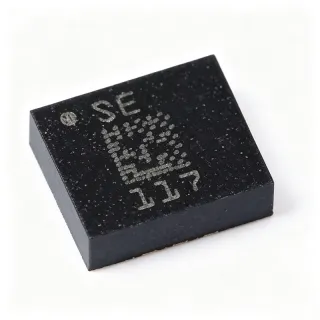
STM32MP257F - Dual Cortex-A35 1.5GHz MPU | STMicroelectronics | Industrial IoT
MPN: STM32MP257F ✓ Active| Qty | Unit Price | Extended |
|---|---|---|
| 1 | $25.5 | $25.50 |
| 10 | $23.2 | $232.00 |
| 100 | $20.8 | $2,080.00 |
| 500 | $18.5 | $9,250.00 |
| 1,000 | $16.9 | $16,900.00 |
STM32MP257F Overview
A microprocessor (MPU) is a complete computing engine that typically runs a full operating system like Linux, in contrast to a microcontroller (MCU) which runs bare-metal or RTOS. The STM32MP257F belongs to the STM32MP2 series, which is part of the broader STM32 family of 32-bit Arm-based devices. This MPU sits at the top of the STM32 performance hierarchy, offering the processing power of an application processor with the real-time capabilities of a microcontroller core.
Key features include a dual-core Cortex-A35 running up to 1.5 GHz, a Cortex-M33 at 400 MHz, and a dedicated 3D GPU for graphical user interfaces. It supports up to 2 GB of DDR4/LPDDR4 memory, providing ample bandwidth for data-intensive applications. The device also includes a hardware cryptographic accelerator, secure boot, and a TrustZone architecture for robust security.
Technically, the STM32MP257F is built on a 28nm FD-SOI process, offering a balance of performance and power efficiency. It features a rich set of peripherals including multiple Ethernet ports (up to 2x GbE with TSN), USB 2.0/3.0, CAN-FD, and a wide range of serial interfaces. The dual-core architecture allows asymmetric multiprocessing (AMP) where the A35 cores run Linux while the M33 core handles real-time tasks, enabling a single-chip solution for complex systems.
Typical applications include industrial PLCs, HMI panels, smart gateways, and edge AI devices. The combination of high-performance processing, real-time control, and rich connectivity makes it ideal for Industry 4.0 deployments where deterministic control and data processing are required.
When designing with the STM32MP257F, careful attention must be paid to power sequencing and thermal management. The device requires multiple supply rails (1.8V, 3.3V, and core voltage) with proper sequencing to avoid latch-up. A thermal solution is recommended for sustained operation at maximum frequency, especially in enclosed industrial enclosures.
Drop-in alternatives for STM32MP257F — same package, pin-to-pin compatible. Different-package parts requiring PCB rework are excluded.
Quick Comparison Tool — Select alternative parts for side-by-side comparison:
STM32MP257FAI3
✅ Drop-In📋 Reference alternative (not in catalog)
STM32MP257CAI3
✅ Drop-In ⚠️ 参数待验证📋 Reference alternative (not in catalog)
STM32MP255FAI3
✅ Drop-In ⚠️ 参数待验证📋 Reference alternative (not in catalog)
STM32MP253FAI3
✅ Drop-In ⚠️ 参数待验证📋 Reference alternative (not in catalog)
STM32MP257F Maximum Ratings & Electrical Characteristics
| Core Architecture | Arm Cortex-A35 (dual-core) + Cortex-M33 |
| Core Count | 2x Cortex-A35, 1x Cortex-M33 |
| Maximum CPU Frequency | 1.5 GHz (Cortex-A35), 400 MHz (Cortex-M33) |
| Bit Width | 64-bit (Cortex-A35), 32-bit (Cortex-M33) |
| L1 Cache | 32 KB I + 32 KB D per Cortex-A35 core |
| L2 Cache | 512 KB unified |
| FPU | Single precision (Cortex-M33) |
| DSP Instructions | Yes (Cortex-M33) |
| TrustZone | Yes (Arm TrustZone) |
| Memory Support | Up to 2 GB DDR4/LPDDR4 |
| Ethernet | Up to 2x GbE with TSN |
| USB | USB 2.0/3.0 |
| CAN | CAN-FD |
| Package | 436-TFBGA (18x18 mm) |
| Mounting Type | Surface Mount |
| Process Technology | 28nm FD-SOI |
| Supply Voltage | 1.8V, 3.3V, core voltage |
| RoHS Status | Compliant |
STM32MP257F Pin Configuration
| Pin A1 | VDD — Core power supply |
| Pin A2 | VSS — Ground |
| Pin B1 | VDD_IO — I/O power supply |
| Pin B2 | VSS_IO — I/O ground |
| Pin C1 | ETH1_TX — Ethernet 1 transmit |
| Pin C2 | ETH1_RX — Ethernet 1 receive |
| Pin D1 | USB1_DP — USB 1 data plus |
| Pin D2 | USB1_DM — USB 1 data minus |
| Pin E1 | CAN1_TX — CAN 1 transmit |
| Pin E2 | CAN1_RX — CAN 1 receive |
| Pin F1 | UART1_TX — UART 1 transmit |
| Pin F2 | UART1_RX — UART 1 receive |
Typical Applications
STM32MP257F is suitable for 6 applications: Industrial PLC, HMI Panels, Smart Gateway, Edge AI Devices, Smart Factory Automation, Medical Monitoring Devices.
Industrial PLC
The STM32MP257F is ideal for industrial programmable logic controllers (PLCs) due to its dual-core Cortex-A35 at 1.5 GHz for high-level control logic and the Cortex-M33 for real-time I/O handling. The rich connectivity including Ethernet with TSN and CAN-FD enables deterministic communication in factory automation. The TrustZone security ensures secure firmware updates and data protection. In a typical PLC, the A35 cores run Linux for HMI and networking, while the M33 handles time-critical tasks like motor control and sensor acquisition. The 28nm FD-SOI process provides low power consumption for 24/7 operation. Compared to traditional MCUs, the STM32MP257F offers higher processing power and memory bandwidth, supporting complex algorithms and larger programs. Designers must ensure proper power sequencing and thermal management for sustained operation in industrial enclosures.
Recommended
HMI Panels
The STM32MP257F is well-suited for human-machine interface (HMI) panels, offering a 3D GPU for rich graphical user interfaces and dual-core Cortex-A35 for smooth rendering. The support for up to 2 GB DDR4/LPDDR4 provides ample memory for high-resolution displays and complex animations. The Cortex-M33 can handle touch input and real-time response, ensuring a responsive user experience. In an HMI application, the A35 cores run a Linux-based UI framework, while the M33 manages input and communication. The device's connectivity options like Ethernet and USB enable easy integration with industrial networks. The 28nm FD-SOI process balances performance and power efficiency, making it suitable for panel-mounted devices. Designers should consider thermal dissipation for enclosed panels and use the GPU efficiently to avoid overheating. The STM32MP257F's security features protect against unauthorized access to the HMI system.
Recommended
Smart Gateway
The STM32MP257F is an excellent choice for smart gateways in IoT applications, providing dual-core Cortex-A35 for protocol processing and data aggregation, and a Cortex-M33 for real-time sensor data handling. With 2x GbE with TSN, USB 3.0, and CAN-FD, it can connect to various industrial and consumer devices. The TrustZone security ensures secure communication and data encryption. In a smart gateway, the A35 cores run Linux for network management and cloud connectivity, while the M33 handles local sensor data and control. The device's high memory bandwidth supports data buffering and analytics. The 28nm FD-SOI process offers low power consumption for always-on operation. Designers must ensure proper power sequencing and use the hardware cryptographic accelerator for efficient encryption. The STM32MP257F's rich peripheral set makes it a versatile platform for edge computing.
Recommended
Edge AI Devices
The STM32MP257F is designed for edge AI applications, offering dual-core Cortex-A35 at 1.5 GHz for running neural network inference and a Cortex-M33 for real-time preprocessing. The 3D GPU can accelerate certain AI workloads, and the support for up to 2 GB DDR4/LPDDR4 provides memory for model storage and data. The TrustZone security ensures secure model deployment and data privacy. In an edge AI device, the A35 cores run AI frameworks like TensorFlow Lite, while the M33 handles sensor data acquisition and preprocessing. The device's connectivity options enable data transfer to the cloud or local servers. The 28nm FD-SOI process provides a balance of performance and power efficiency, crucial for battery-powered or thermally constrained devices. Designers should optimize AI models for the available memory and use the GPU for parallel processing. The STM32MP257F's security features protect intellectual property and user data.
Recommended
Smart Factory Automation
The STM32MP257F is ideal for smart factory automation, providing high-performance processing for machine vision, robotics, and process control. The dual-core Cortex-A35 at 1.5 GHz can handle complex algorithms, while the Cortex-M33 ensures real-time response for safety-critical functions. With Ethernet TSN and CAN-FD, it supports deterministic communication in industrial networks. The TrustZone security protects against cyber threats. In a smart factory, the A35 cores run Linux for HMI and data analytics, while the M33 handles real-time control of actuators and sensors. The device's rich peripheral set includes multiple UARTs, SPI, I2C, and GPIOs for interfacing with various industrial equipment. The 28nm FD-SOI process offers low power consumption and high reliability. Designers must ensure proper thermal management and power sequencing for continuous operation. The STM32MP257F's security features enable secure firmware updates and data integrity.
Recommended
Medical Monitoring Devices
The STM32MP257F can be used in medical monitoring devices, offering high-performance processing for signal processing and data analysis. The dual-core Cortex-A35 at 1.5 GHz can run complex algorithms for ECG, EEG, or vital sign monitoring, while the Cortex-M33 handles real-time data acquisition. The TrustZone security ensures patient data privacy and compliance with regulations. In a medical device, the A35 cores run Linux for user interface and data logging, while the M33 processes sensor data in real-time. The device's connectivity options enable data transmission to healthcare systems. The 28nm FD-SOI process provides low power consumption for portable devices. Designers must ensure medical-grade reliability and safety, including proper power management and thermal control. The STM32MP257F's security features protect sensitive health information.
Recommended
Recommended Products Summary
Engineering reference data for STM32MP257F — comparison, design guidance, and compliance information.
Selection Guide
Comparison with Alternatives
| Parameter | This Product | STM32MP257FAI3 | STM32MP257CAI3 | STM32MP255FAI3 | STM32MP253FAI3 |
|---|---|---|---|---|---|
| Package | 436-TFBGA (18x18 mm) | 436-TFBGA (18x18 mm) - same | 436-TFBGA (18x18 mm) - same | 436-TFBGA (18x18 mm) - same | 436-TFBGA (18x18 mm) - same |
| Brand | STMicroelectronics | STMicroelectronics | STMicroelectronics | STMicroelectronics | STMicroelectronics |
| Core Architecture | Dual Cortex-A35 + Cortex-M33 | Dual Cortex-A35 + Cortex-M33 | Dual Cortex-A35 + Cortex-M33 | Single Cortex-A35 + Cortex-M33 | Single Cortex-A35 + Cortex-M33 |
| Max CPU Frequency | 1.5 GHz (A35), 400 MHz (M33) | 1.5 GHz (A35), 400 MHz (M33) | 1.5 GHz (A35), 400 MHz (M33) | 1.5 GHz (A35), 400 MHz (M33) | 1.5 GHz (A35), 400 MHz (M33) |
| L2 Cache | 512 KB | 512 KB | 512 KB | 512 KB | 512 KB |
| Memory Support | Up to 2 GB DDR4/LPDDR4 | Up to 2 GB DDR4/LPDDR4 | Up to 2 GB DDR4/LPDDR4 | Up to 2 GB DDR4/LPDDR4 | Up to 2 GB DDR4/LPDDR4 |
| Ethernet | 2x GbE with TSN | 2x GbE with TSN | 2x GbE with TSN | 2x GbE with TSN | 2x GbE with TSN |
| USB | USB 2.0/3.0 | USB 2.0/3.0 | USB 2.0/3.0 | USB 2.0/3.0 | USB 2.0/3.0 |
Key Differentiators
- Dual-core Cortex-A35 64-bit at 1.5 GHz (vs STM32MP157F (dual Cortex-A7 32-bit at 650 MHz))
- Cortex-M33 real-time core at 400 MHz (vs STM32MP157F (Cortex-M4 at 209 MHz))
- 2x GbE with TSN (vs STM32MP157F (1x GbE))
Design Notes
The STM32MP257F requires multiple power rails (1.8V, 3.3V, and core voltage) with proper sequencing. Refer to the datasheet's power-up sequence to avoid latch-up. Use a PMIC like STPMIC1 to manage the sequencing and provide clean power. Ensure decoupling capacitors are placed close to each power pin to minimize noise.
At maximum frequency (1.5 GHz), the STM32MP257F can dissipate significant power. Use a thermal solution such as a heatsink or active cooling for sustained operation, especially in enclosed industrial enclosures. The 436-TFBGA package has a thermal resistance that should be considered; refer to the datasheet for thermal data. Ensure adequate airflow and PCB copper pour for heat spreading.
For high-speed interfaces like DDR4/LPDDR4 and Ethernet, follow layout guidelines for impedance control and signal integrity. Keep traces short and matched for differential pairs. Use ground planes to reduce noise. Place the STM32MP257F close to memory and connectors to minimize trace lengths. Refer to ST's application notes for PCB design recommendations.
Compliance Information
RoHS compliance is indicated on ST product page. Other compliance data not explicitly provided in the verified data.