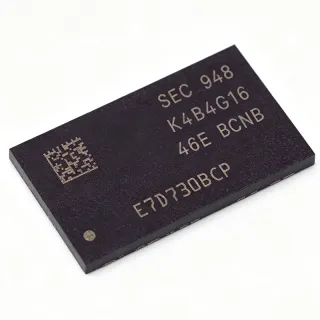
W949D2DBJX5I-TR - 512Mb LPDDR SDRAM 200MHz x32 | Winbond
MPN: W949D2DBJX5I-TR ✓ Active| Qty | Unit Price | Extended |
|---|---|---|
| 1 | $3.2 | $3.20 |
| 10 | $2.88 | $28.80 |
| 100 | $2.55 | $255.00 |
| 500 | $2.3 | $1,150.00 |
| 1,000 | $2.05 | $2,050.00 |
W949D2DBJX5I-TR Overview
Mobile LPDDR SDRAM is a low-power variant of Double Data Rate synchronous DRAM optimized for battery-powered and thermally constrained systems. Within the memory hierarchy, SDRAM sits under the volatile RAM family, distinguished from asynchronous DRAM by a clocked interface and from standard DDR by reduced core voltage, lower I/O swing, and power-saving features such as deep power-down and temperature-compensated self-refresh.
Key features include a 1.7 V to 1.95 V supply range (nominal 1.8 V), x32 organization at 512 Mbit density, a 200 MHz clock rate with 5 ns access time, and the compact 90-VFBGA footprint that minimizes PCB area in portable designs. The industrial temperature grade (-40C to +85C) extends usability from consumer handhelds into industrial and networking equipment.
Fabricated on a 46 nm DRAM process, the device achieves a favorable balance of density, power and cost. The double-data-rate interface transfers data on both clock edges, doubling effective bandwidth relative to SDR SDRAM at the same clock. Standard LPDDR command set support (CKE-based power-down, self-refresh, mode register programming) allows straightforward controller integration with common SoCs and application processors.
Typical applications include embedded industrial controllers, networking and communication equipment, telematics and navigation boxes, portable instrumentation, and battery-buffered data loggers where 64 MByte of low-power program/data memory is sufficient.
Designers should observe LPDDR signal integrity requirements: length-match the differential clock to address/command traces, terminate per the datasheet guidelines, and provide a clean 1.8 V core rail with adequate decoupling at each VDD/VDDQ pin pair of the BGA array.
This page synthesizes distributor pricing, family alternatives, and practical LPDDR layout guidance not consolidated in the manufacturer datasheet alone. Specifications above are drawn from verified distributor listings (DigiKey, Mouser, JLCPCB) as of 2026-09-14.
Drop-in alternatives for W949D2DBJX5I-TR — same package, pin-to-pin compatible. Different-package parts requiring PCB rework are excluded.
Quick Comparison Tool — Select alternative parts for side-by-side comparison:
W949D2DBJX5E-TR
✅ Drop-In ⚠️ 参数待验证📋 Reference alternative (not in catalog)
W949D2DBJX5I-TR Maximum Ratings & Electrical Characteristics
| Memory Type | SDRAM - Mobile LPDDR |
| Memory Size | 512 Mbit (64 MByte) |
| Organization | x32 |
| Interface | Parallel (LPDDR) |
| Clock Frequency | 200 MHz |
| Access Time | 5 ns |
| Supply Voltage Range | 1.7 V to 1.95 V |
| Core Technology | 46 nm DRAM process |
| Operating Temperature | -40C to +85C |
| Package | 90-VFBGA (8x13 mm) |
| Mounting Type | Surface Mount |
| Data Rate | DDR (data on both clock edges) |
| Volatility | Volatile (DRAM) |
| Packaging | Tape & Reel (TR) |
| RoHS Status | RoHS compliant (per JLCPCB listing) |
| Memory Grade | Industrial temperature |
W949D2DBJX5I-TR 90-vfbga (8x13 mm) Pin Configuration Guide
Pin configuration for W949D2DBJX5I-TR (90-vfbga (8x13 mm) package). This digital IC includes GPIO, communication interfaces (UART, SPI, I2C), and power pins. Refer to the manufacturer datasheet for alternate pin functions and configuration options. Essential for embedded system design and PCB layout.

No detailed pinout data available for W949D2DBJX5I-TR.
Refer to the datasheet for full pin configuration.
Typical Applications
W949D2DBJX5I-TR is suitable for 6 applications: Industrial Embedded Controllers, Networking and Communication Equipment, Portable and Battery-Powered Instruments, Telematics and Navigation Boxes, Security and Video Surveillance, IoT Gateways and Smart Home Hubs.
Industrial Embedded Controllers
The W949D2DBJX5I-TR fits industrial embedded controllers because its -40C to +85C industrial rating matches factory-floor temperature extremes that consumer LPDDR cannot tolerate, while its 512Mb (64 MByte) x32 organization supplies adequate working memory for RTOS-based PLC and HMI applications. The 200 MHz DDR interface provides 400 MT/s per pin, delivering sufficient bandwidth for frame buffers and protocol stacks. Used as the program/data DRAM behind an ARM or RISC-V SoC, the 90-VFBGA 8x13 package keeps the memory within centimeters of the processor, shortening length-matched bus routing. Deep power-down and self-refresh modes preserve battery-backed data in intermittently powered nodes, an advantage over power-hungry standard DDR.
Recommended
Networking and Communication Equipment
In switches, routers, and industrial gateways, the W949D2DBJX5I-TR provides 64 MByte of packet-buffer and control-plane memory with the industrial -40C to +85C rating required for unconditioned telecom cabinets and outdoor enclosures. The x32, 200 MHz DDR interface supplies the bandwidth needed to feed multi-port packet processors, while the 1.7 V to 1.95 V rail keeps overall board power budget low compared with 2.5 V DDR parts. Its 46 nm core process yields low standby current in self-refresh during link-idle periods. The 90-ball VFBGA form factor allows dense memory placement beside the network SoC on crowded line-card layouts, reducing trace length and signal-integrity risk on the high-speed data bus.
Recommended
Portable and Battery-Powered Instruments
The W949D2DBJX5I-TR suits portable instrumentation such as handheld testers, data loggers, and field meters where every milliwatt and square millimeter count. Its LPDDR architecture supports CKE-driven power-down and temperature-compensated self-refresh, letting the system drop memory power to microamp-level standby between measurements and extend battery life substantially versus always-active SDRAM. The 8x13 mm 90-VFBGA package occupies far less board area than TSOP-packaged SDRAM, freeing space for batteries and connectors. The 512Mb x32 configuration gives 64 MByte of buffered sample memory, adequate for waveform capture and logging, and the 5 ns access time supports real-time display refresh on embedded GUI controllers.
Recommended
Telematics and Navigation Boxes
Aftermarket telematics, GPS trackers, and navigation head units benefit from the W949D2DBJX5I-TR's combination of industrial temperature tolerance and LPDDR low-power behavior. Vehicle cabins and dash-mounted electronics see -40C cold starts and +85C solar soak, exactly the range this 'I'-grade part covers without derating. The 64 MByte capacity holds map tiles, GPS ephemeris, and cellular modem buffers, while the 200 MHz DDR bus keeps map rendering responsive. Self-refresh preserves navigation state across ignition-off micro-power windows. Designers should pair it with a load-switched 1.8 V rail so the DRAM can enter deep power-down when the vehicle is parked, minimizing quiescent battery drain below fleet-acceptable thresholds.
Recommended
Security and Video Surveillance
IP camera SoCs and NVR front-end boards use the W949D2DBJX5I-TR as video frame-buffer DRAM: its 400 MT/s x32 interface provides the sustained bandwidth needed to cycle one or more 720p/1080p frame buffers while the ISP pipelines sensor data. The industrial -40C to +85C rating covers pole-mounted and unheated outdoor camera enclosures where condensation and temperature cycling are routine. The 8x13 mm BGA footprint fits within compact camera module PCBs alongside the image sensor and serializer. In standby, CKE-controlled power-down trims camera idle power, important for PoE budgets of roughly 13 W per port. Pair with SPI NOR for bootloader storage and a wide-input regulator fed from the PoE extraction circuit.
Recommended
IoT Gateways and Smart Home Hubs
Smart-home hubs and IoT gateways running Linux-class firmware on low-power SoCs use 512Mb LPDDR like the W949D2DBJX5I-TR as main system memory: 64 MByte accommodates a trimmed Linux userland, Zigbee/Thread/Wi-Fi protocol stacks, and local rule engines. The 1.7 V to 1.95 V LPDDR rail simplifies power-tree design around single-cell lithium or 5 V always-on supplies, and self-refresh retains session state during brief mains outages, improving perceived reliability of hub devices. The -40C to +85C industrial grade covers garages, attics, and outdoor enclosures where hubs are often installed. The compact 90-VFBGA layout suits the crowded mixed-signal boards typical of RF-enabled hubs, and its 46 nm process keeps idle power compatible with energy-regulation targets.
Recommended
Recommended Products Summary
Engineering reference data for W949D2DBJX5I-TR — comparison, design guidance, and compliance information.
Selection Guide
Comparison with Alternatives
| Parameter | This Product | W949D2DBJX5E-TR |
|---|---|---|
| Package | 90-VFBGA (8x13 mm) | 90-VFBGA (8x13 mm) - same |
| Brand | Winbond Electronics | Winbond Electronics |
| Memory Size | 512 Mbit | 512 Mbit |
| Organization | x32 | x32 |
| Clock Frequency | 200 MHz | 200 MHz |
| Supply Voltage | 1.7 V to 1.95 V | 1.7 V to 1.95 V |
| Process Node | 46 nm | 46 nm |
Key Differentiators
- Industrial temperature range (vs W949D2DBJX5E-TR)
- Compact BGA footprint (vs TSOP-packaged 512Mb SDRAM)
- Lower operating voltage (vs Standard 2.5 V DDR SDRAM)
Design Notes
Route the LPDDR bus as a controlled-impedance (approximately 50 ohm single-ended) length-matched group: match CK/CK# differentially within 5 mil to each other, and keep address/command within roughly 25 mil of clock length. Stagger the 32-bit data lines per byte lane and reference them to a continuous ground plane directly under the bus. Avoid routing LPDDR signals across plane splits, as the 1.8 V single-ended signaling offers little noise margin; simulation with IBIS models from Winbond is recommended above 200 MHz operating clocks.
Provide a dedicated 1.8 V (1.7 V to 1.95 V) rail with local bulk capacitance (22 uF to 47 uF) plus at least one 0.1 uF ceramic per power/ground ball pair on the 90-VFBGA array, placed inside the BGA fanout region. Estimated: DRAM core active current on 46 nm LPDDR at 200 MHz is typically in the 100 mA class (verify exact IDD figures in the Winbond datasheet), so IR drop across the fanout vias is small if a solid plane is used. Sequence power so VDD/VDDQ are stable before releasing reset to the memory controller.
Do not assume cross-brand LPDDR parts share ball maps: Micron and Nanya 512Mb x32 LPDDR pinouts differ from Winbond's 90-VFBGA, so substituting on an existing PCB will not work. Verify the exact package suffix and temperature code before ordering alternates. Also confirm mode-register settings (drive strength, CAS latency) against the controller's LPDDR training results; incorrect MR programming is the most common cause of first-boot failures on LPDDR designs. Follow Winbond's datasheet power-down and self-refresh entry/exit timing to avoid data corruption.
Compliance Information
RoHS compliance indicated by JLCPCB listing; industrial-temperature grade, not AEC-Q100 automotive qualified. REACH/halogen/conflict-minerals status not stated in provided data - request official material declarations from Winbond.