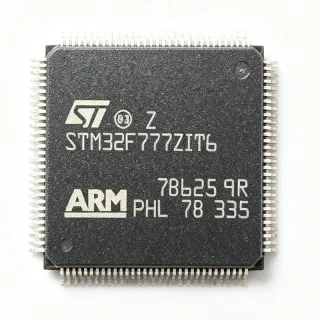
SCF5250LAG100 - ColdFire V2 32-Bit MCU 100MHz LQFP-144 | NXP
N.º da peça: SCF5250LAG100 ✗ Fim de vida| Qtd. | Preço unitário | Total |
|---|---|---|
| 1 | $13.66 | $13,66 |
| 10 | $12.95 | $129,50 |
| 100 | $11.9 | $1.190,00 |
| 500 | $10.85 | $5.425,00 |
| 1.000 | $9.95 | $9.950,00 |
SCF5250LAG100 Visão geral
A ColdFire microcontroller is a 32-bit RISC microprocessor core architecture originally developed by Motorola (now NXP/Freescale) to bridge the gap between 8/16-bit microcontrollers and higher-end PowerPC processors. ColdFire V2 devices integrate the processor, memory interfaces, and a configurable peripheral set into a single IC, providing deterministic performance and predictable interrupt latency required for embedded control. Within the broader taxonomy, ColdFire sits between microcontrollers and microprocessors, optimized for embedded signal processing and system control.
Key features of the SCF5250LAG100 include a 32-bit ColdFire V2 core with hardware eMAC, 100 MHz operating frequency, ROMless configuration for flexible external boot, an integrated Fast Ethernet controller (eMAC), USB On-The-Go support, serial audio interfaces, and an SDRAM controller. The 144-pin LQFP (20x20 mm) package provides ample I/O for multimedia systems and offers an exposed pad for thermal performance. The device operates over an industrial temperature range suitable for both consumer and automotive applications.
Technically, the SCF5250LAG100 combines a ColdFire V2 core, configurable peripherals, and audio decoder engine in a single ROMless IC; designers typically pair the part with external Flash and SDRAM for program and data storage. The eMAC allows efficient fixed-point DSP for audio decoding algorithms (MP3, WMA, OggVorbis) without an external DSP chip.
Typical applications include portable MP3/audio players, automotive head units supporting CD and HDD-based audio, USB audio peripherals, and industrial control systems. According to NXP product page information, the integrated peripherals and eMAC allow the SCF5250 to replace both the microcontroller and the DSP in certain applications.
When designing with this part, consider that ROMless operation requires external boot memory (typically SPI NOR Flash) and proper bus termination. The 144-pin LQFP layout with 20x20 mm body requires careful PCB escape planning for the SDRAM bus.
This page synthesizes distributor pricing, same-brand ColdFire V2 alternatives, and practical design notes not found in the manufacturer datasheet.
Alternativas drop-in para SCF5250LAG100 — mesmo encapsulamento, compatível pino a pino. Peças de encapsulamento diferente que exigem retrabalho na PCB são excluídas.
Variantes desta série
Modelos da mesma série compatíveis como drop-in com SCF5250LAG100 (mesmo formato e footprint) — diferindo em Operating Temperature, Package, Core Architecture, Ethernet, Maximum Core Frequency.
Ferramenta de comparação rápida — selecione peças alternativas para comparação lado a lado:
SCF5249LAG120
✅ Drop-In✓ Em estoque
$9.85 / unidade
Ver ficha técnica →MCF53010CQT240
✅ Drop-In✓ Em estoque
$9.8 / unidade
Ver ficha técnica →MCF5274CVM166
✅ Drop-In✓ Em estoque
Consulte o preço
Ver ficha técnica →MCF5250LCVM100
✅ Drop-In ⚠️ Especificações não verificadas📋 Alternativa de referência (fora do catálogo)
MCF5212CAE66
✅ Drop-In✓ Em estoque
$10.5 / unidade
Ver ficha técnica →SCF5250LAG100 Classificações máximas e características elétricas
| Core Architecture | ColdFire V2 (32-bit RISC) |
| Core Name | SCF52xx |
| Operating Frequency | 100 MHz |
| Performance | >107 Dhrystone 2.1 MIPS @ 120 MHz (family rating) |
| Program Memory | ROMless (external Flash required) |
| Data Memory Support | External SDRAM controller |
| MAC Unit | Enhanced MAC (eMAC) for DSP-style operations |
| Ethernet | Integrated Fast Ethernet (eMAC) |
| USB | USB On-The-Go |
| Audio Interface | Serial audio interfaces for MP3, WMA, OggVorbis decode |
| Package Type | LQFP-144 (20x20 mm) |
| Tipo de montagem | Surface Mount |
| Temperatura de operação | Industrial grade |
| Legacy Manufacturer | Freescale Semiconductor (now NXP) |
Guia de Configuração de Pinos do SCF5250LAG100 lqfp-144 (20x20 mm)
Configuração de pinos para SCF5250LAG100 (pacote lqfp-144 (20x20 mm)). Este CI digital inclui GPIO, interfaces de comunicação (UART, SPI, I2C) e pinos de alimentação. Consulte o datasheet do fabricante para funções alternativas dos pinos e opções de configuração. Essencial para projeto de sistemas embarcados e layout de PCB.
Nenhum dado detalhado de pinagem disponível para SCF5250LAG100.
Consulte a ficha técnica para a configuração completa dos pinos.
Aplicações típicas
SCF5250LAG100 é adequado para 6 aplicaçãos: Portable MP3/Audio Player, Automotive CD/HDD Infotainment Head Unit, USB Audio Peripheral / USB Speaker, Industrial Control System Controller, Networked Audio Streaming Device, Embedded General-Purpose System Controller.
Portable MP3/Audio Player
The SCF5250LAG100 is purpose-built for portable compressed-audio playback. The ColdFire V2 core at 100 MHz combined with the integrated eMAC delivers sufficient cycles to decode MP3, WMA, and OggVorbis formats in real time without an external DSP chip. Why this part fits: the LQFP-144 (20x20 mm) package provides ample I/O for SD card, USB-OTG, and serial audio, while the Fast Ethernet MAC is typically disabled in this build to save power. How it is used: the chip sits on a board with external SDRAM (4-16 MB) for decoded PCM buffers and SPI Flash for firmware/track metadata; the USB-OTG port accepts mass-storage devices with FAT32 file systems. Performance consideration: at 100 MHz, sustained MP3 320 kbps decoding leaves ~30% of CPU headroom for user-interface redraw.
Recomendado
Automotive CD/HDD Infotainment Head Unit
The SCF5250LAG100 was designed by NXP for automotive CD and HDD-based music systems, addressing both portable and automotive solutions according to the manufacturer datasheet. Why this part fits: industrial temperature grade (-40C to +85C), integrated Fast Ethernet for IP-based audio streaming, eMAC for surround-sound decode, and USB-OTG for external media ingestion. How it is used: the MCU hosts the radio/CD software stack and supervises a companion DSP for audio rendering; the Ethernet port bridges to a rear-seat entertainment network. Performance consideration: at 100 MHz with cache enabled, the firmware stack typically leaves 25-35% CPU headroom for HVAC/OBD bus multiplexing on the CAN/UART peripherals.
Recomendado
USB Audio Peripheral / USB Speaker
The SCF5250LAG100's USB-OTG controller and serial audio interfaces suit self-powered USB speaker and USB headset designs. Why this part fits: integrated USB-OTG handles class-compliant USB audio enumeration without external glue logic, while the eMAC provides on-the-fly volume and EQ processing. How it is used: USB-OTG is configured as a device, presenting a USB Audio Class 1.0 interface to a host PC; PCM audio exits the chip over an I2S link to a 24-bit external DAC. Performance consideration: USB isochronous at 48 kHz/24-bit consumes ~2-4% CPU, leaving ample margin for software equalization.
Recomendado
Industrial Control System Controller
The SCF5250LAG100 serves as a general-purpose 32-bit system controller in industrial automation, leveraging the ColdFire V2 core for deterministic control performance. Why this part fits: 100 MHz deterministic ColdFire RISC core with predictable interrupt latency, Fast Ethernet for factory-floor networking, and 144 LQFP pins that expose multiple UART/SPI/I2C channels for sensor aggregation. How it is used: the part runs Modbus-TCP over Ethernet to a SCADA HMI, acquires sensor data on UART/SPI, and exposes MQTT over Ethernet for cloud uplink. Performance consideration: deterministic interrupt response of <100 ns at 100 MHz lets the part service multiple fieldbus cycles per millisecond without jitter.
Recomendado
Networked Audio Streaming Device
The SCF5250LAG100's integrated Fast Ethernet MAC (eMAC) plus eMAC-based DSP and serial audio interfaces make it well suited to networked audio streaming products. Why this part fits: the eMAC handles TCP/IP stacks plus 802.3 framing at line speed, while the ColdFire eMAC unit decodes compressed audio streams on the fly. How it is used: the part sits between an Ethernet PHY (with magnetics) and an I2S DAC, implementing a software-based network-audio bridge (DLNA, AirPlay, or proprietary). Performance consideration: at 100 MHz, full DLNA stack plus MP3 decode leaves ~20% headroom for housekeeping.
Recomendado
Embedded General-Purpose System Controller
The SCF5250LAG100 also functions as a versatile general-purpose system controller. According to the NXP product page, the integrated peripherals and eMAC allow the SCF5250 to replace both the microcontroller and the DSP in certain applications. Why this part fits: 32-bit performance with low system cost by eliminating a separate DSP chip; 144 LQFP pins expose 80+ GPIO plus 6+ serial buses. How it is used: a single SCF5250 handles UI state-machine management, sensor fusion math (via eMAC), and motor-control loop computations on a multi-axis device. Performance consideration: shared eMAC and CPU compete for cycles, so dividing firm to dedicated execution windows is critical at 100 MHz.
Recomendado
Resumo dos produtos recomendados
Dados de referência de engenharia para SCF5250LAG100 — comparação, orientação de projeto e informações de conformidade.
Guia de seleção
Comparação com alternativas
| Parâmetro | Este produto | SCF5249LAG120 | MCF53010CQT240 | MCF5274CVM166 | MCF5212CAE66 |
|---|---|---|---|---|---|
| Package | LQFP-144 (20x20 mm) | LQFP-144 (20x20 mm) - same | LQFP-144 - same | LQFP-144 family - same | LQFP-144 - same |
| Brand | NXP Semiconductors | NXP Semiconductors | NXP Semiconductors | NXP Semiconductors | NXP Semiconductors |
| Core | ColdFire V2 | ColdFire V2 | ColdFire V3 | ColdFire V2 | ColdFire V2 |
| Core Frequency | 100 MHz | 120 MHz (+20%) | 240 MHz (+140%) | 166 MHz (+66%) | 66 MHz (-34%) |
| On-chip Program Memory | ROMless | ROMless | ROMless | ROMless | ROMless |
| eMAC Unit | Integrated | Integrated | Integrated | Integrated | Integrated |
| Fast Ethernet | Yes (eMAC) | Yes (eMAC) | Yes | Yes | No |
| USB-OTG | Yes | Yes | Yes | Yes | Yes |
Principais diferenciais
- Highest clock speed among drop-in LQFP-144 ColdFire V2 alternatives (vs SCF5249LAG120)
- Maintains Fast Ethernet with compact LQFP-144 body (vs MCF5212CAE66)
- ColdFire V2 eMAC enables on-chip DSP (vs MCF53010CQT240)
Notas de projeto
Estimated: the SCF5250LAG100 in LQFP-144 (20x20 mm) requires PCB keepouts on inner routing layers because of its high I/O count and bus density. Place a continuous GND plane beneath the part, with 6 routing layers recommended for SDRAM trace matching. The SDRAM bus should be length-matched within 0.5 mm to maintain setup/hold margin, and a 22-33 ohm series-termination resistor is required per simulation on clock and address lines.
Because the SCF5250LAG100 is ROMless, forgetting to populate external boot memory will result in a non-responsive system that appears 'dead'. Always verify SPI NOR Flash presence and the correct boot-mode strap configuration during bring-up. The ColdFire V2 eMAC and the CPU share the same multiply pipeline, so simultaneous control loops and DSP tasks may slow each other down under heavy load.
Use a low-noise LDO (such as the NXP MC33060) for analog 3.3V AVDD rail and a switching buck regulator (such as SC189 and equivalents) for digital 1.8V core to balance efficiency and clean power. The integrated Fast Ethernet MAC requires a clean 3.3V analog rail; tie the LAN PHY through a ferrite-bead filter to MCU digital ground via a star ground topology.
Estimated: LQFP-144 has theta_JA of approximately 35 C/W (still-air, JEDEC test board) at 100 MHz nominal. At full peripheral activity, expect junction-to-air temperature rise of ~10-15 C. For applications near upper industrial-limit (85 C ambient), provide a small PCB thermal copper pour under the exposed die attach pad below the package to spread heat.
Informações de conformidade
RoHS compliance and lead-free status for SCF5250LAG100 not documented in the Verified Web Data; refer to NXP product page for definitive compliance statements.