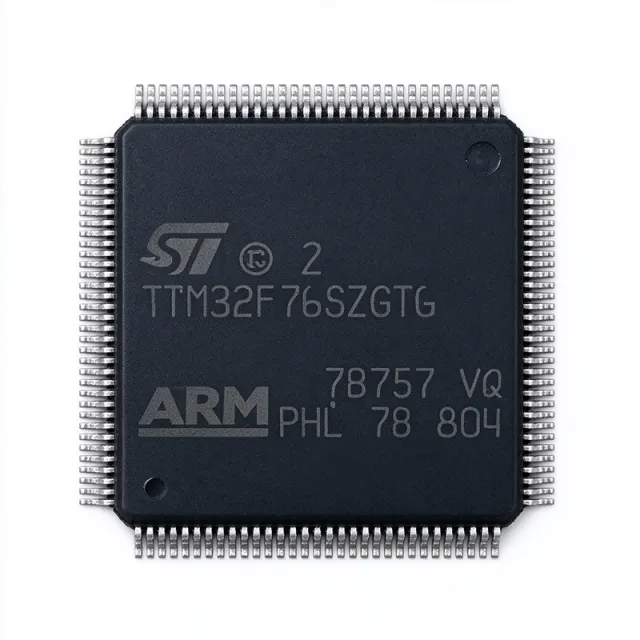
STM32F765ZGT6 - 216MHz Cortex-M7 MCU, 1MB Flash | STMicroelectronics
MPN: STM32F765ZGT6 ✓ Hoạt độngSTM32F765ZGT6 Tóm tắt
A microcontroller (MCU) is a single-chip embedded computer that combines a processor core, on-chip memory, and programmable peripherals, sitting at the heart of nearly every modern electronic system. Within the component taxonomy, the STM32F765ZGT6 belongs to the STM32F7 series of 32-bit Flash MCUs, which falls under the broader STM32 family and the ARM Cortex-M ecosystem, serving industrial, consumer, and medical applications that demand more compute headroom than Cortex-M4 devices can deliver. The Cortex-M7 in turn inherits from ARM's Cortex-M processor lineage, while MCU itself is a hypernym of microprocessor.
Key differentiating features include the Adaptive Real-Time (ART) Accelerator with 16 Kbytes I/D L1 cache enabling 0-wait-state execution from embedded Flash, the Chrom-ART Accelerator (DMA2D) that offloads 2D graphics work, and a rich peripheral set including multiple 12-bit ADCs, DACs, advanced timers, USART/UART, SPI, I2C, CAN, USB OTG full-speed/high-speed, an Ethernet MAC with IEEE 1588 support, and a camera interface. A flexible external memory controller (FMC) supports SDRAM, SRAM, and NOR/NAND Flash for large frame buffers.
Technically, the Cortex-M7 6-stage pipeline with branch prediction and dual-issue capability sustains high throughput even under interrupt load, while the integrated FPU accelerates signal-processing tasks. Supply range is 1.7V to 3.6V with operation from -40C to +85C ambient for the STM32F765ZGT6 industrial grade, and the part supports Sleep, Stop, and Standby low-power modes.
Typical applications include industrial automation (PLCs, motor control), human-machine interfaces with graphical TFT displays, IoT gateways where the Ethernet MAC enables precise IEEE 1588 time synchronization, and audio processing using the DSP extensions. The wide peripheral set also suits building automation, point-of-sale terminals, and medical instrumentation.
Design-wise, place 100nF decoupling capacitors on each VDD pin and a 4.7uF bulk cap on the main supply, follow ST's reference layout for the HSE crystal and VREF+ analog domain, and exploit the low-power modes for battery-sensitive designs.
This page synthesizes distributor pricing, drop-in alternatives, FAQ answers, and practical design notes not found in the manufacturer datasheet, with pricing as of 2026-10-10.
Bộ thay thế dễ dàng lắp đặt cho STM32F765ZGT6 — cùng gói, chân-to-chân tương thích. Các bộ phận yêu cầu hàn PCB bị loại trừ.
Các biến thể trong loạt này
Các mẫu cùng loạt có thể lắp đặt dễ dàng tương thích với STM32F765ZGT6 (cùng hình factor và footprint) — khác nhau ở Package, Operating Temperature, Core, SRAM, RoHS Status.
STM32F767ZGT6
Liên hệ để biết giá
Xem tài liệu →STM32F746ZGT6
Liên hệ để biết giá
Xem tài liệu →STM32F756BGT6
Liên hệ để biết giá
Xem tài liệu →STM32F779BIT6
Liên hệ để biết giá
Xem tài liệu →STM32F769ZGT6
📋 Tham chiếu thay thế (không có trong danh mục)
STM32F765ZGT6 Tỷ lệ tối đa & tính chất điện
| Core | ARM Cortex-M7 with double-precision FPU |
| Maximum CPU Frequency | 216 MHz |
| DMIPS | 462 DMIPS (2.14 DMIPS/MHz, Dhrystone 2.1) |
| Flash Memory | 1 MB |
| SRAM | 384 KB |
| L1 Cache | 16 KB I/D cache |
| Điện áp cung cấp | 1.7 V to 3.6 V |
| Nhiệt độ hoạt động | -40 C to +85 C |
| Hộp | 144-LQFP (20x20 mm) |
| Kiểu lắp đặt | Surface Mount |
| ADC | 12-bit (multiple instances) |
| DAC | 12-bit |
| Communication | USART, SPI, I2C, CAN, USB OTG FS/HS, Ethernet MAC with IEEE 1588 |
| External Memory Controller | FMC for SDRAM, SRAM, NOR/NAND Flash |
| ART Accelerator | Yes (0-wait-state Flash execution) |
| Chrom-ART Accelerator (DMA2D) | Yes |
| Trạng thái RoHS | Compliant |
Cấu hình chân STM32F765ZGT6
| Chân 1 | PE2 — GPIO PE2 / TRACECLK / SPI4_SCK |
| Chân 2 | PE3 — GPIO PE3 / TRACED0 |
| Chân 3 | PE4 — GPIO PE4 / TRACED1 / SPI4_NSS |
| Chân 4 | PE5 — GPIO PE5 / TRACED2 / SPI4_MISO / TIM9_CH1 |
| Chân 5 | PE6 — GPIO PE6 / TRACED3 / SPI4_MOSI / TIM9_CH2 |
| Chân 6 | VBAT — RTC backup supply |
| Chân 7 | PC13 — GPIO PC13 / RTC_TAMP1 |
| Chân 8 | PC14 — GPIO PC14 / OSC32_IN |
| Chân 9 | PC15 — GPIO PC15 / OSC32_OUT |
| Chân 10 | VREF+ — ADC reference voltage |
| Chân 11 | VDDA — Analog supply |
| Chân 12 | PA0 — GPIO PA0 / UART4_TX / TIM5_CH1 |
| Chân 13 | PA1 — GPIO PA1 / UART4_RX / TIM5_CH2 |
| Chân 14 | PA2 — GPIO PA2 / USART2_TX / TIM5_CH3 |
| Chân 15 | PA3 — GPIO PA3 / USART2_RX / TIM5_CH4 |
| Chân 16 | VSS — Ground |
| Chân 17 | VDD — Digital supply |
| Chân 18 | PA4 — GPIO PA4 / SPI1_NSS / DAC_OUT1 |
| Chân 19 | PA5 — GPIO PA5 / SPI1_SCK / DAC_OUT2 |
| Chân 20 | PA6 — GPIO PA6 / SPI1_MISO / TIM13_CH1 |
| Chân 21 | PA7 — GPIO PA7 / SPI1_MOSI / TIM14_CH1 |
| Chân 22 | PC4 — GPIO PC4 / USART3_TX / ETH_RXD0 |
| Chân 23 | PC5 — GPIO PC5 / USART3_RX / ETH_RXD1 |
| Chân 24 | PB0 — GPIO PB0 / TIM3_CH3 / ETH_RXD2 |
| Chân 25 | PB1 — GPIO PB1 / TIM3_CH4 / ETH_RXD3 |
| Chân 26 | PB2 — GPIO PB2 / BOOT1 |
| Chân 27 | PF11 — GPIO PF11 / FMC_NRAS |
| Chân 28 | PF12 — GPIO PF12 / FMC_A6 |
| Chân 29 | VSS — Ground |
| Chân 30 | VDD — Digital supply |
| Chân 31 | PF13 — GPIO PF13 / FMC_A7 |
| Chân 32 | PF14 — GPIO PF14 / FMC_A8 |
| Chân 33 | PF15 — GPIO PF15 / FMC_A9 |
| Chân 34 | PG0 — GPIO PG0 / FMC_A10 |
| Chân 35 | PG1 — GPIO PG1 / FMC_A11 |
| Chân 36 | PE7 — GPIO PE7 / UART7_RX / FMC_D4 |
| Chân 37 | PE8 — GPIO PE8 / UART7_TX / FMC_D5 |
| Chân 38 | PE9 — GPIO PE9 / TIM1_CH1 / FMC_D6 |
| Chân 39 | VSS — Ground |
| Chân 40 | VDD — Digital supply |
| Chân 41 | PE10 — GPIO PE10 / TIM1_CH2 / FMC_D7 |
| Chân 42 | PE11 — GPIO PE11 / TIM1_CH3 / FMC_D8 |
| Chân 43 | PE12 — GPIO PE12 / TIM1_CH4 / FMC_D9 |
| Chân 44 | PE13 — GPIO PE13 / SPI4_MISO / FMC_D10 |
| Chân 45 | PE14 — GPIO PE14 / SPI4_MOSI / FMC_D11 |
| Chân 46 | PE15 — GPIO PE15 / FMC_D12 |
| Chân 47 | PB10 — GPIO PB10 / I2C2_SCL / USART3_TX |
| Chân 48 | PB11 — GPIO PB11 / I2C2_SDA / USART3_RX |
| Chân 49 | VCAP_1 — Core voltage decoupling (1.2V LDO) |
| Chân 50 | VDD — Digital supply |
| Chân 51 | VSS — Ground |
| Chân 52 | PB12 — GPIO PB12 / SPI2_NSS / I2S2_WS |
| Chân 53 | PB13 — GPIO PB13 / SPI2_SCK / I2S2_CK |
| Chân 54 | PB14 — GPIO PB14 / SPI2_MISO / TIM12_CH1 |
| Chân 55 | PB15 — GPIO PB15 / SPI2_MOSI / TIM12_CH2 |
| Chân 56 | PD8 — GPIO PD8 / USART3_TX / FMC_D13 |
| Chân 57 | PD9 — GPIO PD9 / USART3_RX / FMC_D14 |
| Chân 58 | PD10 — GPIO PD10 / FMC_D15 |
| Chân 59 | PD11 — GPIO PD11 / USART3_CTS / FMC_A16 |
| Chân 60 | PD12 — GPIO PD12 / TIM4_CH1 / FMC_A17 |
| Chân 61 | PD13 — GPIO PD13 / TIM4_CH2 / FMC_A18 |
| Chân 62 | VSS — Ground |
| Chân 63 | VDD — Digital supply |
| Chân 64 | PD14 — GPIO PD14 / TIM4_CH3 / FMC_D0 |
| Chân 65 | PD15 — GPIO PD15 / TIM4_CH4 / FMC_D1 |
| Chân 66 | PG2 — GPIO PG2 / FMC_A12 |
| Chân 67 | PG3 — GPIO PG3 / FMC_A13 |
| Chân 68 | PG4 — GPIO PG4 / FMC_A14 |
| Chân 69 | PG5 — GPIO PG5 / FMC_A15 |
| Chân 70 | PG6 — GPIO PG6 / DCMI_D12 / LTDC_B7 |
| Chân 71 | PG7 — GPIO PG7 / USART6_CK / LTDC_CLK |
| Chân 72 | PG8 — GPIO PG8 / USART6_RTS / ETH_PPS_OUT |
| Chân 73 | VSS — Ground |
| Chân 74 | VDD — Digital supply |
| Chân 75 | PG9 — GPIO PG9 / USART6_RX / DCMI_VSYNC |
| Chân 76 | PG10 — GPIO PG10 / LTDC_B2 |
| Chân 77 | PG11 — GPIO PG11 / ETH_TX_EN / LTDC_B3 |
| Chân 78 | PG12 — GPIO PG12 / SPI6_MISO / LTDC_B4 |
| Chân 79 | PG13 — GPIO PG13 / SPI6_SCK / LTDC_DE |
| Chân 80 | PG14 — GPIO PG14 / SPI6_MOSI / LTDC_CLK |
| Chân 81 | VSS — Ground |
| Chân 82 | VDD — Digital supply |
| Chân 83 | PG15 — GPIO PG15 / USART6_CTS / FMC_NCAS |
| Chân 84 | PB3 — GPIO PB3 / SWO / SPI3_SCK |
| Chân 85 | PB4 — GPIO PB4 / SPI3_MISO |
| Chân 86 | PB5 — GPIO PB5 / SPI3_MOSI |
| Chân 87 | PB6 — GPIO PB6 / I2C1_SCL / USART1_TX |
| Chân 88 | PB7 — GPIO PB7 / I2C1_SDA / USART1_RX |
| Chân 89 | BOOT0 — Boot mode select |
| Chân 90 | PB8 — GPIO PB8 / I2C1_SCL / CAN1_RX |
| Chân 91 | PB9 — GPIO PB9 / I2C1_SDA / CAN1_TX |
| Chân 92 | PE0 — GPIO PE0 / TIM4_ETR |
| Chân 93 | PE1 — GPIO PE1 |
| Chân 94 | VSS — Ground |
| Chân 95 | PDR_ON — Power-down reset enable |
| Chân 96 | VDD — Digital supply |
| Chân 97 | PI4 — GPIO PI4 / FMC_NBL0 |
| Chân 98 | PI5 — GPIO PI5 / FMC_NBL1 |
| Chân 99 | PI6 — GPIO PI6 / FMC_D30 |
| Chân 100 | PI7 — GPIO PI7 / FMC_D31 |
| Chân 101 | PI8 — GPIO PI8 / FMC_D24 |
| Chân 102 | PI9 — GPIO PI9 / FMC_D25 |
| Chân 103 | PI10 — GPIO PI10 / ETH_RX_ER / FMC_D26 |
| Chân 104 | PI11 — GPIO PI11 / OTG_FS_DM |
| Chân 105 | VSS — Ground |
| Chân 106 | VDD — Digital supply |
| Chân 107 | PA8 — GPIO PA8 / TIM1_CH1 / USART1_CK / OTG_FS_SOF |
| Chân 108 | PA9 — GPIO PA9 / USART1_TX / OTG_FS_VBUS |
| Chân 109 | PA10 — GPIO PA10 / USART1_RX / OTG_FS_ID |
| Chân 110 | PA11 — GPIO PA11 / USART1_CTS / CAN1_RX / OTG_FS_DM |
| Chân 111 | PA12 — GPIO PA12 / USART1_RTS / CAN1_TX / OTG_FS_DP |
| Chân 112 | PA13 — GPIO PA13 / JTMS / SWDIO |
| Chân 113 | VCAP_2 — Core voltage decoupling (1.2V LDO) |
| Chân 114 | VSS — Ground |
| Chân 115 | VDD — Digital supply |
| Chân 116 | PA14 — GPIO PA14 / JTCK / SWCLK |
| Chân 117 | PA15 — GPIO PA15 / JTDI / SPI3_NSS |
| Chân 118 | PC6 — GPIO PC6 / TIM3_CH1 / USART6_TX |
| Chân 119 | PC7 — GPIO PC7 / TIM3_CH2 / USART6_RX |
| Chân 120 | PC8 — GPIO PC8 / TIM3_CH3 / USART6_CK |
| Chân 121 | PC9 — GPIO PC9 / TIM3_CH4 / I2C3_SDA |
| Chân 122 | PA15 — GPIO PA15 / JTDI |
| Chân 123 | VSS — Ground |
| Chân 124 | VDD — Digital supply |
| Chân 125 | PD0 — GPIO PD0 / CAN1_RX / FMC_D2 |
| Chân 126 | PD1 — GPIO PD1 / CAN1_TX / FMC_D3 |
| Chân 127 | PD2 — GPIO PD2 / TIM3_ETR / UART5_RX |
| Chân 128 | PD3 — GPIO PD3 / USART2_CTS / FMC_CLK |
| Chân 129 | PD4 — GPIO PD4 / USART2_RTS / FMC_NOE |
| Chân 130 | PD5 — GPIO PD5 / USART2_TX / FMC_NWE |
| Chân 131 | VSS — Ground |
| Chân 132 | VDD — Digital supply |
| Chân 133 | PD6 — GPIO PD6 / USART2_RX / FMC_NWAIT |
| Chân 134 | PD7 — GPIO PD7 / USART2_CK / FMC_NE1 |
| Chân 135 | PG10 — GPIO PG10 / LTDC_B2 |
| Chân 136 | PG11 — GPIO PG11 / ETH_TX_EN / LTDC_B3 |
| Chân 137 | PG12 — GPIO PG12 / SPI6_MISO / LTDC_B4 |
| Chân 138 | PG13 — GPIO PG13 / SPI6_SCK / LTDC_DE |
| Chân 139 | PG14 — GPIO PG14 / SPI6_MOSI / LTDC_CLK |
| Chân 140 | VSS — Ground |
| Chân 141 | VDD — Digital supply |
| Chân 142 | PB6 — GPIO PB6 / I2C1_SCL |
| Chân 143 | PB7 — GPIO PB7 / I2C1_SDA |
| Chân 144 | BOOT0 — Boot mode select |
Ứng dụng tiêu biểu
STM32F765ZGT6 phù hợp cho 6 Áp dụngs: Industrial PLC and Motor Control, Human-Machine Interface (HMI) with TFT Display, IoT Gateway with Ethernet and TLS, Audio Processing and DSP Front-End, Medical Instrumentation and Patient Monitoring, Smart Home and Building Automation Hub.
Industrial PLC and Motor Control
The STM32F765ZGT6's 216 MHz Cortex-M7 with DSP extensions and FPU executes field-oriented control (FOC) loops on three-phase motors within the typical 10-20 kHz PWM cycle. Its three 12-bit ADCs sampled at 2.4 MSPS handle dual-shunt current sensing and back-EMF measurement with sub-microsecond conversion latency, while the advanced timer block generates complementary PWM with hardware dead-time insertion and break inputs for safe torque disable. The 1 MB Flash accommodates full IEC 61131-3 runtime plus customer application code, and 384 KB SRAM holds control loop working sets without external memory. For industrial control cabinets the 144-LQFP exposes enough GPIO for multiple encoder interfaces, CAN-FD links to other drives, and isolated UART commissioning ports. Wide 1.7-3.6V supply tolerance lets the part ride out 24V bus transients behind a simple buck regulator.
Được đề xuất
Human-Machine Interface (HMI) with TFT Display
Driving a 480x272 or 800x480 TFT panel from the STM32F765ZGT6 is straightforward thanks to the integrated LTDC controller and the Chrom-ART (DMA2D) accelerator that offloads 2D blits from the CPU. The Cortex-M7 plus 384 KB SRAM can hold a full frame buffer, while the FMC bus streams pixel data to the display at up to 50 MHz without CPU intervention. The 1 MB Flash stores LVGL or emWin graphics libraries plus bitmap assets, leaving room for application code and over-the-air update slots. Resistive or capacitive touch controllers connect over I2C/SPI, and USB OTG HS supports firmware update via a USB stick in the field. For sunlight-readable designs, the LTDC's per-layer color keying and blend modes simplify UI overlays without taxing the M7 pipeline.
Được đề xuất
IoT Gateway with Ethernet and TLS
The STM32F765ZGT6's Ethernet MAC with IEEE 1588 hardware timestamping delivers sub-microsecond clock discipline for protocols such as PTP, NTP, and Modbus TCP, while the dedicated DMA offloads packet handling from the Cortex-M7. The 1 MB Flash comfortably fits mbedTLS plus an MQTT-SN or CoAP broker stack, and 384 KB SRAM buffers incoming TLS sessions without overflow. The ART Accelerator keeps interrupt latency predictable when 1588 timestamps are inserted into the transmit path, and the Cortex-M7 DSP instructions accelerate any on-gateway analytics such as FFT vibration monitoring. USB OTG HS provides a second network path for cellular modems, while CAN-FD links to local sensor clusters. Wide temperature range and 3.3V operation suit outdoor DIN-rail gateways behind industrial PoE rails.
Được đề xuất
Audio Processing and DSP Front-End
Audio products such as active speakers, hearing aids, and automotive headrest displays benefit from the STM32F765ZGT6's single-precision FPU plus DSP extensions, which execute FFT, FIR, and biquad filter kernels at 216 MHz with deterministic cycle counts. The three 12-bit ADCs (with optional interleaving to 7.2 MSPS equivalent) capture multi-microphone arrays for beamforming, while the two 12-bit DACs output line-level audio or PWM drive for Class-D amplifiers. The SAI and I2S peripherals stream samples to external codecs, and 384 KB SRAM holds overlapping audio buffers plus a heap for FreeRTOS plus middleware. With 1 MB Flash the device stores audio effect libraries, voice prompt samples, and the main control loop, all from a single 3.3V supply.
Được đề xuất
Medical Instrumentation and Patient Monitoring
Patient monitors, infusion pumps, and portable diagnostic devices use the STM32F765ZGT6 to combine deterministic Cortex-M7 control with rich connectivity. The 12-bit ADCs sampled at 2.4 MSPS digitize ECG, SpO2, and respiration channels with low noise, while the FPU runs Pan-Tompkins QRS detection or FIR filters in real time. The USB OTG HS port supports tethered firmware update by clinical engineers, and the Ethernet MAC with IEEE 1588 timestamps HL7 data packets on hospital networks. The 1 MB Flash accommodates IEC 62304-compliant code with revision history, and 384 KB SRAM handles waveform ring buffers without DMA thrash. Industrial -40C to +85C operation covers the full medical equipment ambient range, and the LQFP-144 footprint gives plenty of analog and digital GPIO for sensor multiplexing.
Được đề xuất
Smart Home and Building Automation Hub
Zigbee, Matter, and KNX gateways rely on the STM32F765ZGT6 to act as the application processor alongside one or more radio co-processors. The Cortex-M7 at 216 MHz handles Matter commissioning flows, device database, and automation rules while the Ethernet MAC provides the wired uplink, and USB OTG HS adds a second IP path via a cellular or Wi-Fi dongle. The flexible memory controller (FMC) lets designers add SDRAM for large device databases, while the 1 MB Flash fits the full Matter stack plus OTA bootloader. Multiple UARTs, SPIs, and I2Cs interface with radios, sensors, and the host processor of HVAC controllers, and the SDIO peripheral supports an SD card for local event logging. Wide operating temperature and 3.3V supply suit DIN-rail enclosures in basement equipment rooms.
Được đề xuất
Tóm tắt các sản phẩm được đề xuất
Dữ liệu tham khảo kỹ thuật cho STM32F765ZGT6 — so sánh, hướng dẫn thiết kế và thông tin tuân thủ.
Hướng dẫn chọn lựa
So sánh với các sản phẩm thay thế
| Tham số | Sản phẩm này | STM32F767ZGT6 | STM32F769ZGT6 | STM32F746ZGT6 | STM32F756BGT6 | STM32F779BIT6 |
|---|---|---|---|---|---|---|
| Brand | STMicroelectronics | STMicroelectronics | STMicroelectronics | STMicroelectronics | STMicroelectronics | STMicroelectronics |
| Package | 144-LQFP (20x20 mm) | 144-LQFP (20x20 mm) - same | 144-LQFP (20x20 mm) - same | 144-LQFP (20x20 mm) - same | 144-LQFP (20x20 mm) - same | 144-LQFP (20x20 mm) - same |
| CPU Core | ARM Cortex-M7 | ARM Cortex-M7 | ARM Cortex-M7 | ARM Cortex-M7 | ARM Cortex-M7 | ARM Cortex-M7 |
| Max CPU Frequency | 216 MHz | 216 MHz | 216 MHz | 216 MHz | 216 MHz | 216 MHz |
| Flash Memory | 1 MB | 2 MB | 2 MB | 1 MB | 1 MB | 2 MB |
| SRAM | 384 KB | 512 KB | 512 KB | 320 KB | 320 KB | 512 KB |
| Hardware Crypto (AES/SHA/RNG) | No | Yes | Yes | No | No | Yes |
| Display Interface | LTDC (no DSI) | LTDC | LTDC + MIPI-DSI | LTDC | LTDC | LTDC + MIPI-DSI |
Bảo phân biệt quan trọng
- Balanced Flash/SRAM density for graphics and DSP (vsSTM32F746ZGT6)
- Best price-to-specs ratio without crypto overhead (vsSTM32F767ZGT6)
- Pin-compatible upgrade path to MIPI-DSI (vsSTM32F769ZGT6)
Ghi chú thiết kế
Place a 100nF ceramic decoupling capacitor as close as possible to every VDD pin and a 4.7uF bulk capacitor on the main 3.3V rail. The VCAP_1 and VCAP_2 pins each need a 2.2uF low-ESR capacitor to stabilize the internal 1.2V core LDO. Failure to populate the VCAP caps causes core supply ripple and erratic Cortex-M7 execution at 216 MHz. Keep the digital and analog supply planes separate, joining them only at a single ferrite bead.
The STM32F765ZGT6 in 144-LQFP has a junction-to-ambient thermal resistance of approximately 50 C/W on a standard 4-layer PCB. At 216 MHz with all peripherals active the core dissipates around 200 mW, giving a self-heating rise of 10 C above ambient, well within the 85 C industrial limit. For closed enclosures with restricted airflow, add a copper pour under the exposed die pad area (the LQFP-144 has no thermal pad, but a 4-layer PCB with stitched vias to the inner ground plane reduces theta_JA by 30%).
Route the HSE crystal traces as short, impedance-matched pairs within 5 mm of the OSC_IN/OSC_OUT pins, with a guard ground on each side to keep digital switching noise out of the oscillator. The Ethernet MII/RMII signals to the PHY must be length-matched within 50 mil and reference a solid ground plane; USB DP/DM traces need 90-ohm differential impedance and an ESD array at the connector. Avoid routing the SDRAM clock under the analog VREF+ pin.
Do not enable the L1 cache before initializing the external memory controller on STM32F765ZGT6 - speculative fetches can return stale data from unmapped SDRAM. Always boot from internal Flash first, configure the FMC SDRAM timing registers from ST's reference examples, then enable the cache. Also remember that pins PB3/PB4/PA15 default to JTAG functions after reset; remap them to GPIO via the appropriate alternate-function mapping before driving them as outputs.
Thông tin tuân thủ
RoHS and REACH compliance per ST product page. AEC-Q100 qualification not applicable for standard STM32F765ZGT6 industrial grade; STM32F765ZGT6 is not AEC-Q100 qualified.
