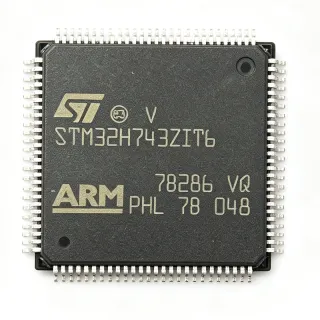
STM32F765ZGT6 - 216MHz Cortex-M7 MCU, 1MB Flash | STMicroelectronics
MPN: STM32F765ZGT6 ✓ Active| Qty | Unit Price | Extended |
|---|---|---|
| 1 | $14.62 | $14.62 |
| 10 | $13.9 | $139.00 |
| 25 | $13.62 | $340.50 |
| 100 | $12.85 | $1,285.00 |
| 1,000 | $11.4 | $11,400.00 |
STM32F765ZGT6 Overview
A microcontroller (MCU) is a single-chip embedded computer combining a processor core, memory, and programmable peripherals. Within the component hierarchy, the STM32F765ZGT6 belongs to the STM32F7 series of 32-bit Flash MCUs, which sits under the broader STM32 family and the ARM Cortex-M ecosystem, serving industrial, consumer, and medical embedded systems that need more compute than Cortex-M4 parts can deliver.
Key differentiating features include the ART Accelerator and 16 Kbytes I/D L1 cache enabling 0-wait-state execution from embedded Flash, a sustained 462 DMIPS (2.14 DMIPS/MHz Dhrystone 2.1) performance rating, and DSP instructions with single-precision FPU. The device also integrates a memory protection unit (MPU) and a rich peripheral set covering multiple 12-bit ADCs, DACs, advanced timers, USARTs, SPIs, I2Cs, CAN, USB OTG, Ethernet MAC, and camera interface.
Technically, the Cortex-M7 6-stage pipeline with branch prediction and the Chrom-ART Accelerator (DMA2D) offload 2D graphics work from the CPU, while the flexible external memory controller (FMC) supports SDRAM, SRAM, and NOR/NAND Flash for large frame buffers and data logging. Supply range is 1.7V to 3.6V with operation from -40C to +85C ambient.
Typical applications include industrial automation (PLCs, motor control), human-machine interfaces with graphical displays, and IoT gateways where the Ethernet MAC with IEEE 1588 support provides precise network time synchronization.
Design-wise, place 100nF and 4.7uF decoupling capacitors at each power pin, follow the ST layout guidance for the crystal oscillator and VREF+ analog domain, and exploit Sleep, Stop, and Standby modes for battery-sensitive designs.
This page synthesizes distributor pricing, drop-in alternatives, FAQ answers, and practical design notes not found in the manufacturer datasheet, with pricing as of 2026-09-06.
Drop-in alternatives for STM32F765ZGT6 — same package, pin-to-pin compatible. Different-package parts requiring PCB rework are excluded.
Variants in this series
Same-series models that are drop-in compatible with STM32F765ZGT6 (same form factor and footprint) — differing in SRAM, Flash Memory, Operating Temperature, Package, Core.
Quick Comparison Tool — Select alternative parts for side-by-side comparison:
STM32F767ZGT6
✅ Drop-In ⚠️ 参数待验证📋 Reference alternative (not in catalog)
STM32F765ZIT6
✅ Drop-In ⚠️ 参数待验证📋 Reference alternative (not in catalog)
STM32F756ZGT6
✅ Drop-In ⚠️ 参数待验证✓ In Stock
$8.1 / Unit
View Datasheet →STM32F746ZGT6
✅ Drop-In ⚠️ 参数待验证✓ In Stock
$6.87 / Unit
View Datasheet →STM32F722ZET6
✅ Drop-In ⚠️ 参数待验证✓ In Stock
$8.1 / Unit
View Datasheet →STM32F765ZGT6 Maximum Ratings & Electrical Characteristics
| Core Processor | ARM Cortex-M7 (32-bit) with double-precision FPU |
| Core Frequency | 216 MHz |
| Flash Memory | 1 MB (1M x 8) |
| SRAM | 384 KB |
| Performance | 462 DMIPS (2.14 DMIPS/MHz, Dhrystone 2.1) |
| L1 Cache | 16 Kbytes I-cache / 16 Kbytes D-cache |
| Accelerators | ART Accelerator, Chrom-ART Accelerator (DMA2D) |
| Operating Voltage | 1.7 V to 3.6 V |
| Operating Temperature | -40C to +85C |
| Package | 144-LQFP (20x20 mm) |
| Mounting Type | Surface Mount |
| Peripherals | 12-bit ADCs, DACs, timers, USART, SPI, I2C, CAN, USB OTG, Ethernet MAC, camera interface, DFSDM |
| External Memory Support | SDRAM, SRAM, NOR/NAND Flash (FMC) |
| Security Features | MPU (Memory Protection Unit) |
| Data Converters | A/D 12-bit, D/A 12-bit |
| Connectivity | CANbus, EBI/EMI, Ethernet, I2C, SPI, UART/USART, USB OTG |
STM32F765ZGT6 144-lqfp (20x20 mm) Pin Configuration Guide
Pin configuration for STM32F765ZGT6 (144-lqfp (20x20 mm) package). This digital IC includes GPIO, communication interfaces (UART, SPI, I2C), and power pins. Refer to the manufacturer datasheet for alternate pin functions and configuration options. Essential for embedded system design and PCB layout.

No detailed pinout data available for STM32F765ZGT6.
Refer to the datasheet for full pin configuration.
Typical Applications
STM32F765ZGT6 is suitable for 6 applications: Industrial Automation and PLC, HMI and Graphical Displays, IoT Gateways and Networked Devices, Medical Devices and Patient Monitoring, Audio and Signal Processing Systems, Test and Measurement Instrumentation.
Industrial Automation and PLC
The STM32F765ZGT6 fits industrial control nodes that need both compute headroom and deterministic I/O: the 216 MHz Cortex-M7 with DSP instructions executes field-oriented motor control and PID loops with margin, while the 462 DMIPS rating leaves cycles free for protocol stacks. Multiple advanced timers generate complementary PWM with dead-time insertion, and the 12-bit ADCs with DFSDM sample current shunts or sigma-delta sensors at high resolution. CAN, USART, and Ethernet MAC interfaces integrate the node into factory networks, and the FMC allows connection of external SRAM for large data buffers. In a typical PLC I/O module, the MCU runs the scan cycle from 1 MB embedded Flash with 0-wait-state execution via the ART Accelerator, while the MPU supports functional-safety-oriented software partitioning.
Recommended
HMI and Graphical Displays
The STM32F765ZGT6 drives human-machine interface panels where the 384 KB SRAM and external SDRAM controller (FMC) hold display frame buffers, and the Chrom-ART Accelerator (DMA2D) performs 2D blits, window moves, and format conversions without CPU load, freeing the 216 MHz core for touch handling and application logic. For panels requiring an RGB LCD-TFT controller, the pin-compatible STM32F767ZGT6 or STM32F746ZGT6 drops onto the same PCB. SPI and I2C interfaces connect capacitive touch controllers, while the camera interface captures video input for simple vision guidance. Typical GUI stacks such as TouchGFX run comfortably within the 462 DMIPS budget, and the ART Accelerator plus 16 Kbytes of I/D cache keep code execution smooth from 1 MB embedded Flash.
Recommended
IoT Gateways and Networked Devices
The STM32F765ZGT6 serves as the main controller in IoT gateways: the integrated Ethernet MAC (with IEEE 1588 precision time protocol support) provides wired backhaul, while USART, SPI, and I2C connect Wi-Fi, LoRa, or cellular modules. The 1 MB Flash hosts an RTOS plus TCP/IP and TLS stacks, and the FMC expands storage with external NOR/NAND Flash for logging and OTA image staging. The optional STM32F756ZGT6 pin-compatible variant adds AES/HASH accelerators that offload TLS record processing from the CPU, materially improving secure-connection throughput. The 216 MHz Cortex-M7 handles protocol parsing, local data aggregation, and edge filtering concurrently, and the 12-bit ADCs allow direct integration of analog sensors without an external data-acquisition chip.
Recommended
Medical Devices and Patient Monitoring
The STM32F765ZGT6 is appropriate for patient monitors, infusion pumps, and portable diagnostic instruments that demand both signal-processing throughput and rich connectivity. The DSP instructions and single-precision FPU accelerate digital filtering of biopotential signals (ECG, SpO2), while multiple 12-bit ADCs digitize sensor channels and the DFSDM connects high-resolution sigma-delta converters used in precision biosensing. The MPU supports software partitioning between safety-critical measurement code and user-interface code, and the 384 KB SRAM accommodates waveform buffering. Operation from -40C to +85C and the 1.7V-3.6V supply range suit both benchtop and portable designs, with Sleep, Stop, and Standby modes extending battery life in ambulatory monitoring products.
Recommended
Audio and Signal Processing Systems
The STM32F765ZGT6 handles professional audio and real-time DSP workloads: the 216 MHz Cortex-M7 with double-precision FPU executes FIR/IIR filters, FFTs, and audio codecs with ample margin, and the DFSDM interfaces directly with digital microphones. I2S-capable SPI and SAI-class connectivity route audio data to external codecs and DACs, while the 384 KB SRAM holds multi-channel buffers and convolution reverb tables. The 0-wait-state Flash execution via the ART Accelerator avoids audio glitches from fetch stalls, and the Ethernet or USB OTG interfaces stream multichannel audio in installed installations. For designs needing only moderate performance, the pin-compatible STM32F722ZET6 offers a cost-reduced option at 512 KB Flash on the same footprint.
Recommended
Test and Measurement Instrumentation
The STM32F765ZGT6 suits handheld and bench instruments that combine fast acquisition with user interfaces: the 216 MHz core and FPU process waveform math, while 12-bit ADCs plus DFSDM achieve high-resolution measurements, and advanced timers generate precise stimulus signals and PWM references. The FMC drives external high-speed SRAM for acquisition buffering and can connect parallel-interface displays, and USB OTG provides PC connectivity for data upload. The 1 MB embedded Flash stores calibration tables, firmware with room for feature growth, and bootloaders; the 462 DMIPS performance supports on-instrument FFT spectrum analysis. The MPU helps separate measurement firmware from UI code, and the -40C to +85C rating covers harsh field environments.
Recommended
Recommended Products Summary
Engineering reference data for STM32F765ZGT6 — comparison, design guidance, and compliance information.
Selection Guide
Comparison with Alternatives
| Parameter | This Product | STM32F767ZGT6 | STM32F765ZIT6 | STM32F756ZGT6 | STM32F746ZGT6 | STM32F722ZET6 |
|---|---|---|---|---|---|---|
| Package | 144-LQFP (20x20 mm) | 144-LQFP (20x20 mm) - same | 144-LQFP (20x20 mm) - same | 144-LQFP (20x20 mm) - same | 144-LQFP (20x20 mm) - same | 144-LQFP (20x20 mm) - same |
| Brand | STMicroelectronics | STMicroelectronics | STMicroelectronics | STMicroelectronics | STMicroelectronics | STMicroelectronics |
| Core / Frequency | Cortex-M7 / 216 MHz | Cortex-M7 / 216 MHz | Cortex-M7 / 216 MHz | Cortex-M7 / 216 MHz | Cortex-M7 / 216 MHz | Cortex-M7 / 216 MHz |
| Flash Memory | 1 MB | 1 MB | 2 MB | 1 MB | 1 MB | 512 KB |
| LCD-TFT Controller | No | Yes | No | Yes | Yes | No |
| Hardware Crypto (AES/HASH/PKA) | No | No | No | Yes | No | No |
| Performance | 462 DMIPS (2.14 DMIPS/MHz) | 462 DMIPS | 462 DMIPS | 462 DMIPS | 462 DMIPS | 462 DMIPS |
| Operating Temperature | -40C to +85C | -40C to +85C | -40C to +85C | -40C to +85C | -40C to +85C | -40C to +85C |
Key Differentiators
- General-purpose F7 without display overhead cost (vs STM32F767ZGT6)
- Upgrade path to double Flash (vs STM32F765ZIT6)
- Security-ready sibling (vs STM32F756ZGT6)
Design Notes
Decouple every VDD/VSS pair with 100nF ceramic capacitors placed within a few millimeters of the pins, plus one bulk 4.7uF capacitor near the regulator output. Use separate LC filtering (ferrite bead plus 1uF plus 10nF) for VDDA/VREF+ so ADC noise floor is not corrupted by digital supply ripple. Follow the ST crystal layout guidance: keep the load capacitors and HSE crystal traces short with a guard ground ring. These practices come from STMicroelectronics hardware getting-started application guidance for the STM32F7 series.
When swapping between STM32F765ZGT6 and the TFT-equipped F746ZGT6/F767ZGT6 on the same PCB, remember that some pins gain LCD alternate functions; verify no peripheral of your design shares a pin with the LTDC signals in the alternate-function mapping tables before reusing the footprint. Also confirm the Flash density assumption in the linker script: code built for 1 MB will not exploit the 2 MB of the STM32F765ZIT6, and code sized over 512 KB cannot run on the STM32F722ZET6.
Estimated: dynamic power scales with f*C*V^2, so at 216 MHz and 3.3V the core supply current is dominated by CPU activity; consult the datasheet typical current tables and budget for Sleep/Stop/Standby mode currents in battery designs. The 1.7V-3.6V supply range tolerates a single Li-ion cell through an LDO, but ensure the 3.3V rail stays within spec during Flash program/erase operations. Use the internal regulator properly: the VCAP pins require the specified external capacitors per the STMicroelectronics datasheet.
Compliance Information
Compliance certificates for the exact ordering code STM32F765ZGT6 were not captured in the verified data. Verify on the official STMicroelectronics product page before regulated production.