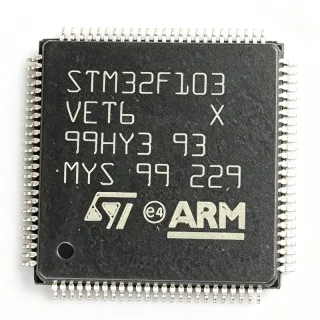
STM32F779BIT6 - 32-bit ARM Cortex-M7 MCU, 2MB Flash, 216MHz | STMicroelectronics
MPN: STM32F779BIT6 ✓ Active| Qty | Unit Price | Extended |
|---|---|---|
| 1 | $18.5 | $18.50 |
| 10 | $16.8 | $168.00 |
| 100 | $14.2 | $1,420.00 |
| 500 | $12.9 | $6,450.00 |
| 1,000 | $11.75 | $11,750.00 |
STM32F779BIT6 Overview
A microcontroller (MCU) is a compact integrated circuit designed to govern a specific operation in an embedded system. It contains a processor core, memory (Flash and SRAM), and programmable input/output peripherals. The STM32F779BIT6 belongs to the STM32F7 series, which is part of the broader STM32 family of 32-bit ARM Cortex-M microcontrollers. This family is widely used in industrial, consumer, and automotive applications due to its balance of performance, power efficiency, and peripheral integration.
Key features include a 216 MHz Cortex-M7 core with double-precision FPU, 2 MB Flash, 512 KB SRAM, and a comprehensive set of peripherals: multiple 12-bit ADCs, DACs, timers, communication interfaces (USART, SPI, I2C, CAN, USB OTG, Ethernet MAC), and advanced security features like cryptographic acceleration and true random number generator. The device also supports external memory interfaces (FMC) for SDRAM, NOR, and NAND Flash expansion.
The STM32F779BIT6 leverages the ARM Cortex-M7 architecture with a 6-stage pipeline and a branch prediction unit, delivering 2.14 CoreMark/MHz. It includes a hardware cryptographic accelerator (AES, DES, 3DES, SHA-1, SHA-256) and a true random number generator (TRNG), enhancing security for IoT and connectivity applications. The device operates from 1.7V to 3.6V supply, with multiple low-power modes (Sleep, Stop, Standby) for energy-sensitive designs.
Typical applications include industrial control systems, motor drives, IoT gateways, audio processing, and high-end consumer electronics. The rich peripheral set and high clock speed make it ideal for real-time control and signal processing tasks. The FMC interface allows seamless connection to external memory, expanding storage for data logging or graphical user interfaces.
When designing with this MCU, ensure proper decoupling of the power supply pins with 100 nF capacitors placed close to each VDD pin, and a 4.7 uF bulk capacitor. The VDDA analog supply should be filtered with a ferrite bead and 1 uF capacitor to reduce noise for ADC accuracy. The BOOT0 pin configuration must be set correctly for desired boot mode (Flash, System memory, or SRAM).
Drop-in alternatives for STM32F779BIT6 — same package, pin-to-pin compatible. Different-package parts requiring PCB rework are excluded.
Variants in this series
Same-series models that are drop-in compatible with STM32F779BIT6 (same form factor and footprint) — differing in Package, Core, Operating Temperature, SRAM, Flash Memory.
Quick Comparison Tool — Select alternative parts for side-by-side comparison:
STM32F769BIT6
✅ Drop-In✓ In Stock
$13.4 / Unit
View Datasheet →STM32F767BIT6
✅ Drop-In ⚠️ Specs Unverified✓ In Stock
$11.85 / Unit
View Datasheet →STM32F779BIT6TR
✅ Drop-In📋 Reference alternative (not in catalog)
STM32F779BIT6Q
✅ Drop-In ⚠️ Specs Unverified📋 Reference alternative (not in catalog)
STM32F746BIT6
✅ Drop-In ⚠️ Specs Unverified📋 Reference alternative (not in catalog)
STM32F779BIT6 Maximum Ratings & Electrical Characteristics
| Core | ARM Cortex-M7 |
| Core Clock Speed | 216 MHz |
| Flash Memory | 2 MB |
| SRAM | 512 KB |
| Package | LQFP208 (28x28 mm) |
| Supply Voltage | 1.7V to 3.6V |
| Operating Temperature | -40C to +85C |
| Number of I/O Pins | 168 |
| ADC Resolution | 12-bit |
| Number of ADCs | 3 |
| DAC Resolution | 12-bit |
| Number of DACs | 2 |
| Communication Interfaces | USART, SPI, I2C, CAN, USB OTG, Ethernet MAC |
| External Memory Interface | FMC (SDRAM, NOR, NAND) |
| Cryptographic Acceleration | AES, DES, 3DES, SHA-1, SHA-256 |
| Random Number Generator | TRNG |
| RoHS Status | Compliant |
STM32F779BIT6 Pin Configuration
| Pin 1 | PE2 — GPIO / FMC_A23 |
| Pin 2 | PE3 — GPIO / FMC_A19 |
| Pin 3 | PE4 — GPIO / FMC_A20 |
| Pin 4 | PE5 — GPIO / FMC_A21 |
| Pin 5 | PE6 — GPIO / FMC_A22 |
| Pin 6 | VBAT — Battery backup supply |
| Pin 7 | PC13 — GPIO / RTC_TAMP1 |
| Pin 8 | PC14 — GPIO / OSC32_IN |
| Pin 9 | PC15 — GPIO / OSC32_OUT |
| Pin 10 | PF0 — GPIO / FMC_A0 |
| Pin 11 | PF1 — GPIO / FMC_A1 |
| Pin 12 | PF2 — GPIO / FMC_A2 |
| Pin 13 | PF3 — GPIO / FMC_A3 |
| Pin 14 | PF4 — GPIO / FMC_A4 |
| Pin 15 | PF5 — GPIO / FMC_A5 |
| Pin 16 | VSS — Ground |
| Pin 17 | VDD — Power supply |
| Pin 18 | PF6 — GPIO / FMC_NWAIT |
| Pin 19 | PF7 — GPIO / FMC_NCE4 |
| Pin 20 | PF8 — GPIO / FMC_NCE3 |
Typical Applications
STM32F779BIT6 is suitable for 6 applications: Industrial Control Systems, IoT Gateways, Audio Processing, Motor Drives, Human-Machine Interface (HMI), Medical Devices.
Industrial Control Systems
The STM32F779BIT6 is ideal for industrial control systems due to its high clock speed (216 MHz) and rich peripheral set. It can handle complex control algorithms, multiple communication protocols (Ethernet, CAN, USART), and real-time data processing. The FMC interface allows connection to external SDRAM for large data buffers, and the cryptographic acceleration ensures secure communication in industrial IoT applications. The device's wide operating temperature range (-40C to +85C) and robust design make it suitable for harsh industrial environments.
Recommended
IoT Gateways
The STM32F779BIT6 is well-suited for IoT gateways that require secure connectivity and edge processing. Its Ethernet MAC and USB OTG interfaces enable wired and wireless connectivity, while the cryptographic acceleration (AES, SHA) ensures secure data transmission. The 2 MB Flash and 512 KB SRAM provide ample storage for firmware and data buffering. The device can run lightweight IoT protocols (MQTT, CoAP) and handle sensor data aggregation before sending to the cloud. Its low-power modes help reduce energy consumption in always-on gateway applications.
Recommended
Audio Processing
The STM32F779BIT6's high-performance Cortex-M7 core with FPU and DSP instructions makes it suitable for audio processing applications. It can handle real-time audio effects, voice recognition, and audio codec interfacing. The device includes multiple I2S interfaces for connecting audio codecs, and its 2 DACs can output analog audio directly. The large SRAM allows buffering of audio samples, and the high clock speed enables complex filtering algorithms. The cryptographic acceleration can be used for secure audio streaming.
Recommended
Motor Drives
The STM32F779BIT6 is excellent for motor drive applications, including BLDC, PMSM, and AC induction motors. Its 216 MHz clock enables high-frequency control loops (e.g., 20 kHz PWM), and the advanced timers provide complementary PWM outputs with dead-time insertion. The 3 ADCs can sample motor currents and voltages simultaneously for FOC (Field-Oriented Control). The device's rich peripheral set includes encoder interfaces and Hall sensor inputs. The cryptographic acceleration can secure firmware updates and communication in industrial motor drives.
Recommended
Human-Machine Interface (HMI)
The STM32F779BIT6 is suitable for HMI applications that require graphical displays and touch input. Its high clock speed and large SRAM support graphical user interfaces (GUIs) using libraries like TouchGFX or STemWin. The FMC interface can connect to external SDRAM for frame buffering, and the LTDC (LCD-TFT Display Controller) supports direct connection to TFT panels. The device includes a touch sensing controller (TSC) for capacitive touch. The cryptographic acceleration can secure firmware updates and user data.
Recommended
Medical Devices
The STM32F779BIT6 is used in medical devices such as patient monitors, infusion pumps, and diagnostic equipment. Its high performance enables real-time signal processing (ECG, EEG), and the cryptographic acceleration ensures secure patient data handling. The device's multiple ADCs and DACs interface with sensors and actuators. The wide operating temperature range and reliability make it suitable for medical environments. The FMC interface can connect to external memory for data logging.
Recommended
Recommended Products Summary
Engineering reference data for STM32F779BIT6 — comparison, design guidance, and compliance information.
Selection Guide
Comparison with Alternatives
| Parameter | This Product | STM32F769BIT6 | STM32F767BIT6 | STM32F746BIT6 |
|---|---|---|---|---|
| Package | LQFP208 | LQFP208 - same | LQFP208 - same | LQFP208 - same |
| Brand | STMicroelectronics | STMicroelectronics | STMicroelectronics | STMicroelectronics |
| Core Clock Speed | 216 MHz | 216 MHz | 216 MHz | 216 MHz |
| Flash Memory | 2 MB | 2 MB | 2 MB | 1 MB |
| SRAM | 512 KB | 512 KB | 512 KB | 320 KB |
| Cryptographic Acceleration | Yes (AES, DES, 3DES, SHA-1, SHA-256) | No | No | No |
| TRNG | Yes | No | No | No |
| Ethernet MAC | Yes | Yes | Yes | Yes |
Key Differentiators
- Hardware cryptographic acceleration (vs STM32F769BIT6)
- True Random Number Generator (TRNG) (vs STM32F767BIT6)
- Larger Flash and SRAM (vs STM32F746BIT6)
Design Notes
The STM32F779BIT6 operates from 1.7V to 3.6V. Use a 100 nF decoupling capacitor on each VDD pin and a 4.7 uF bulk capacitor on the main supply. For VDDA, add a ferrite bead and a 1 uF capacitor to filter noise for ADC accuracy. Ensure the VDD and VDDA supplies are clean and stable to prevent erratic behavior.
For the LQFP208 package, ensure proper soldering with a stencil thickness of 0.125 mm. Place decoupling capacitors as close as possible to the power pins. For high-speed interfaces like Ethernet and USB, use controlled impedance traces (e.g., 90 ohms differential for USB). Keep the crystal oscillator components close to the OSC pins and avoid routing high-speed signals near them.
Do not forget to configure the BOOT0 pin correctly. If BOOT0 is high, the device boots from system memory, which may not contain your firmware. Also, ensure the HSE crystal is properly matched with load capacitors (typically 10-20 pF). For low-power modes, configure the RTC and wakeup sources correctly to avoid unexpected resets.
Compliance Information
RoHS compliant per STMicroelectronics product page. Not AEC-Q100 qualified; for automotive use, consider STM32F779BIT6Q with extended temperature range.