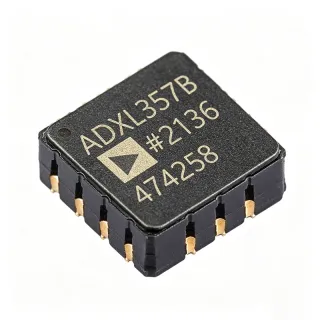
ADXL357BEZ-RL - 3-Axis Digital Accelerometer | Analog Devices
MPN: ADXL357BEZ-RL ✓ 啟用中ADXL357BEZ-RL 概覽
An accelerometer is a sensor that measures proper acceleration, which is the rate of change of velocity per unit time. The ADXL357 is a MEMS capacitive accelerometer that converts mechanical displacement into an electrical signal, which is then digitized by an onboard ADC. It belongs to the category of inertial sensors, which are essential for motion detection, vibration monitoring, and tilt sensing. The ADXL357 family includes the analog output ADXL356 and the digital output ADXL357, with the ADXL357B variant supporting additional interface options.
Key features of the ADXL357BEZ-RL include ultra-low noise density (typically 80 µg/√Hz), low 0 g offset drift over temperature, and low power consumption (typically 150 µA at 3.3V). The selectable measurement ranges allow the user to optimize resolution and dynamic range for specific applications. The device also includes an integrated temperature sensor and a 32-level FIFO buffer to reduce host processor loading.
The ADXL357 uses a MEMS capacitive sensing element with a precision analog front-end and a 20-bit digital output. The device features a programmable high-pass filter and low-pass filter, enabling flexible signal conditioning. The SPI and I2C interfaces allow easy integration with microcontrollers and digital signal processors. The 14-lead CLCC package provides a compact footprint with excellent thermal and mechanical stability.
Typical applications include structural health monitoring, condition monitoring of rotating machinery, inertial measurement units (IMUs), platform stabilization, and seismic sensing. The low noise and low drift characteristics make it suitable for precision tilt and vibration measurements. The wide bandwidth supports both static and dynamic acceleration measurements.
When designing with the ADXL357BEZ-RL, ensure proper decoupling of the power supply and careful PCB layout to minimize noise coupling. The device requires an external pull-up resistor on the I2C lines if used in I2C mode. The FIFO can be configured to reduce interrupt overhead in high-sample-rate applications.
直接替換替代品,適用於 ADXL357BEZ-RL — 相同封裝,腳位對腳位相容。需重新設計 PCB 的不同封裝零件不列入。
此系列的變體
與下列產品可直接替換的同系列型號: ADXL357BEZ-RL (相同外形與佔位) — 差異在於 0 g Offset Drift, Bandwidth, Interface, Measurement Range, Noise Density.
ADXL357BEZ
✅ 直接替換✗ 缺貨
$87.5 / 單位
查看資料表 →ADXL357BEZ-RL7
✅ 直接替換聯絡詢價
查看資料表 →ADXL357BCCZ
✅ 直接替換 ⚠️ 規格未經驗證📋 參考替代品(不在目錄中)
ADXL354BEZ
✅ 直接替換📋 參考替代品(不在目錄中)
ADXL362BCCZ
✅ 直接替換📋 參考替代品(不在目錄中)
ADXL357BEZ-RL 最大額定值與電氣特性
| Axis | X, Y, Z |
| 量測範圍 | ±10g, ±20g, ±40g (selectable) |
| Bandwidth | 1Hz ~ 1kHz |
| 介面 | SPI, I2C |
| 封裝 | 14-CLCC (6x6 mm) |
| 供應電壓 | 2.25V to 3.6V |
| Current Consumption | 150 µA (typical) |
| 雜訊密度 | 80 µg/√Hz (typical) |
| 0 g Offset Drift | 0.75 mg/°C (max) |
| Sensitivity | 2560 LSB/g (at ±10g) |
| 工作溫度 | -40°C to +125°C |
| 安裝類型 | Surface Mount |
| RoHS 狀態 | Compliant |
| FIFO | 32-level |
| Temperature Sensor | Integrated |
ADXL357BEZ-RL 腳位配置
| 腳位 1 | VDD — Power supply input (2.25V to 3.6V) |
| 腳位 2 | GND — Ground |
| 腳位 3 | SCLK/SCL — SPI clock or I2C clock |
| 腳位 4 | SDI/SDA — SPI data input or I2C data |
| 腳位 5 | SDO/ADR0 — SPI data output or I2C address bit 0 |
| 腳位 6 | CS — Chip select (active low) |
| 腳位 7 | INT1 — Interrupt output 1 |
| 腳位 8 | INT2 — Interrupt output 2 |
| 腳位 9 | NC — No connect |
| 腳位 10 | NC — No connect |
| 腳位 11 | NC — No connect |
| 腳位 12 | NC — No connect |
| 腳位 13 | NC — No connect |
| 腳位 14 | NC — No connect |
典型應用
ADXL357BEZ-RL 適用於 6 應用s: Structural Health Monitoring, Condition Monitoring of Rotating Machinery, Inertial Measurement Units (IMUs), Platform Stabilization, Seismic Sensing, Tilt Sensing and Leveling.
Structural Health Monitoring
The ADXL357BEZ-RL's low noise density of 80 µg/√Hz and wide bandwidth up to 1kHz make it ideal for detecting micro-vibrations in bridges, buildings, and other structures. Its low 0 g offset drift ensures accurate long-term measurements, while the selectable ranges allow adaptation to different vibration levels. The digital SPI/I2C interface simplifies integration with data acquisition systems, and the 32-level FIFO reduces host processor load during continuous monitoring.
推薦
Condition Monitoring of Rotating Machinery
In industrial machinery, the ADXL357BEZ-RL can detect bearing faults and imbalance by measuring vibration signatures. Its 1kHz bandwidth captures high-frequency components, and the low noise floor allows early fault detection. The device's wide temperature range (-40°C to +125°C) suits harsh environments. The SPI interface enables high-speed data streaming to an external processor for real-time analysis, and the integrated temperature sensor aids in thermal compensation.
推薦
Inertial Measurement Units (IMUs)
The ADXL357BEZ-RL is a key component in IMUs for drones, robotics, and autonomous vehicles. Its low noise and low drift provide accurate acceleration data for navigation and stabilization. The selectable ranges (up to ±40g) accommodate high-dynamic maneuvers. The digital output simplifies fusion with gyroscopes and magnetometers. The small 6x6mm CLCC package enables compact IMU designs, and the low power consumption extends battery life in portable systems.
推薦
Platform Stabilization
For camera gimbals and antenna stabilization, the ADXL357BEZ-RL provides precise tilt and vibration feedback. Its low noise density ensures smooth stabilization, and the wide bandwidth allows fast response to disturbances. The SPI interface enables high-speed control loops, while the FIFO reduces interrupt overhead. The device's low power consumption is beneficial for battery-operated gimbals, and the wide temperature range supports outdoor use.
推薦
Seismic Sensing
The ADXL357BEZ-RL's ultra-low noise (80 µg/√Hz) and low drift make it suitable for seismic monitoring applications. It can detect ground motion with high resolution, aiding in earthquake early warning systems. The wide bandwidth captures both low-frequency and high-frequency seismic waves. The digital output allows direct connection to data loggers, and the low power consumption enables remote deployment with battery power. The device's robust package withstands harsh environmental conditions.
推薦
Tilt Sensing and Leveling
The ADXL357BEZ-RL can measure static acceleration due to gravity, enabling precise tilt sensing for leveling applications. Its low 0 g offset drift (0.75 mg/°C max) ensures accurate angle measurements over temperature. The selectable ranges allow optimization for different tilt sensitivities. The I2C interface simplifies connection to microcontrollers, and the integrated temperature sensor can be used for compensation. The device's low power consumption is ideal for battery-powered leveling tools.
推薦
推薦產品摘要
工程參考資料,適用於 ADXL357BEZ-RL — 比較、設計指引及合規資訊。
選型指南
與替代品比較
| 參數 | 本產品 | ADXL357BEZ | ADXL357BEZ-RL7 | ADXL354BEZ | ADXL362BCCZ |
|---|---|---|---|---|---|
| Package | 14-CLCC (6x6 mm) | 14-CLCC (6x6 mm) | 14-CLCC (6x6 mm) | 14-CLCC (6x6 mm) | 14-CLCC (6x6 mm) |
| Brand | Analog Devices | Analog Devices | Analog Devices | Analog Devices | Analog Devices |
| Output Type | Digital (SPI/I2C) | Digital (SPI/I2C) | Digital (SPI/I2C) | Analog | Digital (SPI) |
| Measurement Range | ±10g, ±20g, ±40g | ±10g, ±20g, ±40g | ±10g, ±20g, ±40g | ±2g, ±4g, ±8g | ±2g, ±4g, ±8g |
| Noise Density | 80 µg/√Hz | 80 µg/√Hz | 80 µg/√Hz | 20 µg/√Hz | 175 µg/√Hz |
| Supply Voltage | 2.25V to 3.6V | 2.25V to 3.6V | 2.25V to 3.6V | 2.25V to 3.6V | 1.6V to 3.5V |
| Current Consumption | 150 µA | 150 µA | 150 µA | 150 µA | 1.8 µA (measurement mode) |
| Bandwidth | 1Hz to 1kHz | 1Hz to 1kHz | 1Hz to 1kHz | 1Hz to 1kHz | 0.1Hz to 400Hz |
主要差異化特點
- Selectable measurement ranges up to ±40g (對比ADXL354BEZ)
- Digital output with SPI/I2C interface (對比ADXL354BEZ)
- Lower noise density than ADXL362 (對比ADXL362BCCZ)
設計說明
The ADXL357BEZ-RL operates from 2.25V to 3.6V. Use a low-noise LDO such as the ADP150 to supply the sensor, and place a 0.1µF and 1µF decoupling capacitor close to the VDD pin. Avoid sharing the supply with high-current digital circuits to prevent noise coupling.
For optimal performance, place the accelerometer on a rigid PCB section away from flexural stress. Use a solid ground plane under the device and route the SPI/I2C lines with controlled impedance if long. Ensure the CLCC package's exposed pad is soldered to the ground plane for thermal and mechanical stability.
Do not exceed the absolute maximum supply voltage of 3.6V. When using I2C, ensure pull-up resistors are connected to the correct voltage level. The FIFO can be configured to reduce interrupt load; set the watermark level appropriately to avoid data loss. Also, calibrate the 0 g offset at the system level for best accuracy.
合規資訊
RoHS compliant per Analog Devices product page. Not AEC-Q100 qualified; for automotive, consider ADXL357BCCZ.