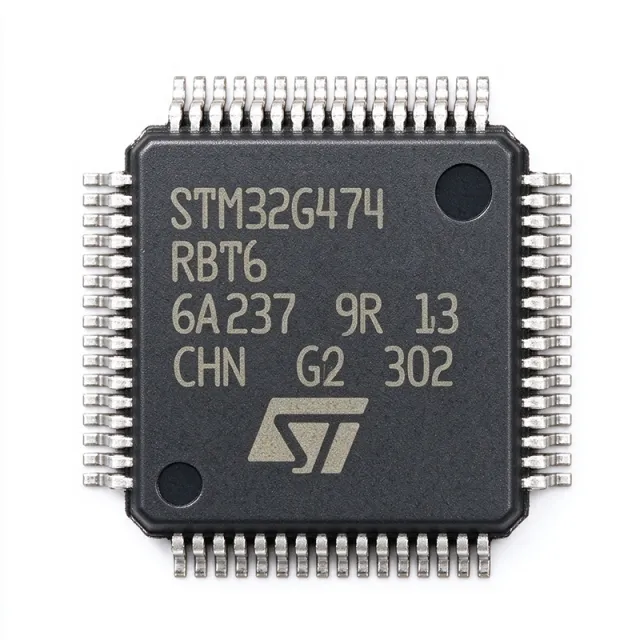
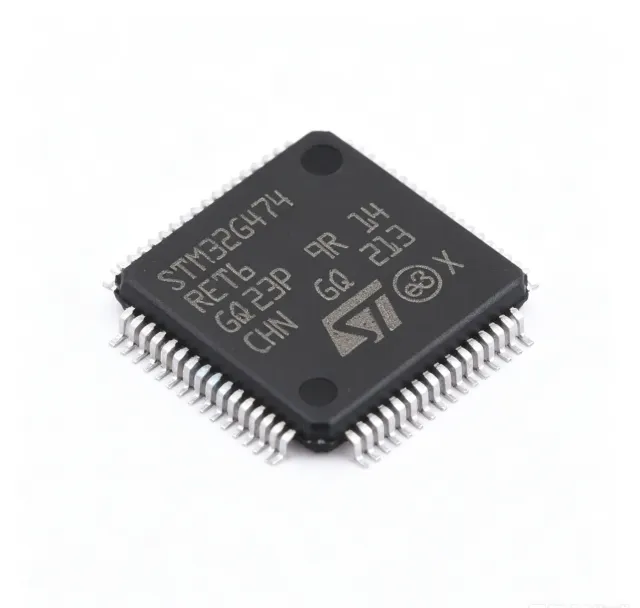
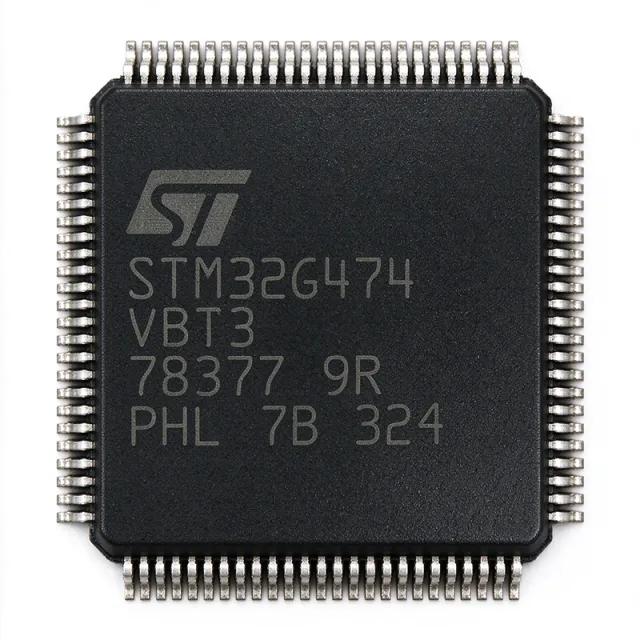
STM32G474VEH6
STM32G474VEH6 - 170MHz Cortex-M4F MCU | STMicroelectronics
The STMicroelectronics STM32G474VEH6 is a 32-bit Arm Cortex-M4F microcontroller with a 170 MHz maximum operating frequency, 512 KB of embedded Flash memory, and 128 KB of SRAM in a 100-TFBGA (8x8 mm) package. It combines the Cortex-M4F processor with high-performance analog peripherals, math accelerator, 12-channel high-resolution timers, and extensive general-purpose I/O. The device is positioned for industrial control, motor drive, power conversion, communications, and embedded measurement systems.
A microcontroller is a programmable system-on-chip that integrates a CPU core, nonvolatile program memory, volatile working memory, peripherals, and communication interfaces. The STM32G4 family combines the STM32 architecture with a high-performance Cortex-M4 core and advanced mixed-signal resources. This combination allows one device to control digital logic while acquiring, converting, and regulating analog signals.
The STM32G474VEH6 operates at up to 170 MHz and is stated at 213 DMIPS in the verified manufacturer result. Its 512 KB Flash provides application code, firmware, and boot software, while 128 KB SRAM supports working state, buffers, communications frames, and control algorithms. The verified sources identify 86 I/O, a 184 ps 12-channel high-resolution timer capability, rich analog resources, and a math accelerator.
The 100-TFBGA package is intended for compact surface-mount designs where fine-pitch routing and board-space optimization are important. Compared with a leaded package, TFBGA requires careful PCB land-pattern design, fine-pitch assembly capability, and adequate thermal design. The STM32G474VEH6 is therefore appropriate for compact industrial, automotive-adjacent, and high-performance embedded platforms where analog control and real-time processing are important.
Typical applications include digital power supplies, motor-control systems, industrial automation, communications gateways, sensor acquisition platforms, and embedded measurement instruments. The timer, analog, math, and connectivity resources can reduce the need for separate support devices when the system architecture is designed around the STM32G4 feature set.
Design attention should focus on decoupling, clock stability, analog reference conditioning, high-resolution timer inputs, thermal behavior, and fine-pitch PCB assembly. Use the manufacturer datasheet and package drawing as the authoritative references for pin multiplexing, alternate functions, electrical limits, and land pattern.
This page consolidates verified manufacturer and distributor information, comparison fields, application guidance, and sourcing references so engineers can identify whether the STM32G474VEH6 fits a compact high-performance embedded design.
RFQ
Contact