Amplifier ICs
بەرهەمەکان (3,200+)

MC33178D - Low-Power Low-Noise Dual Op Amp | onsemi
onsemi MC33178D is a low-power, low-noise dual operational amplifier designed for audio and data-signal processing applications. It is a monolithic bipolar amplifier using high-frequency PNP input transistors, an architecture selected to provide low input offset voltage, low noise, and low distortion. The device is offered in an 8-pin SOIC package and contains two amplifier circuits, allowing it to support common signal-conditioning tasks in compact analog designs. An operational amplifier is a voltage-amplifying component that uses negative feedback to create controlled gain, filtering, buffering, and signal-conditioning functions. The dual-amplifier configuration places two amplifiers in one package, reducing board area and simplifying designs that require two related channels. Within the broader semiconductor hierarchy, MC33178D belongs to the operational-amplifier family, which is part of the wider analog integrated-circuit and signal-processing categories. The MC33178/9 family combines bipolar transistor implementation with PNP input devices and an NPN output stage. This combination is particularly relevant to audio and general-purpose data processing because the input architecture is intended to reduce offset and distortion while maintaining a practical low-noise operating approach. Its dual-channel organization also makes the device applicable to small-signal amplification, filtering, buffering, and related analog front-end functions. The part can be used where two amplifier channels are needed at the same signal level or operating condition. Typical use cases include audio signal conditioning, low-level sensor amplification, active filtering, buffering, and general analog signal processing. The low-noise characteristic makes it relevant to designs in which the amplifier must preserve a small input signal without adding substantial unwanted noise, while the low-distortion architecture supports cleaner waveform reproduction. When designing around MC33178D, begin by confirming the required input common-mode range, output swing, gain-bandwidth behavior, input offset voltage, input bias current, and supply-current limits against the manufacturer datasheet. Decoupling capacitors should be placed close to the supply pins, and sensitive-input routing should avoid nearby switching nodes and high-current return paths. This page combines the manufacturer family information with package, sourcing, comparison, and design guidance to support initial component evaluation and PCB planning. MC33178D is therefore suited to engineers seeking a compact, dual-channel, low-power bipolar op amp for audio or data-signal processing. Its strongest differentiators are the combined low-noise and low-distortion architecture, dual amplifier integration, and 8-pin SOIC implementation. Confirm the exact electrical limits and environmental ratings for the finished design before release to production.

MC33178PG - Dual Low-Power Low-Noise Op Amp | onsemi
The onsemi MC33178PG is a dual, bipolar operational amplifier packaged in an 8-pin PDIP. It operates from 2 V to 18 V, is intended for low-power industrial signal-processing applications, and offers a gain-bandwidth product of 5 MHz. The device uses high-frequency PNP input transistors to provide low input offset voltage, low noise, and low distortion. An operational amplifier is a high-gain analog signal-conditioning component used in instrumentation, audio, and data-processing circuits. It compares an input signal with a feedback reference to amplify voltage differences. Within the broader semiconductor hierarchy, the MC33178PG belongs to the operational-amplifier, analog-amplifier, and signal-conditioning IC families. The MC33178 family combines two amplifiers in one package, reducing board area for dual-channel designs. Its bipolar construction supports low-noise analog signal handling, while the PNP input stage is intended to improve offset voltage and distortion performance. The manufacturer identifies the family for quality audio and data-signal-processing applications. The MC33178PG operates from 2 V to 18 V, making it suitable for low-voltage industrial systems as well as conventional dual-supply analog circuits. A typical dual op-amp layout uses pins 1 and 7 as outputs, pins 2 and 6 as inverting inputs, pins 3 and 5 as non-inverting inputs, and pins 4 and 8 as the negative and positive supplies. Typical applications include audio preamplification, low-level sensor conditioning, active filtering, instrumentation, and general-purpose analog signal processing. When operating from a single supply, the input and output signal levels must remain within the input common-mode range and output swing limits specified by the manufacturer datasheet. For stable operation, follow the datasheet requirements for bypassing the positive supply and configure feedback so that the required noise gain and closed-loop bandwidth remain compatible with the intended signal path. Avoid placing input and output traces beside unrelated high-current switching nodes to reduce coupling. This page combines the manufacturer's device description with application-oriented guidance, pin organization, package information, and a conservative replacement comparison. It also identifies which drop-in alternatives have documented package compatibility and where final electrical verification remains necessary before a substitution is approved.

MC33179PG - 5 MHz Quad Low-Power Op Amp | onsemi
The onsemi MC33179PG is a quad, general-purpose operational amplifier designed for low-power audio and data-signal processing, with four amplifiers in a 14-pin DIP package. Its headline characteristics are a 5 MHz gain-bandwidth product, a 2 V to 18 V supply-voltage range, and a 14-PDIP through-hole package. The device is specified for industrial-temperature operation and combines bipolar input stages with a low-noise, low-power design intended for audio preamplification, active filtering, instrumentation, and general analog signal conditioning. An operational amplifier is an analog building block that uses high open-loop gain and negative feedback to amplify the difference between two input voltages. The MC33179PG belongs to the operational-amplifier hierarchy, where a general-purpose quad amplifier provides four independent amplifiers in one package. Placing four amplifiers in a single 14-pin DIP reduces component count and simplifies PCB assembly in designs that require several matched signal-conditioning channels. Key features include a 5 MHz gain-bandwidth product, a 2 V to 18 V operating supply range, and low-noise bipolar input characteristics. The quad configuration permits four independent amplifier sections with a shared positive and negative supply. This makes the MC33179PG appropriate for audio mixer stages, active low-pass and band-pass filters, sensor-conditioning circuits, and small-signal buffers. Its through-hole package also remains convenient for prototypes, educational designs, repair work, and manually assembled industrial control boards. The MC33179 family uses high-frequency PNP input transistors to obtain a combination of low noise and improved transient response compared with conventional bipolar amplifier inputs. This architecture is useful when a design must recover small signals cleanly while remaining within a modest power budget. Because the amplifiers share package leads for supply voltage, the board layout should treat the power pins as high-current nodes and provide a low-impedance return path to the decoupling capacitors. Typical applications include four-channel audio preamplification, active crossover and equalization networks, instrumentation amplifiers built from discrete sections, sensor signal conditioning, and general-purpose industrial control interfaces. The 14-pin DIP footprint is especially useful where through-hole assembly is preferred over fine-pitch surface-mount assembly. Designers should verify noise, offset, bias-current, output-swing, and stability requirements against the actual signal amplitude and source impedance. When laying out the MC33179PG, place the supply bypass capacitor close to pins 4 and 11 and route the ground return directly to the device ground pin. Keep feedback-loop components compact to minimize parasitic capacitance and oscillation risk, especially when the closed-loop gain is high. Decouple each signal source locally where practical so that input and output currents do not share long current paths on the board. This page consolidates the MC33179PG electrical identity, verified package and sourcing details, drop-in replacement analysis, and practical analog-layout guidance. It is intended to help engineers move quickly from device selection to schematic capture, PCB layout, and legacy-board redesign while remaining mindful of the part's through-hole package and amplifier-level trade-offs.
MC33201D - 12V Rail-to-Rail Operational Amplifier | onsemi
The onsemi MC33201D is a single-circuit, low-voltage, rail-to-rail input and output operational amplifier packaged in an 8-pin SOIC. It operates from a maximum 12 V supply, accepts input voltages up to 200 mV beyond either supply rail without output phase reversal, and produces an output that can swing to within 50 mV of each rail. These characteristics allow analog signals to use nearly the complete supply-voltage range. A rail-to-rail operational amplifier is an analog signal-conditioning amplifier whose input common-mode range and output voltage range extend close to the positive and negative supply rails. In the broader semiconductor hierarchy, an operational amplifier belongs to the amplifier IC and analog signal-processing categories. It can amplify sensor signals, buffer high-impedance sources, compare voltages, or integrate feedback networks around a single analog signal path. The MC33201D combines rail-to-rail input operation with low-noise, high-output-drive characteristics. Its input stage accepts common-mode signals beyond the nominal supply rails by as much as 200 mV without reversing the output polarity. Its output stage can approach each supply rail within 50 mV, improving usable output swing in low-voltage systems where conventional fixed-range amplifiers leave little headroom. The device is designed for low-voltage analog systems in which common-mode and output range are more important than using a larger, higher-voltage amplifier. Rail-to-rail behavior is particularly useful when a sensor output can move close to a low supply rail, when an ADC or DAC must be driven near the end of its input range, or when a bipolar signal must be handled with a single positive supply. The manufacturer documentation identifies the MC33201, MC33202, MC33204, NCV33201, NCV33202, and NCV33204 as members of the same operational-amplifier family. Typical uses include portable instrumentation, sensor interfaces, low-voltage audio paths, ADC input conditioning, current monitoring, and general-purpose signal amplification. In each case, the designer should verify input bias current, offset voltage, bandwidth, output-current capability, noise, stability, and operating-temperature limits against the manufacturer datasheet before fixing the circuit. The most important design consideration is to preserve the amplifier's stability and rail-to-rail performance. Keep feedback components close to the device, avoid excessive capacitive loading on the output, and account for common-mode behavior in the region where the input stage transitions between internal transistors. Decoupling capacitors should be connected directly between each supply pin and the appropriate ground reference. This product record combines the manufacturer family information with package, function, commercial, comparison, and application guidance. It also identifies same-footprint family options for designs that can tolerate their different input-offset characteristics, while making clear that final substitution requires electrical verification in the target circuit.
MC33201PG - 2.2MHz Rail-to-Rail Op Amp | onsemi | DIP-8
The onsemi MC33201PG is a single-amplifier, low-voltage rail-to-rail operational amplifier with a 2.2 MHz gain-bandwidth product, 1 V/µs slew rate, and a 1.8 V to 12 V supply range in an 8-pin plastic DIP package. Designed for general-purpose signal conditioning, the device combines rail-to-rail input and output operation with operation over a -40°C to +105°C temperature range. An operational amplifier, or op amp, is an analog signal-conditioning semiconductor that amplifies the voltage difference between its inverting and non-inverting inputs. Within the broader hierarchy of analog semiconductors, the MC33201PG belongs to the voltage-feedback operational-amplifier family and provides a practical combination of low supply voltage, moderate bandwidth, and wide input and output swing. It is suitable for systems that need useful signal amplification without requiring the noise, offset, or power characteristics of a precision amplifier. The rail-to-rail input stage can accept signals as much as 200 mV beyond the supply rails without phase reversal at the output. Rail-to-rail output operation allows the output voltage to approach both supply rails, with the output swinging within approximately 50 mV of each rail. These characteristics make the amplifier useful in low-voltage sensor interfaces, battery-powered instrumentation, and control systems where available signal range is limited by the supply voltage. With a 2.2 MHz gain-bandwidth product and 1 V/µs slew rate, the MC33201PG is intended for general-purpose signal processing rather than high-speed video or precision measurement. Its single-amplifier configuration reduces board requirements where only one signal path is needed, while the 8-pin DIP format supports through-hole assembly, prototyping, educational platforms, and repair of legacy equipment. Typical applications include low-voltage sensor buffering, portable measurement systems, audio preamplifier stages, motor and actuator control interfaces, and general feedback networks. The 1.8 V minimum supply supports modern low-voltage systems, while the 12 V maximum provides flexibility across industrial and consumer rails. The -40°C to +105°C operating range also supports industrial temperature requirements when other system parameters, such as offset and bias current, are acceptable. PCB layout should keep feedback traces short, connect decoupling capacitors close to the supply pins, and route sensitive input nodes away from switching-current paths. Because a DIP package provides generous lead spacing, it is mechanically convenient for prototyping, but through-hole devices occupy more board area than comparable surface-mount packages. Engineers upgrading an existing MC33201PG design should preserve the established pin connections and account for the device's finite input and output swing limits. This product page combines the manufacturer's electrical characteristics with engineering-oriented application guidance, pin information, comparison criteria, and practical layout considerations. It is intended to help designers evaluate the MC33201PG for low-voltage general-purpose amplification without confusing rail-to-rail capability with precision or high-speed performance.
MC33201VD - 2.2MHz Rail-to-Rail Op Amp | onsemi | SOIC-8
onsemi MC33201VD is a single-circuit, general-purpose rail-to-rail operational amplifier with a 1.8 V to 12 V supply range, 2.2 MHz gain-bandwidth product, and 1 V/µs slew rate, housed in an 8-pin SOIC package. Its input stage can operate 200 mV beyond either supply rail without output phase reversal, while the output can swing to within 50 mV of the rails. A rail-to-rail operational amplifier is an analog amplifier whose input and output voltage ranges extend close to the positive and negative supply rails. It belongs to the operational amplifier hierarchy within analog and signal-processing ICs, making it useful when a low-voltage system cannot support conventional amplifiers whose inputs and outputs remain farther from the supply limits. The MC33201 family is designed to preserve usable signal range in compact, single-supply equipment. The principal operating characteristics include a 1.8 V to 12 V supply-voltage range, 2.2 MHz gain-bandwidth product, and 1 V/µs slew rate. Rail-to-rail input and output operation allows more of the available supply voltage to be used for signal conditioning. The input can be driven 200 mV beyond the supply rails without phase reversal, helping the amplifier tolerate overdrive near the rail limits. Output swing is specified to remain within 50 mV of each rail under the stated conditions. The MC33201 is a single amplifier with one noninverting input, one inverting input, and one output. Its 8-pin SOIC package provides a conventional small-surface-mount implementation for analog boards. The combination of low minimum supply voltage, broad rail-to-rail coverage, and moderate bandwidth supports general-purpose amplification, current-voltage conversion, sensor conditioning, and filtering. These characteristics make it more appropriate for low-to-moderate frequency precision analog stages than for high-speed signal chains. Typical applications include portable sensor interfaces, battery-powered instrumentation, low-voltage control systems, transducer signal conditioning, and audio input stages. The amplifier can operate from a 1.8 V supply, which is useful for energy-efficient systems with limited rail headroom. Its 2.2 MHz gain-bandwidth product allows moderate closed-loop bandwidth at practical gains, while the 1 V/µs slew rate supports responsive changes to waveforms within that bandwidth limit. The principal design tradeoff is the relationship between bandwidth, supply voltage, output load, and stability. Place the device close to the feedback network and supply bypass components, keep feedback traces short, and verify the configuration against the manufacturer’s recommended compensation methods. The VD ordering code is associated with an 8-pin SOIC package, but production-temperature, tape-and-reel, and orderable-package details should be confirmed against the current onsemi product record before release. This page organizes the MC33201VD operating envelope, verified alternatives, package and pin information, cross-reference comparisons, and practical application guidance. It also distinguishes electrical limits from package-ordering details so engineers can assess board compatibility, bandwidth, supply headroom, and thermal or sourcing constraints before selecting the amplifier.
MC33202D - Dual Rail-to-Rail Op Amp | onsemi
The onsemi MC33202D is a dual rail-to-rail operational amplifier designed for low-voltage operation from 1.8 V to 12 V, supplied in an 8-pin SOIC package. The MC33202D contains two amplifier channels, supports rail-to-rail operation at both the input and output stages, and is specified for an ambient temperature range of -40°C to +105°C. These characteristics position it for compact, low-voltage signal-conditioning systems requiring one package to implement two analog channels. An operational amplifier is an analog integrated circuit that compares an input signal with a feedback-defined reference and amplifies the difference between them. In the broader hierarchy, the MC33202D belongs to the operational-amplifier class, then to the amplifier-IC category, and ultimately to the semiconductor and signal-processing markets. Rail-to-rail input operation allows the input common-mode range to extend toward the supply rails, while rail-to-rail output operation improves dynamic range when the output must approach either supply limit. The primary headline features are the 1.8 V to 12 V supply range, dual-channel configuration, and rail-to-rail input and output capability. The 8-pin SOIC package provides a conventional surface-mount footprint suitable for standard PCB assembly methods. Its -40°C to +105°C temperature range makes it relevant to industrial, instrumentation, communications, and consumer applications that require operation across an extended temperature span. MC33202D belongs to the MC33201/MC33202/MC33204 family of low-voltage, rail-to-rail operational amplifiers. The family architecture is intended for low-voltage analog systems in which signal levels may occupy much of the available supply range. Because the device is supplied in a dual amplifier configuration, a complete two-channel circuit can be implemented without selecting two separate single-channel packages, reducing board area and simplifying component procurement. Typical applications include sensor-signal conditioning, low-voltage audio and communications paths, transducer amplification, general-purpose voltage amplification, and dual-channel filtering or feedback networks. For instrumentation applications, the rail-to-rail input characteristic can reduce the need for additional mid-supply biasing when signals vary over a broad range. In communications systems, the low operating voltage can simplify compatibility with modern low-voltage supply rails. Design the surrounding decoupling, input common-mode range, output load, and stability network carefully. Place the power-bypass capacitor close to the supply pins, maintain the device within its specified supply-voltage and temperature limits, and verify the intended feedback topology across the required signal bandwidth. The manufacturer datasheet should be used as the controlling reference for electrical characteristics, limit values, and test conditions. This page organizes the MC33202D datasheet information, pin-compatible replacement candidates, package details, and engineering guidance in a form that helps designers evaluate the amplifier, compare drop-in options, and plan an 8-pin SOIC implementation without relying on generic amplifier-selection advice.
MC33202PG - 2.2 MHz Dual Rail-to-Rail Op Amp | onsemi
onsemi MC33202PG is a dual, low-voltage, rail-to-rail input and output operational amplifier with a 2.2 MHz gain-bandwidth product, 1 V/µs slew rate, and a 1.8 V to 12 V supply range in an 8-pin PDIP package. The device supports industrial-temperature operation from -40 °C to 105 °C and provides two amplifier circuits in one package. An operational amplifier is an analog signal-processing IC that amplifies the voltage difference between its non-inverting and inverting inputs. The MC33202PG belongs to the rail-to-rail operational-amplifier family, combining input and output common-mode capability with low-voltage operation. This places it within the broader hierarchy of analog ICs, signal-conditioning ICs, amplifiers, and general-purpose operational amplifiers. Rail-to-rail input operation allows the input voltage to approach either supply rail. According to the onsemi datasheet, inputs can be driven as high as 200 mV beyond the supply rails without causing phase reversal in the outputs. Rail-to-rail output operation allows each output to swing within approximately 50 mV of its corresponding rail, improving output range utilization in low-voltage systems. The MC33202PG combines a 2.2 MHz gain-bandwidth product with a 1 V/µs slew rate. These values make it suitable for general-purpose signal amplification, low-voltage analog interfaces, and feedback-control circuits where operating from a single 1.8 V supply is useful. Its dual configuration can reduce board area when two independent amplifier channels are required. Typical uses include sensor-interface amplification, audio and communication signal conditioning, voltage buffering, active filtering, and industrial control-system analog sections. The 1.8 V minimum supply supports portable and embedded systems, while the -40 °C to 105 °C temperature range supports industrial environments when the complete system is qualified for the intended conditions. Designers should verify input and output limits under the selected supply voltage and load current. Input and output stability should be evaluated with the actual source impedance, feedback network, load, and bypass capacitance. Because this is a through-hole PDIP device, its larger footprint must be considered when replacing it with surface-mount alternatives. This product summary combines the MC33202PG electrical ratings, package information, pin assignment, practical application guidance, and qualified same-footprint replacement information. The alternatives are restricted to devices presented as pin-to-pin compatible rather than merely similar amplifiers, helping engineers identify a practical migration path without implying electrical identity.
MC33202VD - Dual Rail-to-Rail Op Amp | onsemi | 8-SOIC
The onsemi MC33202VD is a dual, general-purpose operational amplifier with rail-to-rail input and output operation, a 1.8 V to 12 V supply range, and an 8-pin SOIC package. According to the onsemi MC33202 family description, each input may be driven as far as 200 mV beyond the supply rails without phase reversal at the output, while the output can swing within 50 mV of either rail. The device is intended for low-voltage, low-power signal-conditioning systems that need broad input and output voltage coverage. An operational amplifier, commonly called an op amp, is a high-gain analog building block used in amplifier, comparator, buffer, filtering, and feedback-control circuits. The MC33202 belongs to the operational-amplifier hierarchy, where rail-to-rail input and output capability broadens the usable signal range in low-voltage systems. Two amplifiers are integrated into each package, allowing compact designs with two independent analog channels. The principal features are dual-channel construction, input common-mode operation beyond the supply rails, near-rail output swing, and operation from 1.8 V to 12 V. Input overdrive tolerance of 200 mV is particularly useful in sensor, filter, and feedback applications where signals may briefly approach or cross a rail. The 50 mV output-swing specification also allows a large portion of the available supply voltage to be used by downstream circuitry. The MC33202 family is designed for very low supply voltages, making rail-to-rail behavior more relevant than the input and output ranges of conventional non-rail-to-rail amplifiers. The family provides rail-to-rail operation at both inputs and outputs. This architecture supports signal amplification when the input is close to either supply rail and improves output headroom when driving the next stage near the positive or negative limit. Typical applications include low-voltage sensor interfaces, battery-powered analog measurement, audio signal conditioning, active filtering, instrumentation, and general-purpose dual-amplifier modules. Two channels can be used for instrumentation-amplifier input stages, active filters, differential signal conditioning, or separate gain and buffer functions when the circuit operates within the device's common-mode and output limits. PCB design should prioritize short analog input paths, clean grounding, and stable supply bypassing. Place the input and output resistors close to their associated amplifier pins, route high-impedance sensor nodes away from switching nodes, and decouple the supply connection near the package. Because rail-to-rail input stages commonly use internal crossover transitions, input bias-current and offset behavior should be evaluated over the complete signal range rather than only near mid-supply. This page combines the manufacturer family characteristics, package information, sourcing guidance, practical design considerations, and pin-compatible replacement options. It also identifies where channel-level electrical data should be confirmed in the manufacturer datasheet before a production design or PCB release.
MC33204P - Quad Rail-to-Rail 1.8V Op Amp | onsemi
onsemi MC33204P is a four-circuit rail-to-rail operational amplifier designed for low-voltage signal conditioning and general-purpose analog systems. It operates from 1.8 V to 12 V and is packaged in a 14-pin plastic dual in-line package. The quad configuration provides four amplifiers in one device, reducing board area and simplifying designs that require several matched low-voltage signal stages. Rail-to-rail input and output operation allows the amplifier to use most of the available supply voltage. An operational amplifier is an analog integrated circuit that uses high-gain differential feedback to amplify small voltage differences between its inputs. The MC33204P belongs to the MC33201/MC33202/MC33204 family of low-voltage rail-to-rail amplifiers. Its differential input stage supports input voltages that may extend beyond the supply rails, while the output stage can approach both rails. This makes it useful where signal levels occupy a significant portion of the supply range. According to the onsemi product page, inputs can be driven as high as 200 mV beyond the supply rails without phase reversal on the outputs, and the output can swing within 50 mV of each rail. These figures are particularly useful when designing from a 1.8 V or 3.3 V rail. The four-amplifier arrangement supports independent gain stages, sensor interfaces, filters, comparators, and active feedback networks without requiring four separate packages. The common-mode input range is a defining feature of this amplifier family. Rail-to-rail input behavior lets a sensor output remain in the usable input range even when it approaches a supply rail. Output swing close to the rails increases the available dynamic range and can reduce the need for an additional output-biasing stage. Designers must still verify signal levels, output-load conditions, stability, and gain bandwidth for the selected operating point. Typical uses include portable sensor interfaces, industrial control and instrumentation, battery-powered monitoring, low-voltage data acquisition, active filters, and general analog signal conditioning. The quad package is particularly suitable when four similar amplifier functions are required. It can also support mixed functions, such as one buffer, two gain stages, and one comparator, although each channel's loading and stability requirements should be evaluated independently. For layout, route input and feedback connections away from output and supply paths to reduce coupling. Place bypassing capacitors close to the supply pins and maintain the feedback network close to the amplifier. Confirm the gain-bandwidth product and stability requirements for the intended closed-loop gain, especially when driving capacitive loads or operating with long PCB traces. This page combines the manufacturer specifications, package information, cross-reference findings, application guidance, and engineering trade-offs needed to evaluate the MC33204P for a new analog design. It also highlights where the quad pin-compatible LM348 may be considered and where its rail-to-rail performance must be checked before substitution.
MC33204PG - Quad Rail-to-Rail Op Amp | onsemi
The onsemi MC33204PG is a quad general-purpose operational amplifier with rail-to-rail input and output operation in a 14-pin PDIP package. It provides four amplifiers per device, a 2.2 MHz gain-bandwidth product, and a 1 V/us slew rate. The MC33204 operates from 1.8 V to 12 V, making it suitable for low-voltage battery-powered, industrial control, sensor-conditioning, and general signal-processing systems. An operational amplifier is an analog integrated circuit that amplifies the voltage difference between its inverting and non-inverting inputs. A rail-to-rail input amplifier accepts common-mode input voltages close to the positive and negative supply rails, while a rail-to-rail output amplifier can swing its output close to those rails. This expands the usable input and output range compared with conventional fixed-range amplifiers, especially when the supply voltage is only a few volts above the signal amplitude. The MC33204 family combines four amplifiers in one package, reducing board area and simplifying multi-channel designs where identical amplifier performance is useful. Its inputs may be driven approximately 200 mV beyond the supply rails without phase reversal at the outputs. The output can swing to within approximately 50 mV of either rail. A gain-bandwidth product of 2.2 MHz supports signal bandwidths suitable for audio, instrumentation, filtering, and feedback-control circuits. The 1 V/us slew rate provides practical full-power-bandwidth capability for low- and mid-frequency analog signals. The device is intended for general-purpose amplification rather than high-speed precision applications, so input offset voltage, input bias current, noise density, and stability characteristics should be reviewed against the precision required by each circuit. Decoupling capacitors should be placed close to the supply pins to control impedance in feedback networks and prevent oscillation. Typical uses include low-voltage sensor interfaces, current-to-voltage conversion, active filtering, audio summing stages, joystick and touch inputs, and general instrumentation. Because the MC33204PG contains four matched-function amplifiers in one PDIP package, it is especially useful where a design needs several channels of similar gain, bandwidth, and output-drive capability. When designing with the MC33204, verify that the signal and output ranges remain within the rail limits at the lowest operating supply voltage. Check the required common-mode range for sensor outputs and confirm that capacitive loads connected to the output remain inside the stable operating region. Use the pin-description table in the onsemi MC33204 datasheet when assigning PCB tracks. This page combines the manufacturer product information with ordering details, drop-in replacement analysis, application guidance, and practical design notes. It helps engineers evaluate the MC33204PG for low-voltage analog signal chains while keeping package, sourcing, and circuit-integration considerations in one place.
MC33272AP - Dual 24 MHz Low-Offset Op Amp | onsemi
onsemi MC33272AP is a dual, general-purpose operational amplifier with a 24 MHz gain-bandwidth product, 10 V/µs slew rate, and low input-offset voltage, housed in an 8-pin plastic DIP package. It operates from 3 V to 36 V and uses bipolar input circuitry with Zip-R-Trim offset adjustment. The two amplifiers in the package are independently usable in conventional inverting, non-inverting, differential, active-filter, and instrumentation circuits. An operational amplifier is a voltage-controlled differential amplifier whose inverting and non-inverting inputs are compared to produce an amplified output. Within the amplifier hierarchy, the MC33272AP belongs to the bipolar operational-amplifier family and provides a general-purpose combination of precision input characteristics, wide bandwidth, and high slew rate. It is a voltage-feedback device suitable for signal conditioning, feedback control, analog signal processing, and test equipment. The primary performance features include a 24 MHz gain-bandwidth product, 10 V/µs slew rate, and low input-offset voltage. These characteristics allow the device to handle signals extending well beyond audio-band requirements while retaining the low-offset behavior sought in instrumentation and feedback applications. Wide operating-voltage support also permits use in industrial systems operating from 3 V through 36 V, subject to the absolute maximum ratings and common-mode limitations specified by the manufacturer. The bipolar input architecture and patented Zip-R-Trim element distinguish the MC33272 from simpler general-purpose amplifiers. Input-offset adjustment improves matching between closely related amplifier channels, which is useful in differential measurement paths where offset error can otherwise become a significant part of the total error budget. The dual-doublet frequency-compensation architecture supports stable operation in typical feedback networks without requiring the precision associated with more specialized instrumentation amplifiers. Typical uses include low-level sensor conditioning, current-loop receivers, active filters, audio and communication-signal stages, sample-and-hold buffers, and laboratory control circuits. The 10 V/µs slew rate is particularly useful for waveform and pulse paths, while the 24 MHz bandwidth allows the amplifier to operate effectively above audio frequencies. In closed-loop designs, actual bandwidth depends on the selected noise gain, feedback network, load, and device stability requirements. When designing an MC33272AP circuit, verify common-mode input range, output swing, output-current capability, and noise-gain stability against the manufacturer datasheet for the actual supply voltage. Keep feedback traces short, place compensation or decoupling components close to the relevant pins, and avoid loading the output beyond its specified limits. Input-bias-current errors and resistor-generated noise should also be included in the overall accuracy calculation. This page combines manufacturer specifications, package details, drop-in alternatives, application guidance, and parameter-by-parameter engineering comparisons. It is structured to help engineers identify the appropriate replacement, plan the PCB footprint, and evaluate whether the 24 MHz bandwidth and 10 V/µs slew rate meet the requirements of a particular analog signal chain.
MC33502DG - Dual 1V Rail-to-Rail Op Amp | onsemi
The onsemi MC33502DG is a dual, general-purpose operational amplifier with rail-to-rail input and output operation, a 1.0 V minimum supply voltage, and operation from 1 V to 7 V. The device is packaged in an 8-pin SOIC and is specified for an industrial operating temperature range of -40 °C to +105 °C. Its two amplifier channels can operate independently, making it suitable for compact dual-signal conditioning, buffering, and low-voltage analog systems. An operational amplifier is a high-gain analog signal-conditioning circuit used in the wider hierarchy of analog ICs, signal-chain components, and semiconductor devices. The MC33502DG combines differential input amplification, voltage feedback, and output-drive capability in two channels. Rail-to-rail inputs let the amplifier operate across nearly the complete input supply range, while rail-to-rail outputs improve signal swing when the available supply voltage is limited. Key characteristics include a 1.0 V operating supply, a 7 V maximum supply, dual-channel configuration, and output swing within 50 mV of either supply rail. These characteristics suit portable equipment, battery-powered instrumentation, sensor interfaces, and low-voltage industrial controls where the signal must be amplified without a high-voltage supply. The 8-SOIC package also supports conventional surface-mount assembly and automated board production. The MC33502 architecture is intended for low-voltage rail-to-rail operation. Under a 1.0 V supply and ground, the amplifier can still operate, while its input and output stages use the available supply range. Because the output remains approximately 50 mV from either rail, designers should leave this margin when calculating the usable output range. The dual configuration also reduces package count when two similar amplifier functions are required on the same board. Typical applications include battery-powered sensor conditioning, low-voltage audio and communication interfaces, current sensing, portable medical instrumentation, industrial control modules, and general-purpose analog signal buffering. In a current-measurement circuit, the MC33502DG can amplify the voltage produced across a low-value shunt while operating from a low-voltage rail. Its rail-to-rail inputs help preserve signal range in compact systems. When laying out a design, place the amplifier input and output routes away from switching nodes and high-current supply paths. Stable operation with the intended load and feedback network should be confirmed from the manufacturer datasheet, especially when driving long PCB traces, large capacitors, or cable capacitance. Decoupling capacitors should be placed close to the supply pins to suppress local supply noise. This product page combines the manufacturer electrical characteristics, package information, application guidance, and verified drop-in cross-reference results. It also identifies the differences that matter when evaluating the MC33502DG against other low-voltage dual rail-to-rail operational amplifiers, while avoiding confusion between electrical equivalence and purely different order codes.
MC33502P - 1-7V Dual Rail-to-Rail Op Amp | onsemi
onsemi MC33502P is a dual operational amplifier designed for low-voltage signal-processing applications, with two amplifier circuits in an 8-pin PDIP package. It operates from 1 V to 7 V, supports rail-to-rail operation at both the input and output, and can swing its output to within 50 mV of either supply rail. These characteristics make it useful where the usable signal range must extend close to the positive and negative supply limits. An operational amplifier is an analog signal-conditioning component that uses differential input voltage to control an amplified output voltage. The dual-amplifier configuration provides two independent amplifiers in one package, reducing component count on boards that require two gain stages, buffers, comparators, or active-filter channels. In the MC33502P, rail-to-rail inputs help preserve signal range in single-supply systems, while the rail-to-rail output improves the available output swing. The principal features of the MC33502P are its 1 V to 7 V supply range, dual-circuit configuration, rail-to-rail input and output operation, and output capability within 50 mV of the rails. The 8-pin PDIP package supports conventional through-hole PCB assembly and is useful for prototypes, educational designs, and legacy equipment. Its dual topology also allows the two channels to operate in inverting, non-inverting, buffer, comparator, and filter configurations, subject to the operating limits in the manufacturer datasheet. At low supply voltages, amplifier headroom becomes a central design constraint. The MC33502P is intended for circuits operating from 1 V to 7 V, allowing it to serve portable sensors, low-voltage analog interfaces, battery-powered instruments, and mixed-signal embedded systems. Because a rail-to-rail output still does not reach the ideal supply rails, designers should account for the stated 50 mV output-swing limit when defining logic thresholds or low-amplitude signal ranges. Typical applications include low-voltage sensor conditioning, active filtering, microphone or audio preamplification, transducers with limited supply voltage, and general-purpose dual-stage amplification. The device can also implement two independent buffer channels where low quiescent consumption and compact through-hole assembly are useful. For new high-density products, the older PDIP format should be weighed against newer surface-mount dual op amps that can offer lower board area and automated assembly. When designing around the MC33502P, begin by checking the required input common-mode range, output load, gain-bandwidth behavior, slew rate, noise, and stability for the selected configuration. Keep feedback resistors and compensation components close to their associated pins, provide adequate input and output decoupling, and avoid driving capacitive loads without stability analysis. Review the manufacturer datasheet for the exact dual-pinout, electrical limits, and recommended operating conditions before releasing a production schematic.
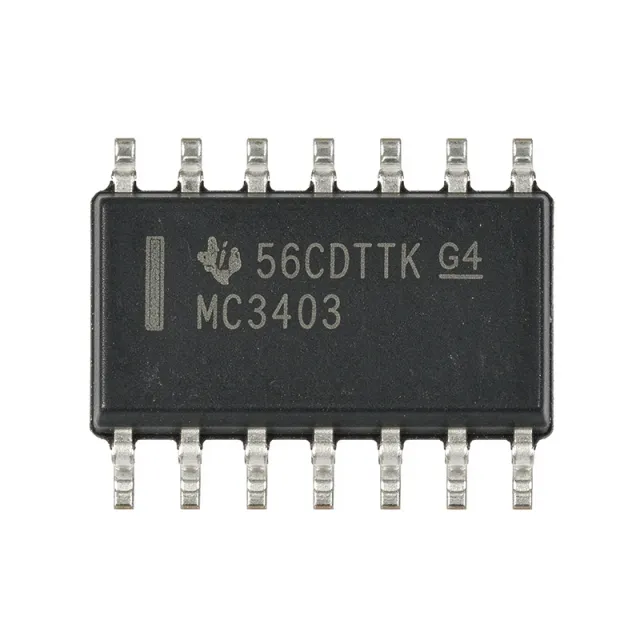
MC3403D - Quad 30 V 1 MHz Op Amp | Texas Instruments
The Texas Instruments MC3403D is a quad, general-purpose bipolar operational amplifier built for single-supply and dual-supply analog systems. The device provides four amplifiers in a 14-SOIC package, operates from ±2.5 V to ±15 V according to the cited distributor specification, and supports a 1 MHz gain-bandwidth product. Its four-circuit integration reduces package count while providing true differential inputs and push-pull output capability. What is a quad operational amplifier? A quad operational amplifier combines four independent amplifier sections in one IC. These amplifiers serve as the active gain elements in sensors, buffers, analog filters, comparators, and feedback-control circuits. The MC3403 belongs to the operational-amplifier hierarchy, which is part of the broader amplifier-IC and signal-conditioning categories used in industrial control, instrumentation, audio, and communications equipment. Key verified features include four amplifier circuits, 1 MHz operation, 0.6 V/µs slew rate, a 14-pin SOIC package, and operation from −25 °C to 85 °C. The push-pull output stage supports bidirectional output-current drive in suitable loads, while the quad configuration gives designers four reusable analog channels in one package. These attributes make the MC3403D practical for low-to-moderate-frequency analog signal paths where four similar amplifier functions are required. The MC3403’s electrical characteristics are described as similar to the popular UA741 family, but its architecture is specifically useful in single-supply applications. Compared with a basic dual-supply-only op amp, the part offers a practical path to operating from a single rail in many circuits. Designers must still check input common-mode limits, output swing, supply current, noise, offset behavior, and stability against the manufacturer datasheet for the exact operating condition. Typical uses include sensor buffering, low-frequency active filtering, audio preamplification, transducers, analog control loops, and general instrumentation. For a new design, confirm the required input and output voltage ranges, acceptable slew rate, load impedance, noise performance, and temperature limits. For a replacement, verify the exact pinout, supply range, common-mode range, and output-swing requirements rather than relying only on the amplifier count. A key practical consideration is decoupling. Place the required supply bypass capacitors close to the power pins and keep sensitive input and feedback traces short. The MC3403D is a general-purpose amplifier, not a precision or high-speed device; use a more specialized amplifier when low offset, low noise, high speed, rail-to-rail operation, or extended temperature performance is mandatory. This page consolidates verified manufacturer and distributor information, drop-in alternatives, application guidance, package details, and selection considerations for engineers evaluating MC3403D. It is intended to support procurement and design review without substituting unsupported specifications for missing datasheet data.

MC3403DG - Quad 1MHz Op Amp, 3-36V | onsemi
onsemi MC3403DG is a quad general-purpose operational amplifier with true differential inputs, a 3 V to 36 V supply range, 1 MHz gain-bandwidth product, and a 14-pin SOIC package. It provides four amplifiers in one package and is designed for single-supply signal-conditioning, buffering, filtering, current-sensing, analog measurement, and precision-control circuits. An operational amplifier, or op amp, is a voltage-amplified differential building block whose open-loop gain falls with frequency. The MC3403 family belongs to the broader hierarchy of analog amplifier ICs used to amplify small differential signals, buffer high-impedance sources, implement active filters, and close feedback loops around sensors or actuators. Its true differential inputs make the device particularly useful when a useful output must follow the difference between two input voltages rather than either input alone. The quad configuration provides four amplifiers in one 14-pin SOIC, reducing board area and simplifying multi-channel designs. Key characteristics include operation from 3 V to 36 V, a 1 MHz gain-bandwidth product, and a maximum input offset voltage of 10 mV as listed by Mouser. The part is identified as a standard general-purpose amplifier and is suitable for instrumentation, buffer-amplifier, measurement, filtering, and precision-control applications. Its single-supply capability is particularly useful in cost-sensitive systems where one supply rail must support the complete analog signal chain. Differential inputs allow subtraction, current-loop monitoring, sensing across resistive elements, and amplification of sensor outputs without external input networks. Because the package contains four amplifiers, designers can use matched functional channels for simultaneous acquisition, multi-axis sensing, or multiple filter stages while preserving consistent board organization. Typical uses include 4-20 mA process-control inputs, resistive sensor conditioning, active low-pass or band-pass filters, buffered sensor outputs, general-purpose instrumentation, and current-shunt measurements. The 3 V minimum supply supports modern 3.3 V systems, while the 36 V maximum provides additional headroom for industrial supply rails. Commercial-temperature operation is identified in distributor listings, although the exact temperature limits require confirmation from the manufacturer datasheet. When laying out a MC3403DG circuit, place input, feedback, and compensation components close to the relevant SOIC pins and provide adequate return paths for each amplifier channel. Decoupling capacitors should connect between the supply pins and ground with short traces, and unused amplifier inputs should be tied to a defined potential rather than left floating. Check output-current, input-common-mode, noise, and stability requirements against the complete operating conditions before finalizing the design. This product page combines verified manufacturer and distributor information, a complete 14-pin pinout, practical single-supply design guidance, and a parameter-based comparison with available 14-pin quad amplifier alternatives. It also distinguishes confirmed electrical characteristics from parameters that still require verification in the manufacturer datasheet.
MC3403DR - Quad 30 V 1 MHz Op Amp | Texas Instruments (Tape & Reel)
The Texas Instruments MC3403DR is a quad, general-purpose bipolar operational amplifier built for single-supply and dual-supply analog systems. The device provides four amplifiers in a 14-SOIC package, operates from ±2.5 V to ±15 V according to the cited distributor specification, and supports a 1 MHz gain-bandwidth product. Its four-circuit integration reduces package count while providing true differential inputs and push-pull output capability. What is a quad operational amplifier? A quad operational amplifier combines four independent amplifier sections in one IC. These amplifiers serve as the active gain elements in sensors, buffers, analog filters, comparators, and feedback-control circuits. The MC3403 belongs to the operational-amplifier hierarchy, which is part of the broader amplifier-IC and signal-conditioning categories used in industrial control, instrumentation, audio, and communications equipment. Key verified features include four amplifier circuits, 1 MHz operation, 0.6 V/µs slew rate, a 14-pin SOIC package, and operation from −25 °C to 85 °C. The push-pull output stage supports bidirectional output-current drive in suitable loads, while the quad configuration gives designers four reusable analog channels in one package. These attributes make the MC3403DR practical for low-to-moderate-frequency analog signal paths where four similar amplifier functions are required. The MC3403’s electrical characteristics are described as similar to the popular UA741 family, but its architecture is specifically useful in single-supply applications. Compared with a basic dual-supply-only op amp, the part offers a practical path to operating from a single rail in many circuits. Designers must still check input common-mode limits, output swing, supply current, noise, offset behavior, and stability against the manufacturer datasheet for the exact operating condition. Typical uses include sensor buffering, low-frequency active filtering, audio preamplification, transducers, analog control loops, and general instrumentation. For a new design, confirm the required input and output voltage ranges, acceptable slew rate, load impedance, noise performance, and temperature limits. For a replacement, verify the exact pinout, supply range, common-mode range, and output-swing requirements rather than relying only on the amplifier count. A key practical consideration is decoupling. Place the required supply bypass capacitors close to the power pins and keep sensitive input and feedback traces short. The MC3403DR is a general-purpose amplifier, not a precision or high-speed device; use a more specialized amplifier when low offset, low noise, high speed, rail-to-rail operation, or extended temperature performance is mandatory. This page consolidates verified manufacturer and distributor information, drop-in alternatives, application guidance, package details, and selection considerations for engineers evaluating MC3403DR. It is intended to support procurement and design review without substituting unsupported specifications for missing datasheet data.
MC3403DT - Quad 36V 1MHz Op Amp IC | STMicroelectronics
The STMicroelectronics MC3403DT is a low-cost, low-power quad bipolar operational amplifier with four true differential amplifier sections, a 1 MHz gain-bandwidth product, and single-supply operation from 3 V to 36 V. The device is packaged in a 14-pin SOIC and can also operate from dual supplies of ±18 V. Its short-circuit-protected outputs, internally compensated Class AB output stages, and input bias current of 500 nA maximum make it suitable for general-purpose analog signal conditioning. An operational amplifier is an amplifier IC that compares two input voltages and drives its output to represent their difference. A differential input stage rejects common-mode signals, while internal frequency compensation simplifies closed-loop design. The MC3403 combines four amplifiers in one package, placing it in the hierarchy of quad op amp, operational amplifier, analog amplifier IC, and semiconductor. Its broad supply range also makes it a bridge between classic 741-class circuitry and newer low-voltage single-supply systems. Key features include four independent amplifier channels, true differential inputs, 1 MHz gain-bandwidth performance, operation down to a 3 V single supply, and operation up to a 36 V single supply. Each output stage uses a Class AB topology for reduced crossover distortion, while short-circuit protection improves robustness when an output is driven into a difficult load. The internally compensated design supports direct use as a voltage follower or noninverting amplifier without external frequency-compensation components. The MC3403 family combines the general-purpose behavior of the UA741 with lower supply-current demand and improved suitability for single-supply operation. Each channel presents differential inputs, allowing signals to be referenced around the supply midpoint in single-supply circuits. Because the amplifiers are not rail-to-rail, input and output common-mode limits remain important when the signal approaches either supply rail. Designers should use the manufacturer data sheet for exact electrical limits, input-offset voltage, slew rate, output-current capability, and channel-matching characteristics. Typical uses include sensor-signal conditioning, low-frequency active filters, instrumentation amplifiers, audio preamplifiers, transducers, analog control loops, and general instrumentation. Four amplifiers in one package can implement a complete filter, multi-stage gain block, comparator-style signal conditioning, or several independent channels when board area and component count are priorities. The SOIC-14 package also supports conventional through-hole PCB assembly rather than requiring a fine-pitch surface-mount land pattern. When designing around the MC3403DT, begin with the required input and output common-mode range at the actual supply voltage. Place supply-bypass capacitors near the device, maintain a stable reference point for single-supply signals, and verify stability for the selected gain, load, and feedback network. Avoid relying on rail-to-rail operation, and check the maximum total supply voltage when combining bipolar or dual-supply systems. This product page combines the manufacturer operating limits, package information, sourcing details, pin-level guidance, drop-in comparison criteria, and practical circuit considerations into one engineering reference. It also identifies where a new design should remain with the MC3403 family and where a lower-voltage or differently characterized amplifier offers a better fit.
MC3403N - Quad 30V 1MHz Op Amp | Texas Instruments
The Texas Instruments MC3403N is a quad general-purpose operational amplifier built for single- and dual-supply systems, with four amplifiers, a 30 V maximum supply rating, 1 MHz typical gain-bandwidth product, and operation from -25°C to 85°C. It is supplied in a 14-pin PDIP package. An operational amplifier is an analog integrated circuit that uses high-gain differential feedback to amplify the difference between two input voltages. The MC3403 belongs to the broader amplifier hierarchy: operational amplifier, analog IC, semiconductor, and general-purpose signal-conditioning component. Its quad construction reduces package count when a design needs several independent gain stages, buffers, or comparators. The verified product information identifies wide supply-voltage support, a true differential input stage, internal frequency compensation, low input bias current, a Class AB output stage, and short-circuit protection. The 1 MHz gain-bandwidth product is suitable for general-purpose audio, control, and instrumentation circuits rather than precision or high-speed applications. Because all four amplifiers share one package, supply pins and exposed signal pins must be routed carefully on mixed analog and digital boards. The 30 V supply capability permits operation from conventional single supplies or split dual supplies, making the device useful in legacy industrial, audio, and control designs. However, exact input common-mode limits, output swing, input offset voltage, supply-current, noise, and slew-rate values are not stated in the supplied verified excerpts; those parameters require confirmation in the manufacturer datasheet before final circuit sign-off. Typical applications include four-channel audio preamplification, low-frequency active filtering, sensor-signal conditioning, industrial control loops, and general buffer or gain stages. In each case, the 1 MHz bandwidth should be compared with the closed-loop gain and required settling behavior. A four-amplifier package can reduce board area, but it does not eliminate the need to check common-mode range, output swing, stability, and supply-decoupling requirements at every amplifier section. Design with a local bypass capacitor near the supply pins, maintain the required input common-mode range, and verify output-voltage headroom under the intended load. Do not infer precision performance from the word general-purpose. This product page consolidates the verified manufacturer identity, distributor listing, package, temperature range, supply rating, and replacement research while explicitly marking unavailable detailed electrical parameters. The alternatives listed here are limited to candidates supported by the supplied cross-reference data and are presented as package-compatible engineering options; final qualification should confirm pinout, supply limits, input/output ranges, offset, bandwidth, slew rate, and lifecycle status against the selected manufacturer datasheet.
MC3403NG4 - 30V 1MHz Quad Op Amp | Texas Instruments
The Texas Instruments MC3403NG4 is a quad, general-purpose operational amplifier with four amplifiers in a 14-pin plastic dual-inline package. It supports supply voltages up to 30 V, operates over a -25°C to 85°C temperature range, and provides a gain-bandwidth product of 1 MHz. The MC3403NG4 is therefore suitable for instrumentation, control, data acquisition, and audio-signal conditioning applications that require multiple amplifiers on one board. An operational amplifier is an active semiconductor device that uses high-gain differential amplification with negative feedback. Within the broader semiconductor hierarchy, an operational amplifier belongs to the analog amplifier and signal-conditioning category. Its inverting and non-inverting inputs determine how an external feedback network sets the closed-loop gain, while output-current capability and slew rate determine how quickly the amplifier can charge or discharge the load connected at the output. The MC3403 provides four amplifier sections, reducing the package count and board area required for multi-channel analog systems. Its 30 V maximum supply rating provides useful headroom for industrial control equipment, while the 1 MHz gain-bandwidth product supports moderate-frequency feedback networks. The specified -25°C to 85°C operating range covers many commercial and industrial environments where a wider-temperature grade is not required. Each amplifier section provides differential inputs and an output, allowing the device to implement inverting, non-inverting, summing, differential, and feedback-control circuits. Because all four sections share one package, the power rails and bypass network also serve the complete device. PCB designers should preserve symmetry between paired input and feedback components and route sensitive input traces away from output and supply-current paths to reduce parasitic pickup. Typical uses include industrial process-control loops, multichannel sensor amplification, low-frequency audio preamplification, instrumentation signal conditioning, and active filtering. The quad organization is particularly useful when four related channels must operate under a common supply. For applications requiring higher precision, lower offset, faster settling, lower noise, or rail-to-rail output operation, a newer precision amplifier family should be evaluated before committing the MC3403NG4 to the design. The most important design tradeoff is generality versus precision. The MC3403NG4 provides four inexpensive, widely applicable amplifier sections, but its 1 MHz bandwidth and legacy general-purpose architecture are not ideal for demanding sensor-front-end accuracy or high-speed signal chains. Verify input common-mode range, output swing, output-current capability, offset voltage, noise, slew rate, and stability requirements against the manufacturer datasheet for the operating conditions. This product record combines the manufacturer’s device description with application-oriented guidance for package layout, bypassing, input routing, selection tradeoffs, and drop-in evaluation. It is structured to help engineers confirm whether a legacy quad amplifier still satisfies the electrical and environmental requirements of a new instrumentation, industrial-control, audio, or data-acquisition design.
MC3403NS - Quad 30V 1MHz Op Amp | Texas Instruments
Texas Instruments MC3403NS is a quad general-purpose operational amplifier rated for 30 V supply operation, 1 MHz gain-bandwidth product, and operation from -25°C to 85°C. The device is offered in a 14-pin SOIC package and contains four amplifiers, each with a Class AB output stage, true differential inputs, and internal frequency compensation. It supports single-supply operation from 3 V to 36 V or dual-supply operation, making it suitable for industrial control, instrumentation, audio, and signal-conditioning systems. An operational amplifier is an analog signal-processing IC that compares an inverting input with a non-inverting input and amplifies the voltage difference between them. Operational amplifiers belong to the amplifier IC hierarchy, combining high open-loop gain, negative feedback, signal amplification, filtering, buffering, and active transducer conditioning. Their internal frequency compensation removes the need for an external dominant-pole capacitor in ordinary closed-loop applications. The MC3403NS provides four low-power amplifiers in one package, reducing board area compared with discrete single or dual amplifier implementations. Its low input bias current is useful when the source impedance is relatively high, while short-circuit protection improves robustness in feedback-controlled circuits. The 30 V rating and wide supply range support legacy industrial systems operating from higher-voltage rails than typical modern 3.3 V or 5 V analog circuits. Technically, each channel uses a true differential input stage and a Class AB output stage. Internal frequency compensation supports stable operation in standard closed-loop configurations, including inverting and non-inverting amplifiers. The 1 MHz gain-bandwidth product limits closed-loop bandwidth according to the selected noise gain, so higher gain reduces usable bandwidth. The wide common supply range also allows ±15 V dual-supply operation in legacy analog systems. Typical uses include four-channel sensor conditioning, general-purpose voltage amplification, audio preamplification, active filtering, data acquisition front ends, and industrial control interfaces. Multiple independent channels can process several low-frequency signals while sharing one supply and package. Where source impedance is high, input bias current and offset characteristics should be checked before selecting the amplifier. A primary design consideration is rail headroom. The output cannot swing fully to either supply rail, and single-supply designs must include sufficient voltage at the output for the downstream load. Place bypass capacitors close to the supply pins, keep feedback loops compact, and verify stability, output swing, and input common-mode range across temperature. This page combines the manufacturer specifications with package guidance, practical circuit considerations, comparison criteria, and sourcing information for engineers evaluating the MC3403NS. The technical guidance emphasizes how its 30 V supply capability, 1 MHz bandwidth, four-channel integration, and 14-pin SOIC footprint affect replacement and design decisions.
MC3403P - Quad 36V 1MHz Operational Amplifier | onsemi
The onsemi MC3403P is a low-cost quad operational amplifier with true differential inputs, internally compensated operation, and a 14-pin plastic DIP package. It contains four amplifiers in one package and operates from a single supply or from split dual supplies, with a maximum single-supply rating of 36 V corresponding to dual operation up to ±18 V. Its 1 MHz gain-bandwidth product supports general-purpose signal conditioning at frequencies up to 1 MHz. An operational amplifier is an analog integrated circuit that amplifies the voltage difference between its inverting and non-inverting inputs. The MC3403 belongs to the general-purpose bipolar operational-amplifier family within the broader amplifier IC and semiconductor hierarchy. Unlike circuits built around the classic UA741, the MC3403 was designed with practical single-supply operation in mind. True differential inputs also allow the amplifier to reject common-mode signals when suitable feedback networks and operating conditions are used. The MC3403P provides internally compensated amplifiers, short-circuit-protected outputs, and a Class AB output stage designed for minimal crossover distortion. Maximum input bias current is specified at 500 nA, making the device practical for higher-impedance sensing paths when leakage and bias-current errors are controlled. Its internally compensated architecture removes the need for an external compensation capacitor in the standard closed-loop configurations shown in typical applications. Each of the four amplifier sections supports common inverting, non-inverting, summing, and difference-amplifier arrangements. The 1 MHz gain-bandwidth product means bandwidth decreases as closed-loop gain increases; designers should therefore account for gain-bandwidth behavior when targeting precision, pulse, or audio-frequency signals. The 36 V maximum supply also provides ample headroom for industrial and educational circuits, although the actual common-mode and output-swing limits must be observed at lower supply voltages. Typical uses include low-frequency audio amplification, active filtering, sensor signal conditioning, waveform generation, and general instrumentation. The four independent amplifiers can implement a complete signal chain in one package, reducing board space compared with four separate single or dual amplifier ICs. In AC-coupled audio and instrumentation circuits, input and feedback components can be selected around the required gain and bandwidth rather than relying on a fixed internal compensation network. Designers should verify the MC3403P pinout before PCB assembly and observe the datasheet limits for input voltage, common-mode range, output swing, supply current, and temperature. A stable bypass capacitor near the supply pins is advisable, and the unused amplifier sections should be configured according to the manufacturer’s recommended practice rather than left floating. Because this is a through-hole DIP device, insertion and soldering require adequate clearance around the package and between adjacent board components. This product record combines verified manufacturer and distributor information, same-footprint alternatives, package and pinout details, and practical selection guidance. It is intended to help engineers identify the MC3403P quickly for legacy industrial, audio, education, and prototype designs while making package constraints and replacement limits explicit.
MC3403PG - Quad 1 MHz Operational Amplifier | onsemi
The onsemi MC3403PG is a general-purpose quad operational amplifier with true differential inputs, a 1 MHz gain-bandwidth product, and a 0.6 V/us slew rate. The device operates from a single supply over a 3 V to 36 V range and is packaged in a 14-pin dual inline package for through-hole assembly. An operational amplifier is an analog signal-conditioning IC used to amplify voltage differences, buffer sensor outputs, and support feedback-control networks. The MC3403 belongs to the operational-amplifier hierarchy, which includes differential-input amplifiers, analog amplifiers, and integrated analog ICs. Its four amplifiers can perform independent signal-conditioning functions while sharing one package and supply connection. The principal features of the MC3403PG include four internally compensated operational-amplifier circuits, true differential inputs, a 1 MHz gain-bandwidth product, a 0.6 V/us slew rate, and operation from a single supply as low as 3 V or as high as 36 V. The electrical characteristics are similar to the popular MC1741C, but the MC3403 adds the advantages required in modern single-supply circuitry. Split-supply operation is also possible when the total voltage between the supply terminals remains within the device's operating range. Because this is a general-purpose amplifier rather than a precision or rail-to-rail part, the input common-mode range, output swing, offset voltage, and stability behavior should be checked against the actual signal and load before final circuit approval. Typical uses include four-channel sensor conditioning, low-frequency active filters, audio preamplification, transducer interfaces, general feedback-control loops, and instrumentation. The 14-DIP format is particularly suitable for through-hole prototypes, educational equipment, legacy control boards, and industrial assemblies where a through-hole quad amplifier simplifies socketed construction and servicing. When laying out a MC3403PG circuit, connect each amplifier's supply pins to the same supply network and place suitable bypassing capacitance close to those pins. Keep sensitive input routing away from high-current switching nodes, and verify that the selected feedback network remains stable with the actual source impedance and load capacitance. This product record combines the MC3403PG specifications, package information, sourcing guidance, candidate replacements, and application-oriented design notes in one place. The comparison tables and selection guidance help engineers distinguish true same-package alternatives from devices that would require board or signal-chain changes.

MC3403PT - Quad Low-Power Op Amp | STMicroelectronics
STMicroelectronics MC3403PT is a four-circuit, low-power bipolar operational amplifier packaged in a 14-pin TSSOP. Each amplifier supports single-supply operation to +36 V and dual-supply operation to ±18 V, providing broad flexibility for industrial, analog-control, instrumentation, and signal-conditioning designs. The device offers a 1 MHz gain-bandwidth product, internally compensated operation, short-circuit-protected outputs, and a Class AB output stage. An operational amplifier is an analog integrated circuit that uses high-gain feedback to amplify the difference between two input voltages. Within the broader semiconductor hierarchy, the MC3403PT belongs to the operational-amplifier family, which falls under analog amplifier ICs and signal-processing semiconductors. The quad configuration places four independent amplifiers in one package, reducing board area in designs requiring multiple buffered or gain-stage channels. The principal features of the MC3403PT include a maximum input bias current of 500 nA, internal compensation, short-circuit-protected outputs, and a minimum Class AB output stage for reduced crossover distortion. Its 1 MHz gain-bandwidth product supports general-purpose amplification at low and moderate frequencies. Single-supply operation up to +36 V is especially useful when the signal source and load share a positive reference without a negative rail. The bipolar input stage supports operation from dual supplies of ±18 V or a single supply up to +36 V. Internal compensation simplifies circuit construction because separate external compensation components are not required for ordinary closed-loop amplifier use. Four independent channels can also be configured as voltage followers, non-inverting or inverting amplifiers, differential stages, comparators in suitable circuits, or general analog signal-conditioning elements. Typical uses include low-frequency sensor amplification, industrial control loops, audio preamplification, active filtering, transducers, sample-and-hold stages, and general-purpose analog boards. The quad package is particularly useful when a design needs several channels with the same supply architecture. Engineers should also evaluate output swing, slew rate, input common-mode range, and load capability against their particular signal chain. For layout, place input and output paths away from high-current switching nodes and connect the supply pins to a low-impedance bypass network. Stable feedback networks and properly grounded unused channels help prevent oscillation or unintended signal coupling. Use the manufacturer pin table and electrical-characteristics curves to verify the final operating points. This product page combines manufacturer and distributor technical information, package and pin details, lifecycle-oriented sourcing guidance, application analysis, and validated drop-in alternatives. It also highlights the differences engineers should evaluate before replacing the MC3403PT on an existing 14-pin TSSOP layout.