Produits (18140)

STM32F205ZET6 - 32-bit ARM Cortex-M3 MCU, 512KB Flash | STMicroelectronics
STM32F205ZET6

STM32F205ZET6 - 32-bit ARM Cortex-M3 MCU, 512KB Flash | STMicroelectronics

The STMicroelectronics STM32F205ZET6 is a high-performance 32-bit microcontroller based on the ARM Cortex-M3 core, operating at up to 120 MHz. It features 512 KB of Flash memory and 128 KB of SRAM, making it suitable for a wide range of embedded applications. The device is housed in a 144-pin LQFP package (LQFP144) with a 20x20 mm body and 0.5 mm pitch, providing ample GPIOs and connectivity options. What is a microcontroller? A microcontroller (MCU) is a compact integrated circuit designed to govern a specific operation in an embedded system. It integrates a processor core, memory (Flash and SRAM), and programmable input/output peripherals on a single chip. Microcontrollers are the backbone of embedded systems, enabling control, monitoring, and communication in applications ranging from consumer electronics to industrial automation. The STM32F205ZET6 belongs to the STM32F2 series, which is part of the broader STM32 family of 32-bit Flash microcontrollers based on the ARM Cortex-M processor. This family hierarchy positions the STM32F205ZET6 as a high-performance MCU with advanced connectivity and rich analog peripherals. Key features of the STM32F205ZET6 include a 32-bit ARM Cortex-M3 CPU with adaptive real-time accelerator (ART) allowing 0-wait state execution from Flash, a memory protection unit (MPU), and a comprehensive set of peripherals. It offers up to 114 I/O ports, 3x 12-bit ADCs, 2x DACs, 12-bit timers, and advanced communication interfaces including USB 2.0 OTG HS/FS, Ethernet MAC, CAN, SPI, I2C, USART, and SDIO. The device operates from a 1.8V to 3.6V power supply and supports a temperature range of -40°C to +85°C (industrial grade). Technically, the STM32F205ZET6 is built on a 90nm process technology, enabling high clock speeds with low power consumption. It includes a nested vectored interrupt controller (NVIC) for efficient interrupt handling, a DMA controller with 16 channels, and a true random number generator (RNG). The device also features a real-time clock (RTC) with calendar and alarm functions, and a flexible static memory controller (FSMC) for external memory expansion. Typical applications include industrial control systems, motor drives, medical devices, consumer electronics, and IoT gateways. Its rich connectivity and high processing power make it ideal for applications requiring real-time control and communication, such as PLCs, robotics, and smart home hubs. When designing with the STM32F205ZET6, ensure proper decoupling of the power supply pins with 100nF capacitors placed close to each VDD pin, and a 4.7uF bulk capacitor. The VDDA pin should be connected to a clean analog supply to minimize noise in ADC conversions. Also, configure the boot pins correctly to select the desired boot mode (Flash, SRAM, or system memory) for programming and debugging.

USD $8,10 En stock
STM32F207VCT6 - 32-bit ARM Cortex-M3 MCU, 256KB Flash | STMicroelectronics
STM32F207VCT6

STM32F207VCT6 - 32-bit ARM Cortex-M3 MCU, 256KB Flash | STMicroelectronics

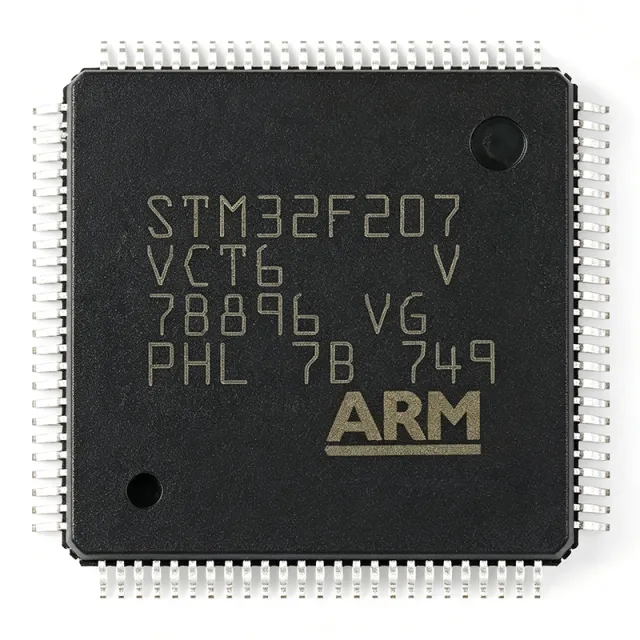
The STMicroelectronics STM32F207VCT6 is a high-performance 32-bit microcontroller based on the ARM Cortex-M3 core, operating at up to 120 MHz. It features 256 KB of Flash memory and 128 KB of SRAM, making it suitable for a wide range of embedded applications. The device is housed in a 100-pin LQFP package (14x14 mm) and supports a supply voltage range of 1.8V to 3.6V. A microcontroller (MCU) is a compact integrated circuit designed to govern a specific operation in an embedded system. It contains a processor core, memory, and programmable input/output peripherals. The STM32F207VCT6 belongs to the STM32F2 series, which is part of the broader STM32 family of 32-bit Flash microcontrollers. This family is widely used in industrial control, consumer electronics, and IoT devices due to its balance of performance, power efficiency, and peripheral integration. Key features include a rich set of peripherals: 3x SPI, 3x I2C, 4x USART, 2x UART, 2x CAN, 1x USB 2.0 OTG FS, 1x USB 2.0 OTG HS, 1x Ethernet MAC, 1x SDIO, 1x FSMC, 2x 12-bit DAC, 3x 12-bit ADC (up to 24 channels), and multiple timers including advanced-control timers. The device also includes a cryptographic/hash processor for AES, DES, and SHA-1/MD5, and a true random number generator (RNG). The STM32F207VCT6 is built on a 90nm process technology, offering a good balance of speed and power consumption. It supports a wide operating temperature range of -40°C to +85°C, making it suitable for industrial environments. The Cortex-M3 core includes a Nested Vectored Interrupt Controller (NVIC) for efficient interrupt handling, and a Memory Protection Unit (MPU) for enhanced system reliability. Typical applications include industrial automation, motor control, medical devices, smart meters, and IoT gateways. The Ethernet MAC and USB OTG HS interfaces enable connectivity in networked systems, while the advanced timers and ADC/DAC support precise analog control loops. When designing with this device, ensure proper decoupling of the power supply pins and a stable clock source. The internal RC oscillator can be used for basic operation, but an external crystal is recommended for applications requiring precise timing. The device supports in-circuit programming and debugging via SWD and JTAG interfaces.

USD $7,32 En stock
STM32F207VGT6 - 32-bit ARM Cortex-M3 MCU, 1MB Flash | STMicroelectronics
STM32F207VGT6

STM32F207VGT6 - 32-bit ARM Cortex-M3 MCU, 1MB Flash | STMicroelectronics

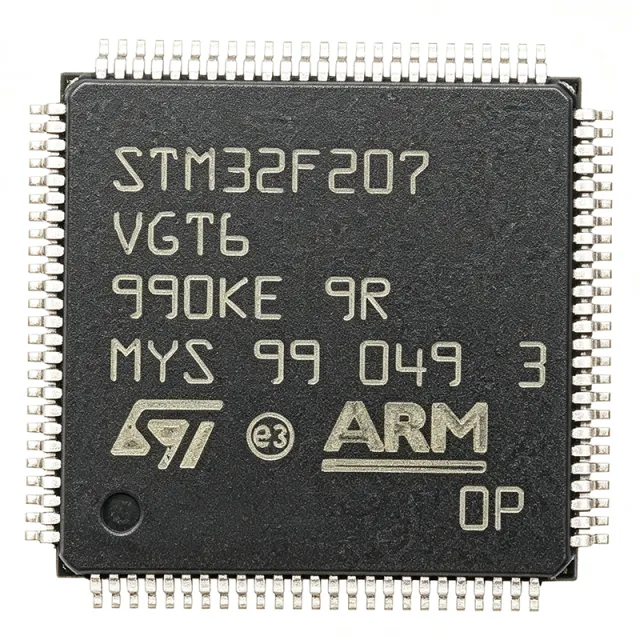
The STMicroelectronics STM32F207VGT6 is a high-performance 32-bit microcontroller based on the ARM Cortex-M3 core, operating at up to 120 MHz. It features 1 MB of Flash memory and 128 KB of SRAM, making it suitable for a wide range of embedded applications. The device is housed in a 100-pin LQFP package (LQFP100) and supports a supply voltage range of 1.8V to 3.6V. What is a microcontroller? A microcontroller (MCU) is a compact integrated circuit designed to govern a specific operation in an embedded system. It contains a processor core, memory (Flash and SRAM), and programmable input/output peripherals on a single chip. The STM32F207VGT6 belongs to the STM32F2 series, which is part of the broader STM32 family of 32-bit ARM Cortex-M microcontrollers. This family is widely used in industrial control, consumer electronics, and IoT devices due to its balance of performance, power efficiency, and peripheral integration. Key features of the STM32F207VGT6 include a 120 MHz ARM Cortex-M3 core with 1.25 DMIPS/MHz, 1 MB of Flash memory, 128 KB of SRAM, and a comprehensive set of peripherals. It integrates a 12-bit ADC with up to 24 channels, a 12-bit DAC, multiple timers, USART, SPI, I2C, USB 2.0 OTG, Ethernet MAC, and a camera interface. The device also supports a flexible memory controller (FMC) for external memory expansion, and a cryptographic/hash processor for security applications. Technically, the STM32F207VGT6 is built on a 90nm process technology, offering a good balance between performance and power consumption. It features a nested vectored interrupt controller (NVIC) for efficient interrupt handling, and a memory protection unit (MPU) for enhanced system reliability. The device supports a wide operating temperature range of -40°C to +85°C, making it suitable for industrial environments. Typical applications include industrial control systems, motor drives, medical devices, point-of-sale terminals, and IoT gateways. The Ethernet MAC and USB OTG interfaces enable connectivity in networked applications, while the rich analog peripherals support sensor interfacing and data acquisition. When designing with this MCU, ensure proper decoupling of the power supply pins and a stable clock source. The device supports multiple low-power modes, which can be leveraged to optimize energy consumption in battery-powered applications. Careful PCB layout is recommended to minimize noise and ensure reliable operation at high clock speeds.

USD $6,82 En stock
STM32F207ZET6 - 32-bit ARM Cortex-M3 MCU, 512KB Flash | STMicroelectronics
STM32F207ZET6

STM32F207ZET6 - 32-bit ARM Cortex-M3 MCU, 512KB Flash | STMicroelectronics

The STMicroelectronics STM32F207ZET6 is a high-performance 32-bit microcontroller based on the ARM Cortex-M3 core, operating at up to 120 MHz. It features 512 KB of Flash memory and 128 KB of SRAM, making it suitable for a wide range of embedded applications. The device is housed in a 144-pin LQFP package (LQFP144) with a 20x20 mm body, offering extensive I/O and connectivity options. What is a microcontroller? A microcontroller (MCU) is a compact integrated circuit designed to govern a specific operation in an embedded system. It integrates a processor core, memory (Flash and SRAM), and programmable input/output peripherals on a single chip. Microcontrollers are the brain of countless electronic products, from automotive engine control units to consumer appliances and IoT devices. The STM32F207ZET6 belongs to the STM32F2 series, which is part of the broader STM32 family of 32-bit ARM Cortex-M microcontrollers, positioned between the mainstream F1 series and the high-performance F4/H7 series. Key features of the STM32F207ZET6 include a 120 MHz ARM Cortex-M3 core with 1.25 DMIPS/MHz, 512 KB Flash, 128 KB SRAM, and a comprehensive set of peripherals: 3x 12-bit ADCs, 2x DACs, 4x USARTs, 2x UARTs, 3x SPI, 2x I2C, 2x CAN, 1x USB 2.0 OTG FS/HS, 1x Ethernet MAC, and a camera interface. It also includes a cryptographic/hash processor for AES, DES, and 3DES encryption, and a true random number generator (TRNG). The device operates from 1.8V to 3.6V supply and supports a temperature range of -40°C to +85°C (industrial grade). The STM32F207ZET6 is built on ST's advanced 90nm process technology, providing a balance of performance and power efficiency. The ART Accelerator™ (Adaptive Real-Time memory accelerator) enables zero-wait-state execution from Flash, maximizing the effective throughput of the Cortex-M3 core. The device also features a flexible memory controller (FMC) supporting external memory interfaces, including SRAM, PSRAM, NOR, and NAND Flash. Typical applications include industrial control systems, motor drives, PLCs, medical devices, point-of-sale terminals, networking equipment, and IoT gateways. The rich connectivity (Ethernet, USB, CAN) makes it ideal for applications requiring multiple communication interfaces. The cryptographic hardware accelerates secure communication protocols, enhancing data security in connected devices. When designing with this MCU, pay attention to power supply decoupling: place 100nF capacitors close to each VDD pin and a 4.7uF bulk capacitor. The VDDA analog supply should be filtered with a ferrite bead and 1uF capacitor to reduce noise for ADC accuracy. Also, configure the boot pins correctly to select the desired boot source (Flash, SRAM, or system memory).

USD $8,10 En stock
STM32F207ZGT6 - 32-bit ARM Cortex-M3 MCU, 1MB Flash | STMicroelectronics
STM32F207ZGT6

STM32F207ZGT6 - 32-bit ARM Cortex-M3 MCU, 1MB Flash | STMicroelectronics

The STM32F207ZGT6 is a high-performance 32-bit microcontroller from STMicroelectronics, based on the ARM Cortex-M3 core running at up to 120 MHz. It integrates 1 MB of Flash memory and 128 KB of SRAM, making it suitable for complex embedded applications requiring substantial code and data storage. The device is housed in a 144-pin LQFP package (LQFP144) with a 20x20 mm body, offering a rich set of peripherals and I/O capabilities. A microcontroller (MCU) is a compact integrated circuit designed to govern a specific operation in an embedded system. It contains a processor core, memory (Flash and SRAM), and programmable input/output peripherals. The STM32F207ZGT6 belongs to the STM32F2 series, which is part of the broader STM32 family of 32-bit Flash microcontrollers. This family is widely used in industrial control, consumer electronics, and IoT devices due to its balance of performance, power efficiency, and peripheral integration. Key features of the STM32F207ZGT6 include a 120 MHz ARM Cortex-M3 core with 1.25 DMIPS/MHz, 1 MB of Flash memory, 128 KB of SRAM, and a comprehensive set of peripherals: 3x 12-bit ADCs, 2x DACs, 4x USARTs, 2x UARTs, 3x SPI, 2x I2C, 2x CAN, 1x USB 2.0 OTG FS/HS, 1x Ethernet MAC, and a camera interface. It also features a flexible memory controller (FMC) for external memory expansion, a true random number generator (RNG), and a cryptographic acceleration cell for AES, DES, and 3DES. The STM32F207ZGT6 is built on a 90nm process technology, offering a good balance between performance and power consumption. It operates from a 1.8V to 3.6V power supply and supports a wide temperature range of -40°C to +85°C. The device includes multiple low-power modes (Sleep, Stop, Standby) to optimize energy consumption in battery-powered applications. Typical applications include industrial automation, motor control, medical devices, point-of-sale terminals, and IoT gateways. The Ethernet MAC and USB OTG support enable connectivity in networked systems, while the rich analog peripherals suit data acquisition and control loops. When designing with this MCU, ensure proper decoupling of the power supply pins and a stable clock source. The device supports external crystal oscillators (4-26 MHz) and an internal 16 MHz RC oscillator. For high-speed USB and Ethernet, an external 25 MHz crystal is recommended. The boot pins must be configured correctly for programming via USART or USB.

USD $8,10 En stock
STM32F301K6T7 - 32KB Flash Cortex-M4 MCU 32-LQFP | STMicroelectronics
STM32F301K6T7

STM32F301K6T7 - 32KB Flash Cortex-M4 MCU 32-LQFP | STMicroelectronics

The STMicroelectronics STM32F301K6T7 is a mainstream mixed-signal microcontroller built on the Arm Cortex-M4 32-bit RISC core with single-cycle hardware multiply, hardware divide, DSP instructions and an integrated single-precision Floating Point Unit (FPU), running up to 72 MHz. The device integrates 32 KB of Flash and 16 KB of SRAM on the data bus, packaged in a 32-pin LQFP. The supply voltage VDD/VDDA spans 2.0 V to 3.6 V, and the part includes an integrated voltage regulator and a CRC calculation unit. What is a mixed-signal MCU? A mixed-signal microcontroller integrates a digital processor core with on-chip analog peripherals such as ADCs, DACs, comparators and operational amplifiers, allowing one chip to interface directly with sensors and analog signal chains without external analog components. This category sits beneath the broader product hierarchy of microcontroller -> embedded MCU -> ARM Cortex-M device -> mixed-signal MCU -> semiconductor. Key features of the STM32F301K6T7 include up to two 12-bit fast ADCs (5 MSPS) with selectable resolution, one 12-bit DAC channel, four fast rail-to-rail analog comparators with programmable threshold, one 8 MHz operational amplifier with PGA capability, and advanced-control PWM timers for motor-control and digital-power topologies. Communication peripherals include one I2C, up to two SPI, up to three USART, and a CAN 2.0B interface. The device supports up to 21 fast GPIOs and embeds a 16-channel DMA controller. Architecturally the part leverages the Cortex-M4 core with FPU, enabling C-level DSP code without software emulation and accurate math for sensor fusion, while the on-chip analog front-end reduces BOM cost. Reset and power-management blocks include power-on reset, brown-out reset, programmable voltage detector, and a low-power RTC with backup-domain registers. Typical applications include digital power conversion (SMPS digital control loops), motor drives for low-voltage BLDC and PMSM systems, sensor-hub and signal-conditioning front-ends, factory-automation I/O modules, consumer appliance control boards, and low-cost instrumentation. When laying out the PCB, place the VDDA decoupling network within 5 mm of the VDDA pin, use an external ferrite or resistor between VDD and VDDA, and keep the analog ground plane separate from the switching-return path to preserve ADC SNR.

USD $1,92 En stock
STM32F302CBT6 - 32-Bit ARM Cortex-M4 MCU 72MHz 128KB Flash | STMicroelectronics
STM32F302CBT6

STM32F302CBT6 - 32-Bit ARM Cortex-M4 MCU 72MHz 128KB Flash | STMicroelectronics

The STM32F302CBT6 is a 32-bit ARM Cortex-M4 microcontroller from STMicroelectronics' STM32F3 series, featuring a 72 MHz CPU with DSP instructions and a floating-point unit (FPU). It integrates 128 KB of Flash memory and 32 KB of SRAM in a compact 48-pin LQFP (7x7 mm) package, making it suitable for a wide range of mixed-signal applications. A microcontroller (MCU) is a compact integrated circuit designed to govern a specific operation in an embedded system. It contains a processor core, memory, and programmable input/output peripherals. The STM32F302CBT6 belongs to the STM32F3 series, which is optimized for mixed-signal processing, combining an ARM Cortex-M4 core with advanced analog peripherals such as high-speed ADCs, operational amplifiers, and comparators. This positions it within the broader hierarchy of embedded processors, from general-purpose MCUs to application-specific system-on-chips. Key features include a 12-bit ADC with 5 MSPS sampling rate, programmable gain amplifiers (PGAs), and analog comparators, enabling precise analog signal conditioning without external components. The device also includes a memory protection unit (MPU) and a CCM (Core Coupled Memory) for real-time performance. The FPU accelerates floating-point calculations, which is critical for control algorithms and digital signal processing tasks. The STM32F302CBT6 is built on a high-performance ARM Cortex-M4 core with a 72 MHz clock, providing 90 DMIPS of processing power. The inclusion of DSP instructions and an FPU allows efficient execution of complex mathematical operations, making it ideal for motor control, power conversion, and audio processing. The device operates from a 2.0V to 3.6V supply and supports a temperature range of -40°C to +85°C. Typical applications include motor control for industrial drives, power management in renewable energy systems, and audio processing in consumer electronics. The high-speed ADC and analog peripherals make it particularly well-suited for applications requiring real-time analog signal acquisition and processing, such as digital power supplies and smart sensors. When designing with this device, ensure proper decoupling of the power supply pins and careful layout of the analog and digital grounds to minimize noise. The flexible clock tree allows the use of an external crystal or internal RC oscillator, providing design flexibility for cost-sensitive applications.

USD $3,10 En stock
STM32F302R8T6 - 64MHz ARM Cortex-M4F MCU | STMicroelectronics
STM32F302R8T6

STM32F302R8T6 - 64MHz ARM Cortex-M4F MCU | STMicroelectronics

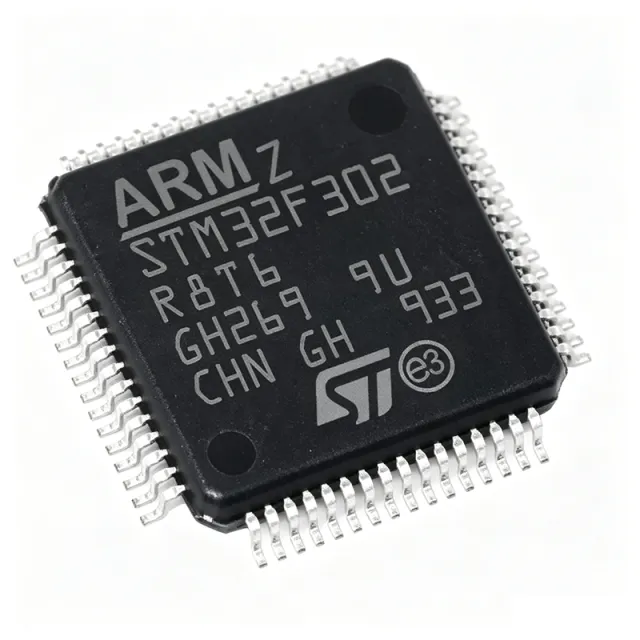
The STMicroelectronics STM32F302R8T6 is a 32-bit ARM Cortex-M4F microcontroller with floating-point unit (FPU), operating at up to 64 MHz. It is part of the STM32F3 series, designed for mixed-signal applications requiring high-performance analog peripherals. The device is housed in a 64-pin LQFP package and provides 64 KB of flash memory and 16 KB of SRAM. A microcontroller (MCU) is a compact integrated circuit designed to govern a specific operation in an embedded system. It contains a processor core, memory, and programmable input/output peripherals. The STM32F302R8T6 belongs to the STM32F3 family, which is optimized for analog and mixed-signal control applications, bridging the gap between general-purpose MCUs and digital signal processors (DSPs). Key features include a 64 MHz ARM Cortex-M4F core with FPU, 64 KB flash, 16 KB SRAM, and a rich set of analog peripherals: two 12-bit DACs, three 12-bit ADCs (up to 5 MSPS), and an operational amplifier. It also integrates a 16-bit advanced-control timer, multiple general-purpose timers, and a real-time clock. Communication interfaces include I2C, SPI, USART, and CAN, making it versatile for industrial and consumer applications. The STM32F302R8T6 leverages the ARM Cortex-M4F architecture with DSP instructions and a single-precision FPU, enabling efficient execution of complex algorithms. The device operates from a 2.0V to 3.6V power supply and supports a temperature range of -40°C to +85°C. Its advanced analog peripherals allow for high-resolution signal acquisition and generation, reducing external component count. Typical applications include motor control, power management, industrial automation, and consumer electronics. The combination of high-speed ADC, DAC, and op-amp makes it ideal for closed-loop control systems, such as field-oriented control (FOC) of brushless DC motors. The CAN interface supports robust communication in automotive and industrial networks. When designing with this MCU, ensure proper decoupling of the power supply pins and a stable clock source. The internal 8 MHz RC oscillator can be used for basic operation, but an external crystal is recommended for applications requiring precise timing. The device supports in-circuit programming and debugging via SWD, simplifying firmware development.

USD $5,41 En stock
STM32F302RCT6 - 256KB Flash ARM Cortex-M4F MCU | STMicroelectronics
STM32F302RCT6

STM32F302RCT6 - 256KB Flash ARM Cortex-M4F MCU | STMicroelectronics

The STM32F302RCT6 is a 32-bit ARM Cortex-M4F microcontroller from STMicroelectronics, featuring a floating-point unit (FPU) and running at up to 72 MHz. It integrates 256 KB of flash memory and 40 KB of SRAM, making it suitable for a wide range of embedded control applications. The device is housed in a 64-pin LQFP package (LQFP64) and operates over a supply voltage range of 2.0V to 3.6V. What is a microcontroller? A microcontroller (MCU) is a compact integrated circuit designed to govern a specific operation in an embedded system. It contains a processor core, memory (flash and SRAM), and programmable input/output peripherals on a single chip. Microcontrollers are the backbone of modern embedded systems, from automotive engine control units to consumer electronics and industrial automation. The STM32F302RCT6 belongs to the STM32F3 series, which is optimized for mixed-signal control applications, combining an ARM Cortex-M4F core with advanced analog peripherals. Key features of the STM32F302RCT6 include a 12-bit ADC with up to 5 MSPS, two 12-bit DACs, three operational amplifiers, and a 16-bit advanced-control timer. It also provides multiple communication interfaces: I2C, SPI, USART, CAN, and USB. The device supports a temperature range of -40°C to +85°C and is available in a 64-pin LQFP package, which is suitable for space-constrained designs. The STM32F302RCT6 leverages the ARM Cortex-M4F core with DSP instructions and a single-precision FPU, enabling efficient execution of complex algorithms such as digital signal processing and motor control. The device includes a memory protection unit (MPU) and a nested vectored interrupt controller (NVIC) for real-time performance. Its advanced analog peripherals, including a 5 MSPS ADC and fast comparators, make it ideal for applications requiring high-speed data acquisition and precise control. Typical applications include motor control, power conversion, industrial automation, and consumer electronics. The device's rich analog feature set and CAN interface make it particularly well-suited for automotive and industrial control systems. Its low-power modes and wide operating voltage range also support battery-powered portable devices. When designing with the STM32F302RCT6, ensure proper decoupling of the power supply pins with 100 nF capacitors placed close to each VDD pin. The VDDA pin should be connected to a clean analog supply, and the VREF+ pin should be decoupled with a 1 µF capacitor. For reliable operation, the NRST pin should be pulled high with a 10 kΩ resistor and a 100 nF capacitor to ground.

USD $5,44 En stock
STM32F303CBT6 - 32-bit ARM Cortex-M4 MCU, 256KB Flash | STMicroelectronics
STM32F303CBT6

STM32F303CBT6 - 32-bit ARM Cortex-M4 MCU, 256KB Flash | STMicroelectronics

The STMicroelectronics STM32F303CBT6 is a 32-bit ARM Cortex-M4F microcontroller with FPU, operating at up to 72 MHz. It features 256 KB of flash memory and 40 KB of SRAM, packaged in a 48-pin LQFP (7x7 mm) package. This device is part of the STM32F303x6/8/B family, designed for mixed-signal applications requiring high-performance analog peripherals. What is a microcontroller? A microcontroller (MCU) is a compact integrated circuit containing a processor core, memory, and programmable input/output peripherals on a single chip. It is the brain of embedded systems, executing firmware to control devices, process sensor data, and communicate with other systems. MCUs are categorized by their core architecture (e.g., ARM Cortex-M), memory size, and peripheral set, and are fundamental to applications ranging from consumer electronics to industrial automation. Key features of the STM32F303CBT6 include a 32-bit ARM Cortex-M4 core with FPU, 72 MHz maximum clock speed, 256 KB flash, 40 KB SRAM, and a rich set of analog peripherals: three 12-bit DACs, four 12-bit ADCs (up to 5 MSPS), seven fast comparators, and operational amplifiers. It also provides advanced timers, a 12-channel DMA controller, and multiple communication interfaces including I2C, SPI, USART, CAN, and USB. The device operates from 2.0V to 3.6V supply and over a -40°C to +85°C temperature range. The STM32F303CBT6 leverages the ARM Cortex-M4 core with single-precision FPU and DSP instructions, enabling efficient execution of complex algorithms such as motor control, digital signal processing, and sensor fusion. The high-speed ADCs (5 MSPS) and fast comparators (25 ns) make it particularly suited for real-time control loops and power conversion applications. Typical applications include motor control (field-oriented control of BLDC/PMSM motors), digital power conversion (SMPS, inverters), industrial automation (PLCs, sensors), medical devices (patient monitoring), and consumer electronics (audio processing, smart appliances). The combination of analog performance and digital processing capability allows designers to integrate multiple functions into a single MCU, reducing BOM cost and board space. When designing with this device, ensure proper decoupling of the VDD and VDDA pins with 100 nF and 4.7 uF capacitors, and connect the VCAP pin to ground with a 2.2 uF capacitor. The BOOT0 pin configuration determines boot source; leave it pulled low for normal flash boot. For high-speed ADC operation, use a stable reference voltage on VREF+ and minimize noise on the analog supply.

USD $4,16 En stock
STM32F303CCT6 - 256KB Flash, 72MHz ARM Cortex-M4F MCU | STMicroelectronics
STM32F303CCT6

STM32F303CCT6 - 256KB Flash, 72MHz ARM Cortex-M4F MCU | STMicroelectronics

The STM32F303CCT6 is a 32-bit ARM Cortex-M4F microcontroller from STMicroelectronics, featuring a 72 MHz CPU with FPU and DSP instructions, 256 KB of Flash memory, and 40 KB of SRAM. It is housed in a 48-pin LQFP package (7x7 mm) and operates over a supply voltage range of 2.0V to 3.6V. This device is part of the STM32F303x6/x8 family, designed for mixed-signal applications requiring high-performance analog peripherals. A microcontroller (MCU) is a compact integrated circuit designed to govern a specific operation in an embedded system. It contains a processor core, memory, and programmable input/output peripherals. The STM32F303CCT6 belongs to the STM32F3 series, which is optimized for analog-intensive applications such as motor control, industrial sensors, and power management. The Cortex-M4F core adds a floating-point unit (FPU) and DSP instructions, enabling efficient handling of complex mathematical operations. Key features include a 72 MHz ARM Cortex-M4F core with FPU, 256 KB Flash, 40 KB SRAM, and a rich set of analog peripherals: three 12-bit ADCs (up to 5 MSPS), four 12-bit DACs, seven fast comparators, and programmable gain amplifiers (PGA). It also integrates advanced timers (up to 8 timers), a real-time clock (RTC), and multiple communication interfaces including I2C, SPI, USART, CAN, and USB. The device supports a temperature range of -40°C to +85°C and is available in a 48-pin LQFP package. The STM32F303CCT6 leverages ST's advanced 90nm process technology, providing a balance of performance and power efficiency. The Cortex-M4F core with FPU accelerates signal processing tasks, while the extensive analog peripherals reduce the need for external components. The device includes a memory protection unit (MPU), DMA controller, and a nested vectored interrupt controller (NVIC) for real-time responsiveness. Typical applications include motor control (field-oriented control), industrial automation, medical devices, and consumer electronics. The high-resolution ADCs and fast comparators make it ideal for closed-loop control systems, while the CAN interface supports automotive and industrial networking. The USB interface enables connectivity for data logging and firmware updates. When designing with this device, ensure proper decoupling of the VDD and VDDA pins with 100nF capacitors placed close to the pins. The VDDA pin must be connected to a clean analog supply to achieve the specified ADC performance. Use the internal voltage regulator with external capacitors as recommended in the datasheet to ensure stable operation.

USD $5,60 En stock
STM32F303RCT6 - 256KB Flash, 72MHz Cortex-M4 MCU | STMicroelectronics
STM32F303RCT6

STM32F303RCT6 - 256KB Flash, 72MHz Cortex-M4 MCU | STMicroelectronics

The STMicroelectronics STM32F303RCT6 is a 32-bit ARM Cortex-M4F mixed-signal microcontroller delivering 72 MHz CPU performance with single-precision FPU and DSP instructions, 256 KB of Flash and 40 KB of SRAM, packaged in a 64-pin LQFP (10x10 mm). It operates from 2.0 V to 3.6 V and integrates four 12-bit 5 MSPS ADCs, three 12-bit DACs, four programmable gain amplifiers, seven fast comparators, and two operational amplifiers on-chip. What is a microcontroller? A microcontroller (MCU) is a compact integrated circuit that combines a processor core, non-volatile Flash memory, volatile SRAM, and programmable peripherals to govern a specific operation inside an embedded system. Within the broader component taxonomy, an MCU is a type of embedded processor, which is itself a subcategory of integrated circuits. The STM32F303 family further specializes as a mixed-signal MCU, layering high-performance analog front-end blocks (ADCs, DACs, op-amps, comparators) on top of a Cortex-M4 core. Key features of the STM32F303RCT6 include the Cortex-M4F core with FPU and DSP extensions, 256 KB single-bank Flash, 40 KB SRAM including 8 KB hardware-parity SRAM, four 12-bit ADCs capable of 5 MSPS with hardware oversampling, three 12-bit DAC channels, four PGA blocks, seven comparators with 25 ns propagation delay, two op-amps, a true random number generator (TRNG), and four 16-bit timers plus one 32-bit timer for advanced motor-control PWM. Communication interfaces include USB 2.0 Full-Speed, CAN 2.0B, three I2C, three SPI, four USART and two UART blocks. Technically, the STM32F303RCT6 is built on a low-power 90 nm CMOS process. The Cortex-M4F core delivers 1.25 DMIPS/MHz (Dhrystone 2.1) and supports single-cycle MAC plus single-precision IEEE-754 floating point. The interconnect matrix uses an AHB/APB bridge structure; peripherals are clock-gated for low-power modes (Sleep, Stop, Standby, VBAT). The memory protection unit and CCM SRAM (Core-Coupled Memory) enable deterministic zero-wait-state code execution for interrupt routines. Typical applications include field-oriented control (FOC) of brushless DC and permanent-magnet synchronous motors, industrial PLCs and sensor conditioning, digital power conversion (PFC, LLC, full-bridge), medical instrumentation, building automation, and consumer audio processing. The integrated op-amps and comparators eliminate external analog front-end components, lowering BOM cost in motor drive and power stages. When designing with the STM32F303RCT6, provide 100 nF decoupling on each VDD pin placed within 3 mm of the pad, separate VDDA/VDD analog and digital grounds joined at one point, and a 1 uF + 100 nF combination on the VCAP pin. Configure unused I/O as analog inputs to minimize leakage. The TRNG peripheral requires entropy accumulation; consult the RNG application note before cryptographic use.

USD $5,20 En stock
STM32F303RET6 - 512KB Flash 72MHz Cortex-M4F MCU | STMicroelectronics
STM32F303RET6

STM32F303RET6 - 512KB Flash 72MHz Cortex-M4F MCU | STMicroelectronics

The STMicroelectronics STM32F303RET6 is a 32-bit ARM Cortex-M4F microcontroller running at up to 72 MHz with 512 KB of flash memory, 80 KB of SRAM, and a rich mixed-signal peripheral set, housed in a 64-pin LQFP (10x10 mm, 0.5 mm pitch) package. According to the STMicroelectronics datasheet, it operates from a 2.0V to 3.6V supply over a -40C to +85C industrial temperature range. A microcontroller (MCU) is a compact integrated circuit that combines a processor core, program memory, RAM, and programmable peripherals on a single chip to govern a specific operation in an embedded system. Within the semiconductor taxonomy, the MCU sits under embedded processors, which belong to the broader class of integrated circuits and semiconductors. The STM32F303RET6 belongs to the STM32F3 series, a family specifically optimized for mixed-signal real-time control where analog and digital peripherals must work closely together. Key differentiating features include two fast 12-bit ADCs capable of up to 5 MSPS, three 12-bit DAC channels, seven fast comparators, and an advanced motor-control PWM timer. Communication coverage is broad: CAN 2.0B, USB 2.0 full-speed device, multiple USARTs, SPI, and I2C buses. Two 32-bit timers plus an MPU, DMA controller, and nested vectored interrupt controller (NVIC) round out the real-time capability. Technically, the Cortex-M4F core adds single-precision floating-point hardware and DSP instructions, so control loops and FFT-based analysis execute efficiently without external math coprocessors. The mixed-signal integration significantly reduces external component count and total system cost in digital-power and motor-drive designs. The RET6 suffix denotes 512 KB flash and an industrial -40C to +85C temperature grade in the LQFP-64 package. Typical applications include field-oriented control (FOC) of BLDC and PMSM motors, industrial automation such as PLCs and sensor front ends, digital power conversion (totem-pole PFC, LLC controllers), and medical devices like patient monitors and infusion pumps, where the 5 MSPS ADCs and fast comparators directly support current sensing and protection functions. Design consideration: decouple every VDD pin and the VDDA pin with 100 nF ceramics plus bulk 4.7 uF capacitance placed as close to the pins as possible, and feed VDDA from a filtered analog supply to realize the specified ADC performance. This page synthesizes distributor pricing, drop-in alternatives, and practical design notes not found in the manufacturer datasheet, giving engineers procurement and engineering data in one place.

USD $3,92 En stock
STM32F303VET6 - 512KB Flash, 72MHz ARM Cortex-M4F MCU | STMicroelectronics
STM32F303VET6

STM32F303VET6 - 512KB Flash, 72MHz ARM Cortex-M4F MCU | STMicroelectronics

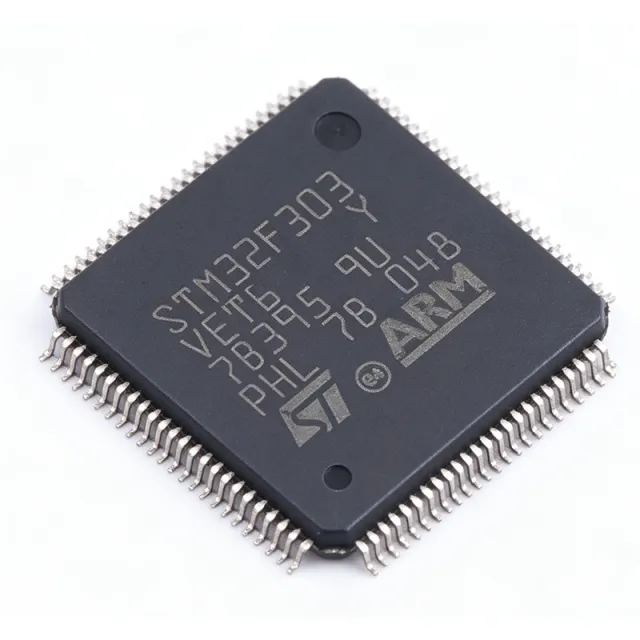
The STMicroelectronics STM32F303VET6 is a high-performance ARM Cortex-M4F based microcontroller with floating-point unit (FPU), operating at up to 72 MHz. It features 512 KB of flash memory and 80 KB of SRAM, making it suitable for a wide range of real-time control and signal processing applications. The device is housed in a 100-pin LQFP package (LQFP100) with a 14x14 mm body and 0.5 mm pitch, offering a compact yet feature-rich solution for embedded systems. What is an ARM Cortex-M4F microcontroller? It is a 32-bit processor core designed for embedded applications that require a balance of performance, power efficiency, and advanced digital signal processing (DSP) capabilities. The 'F' suffix indicates the presence of a hardware floating-point unit (FPU), which accelerates single-precision floating-point arithmetic, essential for control loops, audio processing, and sensor fusion. In the system hierarchy, the STM32F303VET6 sits at the application processor level, integrating the CPU, memory, peripherals, and I/O on a single chip, reducing system cost and board space. Key features of the STM32F303VET6 include a 72 MHz ARM Cortex-M4F core with FPU, 512 KB flash, 80 KB SRAM, and a rich set of peripherals: two advanced 12-bit ADCs (up to 5 MSPS), three 12-bit DACs, seven comparators, four operational amplifiers, and a 12-channel DMA controller. It also integrates multiple communication interfaces: USART, SPI, I2C, CAN, USB, and SDIO. The device supports a supply voltage range of 2.0V to 3.6V and operates over a temperature range of -40°C to +85°C (industrial grade). The STM32F303VET6 is built on ST's advanced 90nm process technology, offering a good balance of performance and power consumption. The Cortex-M4F core with FPU and DSP instructions enables efficient execution of complex algorithms, such as PID control, FFT, and digital filtering. The device also features a memory protection unit (MPU) and a nested vectored interrupt controller (NVIC) for robust real-time operation. Typical applications include industrial motor control, power conversion, digital power supplies, three-phase inverters, medical devices, and audio processing. The high-speed ADCs and comparators make it ideal for fast closed-loop control systems, while the FPU accelerates mathematical computations. The device is also well-suited for IoT edge nodes that require local signal processing. When designing with the STM32F303VET6, ensure proper decoupling of the VDD and VDDA pins with 100nF and 4.7uF capacitors, and connect the VCAP pins to ground with 2.2uF capacitors for internal regulator stability. The BOOT0 pin configuration determines the boot source; a 10k pull-down resistor is recommended for normal flash boot. For high-speed ADC applications, use a low-impedance analog supply and reference to minimize noise.

USD $3,50 En stock
STM32F303ZET6 - 512KB Flash ARM Cortex-M4F MCU | STMicroelectronics
STM32F303ZET6

STM32F303ZET6 - 512KB Flash ARM Cortex-M4F MCU | STMicroelectronics

The STMicroelectronics STM32F303ZET6 is a high-performance 32-bit ARM Cortex-M4F microcontroller with floating-point unit (FPU), operating at up to 72 MHz. It integrates 512 KB of flash memory and 64 KB of SRAM, making it suitable for complex control and signal processing applications. The device is housed in a 144-pin LQFP package (LQFP144) with a 20x20 mm body and 0.5 mm pitch, providing extensive I/O and peripheral connectivity. What is an ARM Cortex-M4F microcontroller? It is a 32-bit processor core designed for embedded control applications, featuring a floating-point unit (FPU) for efficient handling of mathematical operations, DSP instructions for digital signal processing, and a memory protection unit (MPU) for enhanced system reliability. The Cortex-M4F is part of the ARM Cortex-M family, which includes the M0, M0+, M3, M4, and M7 cores, each optimized for different performance and power trade-offs. In the system hierarchy, the microcontroller sits between the application software and the physical hardware, executing instructions and managing peripherals such as timers, ADCs, and communication interfaces. Key features of the STM32F303ZET6 include a 72 MHz maximum clock speed, 512 KB flash, 64 KB SRAM, and a rich set of peripherals: 4x 12-bit ADCs with up to 5 MSPS, 2x 12-bit DACs, 7x comparators, 4x operational amplifiers, 3x 16-bit advanced-control timers, 2x 32-bit timers, and multiple communication interfaces (SPI, I2C, USART, CAN, USB). The device also features a true random number generator (RNG), a CRC calculation unit, and a 12-channel DMA controller. The FPU accelerates single-precision floating-point arithmetic, which is critical for control loops and sensor fusion algorithms. Technically, the STM32F303ZET6 is built on a 90nm process technology, offering a balance of performance and power efficiency. It operates from a 2.0V to 3.6V supply and features multiple low-power modes (Sleep, Stop, Standby) to minimize energy consumption in battery-powered designs. The device includes a comprehensive clock system with an internal 8 MHz RC oscillator, an internal 32 kHz RC oscillator, and support for external crystals up to 32 MHz. The ADC can operate in dual or triple interleaved mode to achieve higher sampling rates, and the comparators and op-amps enable analog signal conditioning without external components. Typical applications include motor control (field-oriented control of brushless DC motors), industrial automation (PLC, sensors, actuators), medical devices (patient monitoring, infusion pumps), and consumer electronics (audio processing, smart home controllers). The combination of analog peripherals and DSP capabilities makes it ideal for applications requiring both signal conditioning and real-time control. When designing with this device, ensure adequate decoupling of the power supply pins (VDD, VDDA) with 100nF and 4.7uF capacitors placed close to the pins. The VDDA pin must be connected to a clean analog supply to achieve the specified ADC accuracy. Also, configure the boot pins correctly to select the desired boot source (flash, system memory, or SRAM) during development.

USD $7,90 En stock
STM32F334C8T6 - 32-bit ARM Cortex-M4 MCU with FPU | STMicroelectronics
STM32F334C8T6

STM32F334C8T6 - 32-bit ARM Cortex-M4 MCU with FPU | STMicroelectronics

The STMicroelectronics STM32F334C8T6 is a 32-bit ARM Cortex-M4 microcontroller with floating-point unit (FPU) operating at up to 72 MHz. It is part of the STM32F3 series, designed for advanced motor control, digital power conversion, and industrial applications. The device features 64 KB of Flash memory and 12 KB of SRAM, packaged in a 48-pin LQFP (7x7 mm) package. A microcontroller (MCU) is a compact integrated circuit designed to govern a specific operation in an embedded system. It contains a processor core, memory, and programmable input/output peripherals. The STM32F334C8T6 belongs to the STM32F3 family, which is optimized for mixed-signal control applications, combining a high-performance ARM Cortex-M4 core with advanced analog peripherals such as high-resolution timers, comparators, and operational amplifiers. Key features include a 72 MHz ARM Cortex-M4 core with FPU, 64 KB Flash, 12 KB SRAM, and a rich set of peripherals: 5x USART, 2x SPI, 2x I2C, 1x USB 2.0 FS, 1x CAN, 12-bit ADC with up to 21 channels, 12-bit DAC, and advanced 16-bit timers with dead-time generation for motor control. The device also includes a high-resolution timer (HRTIM) with 217 ps resolution, making it ideal for digital power conversion and lighting applications. The STM32F334C8T6 integrates a nested vectored interrupt controller (NVIC), a memory protection unit (MPU), and a single-cycle multiply and hardware divide. The FPU accelerates mathematical operations for control algorithms, while the advanced analog peripherals reduce external component count. The device operates from 2.0V to 3.6V supply and supports a temperature range of -40°C to +85°C. Typical applications include field-oriented control (FOC) of brushless DC motors, digital power supplies (buck, boost, flyback), solar inverters, LED lighting, and industrial automation. The high-resolution timer and fast ADC enable precise current and voltage sensing for closed-loop control. When designing with this MCU, ensure proper decoupling of the VDD pins with 100 nF capacitors and a 4.7 uF bulk capacitor. The VDDA pin must be connected to a clean analog supply, and the VREF+ pin should be filtered to achieve optimal ADC accuracy. For motor control, use the HRTIM and ADC in interleaved mode to minimize latency.

USD $4,16 En stock
STM32F334R8T6 - 64KB Flash ARM Cortex-M4 MCU | STMicroelectronics
STM32F334R8T6

STM32F334R8T6 - 64KB Flash ARM Cortex-M4 MCU | STMicroelectronics

The STM32F334R8T6 is a 32-bit ARM Cortex-M4 microcontroller from STMicroelectronics, featuring a floating-point unit (FPU) and a maximum clock speed of 72 MHz. It is part of the STM32F3 series, specifically designed for advanced motor control and digital power conversion applications. The device is housed in a 64-pin LQFP package (LQFP64) and offers 64 KB of flash memory and 12 KB of SRAM. A microcontroller (MCU) is a compact integrated circuit designed to govern a specific operation in an embedded system. It contains a processor core, memory, and programmable input/output peripherals. The STM32F334R8T6 belongs to the STM32F3 family, which is optimized for mixed-signal processing and control applications. Within the hierarchy, it is a microcontroller -> ARM Cortex-M4 -> STM32F3 series -> STM32F334 line, positioning it as a high-performance yet cost-effective solution for real-time control. Key features include a 72 MHz ARM Cortex-M4 core with FPU, 64 KB flash, 12 KB SRAM, and a rich set of peripherals: three 12-bit ADCs (up to 5 MSPS), two 12-bit DACs, seven comparators, and advanced timers including a high-resolution timer (HRTIM) with 217 ps resolution. The device also supports a CAN controller, USART, SPI, I2C, and USB. These features make it ideal for digital power conversion, motor control, and industrial automation. Technically, the STM32F334R8T6 leverages the ARM Cortex-M4 architecture with DSP instructions and a single-precision FPU, enabling efficient execution of complex control algorithms. The HRTIM is a standout feature, providing high-resolution PWM generation essential for switch-mode power supplies and motor drives. The device operates from 2.0V to 3.6V and supports a temperature range of -40°C to +85°C, ensuring robust performance in harsh environments. Typical applications include digital power supplies, three-phase motor control, solar inverters, and industrial automation. The combination of high-resolution timers, fast ADCs, and comparators allows for precise, real-time control loops. For instance, in a digital power supply, the HRTIM generates PWM signals with nanosecond-level accuracy, while the fast ADC samples the output voltage for closed-loop regulation. When designing with this MCU, ensure proper decoupling of the power supply pins and a clean ground plane to minimize noise, especially when using the high-resolution timer and ADC simultaneously. The device supports SWD and JTAG debugging, facilitating development. Consider using the STM32CubeF3 software package for rapid prototyping and code generation.

USD $4,16 En stock
STM32F358RCT6 - 256KB Flash ARM Cortex-M4F MCU | STMicroelectronics
STM32F358RCT6

STM32F358RCT6 - 256KB Flash ARM Cortex-M4F MCU | STMicroelectronics

The STM32F358RCT6 is a high-performance 32-bit microcontroller from STMicroelectronics, based on the ARM Cortex-M4F core with floating-point unit (FPU). It operates at a maximum frequency of 72 MHz and provides 256 KB of flash memory and 48 KB of SRAM. The device is housed in a 64-pin LQFP package (LQFP64) and is designed for a wide range of embedded applications requiring advanced analog features and digital signal processing. What is a microcontroller? A microcontroller (MCU) is a compact integrated circuit designed to govern a specific operation in an embedded system. It integrates a processor core, memory (flash and SRAM), and programmable input/output peripherals on a single chip. Microcontrollers are the backbone of embedded systems, enabling control, monitoring, and communication in applications ranging from consumer electronics to industrial automation. The STM32F358RCT6 belongs to the STM32F3 series, which is optimized for mixed-signal processing, combining a powerful Cortex-M4F core with advanced analog peripherals such as operational amplifiers, comparators, and a 12-bit ADC with up to 5 MSPS. Key features of the STM32F358RCT6 include a 72 MHz ARM Cortex-M4F core with FPU, 256 KB flash, 48 KB SRAM, and a rich set of peripherals: three 12-bit ADCs (up to 5 MSPS), two 12-bit DACs, three operational amplifiers, two comparators, multiple timers (including advanced-control timers), and a wide range of communication interfaces (I2C, SPI, USART, CAN, USB). The device also features a memory protection unit (MPU), a DMA controller, and a CRC calculation unit. These features make it suitable for applications requiring precise analog measurement and real-time control. Technically, the STM32F358RCT6 is built on a 90nm process technology, offering a balance between performance and power consumption. The Cortex-M4F core includes a single-precision FPU and DSP instructions, enabling efficient execution of complex algorithms such as digital filters and motor control loops. The device supports a supply voltage range of 2.0V to 3.6V and operates over a temperature range of -40°C to +85°C. The LQFP64 package provides 51 GPIOs, with many pins multiplexed to support alternate functions. Typical applications include motor control (e.g., field-oriented control of brushless DC motors), industrial automation (PLC, sensors), medical devices (patient monitoring), and consumer electronics (smart home hubs). The advanced analog peripherals make it particularly well-suited for applications requiring high-resolution analog-to-digital conversion and signal conditioning. When designing with the STM32F358RCT6, ensure proper decoupling of the power supply pins with 100nF capacitors placed close to each VDD pin, and a 4.7uF bulk capacitor. The VDDA pin must be connected to a clean analog supply, and VREF+ should be decoupled with a 1uF capacitor. For ADC accuracy, use a low-impedance source and consider adding a small RC filter on analog inputs.

USD $5,44 En stock
STM32F373R8T6 - 72MHz Cortex-M4 MCU 64KB Flash LQFP-64 | ST
STM32F373R8T6

STM32F373R8T6 - 72MHz Cortex-M4 MCU 64KB Flash LQFP-64 | ST

The STMicroelectronics STM32F373R8T6 is a 32-bit ARM Cortex-M4F microcontroller with FPU and DSP instructions, operating at up to 72 MHz, integrating 64 KB of Flash and 16 KB of SRAM, and housed in a 64-pin LQFP package. Its headline parameters are 72 MHz core clock, 64 KB Flash, 16 KB SRAM, and a 64-pin LQFP (10x10 mm) industrial-grade package, all operating from a 2.0 V to 3.6 V supply. An ARM Cortex-M4 microcontroller is a 32-bit RISC processor core designed for embedded applications that require deterministic real-time control with optional single-precision floating-point and DSP acceleration. The Cortex-M4 sits within the broader ARM Cortex-M family used in microcontrollers and system-on-chips, and STM32 devices belong to the power-managed semiconductor category that combines processing, memory, and analog peripherals in a single IC. Key features of the STM32F373R8T6 include a 16-bit sigma-delta ADC (up to 3 channels, 16-bit resolution), a 12-bit 1 MSPS ADC, three 12-bit DAC channels, four op-amps, up to four comparators, a real-time clock, and a full-speed USB 2.0 device/host controller. Communication peripherals include CAN 2.0B, I2C, SPI, I2S, and USART/UART interfaces. The integrated FPU accelerates single-precision math, while DSP extensions support MAC and SIMD operations on 16-bit data. The architecture combines a 3-stage pipeline Cortex-M4 core with a 32-bit AHB-Lite bus matrix and multi-channel DMA. The sigma-delta ADC uses a dedicated modulator path separate from the SAR ADC, providing high-resolution measurements for precision sensor interfaces. The 2.4 V to 3.6 V operating range is fully compatible with 3.3 V logic, and the device supports four low-power modes (Sleep, Stop, Standby, VBAT) for battery-friendly designs. Typical applications include industrial sensor transmitters, motor control boards, USB peripherals, medical instrumentation, and precision metering. The combination of sigma-delta ADC, op-amps, and 12-bit DAC inside one IC makes the part especially well suited to weigh scales, process-control loops, and portable data-acquisition modules. When designing with the STM32F373R8T6, pay close attention to the analog supply (VDDA) and reference (VREF+) decoupling - the 16-bit sigma-delta ADC is sensitive to noise on these rails and benefits from a 100 nF + 1 µF + 10 µF local bypass network. The VREF+ pin should be tied to VDDA if not driven externally to minimize offset error. The LQFP-64 package dissipates about 500 mW at full 72 MHz load with all peripherals active; ensure the thermal pad footprint is soldered to a copper pour of at least 200 mm² to stay within the 85 °C industrial temperature window. This page synthesizes real distributor stock and pricing, drop-in compatible alternatives, and analog-front-end design guidance for the STM32F373R8T6 - context not consolidated on the ST product page alone.

USD $5,05 En stock
STM32F373RBT6 - 72MHz Cortex-M4 MCU 128KB Flash | STMicroelectronics
STM32F373RBT6

STM32F373RBT6 - 72MHz Cortex-M4 MCU 128KB Flash | STMicroelectronics

The STMicroelectronics STM32F373RBT6 is a 32-bit ARM Cortex-M4 microcontroller with FPU, running up to 72 MHz, integrating 128 KB of Flash and 24 KB of SRAM, and housed in a 64-pin LQFP (10x10 mm) package. The device belongs to the STM32F3 mainstream mixed-signal family and is specified for an industrial-grade 2.0-3.6 V supply, with five low-power modes including Standby (1.9 µA typ.) and Stop (3.5 µA typ.). The part integrates a 12-bit ADC (1 MSPS, up to 16 channels) and three 12-bit DAC channels, four general-purpose 16-bit timers, two 16-bit motor-control timers, USB 2.0 Full-Speed device, CAN 2.0B, I2C, SPI, and USART/UART peripherals. An MCU (microcontroller) is a single-chip computer that integrates a CPU core, program memory (Flash), data memory (SRAM), and a rich set of peripherals such as ADCs, timers, and communication interfaces. Within the system hierarchy it sits between a microprocessor (which needs external memory) and a custom ASIC; the STM32 family hierarchy is: Cortex-M4 core -> STM32F3 series -> STM32F373 sub-line -> STM32F373RB part. Mixed-signal MCUs like the F3 series are particularly suited to applications requiring simultaneous precision analog conversion and deterministic real-time control. Key features of the STM32F373RBT6 include the Cortex-M4 with single-precision FPU and DSP instructions, an MPU for memory protection, a 4 KB backup SRAM domain with VBAT operation, and a fast 12-bit ADC with programmable resolution and oversampling. The triple 12-bit DAC enables waveform generation without external converters, while the USB Full-Speed device interface supports battery-charging detection (BC1.2). Internal oscillators include a factory-trimmed 8 MHz HSI (1% accuracy) and a 40 kHz LSI for RTC and watchdog, eliminating the need for external crystals in many designs. Architecturally the device uses a multi-AHB bus matrix that allows independent DMA-controlled data movement between peripherals and SRAM, offloading the CPU and enabling deterministic response at 72 MHz. The Flash interface supports read-while-write and a 128-bit prefetch buffer that effectively hides Flash latency at zero wait-state access up to 24 MHz and 1 wait-state above. The temperature range is -40 °C to +85 °C (grade 6) or +105 °C (grade 7), and ESD HBM is 2 kV with CDM 500 V, conforming to industrial robustness expectations. Typical applications include motor-control inverter stages (BLDC, PMSM, FOC), industrial sensor-conditioning front-ends that combine op-amp gain stages with built-in 12-bit ADC, USB HID peripherals such as game controllers and test equipment, CAN-based automotive body controllers, and precision instrumentation with simultaneous analog acquisition. The 64-pin LQFP is a popular footprint that gives access to most peripherals while remaining hand-solderable for prototypes. When designing with the STM32F373RBT6, ensure that the VDDA/VREF+ analog supply is decoupled with a 1 µF X7R ceramic plus a 10 nF X7R near the pin to keep the 12-bit ADC and DAC rail-noise contribution below the LSB at full rate; the application notes AN3216 and AN3225 describe recommended PCB layouts. USB design should follow the 90-ohm differential impedance rule for D+/D- and the DP pull-up of 1.5 kΩ to 3.3 V should be added only when the host signals connect. With VBAT, a 1 nF ceramic and a 100 nF bulk capacitor are required to handle RTC backup battery hot-plug events. This page synthesizes distributor pricing, drop-in alternatives, and practical design notes not found in the manufacturer datasheet alone.

USD $6,14 En stock
STM32F373RCT6 - Cortex-M4F 256KB Flash MCU | STMicroelectronics
STM32F373RCT6

STM32F373RCT6 - Cortex-M4F 256KB Flash MCU | STMicroelectronics

The STMicroelectronics STM32F373RCT6 is a high-performance 32-bit ARM Cortex-M4F microcontroller with FPU, operating at up to 72 MHz, integrating 256 KB of Flash and 32 KB of SRAM in a 64-pin LQFP package. It features a 16-bit Sigma-Delta ADC, three on-chip op-amps, two comparators, a 12-bit DAC, and a USB Full-Speed device interface, making it a mixed-signal MCU tailored for precision sensing. A microcontroller (MCU) is a single-chip computer containing a processor core, on-chip memory, programmable peripherals, and bus interfaces that govern an embedded system's real-time behavior. The STM32F3 series sits within ST's broader STM32 family, positioned between the mainstream STM32F0/F1/F4 lines and the high-performance STM32H7 line; it merges Cortex-M4F digital signal processing with analog front-end integration, reducing external signal-conditioning ICs in sensor-interface designs and shortening time-to-market for measurement products. Key features include three rail-to-rail operational amplifiers with programmable gain, a fast 12-bit ADC (1 MSPS) plus a high-precision 16-bit Sigma-Delta ADC, four 16-bit timers, USB 2.0 Full-Speed with on-chip PHY, and a Memory Protection Unit (MPU). Integrated op-amp + 16-bit Sigma-Delta architecture enables direct interfacing of bridge sensors, thermocouples, and shunt current sensors without external analog components. The Cortex-M4F core with single-precision FPU accelerates DSP routines such as digital filtering, FFT, and sensor fusion, while the Embedded Trace Macrocell (ETM) supports non-intrusive instruction tracing for firmware debug. Operating voltage range is 2.0V to 3.6V and the junction temperature range is -40C to +85C, supported by internal LDO voltage regulation and an 8 MHz HSI RC oscillator that enables crystal-less USB operation. Typical applications include industrial weigh scales, motor-control FOC platforms, smart-metering transducers, medical point-of-care instruments, and asset-tracking wearables. The Sigma-Delta ADC's 16 effective bits deliver direct weight-scale resolution without extra ADC ICs, while the integrated op-amps bias thermocouples and strain gauges. When designing with the STM32F373RCT6, decouple each VDD pin with a 100 nF ceramic capacitor placed within 2 mm, power VDDA from a clean LDO output, and add a 1 uF + 10 nF network on VREF+ to achieve the datasheet's ADC accuracy. The 64-pin LQFP package supports simple 4-layer PCB designs with routing under the exposed pad for ground stitch if the pad is present. This page synthesizes distributor pricing, drop-in same-family alternatives, and practical design notes covering analog front-end PCB layout that go beyond the manufacturer datasheet text, giving working engineers a faster path to a release-ready design.

USD $5,74 En stock
STM32F373VCT6 - ARM Cortex-M4 256KB Flash MCU | STMicroelectronics
STM32F373VCT6

STM32F373VCT6 - ARM Cortex-M4 256KB Flash MCU | STMicroelectronics

The STMicroelectronics STM32F373VCT6 is a high-performance 32-bit microcontroller based on the ARM Cortex-M4 core with FPU, operating at up to 72 MHz. It integrates 256 KB of Flash memory and 32 KB of SRAM, along with a rich set of analog and digital peripherals, making it ideal for industrial control, motor control, and precision measurement applications. The device is housed in a 100-pin LQFP package (14x14 mm) and operates over a supply voltage range of 2.0V to 3.6V. What is an ARM Cortex-M4 microcontroller? It is a 32-bit processor core designed for embedded systems, featuring a single-cycle multiply-accumulate (MAC) unit, hardware divide, and optional single-precision floating-point unit (FPU). The Cortex-M4 is part of the ARM Cortex-M family, which includes the M0, M0+, M3, M4, and M7 cores, each offering different performance and power trade-offs. In the hierarchy of embedded processing, the Cortex-M4 sits above the M3 in DSP capability and below the M7 in raw performance, making it a popular choice for applications requiring both control and signal processing. Key features of the STM32F373VCT6 include a 16-bit advanced motor-control timer, two 12-bit DACs, three 16-bit sigma-delta ADCs (with up to 21 channels), and a 12-bit ADC with up to 16 channels. It also provides multiple communication interfaces: two I2C, three USARTs, two SPIs, one CAN, and one USB 2.0 full-speed device. The device supports a wide range of clock sources, including an internal 8 MHz RC oscillator, an external 4-32 MHz crystal, and a 32 kHz RTC oscillator. The STM32F373VCT6 is built on ST's advanced 90nm process technology, offering low power consumption with multiple low-power modes (Sleep, Stop, Standby). The integrated FPU accelerates floating-point arithmetic, which is beneficial for control algorithms and sensor data processing. The sigma-delta ADCs provide high-resolution measurement capabilities, making the device suitable for precision instrumentation and energy metering. Typical applications include motor control (e.g., field-oriented control of brushless DC motors), industrial automation (PLC, sensors), medical devices (patient monitoring), and smart grid (energy metering). The combination of high-resolution ADCs, DACs, and advanced timers enables precise analog signal generation and measurement. When designing with this device, ensure proper decoupling of the VDD and VDDA pins with 100nF capacitors placed close to the pins. The VDDA pin must be connected to a clean analog supply to achieve the specified ADC performance. Also, consider the use of the internal voltage regulator and the recommended external capacitor on VCAP pins for stable core voltage.

USD $5,25 En stock
STM32F378RCT6 - ARM Cortex-M4F MCU 256KB Flash | STMicroelectronics
STM32F378RCT6

STM32F378RCT6 - ARM Cortex-M4F MCU 256KB Flash | STMicroelectronics

The STM32F378RCT6 is a 32-bit ARM Cortex-M4F microcontroller from STMicroelectronics, featuring a floating-point unit (FPU) and running at up to 72 MHz. It integrates 256 KB of flash memory and 32 KB of SRAM, along with a rich set of analog peripherals including a 16-bit ADC, a 12-bit DAC, and multiple comparators and operational amplifiers. The device is housed in a 64-pin LQFP package (LQFP64) and operates over a supply voltage range of 2.0V to 3.6V, with an extended temperature range of -40°C to +85°C. A microcontroller (MCU) is a compact integrated circuit designed to govern a specific operation in an embedded system. It contains a processor core, memory (flash and SRAM), and programmable input/output peripherals on a single chip. The STM32F378RCT6 belongs to the STM32F3 series, which is optimized for mixed-signal applications requiring high-performance analog capabilities alongside digital control. As a member of the ARM Cortex-M4F family, it provides DSP instructions and a hardware FPU, making it suitable for real-time control and signal processing tasks. Key features of the STM32F378RCT6 include a 16-bit ADC with up to 5 MSPS sampling rate, a 12-bit DAC with two channels, and an advanced 16-bit timer with dead-time generation for motor control. The device also supports multiple communication interfaces: USART, SPI, I2C, CAN, and USB 2.0 full-speed. With its high-resolution analog peripherals and flexible timing, it is ideal for applications such as industrial control, motor drives, and smart sensors. The STM32F378RCT6 is built on a 90nm process technology, offering a balance between performance and power consumption. It includes a nested vectored interrupt controller (NVIC) for efficient interrupt handling and a memory protection unit (MPU) for enhanced system reliability. The device supports a wide range of clock sources, including an internal 8 MHz RC oscillator, an external crystal, and a PLL for frequency multiplication. Typical applications include industrial automation, motor control, power conversion, and medical monitoring devices. The high-resolution ADC and DAC make it particularly well-suited for precision measurement and control loops. The device also supports a comprehensive set of development tools, including the STM32CubeMX configuration tool and the STM32CubeF3 firmware library. When designing with the STM32F378RCT6, ensure proper decoupling of the power supply pins with 100nF capacitors placed close to each VDD pin. The VDDA pin should be connected to a clean analog supply, and the VREF+ pin should be bypassed with a 1uF capacitor for stable ADC reference. For optimal performance, use the internal voltage regulator in the recommended configuration and follow the layout guidelines in the datasheet.

USD $5,25 En stock
STM32F400RBT6 - 128KB Flash Cortex-M4 MCU 64-LQFP | STMicroelectronics
STM32F400RBT6

STM32F400RBT6 - 128KB Flash Cortex-M4 MCU 64-LQFP | STMicroelectronics

The STMicroelectronics STM32F400RBT6 is a 32-bit Arm Cortex-M4 microcontroller with FPU, offering up to 128 KB of Flash memory and 64 KB of SRAM in a 64-pin LQFP package. It operates at up to 100 MHz (with some variants capable of higher speeds) and integrates rich peripherals for mixed-signal embedded designs, targeting the mainstream STM32F4 access line with DSP and FPU support. An Arm Cortex-M4 microcontroller is a 32-bit RISC processor core designed by Arm Holdings, featuring a Thumb-2 instruction set, hardware single-precision floating-point unit (FPU), and DSP extensions. It belongs to the broader MCU (microcontroller unit) hierarchy: Cortex-M4 -> ARM Cortex-M -> 32-bit MCU -> microcontroller -> embedded processor -> semiconductor IC. The STM32F4 series specifically targets high-performance embedded applications requiring DSP and floating-point math, sitting between the lower-cost STM32F0/F1 lines and the higher-end STM32F7/H7 lines. Key features include 128 KB Flash, 64 KB SRAM, a flexible static memory controller supporting Compact Flash, SRAM, PSRAM, NOR and NAND memories, an LCD-TFT controller for display applications up to XGA resolution, and a Crypt/Hash processor for hardware-accelerated AES, DES, 3DES, SHA-1, MD5, and HMAC. The device provides multiple connectivity options including USB 2.0 OTG full-speed, CAN 2.0B, I2C, SPI, USART/UART, and SDIO interfaces. An integrated 12-bit ADC, 12-bit DAC, and multiple timers support mixed-signal designs. The STM32F400RBT6 is built on a 90 nm CMOS process and operates from a 1.8 V to 3.6 V supply. It includes a real-time clock, watchdog timers, and a 4 KB backup SRAM with optional battery supply. The part is rated for the -40 C to +85 C industrial temperature range (suffix 6 = industrial grade), making it suitable for harsh-environment applications. Typical applications include human-machine interface (HMI) panels with TFT LCD, motor drives, industrial control, point-of-sale terminals, GPS platforms, medical equipment, and audio processing. The LCD-TFT controller makes it a particularly strong fit for GUI-rich products requiring direct display driving without an external graphics controller. When designing with this part, ensure adequate decoupling (100 nF + 4.7 uF) close to the VDD pins and consider using the LQFP SRAM within the 64-pin budget for simpler routing. Boot mode selection via BOOT0 pin determines whether the device boots from Flash, System SRAM, or embedded SRAM - verify boot configuration during bring-up to avoid programming surprises. This page synthesizes distributor pricing as of 2026-10-10, drop-in alternatives within the STM32F4 family, and practical design notes for engineers evaluating the STM32F400RBT6 for new designs or replacements.

USD $0,72 En stock