Microchip Technology

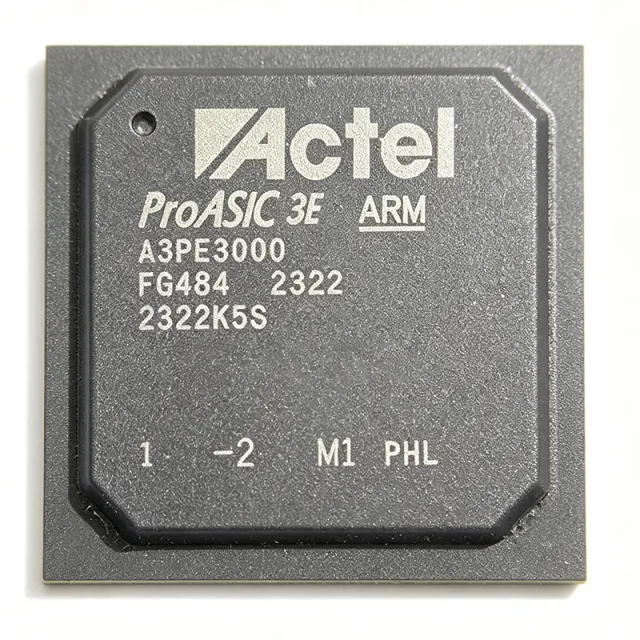
A3PE3000-1FGG484 - 3M-Gate ProASIC3E Flash FPGA | Microchip

Référence : A3PE3000-1FGG484 ✓ Actif
En stock Expédié sous 1 à 3 jours ouvrés
1.5 V Vdss 484-ball FBGA (FGG484) Package 231 MHz Speed 516096 Memory
À partir de $1425.71 USD / unité
MOQ : 1 |
Prix mis à jour : 2026-09-02
Tarifs dégressifs
Qté Prix unitaire Total
1 $1782.14 $1 782,14
10 $1693.03 $16 930,30
100 $1603.93 $160 393,00
500 $1514.82 $757 410,00
1 000 $1425.71 $1 425 710,00
ℹ️ Tous les prix sont en USD

A3PE3000-1FGG484 Présentation

The Microchip Technology A3PE3000-1FGG484 is a 3-million-gate ProASIC3E flash-based FPGA with 75,264 logic elements, 341 user I/O, and 516,096 bits of embedded memory, housed in a 484-ball Fine-Pitch Ball Grid Array (FBGA) measuring 23 x 23 mm with a 1 mm ball pitch. The -1 speed grade device operates from a 1.5V core supply and supports system performance up to 231 MHz on the 130nm flash process.

A flash FPGA is a field-programmable gate array whose configuration is stored in on-chip non-volatile flash memory rather than an external configuration device. Within the programmable logic hierarchy, the ProASIC3E family sits above smaller ProASIC3 parts and is positioned as a single-chip, low-total-cost-of-ownership solution: because the bitstream is stored on-chip, no external flash boot device is required, and the FPGA is inherently secure against bitstream interception.

Key features of the A3PE3000-1FGG484 include instant-on power-up (the fabric is active within microseconds of power application), reprogrammability without a microprocessor, low dynamic power from the 1.5V core, and an abundance of advanced features typical of the ProASIC3E family, including embedded memory blocks and support for the Cortex-M1 soft processor in related M1 ProASIC3 variants. The 341 available user I/O support multiple single-ended and differential standards for flexible board-level integration.

Architecturally, the device uses Microchip (formerly Actel/Microsemi) 130nm flash technology with a fine-grained fabric of versatile logic elements, routing resources, and distributed embedded flash memory totaling 516,096 bits. The 484-ball FBGA with 1 mm pitch balances I/O density with solderability on standard PCB assembly lines.

Typical applications include industrial automation and motor control, aerospace and defense systems requiring non-volatile, secure configuration, medical instrumentation, and communications equipment where single-chip instant-on logic replaces CPLD-plus-FPGA two-chip solutions.

When designing with this device, confirm the industrial temperature variant (A3PE3000-1FGG484I) if the end environment exceeds commercial ranges, and budget power distribution for the 1.5V core rail. Pricing on distributor channels is roughly $1,782 per unit for the industrial variant as of 2026-09-02.

This page synthesizes distributor pricing, same-footprint drop-in alternatives across the ProASIC3E and ProASIC3L families, and practical design notes not found in the manufacturer datasheet.

Alternatives de remplacement direct pour A3PE3000-1FGG484 — même boîtier, compatible broche à broche. Les références à boîtier différent nécessitant une retouche du PCB sont exclues.

Variantes de cette série

Modèles de la même série directement compatibles avec A3PE3000-1FGG484 (même facteur de forme et même empreinte) — différant par Package, Family, Process Technology, RoHS Status, Operating Temperature.

Microchip Technology
Package: 484-ball FBGA, 1 mm pitch
Family: ProASIC3E Flash FPGA
Process Technology: 130 nm, 7-layer metal (6 copper) flash-based CMOS
Comparer avec A3PE3000-1FGG484 →
Microchip Technology
Package: 484-ball FBGA, 1.0 mm pitch (FGG484)
Process Technology: 130-nm, 7-layer metal (6 copper), flash-based CMOS
RoHS Status: Compliant (FGG green package)
Comparer avec A3PE3000-1FGG484 →
Microchip Technology
Package: 484-ball FBGA (23 x 23 mm, 1.0 mm pitch)
Family: ProASIC3E (A3PE3000)
Process Technology: 130 nm
Comparer avec A3PE3000-1FGG484 →
Microchip Technology
Package: 484-Ball FBGA
Family: ProASIC3E (Flash)
RoHS Status: Compliant (green package per manufacturer data)
Comparer avec A3PE3000-1FGG484 →
Microchip Technology
Package: 484-BGA (FBGA-484), 23 x 23 mm, 1 mm pitch, 2.23 mm height
Process Technology: 130 nm CMOS
RoHS Status: RoHS Compliant (FGG lead-free variant)
Comparer avec A3PE3000-1FGG484 →
Microchip Technology
Package: 484-ball FBGA (FGG484), 23 x 23 mm, 1 mm pitch
Operating Temperature: -40C to +100C (Industrial)
Comparer avec A3PE3000-1FGG484 →
Microchip Technology
Package: 484-ball FBGA (FG484), 23 x 23 mm, 1 mm pitch
Family: ProASIC3L
Process Technology: 130 nm, 7-layer metal (6 copper), flash-based CMOS
Comparer avec A3PE3000-1FGG484 →
Microchip Technology
Package: 484-FPBGA (23 x 23 mm, 1 mm pitch, FBGA-484)
Family: ProASIC3L (Flash FPGA)
Process Technology: 130 nm, 7-layer metal (6 copper), flash-based CMOS
Comparer avec A3PE3000-1FGG484 →

Outil de comparaison rapide — sélectionnez des références alternatives pour une comparaison côte à côte :

A3PE3000-1FGG484I

✅ Remplacement direct
Microchip Technology
📦 484-ball FBGA (FGG484)
ProASIC3E · 3,000,000 (3M) · 35,000 · 504 Kbits (516,096 bits) · 341 · 484 · 484-ball FBGA, 1.0 mm pitch (FGG484) · CMOS

✓ En stock

$1336.6 / unité

Voir la fiche technique →

A3PE3000-FGG484

✅ Remplacement direct
Microchip Technology
📦 484-ball FBGA (FGG484)
ProASIC3E · 3000000 gates · 75264 · 341 · 516096 · 231 MHz · 130 nm CMOS · 1.5 V

✓ En stock

$152.6 / unité

Voir la fiche technique →

A3PE3000-FGG484I

✅ Remplacement direct
Microchip Technology
📦 484-ball FBGA (FGG484)
ProASIC3E · 3000000 · 75264 · 341 · 516096 · 1.5 V · 130 nm flash-based CMOS · 484-ball FBGA (FGG484), 23 x 23 mm, 1 mm pitch

✓ En stock

$1451.56 / unité

Voir la fiche technique →

A3PE3000-2FGG484I

✅ Remplacement direct
Microchip Technology
📦 484-ball FBGA (FGG484)
75264 · 3000000 · 341 · ProASIC3E (Flash) · Nonvolatile on-chip Flash · -2 · 484-Ball FBGA · Surface Mount

✓ En stock

$89.4 / unité

Voir la fiche technique →

A3PE3000L-1FGG484

✅ Remplacement direct
Microchip Technology
📦 484-ball FBGA (FGG484)
ProASIC3L · 3,000,000 · 75,264 · 341 · 616 · Up to 504 kbits true dual-port · 1.2 V to 1.5 V

✓ En stock

$134 / unité

Voir la fiche technique →

A3PE3000L-FGG484I

✅ Remplacement direct
Microchip Technology
📦 484-ball FBGA (FGG484)
ProASIC3L (Flash FPGA) · 3000000 · 75264 · 341 · 504 kbits true dual-port · 1.2 V to 1.5 V · 1.14 V to 1.575 V · 130 nm, 7-layer metal (6 copper), flash-based CMOS

✓ En stock

Contactez-nous pour le prix

Voir la fiche technique →

A3PE3000-1FGG484 Valeurs maximales et caractéristiques électriques

Family ProASIC3E
System Gates 3,000,000
Logic Cells 75264
User I/O 341
Embedded Memory Bits 516096
Maximum System Frequency 231 MHz
Process Technology 130 nm flash
Core Supply Voltage 1.5 V
Speed Grade -1
Boîtier 484-ball FBGA (FGG484)
Package Dimensions 23 x 23 mm
Ball Pitch 1 mm
Package Height 2.23 mm
Type de montage Surface Mount
Configuration Memory On-chip flash (non-volatile, single-chip)
Statut RoHS Compliant (lead-free per Kynix listing)

Guide de configuration des broches du A3PE3000-1FGG484 2.23 mm

Configuration des broches du A3PE3000-1FGG484 (boîtier 2.23 mm). Ce circuit intégré numérique comprend des GPIO, des interfaces de communication (UART, SPI, I2C) et des broches d'alimentation. Consultez la fiche technique du fabricant pour les fonctions alternatives des broches et les options de configuration. Indispensable pour la conception de systèmes embarqués et la conception de circuits imprimés.

Schéma de brochage du boîtier 2.23 mm pour le A3PE3000-1FGG484

Aucune donnée de brochage détaillée disponible pour A3PE3000-1FGG484.

Consultez la fiche technique pour la configuration complète des broches.

Applications typiques

A3PE3000-1FGG484 convient pour 6 applications: Industrial Automation and Motor Control, Aerospace and Defense Systems, Medical Instrumentation, Communications and Networking Equipment, Secure Single-Chip Embedded Systems, Test and Measurement Instrumentation.

🏭

Industrial Automation and Motor Control

The A3PE3000-1FGG484 fits industrial control backplanes and multi-axis motor controllers where deterministic instant-on logic is required at power-up. Its 75,264 logic cells and 341 user I/O provide enough capacity to integrate PWM generation, encoder interfaces, and safety interlock logic in a single chip, while 516,096 bits of embedded memory buffer telemetry and recipe data. Because configuration is stored on-chip in flash, production lines start immediately without a boot sequence, and the 1.5V core keeps dynamic power acceptable in sealed cabinets. Place the FPGA between 24V field-side isolation and the backplane interface, using its I/O banks for 3.3V/2.5V standards; the 231 MHz-class fabric comfortably closes timing on 100 MHz-class control loops.

✈️

Aerospace and Defense Systems

ProASIC3E flash FPGAs are a mainstay in avionics, satellites, and defense electronics because the configuration bitstream resides in secure on-chip flash with no external configuration device to read, intercept, or fail. The A3PE3000-1FGG484 supplies 3 million system gates and 341 I/O for payload data formatting, bus bridging, and telemetry aggregation, with instant-on behavior valuable in power-cycled flight scenarios. The 484-ball 23 x 23 mm FBGA supports reliable solder attachment on high-reliability assembly lines. For programs with wide temperature requirements, the pin-compatible A3PE3000-1FGG484I industrial variant is the standard substitution; verify screening requirements against program specifications before final selection.

💊

Medical Instrumentation

Medical imaging front-ends, patient monitors, and diagnostic analyzers benefit from the A3PE3000-1FGG484's single-chip, non-volatile architecture: no configuration PROM means one fewer component to qualify and a reduced failure surface in long-lifecycle instruments. The 75,264 logic elements implement sensor timing controllers, filter accelerators, and interface bridges, while 341 I/O banks connect ADCs, displays, and communication modules at 3.3V/2.5V/1.8V standards. The 1.5V core reduces dynamic power, simplifying thermal design in fanless bedside equipment. Designers should allocate I/O banks so analog-adjacent signals use the quietest banks and follow Microchip's layout guidance for the 1 mm-pitch FBGA escape routing.

🌐

Communications and Networking Equipment

In line cards, aggregation switches, and wireless infrastructure, the A3PE3000-1FGG484 serves as glueless bridge logic between MACs, PHYs, and backplanes, using its 341 I/O to span multiple voltage domains. The 516,096-bit embedded memory implements FIFOs and descriptor rings, and the 231 MHz-class fabric closes timing for 125-156 MHz interface clocks common in MII/GMII-adjacent designs. Because the fabric is active within microseconds of power application, link supervision and safety shut-off logic operate before software boots, an advantage over SRAM FPGAs that wait for configuration. Estimated: dynamic power scales with toggle rate - use SmartPower analysis when budgeting the 1.5V core rail.

🔒

Secure Single-Chip Embedded Systems

Applications that must resist cloning and bitstream theft - payment terminals, license-control hardware, cryptographic accelerators - choose the A3PE3000-1FGG484 because flash-based configuration cannot be read out like SRAM configuration bits, and no external boot flash exists to dump. The 3M-gate fabric hosts AES-class logic and system controllers, and 516,096 bits of embedded memory stores keys and counters. Instant-on operation means security logic enforces policy from the first microsecond of power. The 484-ball FBGA (23 x 23 mm, 1 mm pitch) suits both cost-sensitive and high-reliability assembly; pair with Microchip secure memory or authentication ICs for device-identity architectures.

🔧

Test and Measurement Instrumentation

Bench instruments, protocol analyzers, and automated test equipment use the A3PE3000-1FGG484 as a flexible timing, trigger, and interface engine. Its 341 I/O connect to probe front ends, pattern generators, and host interfaces across multiple I/O standards, while the 231 MHz-class fabric and 75,264 logic elements implement deep trigger state machines and timestamping with the 516,096-bit embedded memory as capture buffers. Non-volatile configuration lets instruments pass calibration self-test immediately at power-up, and field firmware updates are applied through JTAG using Microchip Libero tooling. The industrial -1FGG484I variant suits portable instruments exposed to wide ambient ranges in the identical 484-ball footprint.

Récapitulatif des produits recommandés

MCP2515 CAN controller for fieldbus interface Utilisé dans : Industrial Automation and Motor Control M29W640GB70N3E Micron Technology Utilisé dans : Industrial Automation and Motor Control A3PE3000-1FGG484I Microchip Technology Utilisé dans : Aerospace and Defense Systems M29W128GL70N3E Micron Technology Utilisé dans : Aerospace and Defense Systems A3PE600-1FGG484I Microchip Technology Utilisé dans : Medical Instrumentation MCP23S17 SPI GPIO expander for control panel I/O Utilisé dans : Medical Instrumentation M29W800FT70N3E Micron Technology Utilisé dans : Communications and Networking Equipment MCP2562 CAN transceiver for management plane Utilisé dans : Communications and Networking Equipment ATSHA204A secure authentication companion IC Utilisé dans : Secure Single-Chip Embedded Systems M25P16-VMF3PB Micron Technology Utilisé dans : Secure Single-Chip Embedded Systems A3PE3000-2FGG484I Microchip Technology Utilisé dans : Test and Measurement Instrumentation MCP3208 12-bit ADC for housekeeping channels Utilisé dans : Test and Measurement Instrumentation
What is the A3PE3000-1FGG484 and what are its key specifications?
The A3PE3000-1FGG484 is a Microchip Technology ProASIC3E flash-based FPGA with 3 million system gates, 75,264 logic cells, 341 user I/O, and 516,096 bits of embedded memory. It runs from a 1.5V core supply, reaches up to 231 MHz system performance on a 130nm flash process, and comes in a 484-ball FBGA measuring 23 x 23 mm with 1 mm pitch. According to DigiKey and Microchip product data, the -1 speed grade part is a single-chip, non-volatile FPGA that requires no external configuration device.
What is the price of A3PE3000-1FGG484?
The A3PE3000-1FGG484 is a premium FPGA; the industrial variant A3PE3000-1FGG484I is listed at approximately $1,782.14 per unit at quantity one on eBee Electronics as of 2026-09-02. Octopart compares bulk pricing across 7 distributors for the commercial variant. Expect volume discounts of roughly 5-20% at 100+ piece quantities depending on distributor stock levels, and request quotes for large orders since availability fluctuates on this mature ProASIC3E family.
Where can I buy A3PE3000-1FGG484 online?
The A3PE3000-1FGG484 can be purchased from DigiKey (stock status: ships today per their listing), Mouser, Arrow, and specialized distributors such as Microchip USA and Kynix, with Octopart aggregating offers from 7 distributors. XAIPART also supplies this part with quote-based ordering. Because this is a higher-cost FPGA, compare at least two distributors before ordering, and verify whether the listing is the commercial (-1FGG484) or industrial (-1FGG484I) temperature variant.
Is A3PE3000-1FGG484 in stock and what is the lead time?
DigiKey lists the A3PE3000-1FGG484 as in stock with same-day shipping (Order today, ships today), and Octopart reports 7 distributors carrying the part as of 2026-09-02. Lead times on mature Microchip ProASIC3E parts can vary; if primary distributors are depleted, authorized brokers such as Microchip USA typically quote 4-12 weeks. Always confirm real-time stock at checkout, as FPGA inventory in this family moves in spikes with defense and industrial demand.
What is the difference between A3PE3000-1FGG484 and A3PE3000-FGG484?
The suffix difference is the speed grade: the -1 in A3PE3000-1FGG484 denotes the -1 (standard) speed grade, while A3PE3000-FGG484 is the baseline speed grade with lower maximum system frequency. Both share the same 484-ball FGG package, 3M gate density, 341 I/O, and 1.5V core, so they are drop-in compatible on the same PCB footprint. Choose the -1 grade when your design timing closure benefits from the faster fabric; the slower grade costs less for non-timing-critical glue logic.
A3PE3000-1FGG484 vs A3PE3000-1FGG484I - which should I choose?
Choose the A3PE3000-1FGG484I if your product must operate over the industrial temperature range (typically -40C to +100C junction for this family); choose the commercial A3PE3000-1FGG484 for controlled-environment products. Both are electrically identical: 3M gates, 341 I/O, 516,096 memory bits, 1.5V core, same 484-ball FBGA footprint and pinout, so the PCB layout is unchanged. The industrial variant carries a premium - approximately $1,782 per unit on eBee as of 2026-09-02 - so specify it only when the temperature envelope demands it.
When should I choose the A3PE3000 over a SRAM-based FPGA?
Choose the A3PE3000-1FGG484 when you need instant-on operation, single-chip configuration without an external boot flash, and resistance to bitstream interception. Unlike SRAM FPGAs that lose configuration at power-off, the ProASIC3E stores its bitstream in on-chip flash and becomes active within microseconds of power-up, eliminating the CPLD-plus-FPGA two-chip solution. Trade-offs to accept honestly: 130nm fabric performance (231 MHz class) trails modern SRAM families, so choose a Xilinx or Intel device instead if you need multi-gigabit transceivers or very high logic speeds.
Is the A3PE3000-1FGG484 suitable for aerospace and defense applications?
Yes, ProASIC3E flash FPGAs are widely used in aerospace and defense because the configuration lives in non-volatile on-chip flash, removing the external configuration device that is a common attack and failure point. The single-chip solution reduces board complexity, and flash cells are inherently immune to configuration readback. For space or extreme-temperature programs, Microchip offers military/screened variants of the ProASIC3 family; for standard industrial-grade programs, the -1FGG484I industrial variant in the same 484-ball package is the usual choice.
What is the best drop-in replacement for A3PE3000-1FGG484?
The best drop-in replacements are same-family Microchip parts in the identical 484-ball FGG package: A3PE3000-FGG484 and A3PE3000-FGG484I (slower baseline speed grade, same pinout), A3PE3000-2FGG484I (faster -2 speed grade, same footprint), and A3PE3000L-1FGG484 / A3PE3000L-FGG484I (ProASIC3L low-power variants, pin-compatible). All preserve the 3M-gate density and 341 I/O, so no PCB rework is required - only a firmware/toolchain recompile for the chosen speed grade or power variant.
What is the best cross-brand equivalent for A3PE3000-1FGG484?
There is no true cross-brand drop-in equivalent for the A3PE3000-1FGG484: Lattice MachXO2/ECO families, Xilinx Spartan-6 (e.g., XC6SLX9), and Intel MAX 10 offer similar logic density in different packages and pinouts, requiring PCB redesign. According to distributor comparison data (ETEI), these parts approximate the ~3M-gate function but are functional alternatives, not pin-compatible drop-ins. If your board is already laid out for the 484-ball ProASIC3E footprint, stay within the Microchip ProASIC3E/ProASIC3L family for guaranteed pin compatibility.
Where can I download the A3PE3000-1FGG484 datasheet PDF?
The A3PE3000-1FGG484 datasheet is available free from the Microchip product page at microchip.com/en-us/product/A3PE3000, which links the current ProASIC3E family datasheet PDF covering DC/AC characteristics, timing, I/O standards, and package mechanicals. DigiKey and Mouser product pages also host the datasheet download for registered and guest users. Avoid third-party mirror sites for the latest revision; Microchip's page is authoritative and includes the companion Libero SoC design software documentation.
Where can I find the A3PE3000-1FGG484 pinout or ball map?
The complete 484-ball ball map for the A3PE3000-1FGG484 is provided in the ProASIC3E family datasheet package section on the Microchip website, and Microchip's Libero SoC design suite generates the exact ball assignments for your design's I/O constraints. Distributors such as DigiKey and eBee also provide pinout diagram access. Because the ball map spans 484 balls across power, ground, JTAG, configuration, and 341 user I/O, always constrain I/O placement in Libero rather than copying ball assignments from another package variant.
What power supply design does the A3PE3000-1FGG484 require?
The A3PE3000-1FGG484 operates from a 1.5V core supply, with separate I/O bank supplies supporting the voltage standards your design selects (VCCI per bank). Estimated: dynamic power scales with clock frequency and toggle rate - at the 231 MHz class performance, budget core current using Microchip's SmartPower power estimator in Libero before finalizing regulators. Decouple each supply ball group with ceramic capacitors placed close to the package, and sequence power so I/O banks are not driven externally before their supplies are established to avoid latch-up.
Can A3PE3000L variants replace the A3PE3000-1FGG484?
Yes, the ProASIC3L low-power variants (A3PE3000L-1FGG484, A3PE3000L-FGG484I) are pin-compatible drop-in replacements in the same 484-ball package with the same 3M-gate fabric. The key difference is process/power optimization: ProASIC3L parts are built for lower static and dynamic power, at some cost in maximum frequency versus the standard ProASIC3E. If your system is battery-powered or thermally constrained, the L variant reduces power in the same footprint; if you need maximum speed margin, stay with the ProASIC3E.
Is the A3PE3000-1FGG484 RoHS compliant and lead-free?
Yes, the A3PE3000-1FGG484 is RoHS compliant and lead-free; the Kynix product listing explicitly marks the part as LEAD FREE, and Microchip's current production ProASIC3E devices are green/RoHS packages (the Xecor component database records RoHS Code Yes for the FGG484 package, 23 x 23 mm). The package uses a 1 mm ball pitch FBGA construction compatible with standard lead-free reflow profiles. For exact REACH and substance-of-concern declarations, download the certificate of conformance from Microchip's environmental documentation portal.

Données de référence d'ingénierie pour A3PE3000-1FGG484 — comparaison, recommandations de conception et informations de conformité.

Guide de sélection

Choose the A3PE3000-1FGG484 when you need 3M-gate-class, instant-on, secure flash FPGA logic on an existing ProASIC3E 484-ball footprint in a commercial temperature environment. Choose A3PE3000-1FGG484I for industrial or defense ambient ranges - same die, package, and pinout, roughly $1,782/unit at qty 1 as of 2026-09-02. Choose A3PE3000-FGG484 to save cost where timing closure has margin (baseline speed grade, same footprint), or A3PE3000-2FGG484I when you need speed and industrial range. Choose A3PE3000L-1FGG484 or A3PE3000L-FGG484I when power budget dominates, accepting reduced maximum frequency. Do not treat Lattice MachXO2, Xilinx Spartan-6, or Intel MAX 10 as drop-ins: they approximate density but differ in package and pinout, forcing board redesign - consider them only for new layouts.

Comparaison avec les alternatives

Paramètre Ce produit A3PE3000-1FGG484I A3PE3000-FGG484 A3PE3000-2FGG484I A3PE3000L-1FGG484
Package 484-ball FBGA (FGG484), 23 x 23 mm 484-ball FBGA (FGG484) - same 484-ball FBGA (FGG484) - same 484-ball FBGA (FGG484) - same 484-ball FBGA (FGG484) - same
Brand Microchip Technology Microchip Technology Microchip Technology Microchip Technology Microchip Technology
System Gates 3,000,000 3,000,000 3,000,000 3,000,000 3,000,000
Speed Grade -1 -1 Standard (slower) -2 (faster) -1 class
User I/O 341 341 341 341 341
Core Supply Voltage 1.5 V 1.5 V 1.5 V 1.5 V 1.5 V
Temperature Range Commercial Industrial (-40C to +100C class) Commercial Industrial (-40C to +100C class) Commercial
Power Profile Standard ProASIC3E dynamic power Same as this product Lower (slower speed grade) Higher (faster speed grade) Lower (ProASIC3L low-power process)

Principaux différenciateurs

  • Faster -1 speed grade at identical footprint (vs A3PE3000-FGG484)
  • Industrial temperature option without redesign (vs A3PE3000-1FGG484I)
  • Lower power alternative in the same package (vs A3PE3000L-1FGG484)
  • Single-chip non-volatile configuration (vs XC6SLX9 (Xilinx Spartan-6, cross-brand))

Notes de conception

The A3PE3000-1FGG484 requires a regulated 1.5V core supply plus per-bank VCCI rails for the I/O standards in use. Estimated: dynamic core current scales with clock frequency and logic toggle rate - run Microchip SmartPower in Libero SoC with your post-place-and-route design to size the core regulator before committing hardware. Decouple each VCCI bank with local ceramic capacitors (10uF bulk plus 0.1uF per bank) placed within a few millimeters of the associated balls. Sequence supplies so external drivers do not back-power I/O banks before their rails stabilize.

Escape routing for the 484-ball, 1 mm-pitch FBGA (23 x 23 mm) typically requires via-in-pad or dog-bone escapes with 4-mil trace/space on at least a 4-layer board; dedicate internal layers to a solid ground plane under the package for return-current integrity. Solder the package with a standard lead-free reflow profile compatible with RoHS SAC305 balls, and inspect with X-ray given the 1 mm pitch. Do not route high-speed signals on the outer layer directly beneath the die area without an adjacent reference plane.

Order the correct temperature suffix: the commercial A3PE3000-1FGG484 and industrial A3PE3000-1FGG484I share the same footprint and pinout, so a commercial part specified into an industrial build will not be caught by layout review. Also confirm speed grade in the Libero constraint file matches the purchased device (-1 here); a mismatch causes timing closure to be optimistic. Finally, remember that unlike SRAM FPGAs, no external configuration flash is needed - do not copy boot-flash circuitry from Spartan-6 reference designs.

With 341 user I/O across multiple banks, assign simultaneous-switching groups carefully: distribute high-toggle-count buses across banks and VCCI domains to reduce ground bounce on the shared return path. The 1 mm ball pitch introduces stub inductance; for the fastest single-ended standards, use Microchip's IBIS models from the product page in your board-level simulations. Differential pairs should be length-matched from ball to receiver, keeping the escape region symmetrical to avoid skew introduced by via stubs.

Informations de conformité

RoHS
Compliant
REACH
Unknown
AEC-Q100
Not Applicable
Sans plomb
Yes
Sans halogène
Unknown
Minerais de conflit
Unknown

Kynix listing marks A3PE3000-1FGG484 as LEAD FREE; Xecor database records RoHS Code Yes for the FGG484 package (23 x 23 mm, green package description). REACH and halogen-free declarations not found in provided data.

Données vérifiées le : 2026-09-02 — données vérifiées et sélectionnées par l'équipe d'ingénierie composants de XAIPART

Recherches associées

A3PE3000-1FGG484 datasheet A3PE3000-1FGG484 price Microchip A3PE3000-1FGG484 A3PE3000-1FGG484 vs A3PE3000-1FGG484I A3PE3000-1FGG484 drop-in replacement ProASIC3E 3M gate FPGA 484 FBGA A3PE3000 pinout ball map 484 flash FPGA industrial automation motor control A3PE3000-1FGG484 buy in stock what can replace A3PE3000-1FGG484 instant-on FPGA no external configuration flash A3PE3000L low power FPGA equivalent

Composants & termes associés

Microchip Technology A3PE3000-1FGG484 A3PE3000-1FGG484I A3PE3000-FGG484 A3PE3000L-1FGG484 ProASIC3E ProASIC3L FPGA field-programmable gate array flash-based FPGA non-volatile configuration 484-ball FBGA BGA package family 130nm process 1.5V core 341 user I/O 516096 embedded memory bits RoHS Cortex-M1 soft processor Libero SoC Actel Microsemi instant-on power-up industrial automation
Guides techniques associés
Guide complet A3PE3000-1FGG484 : caractéristiques du FPGA Flash ProASIC3E 3M portes, alternatives et notes de conception
A3PE3000-1FGG484 : FPGA Flash ProASIC3E 3M portes de Microchip, 75 264 cellules logiques, 341 E/S, 231 MHz, FBGA 484 billes. En stock, à par
9 min de lecture
RFQ de devis rapide
Renseignez tous les détails — notre équipe commerciale vous répondra sous 24 heures
Référence Fabricant Boîtier QTY Prix cible Total
Total : 0,00 USD
✓
Devis envoyé !

Nous répondrons à votre e-mail sous 24 heures

1
RFQ envoyée
2
Devis reçu
3
Commande passée
4
Paiement
5
Expédié
6
Livré
Voir les détails de la RFQ