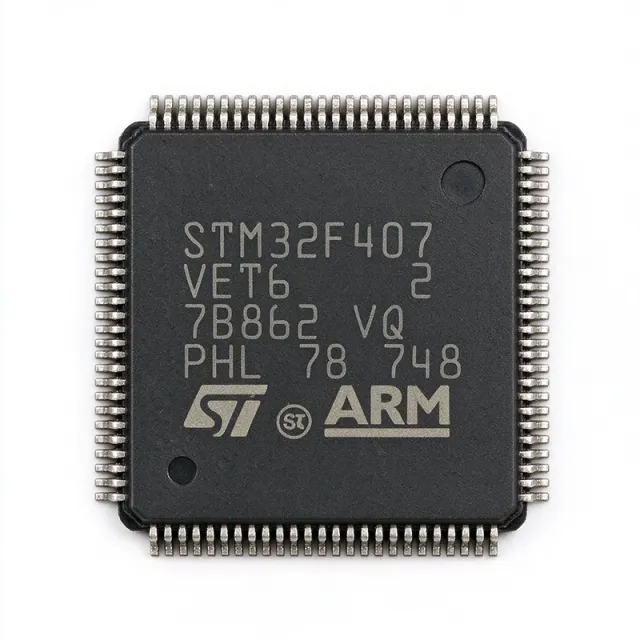
STM32F407VET6 - 168MHz Cortex-M4 MCU 512KB Flash LQFP-100 | ST
MPN: STM32F407VET6 ✓ פעיל| כמות | מחיר ליחידה | סה"כ |
|---|---|---|
| 1 | $6.1875 | $6.19 |
| 10 | $4.4688 | $44.69 |
| 100 | $3.9531 | $395.31 |
| 500 | $3.7813 | $1,890.65 |
| 1,000 | $3.6094 | $3,609.40 |
STM32F407VET6 סקירה
What is a microcontroller? A microcontroller (MCU) is a single-chip integrated circuit that combines a processor core, non-volatile program memory (Flash), volatile working memory (SRAM), and programmable peripherals to govern specific operations in embedded systems. The STM32F407VET6 belongs to the STM32F4 series built on the ARM Cortex-M4 core with FPU, positioned within the broader hierarchy of 32-bit MCUs - microcontroller in the embedded semiconductor taxonomy used in supply chains.
Key features include an on-chip 10/100 Ethernet MAC with IEEE 1588v2, USB 2.0 OTG Full-Speed and High-Speed with PHY, a digital camera interface (DCMI), three 12-bit ADCs with up to 24 channels and 2.4 MSPS, dual 12-bit DACs, an SDIO interface, FSMC for external memory, a crypto/hash peripheral, and a rich set of timers, USART, SPI, I2C, and CAN interfaces. The supply range is 1.8V to 3.6V with operation from -40C to +85C.
Technically, the STM32F407VET6 uses a Harvard bus architecture with separate instruction and data buses enabling simultaneous fetch and access, an ART Accelerator with 128-bit Flash prefetch eliminating wait states from Flash, a memory protection unit (MPU), and a nested vectored interrupt controller (NVIC) supporting deterministic real-time behavior. The single-precision FPU accelerates math-intensive firmware for control loops and DSP.
Typical applications include industrial motor control and PLCs, networked IoT gateways using the on-chip Ethernet MAC, USB device and host designs, and machine-vision or imaging systems using the DCMI camera interface.
Design tip: decouple every VDD pin with 100 nF ceramics plus bulk capacitance, route VDDA/VSSA on a clean analog plane to minimize ADC noise, and place the HSE crystal as close as possible with proper guard rings for stable clocking.
This page synthesizes distributor pricing, drop-in alternatives, and practical design considerations not found in the standalone manufacturer datasheet, including LQFP-100 same-footprint cross references and companion MPNs for reference designs.
חלופות תחליף ישיר עבור STM32F407VET6 — אותו מארז, תואם פין-לפין. חלקים במארז שונה הדורשים עיבוד מחדש של ה-PCB אינם נכללים.
וריאנטים בסדרה זו
דגמים מאותה סדרה התואמים Drop-in עם STM32F407VET6 (אותו גורם צורה וטביעת רגל) — שונים ב Package, SRAM, ADC, Communication Interfaces, Mounting Type.
כלי השוואה מהיר — בחרו חלקים חלופיים להשוואה זה לצד זה:
STM32F407VGT6
✗ אזל מהמלאי
$7.55 / יחידה
הצג גיליון נתונים ←STM32F405VGT6
צור קשר לקבלת מחיר
הצג גיליון נתונים ←STM32F427VIT6
✗ אזל מהמלאי
$10.5 / יחידה
הצג גיליון נתונים ←STM32F417VIT6
📋 חלופה להתייחסות (לא בקטלוג)
GD32F407VET6
📋 חלופה להתייחסות (לא בקטלוג)
GD32F407VGT6
📋 חלופה להתייחסות (לא בקטלוג)
STM32F407VET6 דירוגים מרביים ומאפיינים חשמליים
| Core Architecture | ARM Cortex-M4F (32-bit RISC with FPU) |
| תדר שעון מקסימלי | 168 MHz |
| Program Memory (Flash) | 512 KB |
| SRAM | 192 KB |
| מארז | LQFP-100 (14x14 mm) |
| Supply Voltage (VDD) | 1.8 V to 3.6 V |
| טמפרטורת פעולה | -40C to +85C |
| רוחב אפיק נתונים | 32 bit |
| ADC | 3 x 12-bit, up to 24 input channels |
| DAC | 2 x 12-bit |
| Communication Interfaces | USB OTG HS/FS, Ethernet MAC, 3x SPI, 3x I2C, 4x USART, 2x UART, 2x CAN, SDIO |
| Camera Interface | DCMI (Digital Camera Interface) |
| סוג הרכבה | Surface Mount (SMD/SMT) |
| רמת MSL | 3 (168 hours) |
| סטטוס RoHS | Compliant |
| External Memory Bus | FSMC (Flexible Static Memory Controller) |
תצורת פינים של STM32F407VET6
| פין 1 | PE2 — GPIO PE2 / TRACECLK / FSMC_A23 |
| פין 2 | PE3 — GPIO PE3 / TRACED0 / FSMC_A19 |
| פין 3 | PE4 — GPIO PE4 / TRACED1 / FSMC_A20 |
| פין 4 | PE5 — GPIO PE5 / TRACED2 / FSMC_A21 |
| פין 5 | PE6 — GPIO PE6 / TRACED3 / FSMC_A22 |
| פין 6 | VBAT — Battery backup supply for RTC and backup registers |
| פין 7 | PC13 — GPIO PC13 / RTC_TAMP1 / RTC_OUT / RTC_TS |
| פין 8 | PC14 — GPIO PC14 / OSC32_IN |
| פין 9 | PC15 — GPIO PC15 / OSC32_OUT |
| פין 10 | VSS — Digital ground |
| פין 11 | VDD — Digital supply (1.8V-3.6V) |
| פין 12 | OSC_IN — HSE oscillator input |
| פין 13 | OSC_OUT — HSE oscillator output |
| פין 14 | NRST — Reset input (active low) |
| פין 15 | PC0 — GPIO PC0 / ADC10_IN10 |
| פין 16 | PC1 — GPIO PC1 / ADC11_IN11 |
| פין 17 | PC2 — GPIO PC2 / ADC12_IN12 |
| פין 18 | PC3 — GPIO PC3 / ADC13_IN13 |
| פין 19 | VSSA — Analog ground |
| פין 20 | VDDA — Analog supply (1.8V-3.6V) |
| פין 21 | PA0/WKUP — GPIO PA0 / WKUP / ADC0_IN0 / TIM2_CH1 |
| פין 22 | PA1 — GPIO PA1 / ADC1_IN1 / TIM2_CH2 |
| פין 23 | PA2 — GPIO PA2 / ADC2_IN2 / TIM2_CH3 / USART2_TX |
| פין 24 | PA3 — GPIO PA3 / ADC3_IN3 / TIM2_CH4 / USART2_RX |
| פין 25 | VSS — Digital ground |
| פין 26 | VDD — Digital supply |
| פין 27 | PA4 — GPIO PA4 / ADC4_IN4 / DAC_OUT1 / SPI1_NSS |
| פין 28 | PA5 — GPIO PA5 / ADC5_IN5 / DAC_OUT2 / SPI1_SCK |
| פין 29 | PA6 — GPIO PA6 / ADC6_IN6 / SPI1_MISO / TIM13_CH1 |
| פין 30 | PA7 — GPIO PA7 / ADC7_IN7 / SPI1_MOSI / TIM14_CH1 |
| פין 31 | PC4 — GPIO PC4 / ADC14_IN14 |
| פין 32 | PC5 — GPIO PC5 / ADC15_IN15 |
| פין 33 | PB0 — GPIO PB0 / ADC8_IN8 / TIM3_CH3 |
| פין 34 | PB1 — GPIO PB1 / ADC9_IN9 / TIM3_CH4 |
| פין 35 | PB2 — GPIO PB2 / BOOT1 |
| פין 36 | PE7 — GPIO PE7 / FSMC_D4 |
| פין 37 | PE8 — GPIO PE8 / FSMC_D5 |
| פין 38 | PE9 — GPIO PE9 / FSMC_D6 |
| פין 39 | PE10 — GPIO PE10 / FSMC_D7 |
| פין 40 | PE11 — GPIO PE11 / FSMC_D8 |
| פין 41 | PE12 — GPIO PE12 / FSMC_D9 |
| פין 42 | PE13 — GPIO PE13 / FSMC_D10 |
| פין 43 | PE14 — GPIO PE14 / FSMC_D11 |
| פין 44 | PE15 — GPIO PE15 / FSMC_D12 |
| פין 45 | PB10 — GPIO PB10 / I2C2_SCL / USART3_TX |
| פין 46 | PB11 — GPIO PB11 / I2C2_SDA / USART3_RX |
| פין 47 | VSS — Digital ground |
| פין 48 | VDD — Digital supply |
| פין 49 | PB12 — GPIO PB12 / SPI2_NSS / I2C2_SMBA / USBOTGHS_ID |
| פין 50 | PB13 — GPIO PB13 / SPI2_SCK / USBOTGHS_VBUS |
| פין 51 | PB14 — GPIO PB14 / SPI2_MISO / USBOTGHS_DM |
| פין 52 | PB15 — GPIO PB15 / SPI2_MOSI / USBOTGHS_DP |
| פין 53 | PD8 — GPIO PD8 / FSMC_D13 / USART3_TX |
| פין 54 | PD9 — GPIO PD9 / FSMC_D14 / USART3_RX |
| פין 55 | PD10 — GPIO PD10 / FSMC_D15 |
| פין 56 | PD11 — GPIO PD11 / FSMC_A16 |
| פין 57 | PD12 — GPIO PD12 / FSMC_A17 |
| פין 58 | PD13 — GPIO PD13 / FSMC_A18 |
| פין 59 | PD14 — GPIO PD14 / FSMC_D0 |
| פין 60 | PD15 — GPIO PD15 / FSMC_D1 |
| פין 61 | PC6 — GPIO PC6 / I2S2_MCK / TIM8_CH1 / SDIO_D6 |
| פין 62 | PC7 — GPIO PC7 / I2S3_MCK / TIM8_CH2 / SDIO_D7 |
| פין 63 | PC8 — GPIO PC8 / TIM8_CH3 / SDIO_D0 |
| פין 64 | PC9 — GPIO PC9 / I2C3_SDA / SDIO_D1 |
| פין 65 | PA8 — GPIO PA8 / I2C3_SCL / USART1_CK / MCO1 |
| פין 66 | PA9 — GPIO PA9 / USART1_TX / TIM1_CH2 / USBOTGFS_VBUS |
| פין 67 | PA10 — GPIO PA10 / USART1_RX / TIM1_CH3 / USBOTGFS_ID |
| פין 68 | PA11 — GPIO PA11 / USART1_CTS / USBOTGFS_DM |
| פין 69 | PA12 — GPIO PA12 / USART1_RTS / USBOTGFS_DP |
| פין 70 | PA13 — GPIO PA13 / JTMS-SWDIO |
| פין 71 | VSS — Digital ground |
| פין 72 | VDD — Digital supply |
| פין 73 | PA14 — GPIO PA14 / JTCK-SWCLK |
| פין 74 | PA15 — GPIO PA15 / JTDI / SPI3_NSS |
| פין 75 | PC10 — GPIO PC10 / UART4_TX / SDIO_D2 |
| פין 76 | PC11 — GPIO PC11 / UART4_RX / SDIO_D3 |
| פין 77 | PC12 — GPIO PC12 / UART5_TX / SDIO_CK |
| פין 78 | PD0 — GPIO PD0 / FSMC_D2 / CAN1_RX |
| פין 79 | PD1 — GPIO PD1 / FSMC_D3 / CAN1_TX |
| פין 80 | PD2 — GPIO PD2 / UART5_RX / SDIO_CMD |
| פין 81 | PD3 — GPIO PD3 / FSMC_CLK |
| פין 82 | PD4 — GPIO PD4 / FSMC_NOE |
| פין 83 | PD5 — GPIO PD5 / FSMC_NWE |
| פין 84 | PD6 — GPIO PD6 / FSMC_NWAIT |
| פין 85 | PD7 — GPIO PD7 / FSMC_NCE2 / FSMC_NE1 |
| פין 86 | PB3 — GPIO PB3 / JTDO / SPI3_SCK / I2S3_CK |
| פין 87 | PB4 — GPIO PB4 / NJTRST / SPI3_MISO |
| פין 88 | PB5 — GPIO PB5 / I2C1_SMBA / SPI3_MOSI / I2S3_SD |
| פין 89 | PB6 — GPIO PB6 / I2C1_SCL / TIM4_CH1 / USART1_TX |
| פין 90 | PB7 — GPIO PB7 / I2C1_SDA / TIM4_CH2 / USART1_RX |
| פין 91 | BOOT0 — Boot mode selection (main Flash / system memory / SRAM) |
| פין 92 | PB8 — GPIO PB8 / TIM4_CH3 / I2C1_SCL / CAN1_RX |
| פין 93 | PB9 — GPIO PB9 / TIM4_CH4 / I2C1_SDA / CAN1_TX |
| פין 94 | PE0 — GPIO PE0 / TIM4_ETR / FSMC_NBL0 |
| פין 95 | PE1 — GPIO PE1 / FSMC_NBL1 |
| פין 96 | VSS — Digital ground |
| פין 97 | VSS — Digital ground |
| פין 98 | VDD — Digital supply |
| פין 99 | VDD — Digital supply |
| פין 100 | VSS — Digital ground |
יישומים טיפוסיים
STM32F407VET6 מתאים עבור 6 יישוםs: Industrial Motor Control and PLCs, Networked IoT Gateway with Ethernet, USB Device, Host and OTG Designs, Machine Vision and Imaging Systems, Audio Processing and DSP, Data Acquisition and Industrial Instrumentation.
Industrial Motor Control and PLCs
The STM32F407VET6 is well-suited for industrial motor control and PLC platforms where deterministic real-time performance is required. Its 168 MHz Cortex-M4F core with FPU and DSP extensions accelerates Park/Clarke transforms used in field-oriented control (FOC) for PMSM and ACIM motors. Three 12-bit ADCs at up to 2.4 MSPS enable simultaneous current and voltage sensing on all three motor phases for high-bandwidth torque control loops. Advanced timers with complementary PWM outputs and programmable dead-time insertion directly drive half-bridge power stages such as the STGIPN3H60 or gate drivers. Industrial operating temperature from -40C to +85C supports factory floor deployments, while CAN interfaces (2x) integrate with industrial fieldbus networks. Companion MPNs include STGIPN3H60 IGBT module, ACS712 current sensor, and isolated CAN transceiver.
מומלץ
Networked IoT Gateway with Ethernet
The STM32F407VET6 integrates a 10/100 Ethernet MAC with IEEE 1588v2 hardware timestamping that, paired with an external LAN8720A or DP83848 PHY, brings up a full TCP/IP gateway without an external Ethernet controller. Its 168 MHz Cortex-M4F core runs lwIP or similar stacks while reserving CPU headroom for application logic and TLS encryption accelerated by the on-chip crypto/hash peripheral. The 192 KB SRAM comfortably fits MQTT, CoAP, and TLS session buffers for typical edge gateway workloads, and the 512 KB Flash holds bootloader, application, and OTA staging partitions. USB OTG FS enables local configuration via mass storage or CDC, while SDIO supports local data logging. Companion MPNs include LAN8720A PHY, W25Q128JVSIQ NOR Flash for OTA, and TPS62135RGTR for power regulation.
מומלץ
USB Device, Host and OTG Designs
The STM32F407VET6 includes both USB OTG Full-Speed (12 Mbps) and High-Speed (480 Mbps) controllers with on-chip PHYs, enabling USB device, host, and OTG roles without external components. HS USB with the integrated ULPI-less PHY supports high-throughput functions such as mass storage, CDC ACM, HID, and audio class devices at full USB 2.0 speeds for industrial peripherals and test instruments. The 168 MHz Cortex-M4F core handles USB stack processing, class drivers, and application code concurrently, while 192 KB SRAM buffers USB packets efficiently. VBUS sensing pins and integrated 5V-tolerance on D+/D- simplify USB-C connector interfaces when paired with FUSB302 chipset. Companion MPNs include FUSB302UCX USB-C controller, USBLC6-2SC6 ESD protection, and TPS73633DBVR LDO.
מומלץ
Machine Vision and Imaging Systems
The STM32F407VET6 integrates a Digital Camera Interface (DCMI) that receives 8/10/12/14-bit parallel video streams from CMOS image sensors such as OV5640 or MT9V032, enabling cost-effective machine-vision and embedded imaging applications. The 168 MHz Cortex-M4F core runs JPEG/MJPEG compression, basic image processing, and feature extraction at video rates for applications like barcode scanning, optical inspection, and biometric capture. FSMC bus supports external SRAM or PSRAM buffering of full-resolution frames, while SDIO offloads captured images to SD cards at high speed. The camera interface synchronizes with on-chip timers for strobe/flash control. Companion MPNs include OV5640 image sensor, MT9V032 global shutter sensor, and IS42S16400F SDRAM for frame buffer.
מומלץ
Audio Processing and DSP
The STM32F407VET6 is well-suited for audio DSP applications thanks to its single-precision FPU and DSP instruction extensions on the Cortex-M4F core. Audio CODECs such as SGTL5000, WM8994, or CS43L22 interface to the MCU via I2S, providing stereo line/microphone inputs, headphone output, and integrated PLLs for low-jitter clocking. The 168 MHz core runs sample rates up to 192 kHz with headroom for EQ, mixing, and effects processing in real time on multiple audio channels. Dual 12-bit DACs provide analog audio output for simpler designs, and the SDIO interface reads audio files from SD cards for stand-alone players. Companion MPNs include SGTL5000 audio codec, CS43L22 DAC, and TPA6130A2 headphone amplifier.
מומלץ
Data Acquisition and Industrial Instrumentation
The STM32F407VET6 excels in multi-channel data acquisition systems where its three 12-bit ADCs (up to 24 channels, 2.4 MSPS total) capture analog signals simultaneously for power monitoring, condition monitoring, and instrumentation front-ends. The FPU and DSP extensions accelerate FFT-based frequency analysis for vibration, harmonic, and spectral measurements in industrial test equipment. FSMC interface supports external ADC converters (such as AD7606 16-bit) for higher resolution, while SDIO logs captured data to removable storage. The Ethernet MAC and USB OTG enable both bench-top SCPI-style instruments and networked remote data loggers. Industrial temperature rating of -40C to +85C supports factory floor installation. Companion MPNs include AD7606 16-bit ADC, AD620AN instrumentation amp, and TMP117 temperature sensor.
מומלץ
סיכום מוצרים מומלצים
נתוני עזר הנדסיים עבור STM32F407VET6 — השוואה, הנחיות תכנון ומידע על תאימות.
מדריך בחירה
השוואה עם חלופות
| פרמטר | מוצר זה | STM32F407VGT6 | STM32F405VGT6 | STM32F417VIT6 | STM32F427VIT6 | GD32F407VET6 | GD32F407VGT6 |
|---|---|---|---|---|---|---|---|
| Package | LQFP-100 (14x14 mm) | LQFP-100 (14x14 mm) - same | LQFP-100 (14x14 mm) - same | LQFP-100 (14x14 mm) - same | LQFP-100 (14x14 mm) - same | LQFP-100 (14x14 mm) - same | LQFP-100 (14x14 mm) - same |
| Brand | STMicroelectronics | STMicroelectronics | STMicroelectronics | STMicroelectronics | STMicroelectronics | GigaDevice | GigaDevice |
| Core / Clock | Cortex-M4F / 168 MHz | Cortex-M4F / 168 MHz | Cortex-M4F / 168 MHz | Cortex-M4F / 168 MHz | Cortex-M4F / 180 MHz | Cortex-M4F / 168 MHz | Cortex-M4F / 168 MHz |
| Flash | 512 KB | 1 MB | 1 MB | 1 MB | 2 MB | 512 KB | 1 MB |
| SRAM | 192 KB | 192 KB | 192 KB | 192 KB | 256 KB | 192 KB | 192 KB |
| Ethernet MAC | Yes | Yes | No | Yes | Yes | Yes | Yes |
| USB OTG HS | Yes | Yes | Yes (no PHY) | Yes (with crypto) | Yes | Yes | Yes |
| Crypto / Hash | No | No | No | Yes (AES, Hash, RNG) | Yes | No | No |
| SDRAM Interface | No (FSMC only) | No (FSMC only) | No (FSMC only) | No (FSMC only) | Yes (SDRAM) | No (FSMC only) | No (FSMC only) |
| DCMI Camera IF | Yes | Yes | No | Yes | Yes | Yes | Yes |
| Approx. Unit Price | $5.95 (qty 1000) | $7.50 (qty 1000) | $6.20 (qty 1000) | $8.90 (qty 1000) | $9.40 (qty 1000) | $3.50 (qty 1000) | $4.30 (qty 1000) |
מבדילים עיקריים
- Pin-compatible upgrade path with more Flash (לעומתSTM32F407VGT6)
- More memory than STM32F407VET6 in same LQFP-100 (לעומתSTM32F427VIT6)
- Cryptographic acceleration absent on STM32F407VET6 (לעומתSTM32F417VIT6)
- Cost-effective cross-brand second source (לעומתGD32F407VET6)
הערות תכנון
Decouple every VDD pin with a 100 nF X7R ceramic placed within 2 mm of the pin, plus a shared 4.7 uF bulk capacitor on each supply rail. The VDDA analog supply should be filtered with a ferrite bead from VDD and bypassed with 10 nF + 1 uF ceramics to minimize ADC noise. If VREF+ is used, drive it from a low-noise reference source; otherwise tie it to VDDA and accept the reduced ADC linearity. Refer to ST application note AN5031 for STM32F4 power-supply hardware design guidelines.
Place the 8 MHz HSE crystal within 5 mm of OSC_IN/OSC_OUT with symmetric traces and a ground guard ring. Route the 32.768 kHz LSE crystal traces short and away from switching nodes, with the load capacitors placed adjacent. Use a 4-layer PCB with continuous ground plane beneath the MCU; for LQFP-100, fan out signals on inner layers to maintain a low-impedance ground return path under the package. ESD protection (TVS arrays) should be placed near any external connector pins.
The STM32F407VET6 in LQFP-100 has a typical junction-to-ambient thermal resistance (theta_JA) of approximately 50 C/W depending on PCB copper area. For applications where the MCU runs near full 168 MHz with all peripherals active, design the ground copper pour under the package to at least 1 square inch to keep junction temperature below 100 C. The internal temperature sensor can be read by application firmware for thermal monitoring and dynamic clock throttling. Refer to ST datasheet DM00037051 for thermal characteristics.
Avoid leaving unused GPIO pins in floating input state; configure them as analog inputs to minimize current leakage. The BOOT0 pin must be held low for normal Flash boot; if left floating, the bootloader may enter system memory and stall. When using the integrated Ethernet MAC, ensure the external PHY is brought up before RMII/MII clock is enabled, or the MCU may hang during PHY initialization. Verify HSE crystal load capacitance matches the crystal specification - typical 8 MHz crystals need 10-20 pF load.
The high-speed USB OTG HS DP/DM traces must be 90 ohm differential impedance matched, length-matched within 150 mil, and routed over a continuous ground plane with no splits. For Ethernet RMII traces between MCU and external PHY, length-match the clock and data lines and keep traces under 50 mm. SDIO and FSMC bus signals should be length-matched within 1 inch when running at the maximum clock rate; place series damping resistors near the driver to control ringing.
מידע על תאימות
RoHS and REACH compliant per STMicroelectronics product page DM00037051. Not AEC-Q100 qualified; for automotive grade, consider STM32F407VET7 or STM32F407VET6 automotive screening options. Lead-free and halogen-free per ST product certification.