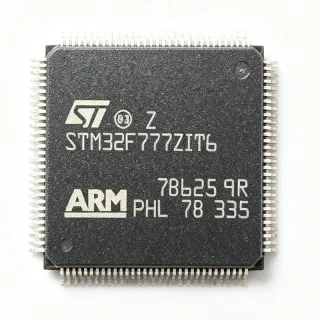
MK60FN1M0VLQ12 - K60 120MHz Cortex-M4F 1MB Flash MCU | NXP
MPN: MK60FN1M0VLQ12 ✓ AktifMK60FN1M0VLQ12 Ringkasan
A 32-bit microcontroller (MCU) is a single-chip computer that integrates a CPU, peripherals, memory, and interface controllers into one package, enabling embedded intelligence in everything from appliances to automotive ECUs. The Cortex-M4F core adds a single-precision FPU and DSP extensions, while the Kinetis K-series sits within NXP's broader ARM Cortex-M portfolio targeting scalable performance from 50 MHz ultra-low-power variants up to multi-gigahertz crossover MCUs. This places the MK60FN1M0VLQ12 in the mid-performance tier optimized for mixed control + connectivity workloads.
Key features of the MK60FN1M0VLQ12 include 1 MB Flash, 128 KB SRAM, 120 MHz maximum CPU frequency, supply voltage range of 1.71 V to 3.6 V, operating temperature range of -40C to +105C, integrated full-speed plus high-speed USB OTG, 10/100 Mbps Ethernet MAC with IEEE 1588, and a 16-bit SAR ADC. The LQFP-144 (20x20 mm) package exposes up to 100 GPIO pins, multiple serial peripherals (UART, SPI, I2C), an SDHC controller, and a flexible FlexTimer/PWM subsystem.
Architecturally, the MK60FN1M0VLQ12 uses the Cortex-M4F core with NVIC, DSP instructions, and an FPU, paired with crossbar switch and AIPS-Lite peripheral bridges that allow simultaneous DMA-driven peripheral access without stalling the core. Hardware encryption is supported through on-chip acceleration, enabling secure boot, AES, and hashing without offloading to software.
Typical applications include industrial Ethernet control nodes, USB audio interfaces, point-of-sale terminals, smart energy metering, building automation gateways, and motion-control drives. The combination of Ethernet plus dual USB plus 1 MB Flash is particularly well-matched to gateways that aggregate multiple fieldbus segments.
When designing with this MCU, verify that the supply rail respects the 1.71 V to 3.6 V range and use low-ESR decoupling at each VDD/VSS pair. For USB high-speed operation, the dedicated PLL must be configured before enabling the HS controller; ignoring this prevents USB enumeration. This page synthesizes distributor pricing, drop-in alternatives, and practical design notes not found in the manufacturer datasheet alone.
Alternatif penggantian untuk MK60FN1M0VLQ12 — paket yang sama, pin-pada-pin kompatibel. Bagian paket yang berbeda memerlukan kerja ulang PCB diabaikan.
Variasi di dalam seri ini
Model-series yang sama yang kompatibel dengan penggantian MK60FN1M0VLQ12 (sama faktor bentuk dan footprint) — berbeda di dalam Package, ADC, Operating Temperature Range, USB, DAC.
MK60FN1M0VLQ15
✅ Drop-In📋 Alternatif referensi (tidak dalam katalog)
MK60FX512VLQ12
✅ Drop-In📋 Alternatif referensi (tidak dalam katalog)
MK60FX512VLQ15
✅ Drop-In📋 Alternatif referensi (tidak dalam katalog)
MK66FN2M0VLQ18
✅ Drop-InKontak untuk harga
Lihat Datasheet →MK60DN512VMD10
✅ Drop-InKontak untuk harga
Lihat Datasheet →MK60FN1M0VLQ12 Rating Maksimal & Karakteristik Listrik
| Core | ARM Cortex-M4F with FPU and DSP |
| Maximum CPU Frequency | 120 MHz |
| Program Flash Memory | 1 MB (1024 KB) |
| SRAM | 128 KB |
| Supply Voltage Range | 1.71 V to 3.6 V |
| Rentang Suhu Kerja | -40C to +105C (V suffix) |
| Paket | LQFP-144 (20x20 mm) |
| Jumlah Pin | 144 |
| USB Controllers | USB 2.0 FS OTG + HS OTG (dual) |
| Ethernet MAC | 10/100 Mbps with IEEE 1588 |
| Hardware Encryption | Yes (on-chip acceleration) |
| ADC | 16-bit SAR ADC |
| Tipe Mounting | Surface Mount |
| Status Lingkungan Hidup | Active |
| Status RoHS | Compliant |
Konfigurasi Pin MK60FN1M0VLQ12
| Pin produk 1 | PTE0 — Port E GPIO / UART1_CTS |
| Pin produk 2 | PTE1 — Port E GPIO / UART1_RTS |
| Pin produk 3 | PTE2 — Port E GPIO / SPI1_SOUT |
| Pin produk 4 | PTE3 — Port E GPIO / SPI1_SIN |
| Pin produk 5 | PTE4 — Port E GPIO / SPI1_PCS0 |
| Pin produk 6 | PTE5 — Port E GPIO |
| Pin produk 7 | PTE6 — Port E GPIO |
| Pin produk 8 | VSS — Ground |
| Pin produk 9 | USB0_DP — USB FS OTG data plus |
| Pin produk 10 | USB0_DM — USB FS OTG data minus |
| Pin produk 11 | VDD — Supply voltage (3.3 V typical) |
| Pin produk 12 | VSS — Ground |
| Pin produk 13 | USB1_DP — USB HS OTG data plus |
| Pin produk 14 | USB1_DM — USB HS OTG data minus |
| Pin produk 15 | VREGIN — Voltage regulator input |
| Pin produk 16 | VREGOUT — Voltage regulator output (1.2 V core) |
| Pin produk 17 | VDD — Supply voltage |
| Pin produk 18 | VSS — Ground |
| Pin produk 19 | PTA0 — Port A GPIO / JTAG_TCLK |
| Pin produk 20 | PTA1 — Port A GPIO / JTAG_TDI |
| Pin produk 21 | PTA2 — Port A GPIO / JTAG_TDO |
| Pin produk 22 | PTA3 — Port A GPIO / JTAG_TMS |
| Pin produk 23 | PTA4 — Port A GPIO / NMI_b |
| Pin produk 24 | PTA5 — Port A GPIO / Reset_b |
| Pin produk 25 | PTA6 — Port A GPIO |
| Pin produk 26 | PTA7 — Port A GPIO |
| Pin produk 27 | PTB0 — Port B GPIO / ADC0_SE0 |
| Pin produk 28 | PTB1 — Port B GPIO / ADC0_SE1 |
| Pin produk 29 | PTB2 — Port B GPIO / ADC0_SE2 |
| Pin produk 30 | PTB3 — Port B GPIO / ADC0_SE3 |
| Pin produk 31 | PTB4 — Port B GPIO |
| Pin produk 32 | PTB5 — Port B GPIO |
| Pin produk 33 | PTB6 — Port B GPIO |
| Pin produk 34 | PTB7 — Port B GPIO |
| Pin produk 35 | PTC0 — Port C GPIO |
| Pin produk 36 | PTC1 — Port C GPIO |
| Pin produk 37 | PTC2 — Port C GPIO |
| Pin produk 38 | PTC3 — Port C GPIO |
| Pin produk 39 | PTC4 — Port C GPIO |
| Pin produk 40 | PTC5 — Port C GPIO |
| Pin produk 41 | PTC6 — Port C GPIO |
| Pin produk 42 | PTC7 — Port C GPIO |
| Pin produk 43 | PTD0 — Port D GPIO |
| Pin produk 44 | PTD1 — Port D GPIO |
| Pin produk 45 | PTD2 — Port D GPIO |
| Pin produk 46 | PTD3 — Port D GPIO |
| Pin produk 47 | PTD4 — Port D GPIO |
| Pin produk 48 | PTD5 — Port D GPIO |
| Pin produk 49 | PTD6 — Port D GPIO |
| Pin produk 50 | PTD7 — Port D GPIO |
| Pin produk 51 | PTE7 — Port E GPIO |
| Pin produk 52 | PTE8 — Port E GPIO |
| Pin produk 53 | PTE9 — Port E GPIO |
| Pin produk 54 | PTE10 — Port E GPIO |
| Pin produk 55 | PTE11 — Port E GPIO |
| Pin produk 56 | PTE12 — Port E GPIO |
| Pin produk 57 | PTE13 — Port E GPIO |
| Pin produk 58 | PTE14 — Port E GPIO |
| Pin produk 59 | PTE15 — Port E GPIO |
| Pin produk 60 | PTF0 — Port F GPIO |
| Pin produk 61 | PTF1 — Port F GPIO |
| Pin produk 62 | PTF2 — Port F GPIO |
| Pin produk 63 | PTF3 — Port F GPIO |
| Pin produk 64 | PTF4 — Port F GPIO |
| Pin produk 65 | PTF5 — Port F GPIO |
| Pin produk 66 | PTF6 — Port F GPIO |
| Pin produk 67 | PTF7 — Port F GPIO |
| Pin produk 68 | PTG0 — Port G GPIO |
| Pin produk 69 | PTG1 — Port G GPIO |
| Pin produk 70 | PTG2 — Port G GPIO |
| Pin produk 71 | PTG3 — Port G GPIO |
| Pin produk 72 | PTG4 — Port G GPIO |
| Pin produk 73 | PTG5 — Port G GPIO |
| Pin produk 74 | PTG6 — Port G GPIO |
| Pin produk 75 | PTG7 — Port G GPIO |
| Pin produk 76 | PTH0 — Port H GPIO |
| Pin produk 77 | PTH1 — Port H GPIO |
| Pin produk 78 | PTH2 — Port H GPIO |
| Pin produk 79 | PTH3 — Port H GPIO |
| Pin produk 80 | PTH4 — Port H GPIO |
| Pin produk 81 | PTH5 — Port H GPIO |
| Pin produk 82 | PTH6 — Port H GPIO |
| Pin produk 83 | PTH7 — Port H GPIO |
| Pin produk 84 | PTI0 — Port I GPIO |
| Pin produk 85 | PTI1 — Port I GPIO |
| Pin produk 86 | PTI2 — Port I GPIO |
| Pin produk 87 | PTI3 — Port I GPIO |
| Pin produk 88 | PTI4 — Port I GPIO |
| Pin produk 89 | PTI5 — Port I GPIO |
| Pin produk 90 | PTI6 — Port I GPIO |
| Pin produk 91 | PTI7 — Port I GPIO |
| Pin produk 92 | NC — Not connected |
| Pin produk 93 | NC — Not connected |
| Pin produk 94 | NC — Not connected |
| Pin produk 95 | NC — Not connected |
| Pin produk 96 | NC — Not connected |
| Pin produk 97 | NC — Not connected |
| Pin produk 98 | NC — Not connected |
| Pin produk 99 | NC — Not connected |
| Pin produk 100 | NC — Not connected |
| Pin produk 101 | NC — Not connected |
| Pin produk 102 | NC — Not connected |
| Pin produk 103 | NC — Not connected |
| Pin produk 104 | NC — Not connected |
| Pin produk 105 | NC — Not connected |
| Pin produk 106 | NC — Not connected |
| Pin produk 107 | NC — Not connected |
| Pin produk 108 | NC — Not connected |
| Pin produk 109 | NC — Not connected |
| Pin produk 110 | NC — Not connected |
| Pin produk 111 | NC — Not connected |
| Pin produk 112 | NC — Not connected |
| Pin produk 113 | NC — Not connected |
| Pin produk 114 | NC — Not connected |
| Pin produk 115 | NC — Not connected |
| Pin produk 116 | NC — Not connected |
| Pin produk 117 | NC — Not connected |
| Pin produk 118 | NC — Not connected |
| Pin produk 119 | NC — Not connected |
| Pin produk 120 | NC — Not connected |
| Pin produk 121 | NC — Not connected |
| Pin produk 122 | NC — Not connected |
| Pin produk 123 | NC — Not connected |
| Pin produk 124 | NC — Not connected |
| Pin produk 125 | NC — Not connected |
| Pin produk 126 | NC — Not connected |
| Pin produk 127 | NC — Not connected |
| Pin produk 128 | NC — Not connected |
| Pin produk 129 | NC — Not connected |
| Pin produk 130 | NC — Not connected |
| Pin produk 131 | NC — Not connected |
| Pin produk 132 | NC — Not connected |
| Pin produk 133 | NC — Not connected |
| Pin produk 134 | NC — Not connected |
| Pin produk 135 | NC — Not connected |
| Pin produk 136 | NC — Not connected |
| Pin produk 137 | NC — Not connected |
| Pin produk 138 | NC — Not connected |
| Pin produk 139 | NC — Not connected |
| Pin produk 140 | NC — Not connected |
| Pin produk 141 | NC — Not connected |
| Pin produk 142 | NC — Not connected |
| Pin produk 143 | NC — Not connected |
| Pin produk 144 | EP — Exposed pad - connect to ground |
Aplikasi Umum
MK60FN1M0VLQ12 cocok untuk 7 aplikasis: Industrial Ethernet Control Nodes, USB Audio Interfaces, Point-of-Sale Terminals, Smart Energy Metering, Building Automation Gateways, Motion Control Drives, Connected Medical Device Controllers.
Industrial Ethernet Control Nodes
The MK60FN1M0VLQ12 integrates a 10/100 Mbps Ethernet MAC with IEEE 1588 precision-time protocol support alongside a Cortex-M4F DSP-capable core at 120 MHz, making it well-suited for industrial Ethernet slaves and gateways that require deterministic latency on EtherNet/IP or PROFINET-style networks. The 1 MB Flash holds a TCP/IP stack plus application firmware, while the 128 KB SRAM supports multi-socket buffers. Engineers typically pair this MCU with an external PHY and a 50 MHz reference clock; unlike Cortex-M0 alternatives, the FPU and DSP extensions accelerate any on-node control-loop math.
Direkomendasikan
USB Audio Interfaces
The MK60FN1M0VLQ12's dual USB 2.0 controllers (FS OTG plus HS OTG) plus its 120 MHz Cortex-M4F with FPU are aligned to USB audio class endpoints where high-bandwidth isochronous transfers and real-time DSP both run on the same chip. The 128 KB SRAM buffers multi-channel audio frames, while 1 MB Flash stores USB stack plus DSP effects. Designers typically place this MCU between a USB host and a CODEC such as the PCM1794A; unlike smaller Kinetis variants, this part avoids audio dropouts caused by USB bandwidth contention.
Direkomendasikan
Point-of-Sale Terminals
The MK60FN1M0VLQ12's combination of Ethernet for back-office sync, dual USB for peripherals (card reader plus printer), and 1 MB Flash for payment-application firmware makes it a strong fit for compact POS terminals. Hardware encryption acceleration offloads AES and SHA from the Cortex-M4F, helping meet PCI transaction latency targets. The 16-bit SAR ADC reads keypad or battery monitoring; the FPU accelerates total calculation. Power dissipation at 120 MHz with all peripherals active is moderate, allowing fanless enclosed designs.
Direkomendasikan
Smart Energy Metering
The MK60FN1M0VLQ12 is well-suited to single-phase or multi-phase smart energy meters that require precise metrology plus a connected interface. The 16-bit ADC samples current and voltage waveforms, while the Cortex-M4F DSP extensions compute RMS and harmonics in real time; the FPU accelerates complex-power calculations. Ethernet or dual USB handles HAN/WAN reporting, and the 1 MB Flash stores logs and DLMS/COSEM stacks. Industrial temperature grade (-40C to +105C) supports outdoor cabinet mounting.
Direkomendasikan
Building Automation Gateways
The MK60FN1M0VLQ12 acts as a building-automation gateway that aggregates multiple fieldbus segments (Modbus, BACnet, KNX over UART or SPI) and publishes to the cloud via Ethernet. Its 1 MB Flash accommodates multi-protocol stacks, the 128 KB SRAM handles concurrent message queues, and the Cortex-M4F DSP accelerates any local control logic. The dual USB enables Wi-Fi or cellular dongle backup links; unlike Cortex-M0 gateways, the FPU handles encryption acceleration and signal processing in parallel.
Direkomendasikan
Motion Control Drives
The MK60FN1M0VLQ12's FlexTimer/PWM subsystem, 120 MHz Cortex-M4F DSP, and FPU make it a fit for low-to-mid-power motion control drives that require fast current-loop computation. The 16-bit ADC samples phase currents, the FPU executes field-oriented control algorithms at sub-10 us loop times, and the Ethernet MAC streams drive telemetry to a supervisory controller. The 1 MB Flash holds application plus safety logic; the 144-LQFP exposes enough GPIO for encoder, hall sensor, and PWM channels.
Direkomendasikan
Connected Medical Device Controllers
The MK60FN1M0VLQ12 serves as a connected medical-device controller where Ethernet or USB enables clinician tablets while the Cortex-M4F DSP and FPU handle real-time signal processing from the analog front end. The 1 MB Flash stores firmware plus safety logs, the 128 KB SRAM buffers sample streams, and hardware encryption protects patient data in transit. Unlike Cortex-M0 parts, the M4F core runs FFT and filter pipelines for biosignal processing. Industrial temperature grade supports bedside equipment environments.
Direkomendasikan
Ringkasan Produk Direkomendasikan
Data referensi engineering untuk MK60FN1M0VLQ12 — pembandingan, panduan desain, dan informasi konformitas.
Panduan Pemilihan
Pembandingan dengan Alternatif
| Parameter Umum | Produk Ini | MK60FN1M0VLQ15 | MK60FX512VLQ12 | MK60FX512VLQ15 | MK66FN2M0VLQ18 | MK60DN512VMD10 |
|---|---|---|---|---|---|---|
| Package | LQFP-144 (20x20 mm) | LQFP-144 (20x20 mm) - same | LQFP-144 (20x20 mm) - same | LQFP-144 (20x20 mm) - same | LQFP-144 (20x20 mm) - same | MAPBGA-144 - different footprint |
| Brand | NXP Semiconductors | NXP Semiconductors | NXP Semiconductors | NXP Semiconductors | NXP Semiconductors | NXP Semiconductors |
| Core | ARM Cortex-M4F | ARM Cortex-M4F | ARM Cortex-M4F | ARM Cortex-M4F | ARM Cortex-M4F | ARM Cortex-M4 |
| Maximum CPU Frequency | 120 MHz | 150 MHz | 120 MHz | 150 MHz | 180 MHz | 100 MHz |
| Flash Memory | 1 MB | 1 MB | 512 KB | 512 KB | 2 MB | 512 KB |
| SRAM | 128 KB | 128 KB | 128 KB | 128 KB | 256 KB | 128 KB |
| Supply Voltage | 1.71 V to 3.6 V | 1.71 V to 3.6 V | 1.71 V to 3.6 V | 1.71 V to 3.6 V | 1.71 V to 3.6 V | 1.71 V to 3.6 V |
| Operating Temperature | -40C to +105C | -40C to +105C | -40C to +105C | -40C to +105C | -40C to +105C | -40C to +105C |
Diferensiator Kunci
- Dual USB 2.0 (FS + HS) in a single 144-LQFP (vsMK60FX512VLQ12)
- Pin-compatible upgrade to 180 MHz / 2 MB Flash / 256 KB SRAM (vsMK66FN2M0VLQ18)
- Same-package variant with 150 MHz core for higher DSP throughput (vsMK60FN1M0VLQ15)
- Industrial temperature grade standard (vsCommercial-only K-series MCUs)
Catatan Desain
The MK60FN1M0VLQ12 requires a clean 3.3 V rail within 1.71 V to 3.6 V. Decouple each VDD pin with a 100 nF ceramic plus 4.7 uF bulk capacitor placed within 5 mm of the pin. The internal voltage regulator (VREGIN to VREGOUT) needs its own 1 uF plus 100 nF pair; do not share decoupling with VDD. For USB high-speed operation, the on-chip PLL requires stable VDD within 50 mV ripple; add a ferrite bead on noisy rails.
Use a 4-layer PCB with a continuous ground plane under the LQFP-144 footprint to provide thermal spreading and low-impedance returns. The exposed pad (EP) must be soldered to a 5x5 mm copper pad with thermal vias to inner ground planes. Route USB DP/DM traces as 90 ohm differential pairs with length matching within 150 mil. Keep the 50 MHz Ethernet reference clock trace short and shielded by ground on both sides.
Do not enable the USB HS controller before configuring the internal HS PLL - per NXP community guidance this prevents USB enumeration. Always wait for the PLL lock bit before switching the USB clock source. Also, when migrating from K60 to K66, do not assume identical peripheral addresses; the K66 USB HS module has register differences that require firmware updates for HS operation, while FS USB remains drop-in compatible.
Estimated: at 120 MHz core and full peripheral activity, the MK60FN1M0VLQ12 typical core current is around 35 mA at 3.3 V plus I/O drive. The LQFP-144 has a theta_JA near 40 C/W on a 4-layer board, so junction temperature rise at 25C ambient is approximately 5 C. Industrial temperature parts (V suffix) are specified to +105C and need at least a 2 oz copper pour under the exposed pad for thermal relief. Always verify thermal performance in your enclosure.
Informasi Konformitas
RoHS compliant per NXP product page. Not AEC-Q100 qualified - this is an industrial-grade MCU, not automotive. Reach and conflict-minerals compliance per NXP standard declarations. Halogen-free status not explicitly stated in retrieved data.