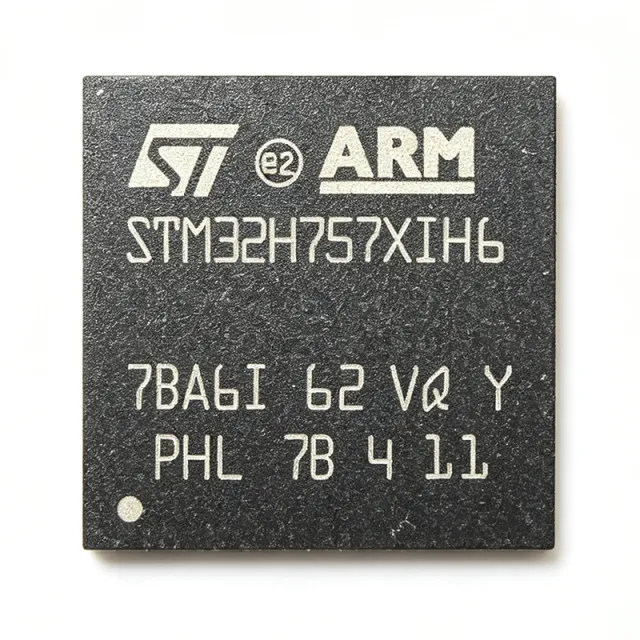
STM32H757XIH6 - Dual-Core M7/M4 MCU, 2MB Flash, TFBGA-240 | STMicroelectronics
部品番号: STM32H757XIH6 ✓ 生産中| 数量 | 単価 | 小計 |
|---|---|---|
| 1 | $18.42 | $18.42 |
| 10 | $17.05 | $170.50 |
| 100 | $15.21 | $1,521.00 |
| 500 | $13.6 | $6,800.00 |
| 1,000 | $12.18 | $12,180.00 |
STM32H757XIH6 概要
A microcontroller (MCU) is a compact integrated circuit containing a processor core, on-chip memory (Flash and SRAM), and programmable peripherals, used to govern a specific function in an embedded system. The category spans from simple 8-bit controllers up to high-performance 32-bit dual-core devices like the STM32H7 series. Within ST's portfolio hierarchy, the STM32H7 sits above STM32F7, STM32L4, and STM32G4 families, targeting applications that require intensive computation, rich connectivity, and real-time responsiveness.
Key features of the STM32H757XIH6 include the asymmetric dual-core architecture enabling workload partitioning between high-performance DSP/AI tasks (M7) and real-time control (M4), an integrated SMPS step-down converter for core supply efficiency, a hardware cryptographic accelerator with AES, hash, and true random number generator (TRNG), a Chrom-ART 2D graphics accelerator, an MIPI-DSI interface for displays, and 46 communication and analog interfaces including Ethernet, USB, CAN-FD, USART, SPI, I2C, multiple ADCs and DACs. The 1.62V to 3.6V supply range supports battery-backed operation.
From a technical depth perspective, the device leverages ST's 40 nm low-power CMOS process, which enables the M7 core to sustain 480 MHz at Cortex-M7 performance levels with DSP extensions while keeping the M4 core running real-time tasks independently. The 2 MB dual-bank flash supports read-while-write operation, allowing one bank to execute code while the other is updated. A 16-stream DMA controller offloads data movement, and the flexible memory controller (FMC) extends the system with external SDRAM, NOR, or NAND flash.
Typical applications include industrial PLC and HMI panels, motor-control drives (field-oriented control of PMSM and BLDC motors), high-end audio processors, medical patient monitoring, advanced driver-assistance systems (ADAS), robotics controllers, and smart-home/IoT edge gateways. The dual-core design is particularly suited to systems that must simultaneously run a graphical UI on the M7 and a deterministic control loop on the M4.
When designing with the STM32H757XIH6, place 100 nF decoupling capacitors close to every VDD pin and use a bulk capacitor on the main 3.3 V rail. Boot-mode pins (BOOT0 and options bytes) must be configured correctly to select the desired boot source (Flash, system memory bootloader, or SDRAM). The TFBGA-240 package requires a 14x14 mm PCB land pattern with 0.8 mm ball pitch, and thermal copper area should be sized to keep junction temperature below 125 °C at full M7 load.
This page synthesizes distributor pricing, drop-in TFBGA alternatives, and practical dual-core design notes not found in the manufacturer datasheet, giving engineers a single source for BOM decisions.
ドロップイン代替品: STM32H757XIH6 — 同一パッケージでピン互換。PCBの作り直しが必要な異なるパッケージの部品は除外されています。
このシリーズのバリエーション
同一シリーズでドロップイン互換のモデル: STM32H757XIH6 (同一形状・フットプリント) — 相違点: Package, Communication Interfaces, Operating Temperature, SRAM, Mounting Type.
クイック比較ツール — 並列比較する代替部品を選択:
STM32H753XIH6
✅ ドロップイン✓ 在庫あり
$13.2 / 個
データシートを見る →STM32H753XIH6TR
✅ ドロップイン ⚠️ 仕様未検証✓ 在庫あり
$16.1 / 個
データシートを見る →STM32H755ZIT6
✅ ドロップイン✓ 在庫あり
$16.19 / 個
データシートを見る →ES32H747XIH6U
✅ ドロップイン ⚠️ 仕様未検証✓ 在庫あり
$19.75 / 個
データシートを見る →STM32H757XIH6 最大定格&電気的特性
| Architecture | Arm Cortex-M7 + Cortex-M4 (dual-core, asymmetric multiprocessing) |
| Cortex-M7 Max Clock | 480 MHz |
| Cortex-M4 Max Clock | 240 MHz |
| Flash Memory | 2 MB (dual-bank, read-while-write) |
| SRAM | 1 MB (multiple banks incl. DTCM, AXI SRAM, SRAM1-4, Backup SRAM) |
| Supply Voltage (VDD) | 1.62 V to 3.6 V |
| パッケージ | TFBGA-240 (14x14 mm, 0.8 mm pitch) plus 25 additional balls (240+25) |
| 動作温度 | -40 °C to +85 °C (grade 6) |
| Communication Interfaces | 46 com. and analog interfaces incl. Ethernet, USB, CAN-FD, USART/UART, SPI, I2C, SAI |
| Display Interface | MIPI-DSI host controller + TFT-LCD controller |
| Crypto Accelerator | AES, hash (SHA-1/SHA-2), TRNG |
| Graphics Accelerator | Chrom-ART (2D DMA2D) |
| Camera Interface | DCMI (parallel, 8- to 14-bit) |
| External Memory Controller | FMC for SDRAM, NOR, NAND, PSRAM |
| Internal SMPS | Yes (voltage scaling for core) |
| 実装タイプ | Surface Mount (TFBGA) |
| RoHS ステータス | Compliant |
STM32H757XIH6 tfbga-240 (14x14 mm, 0.8 mm pitch) plus 25 additional balls (240+25) ピン配置ガイド
STM32H757XIH6 (tfbga-240 (14x14 mm, 0.8 mm pitch) plus 25 additional balls (240+25) パッケージ) のピン配置。 このデジタルICには、GPIO、通信インターフェース (UART、SPI、I2C)、および電源ピンが含まれています。代替ピン機能と設定オプションについては、メーカーのデータシートを参照してください。組み込みシステム設計とPCBレイアウトに不可欠です。

詳細なピン配置データはありません: STM32H757XIH6.
詳細は データシート をご参照ください。
主な用途
STM32H757XIH6 の用途: 6 件s: Industrial Human-Machine Interface (HMI) Panels, Field-Oriented Control (FOC) Motor Drives, High-End Audio Processors and Soundbars, Medical Patient Monitoring Devices, IoT Edge Gateways with Local Inference, Robotics Controllers and CNC Machines.
Industrial Human-Machine Interface (HMI) Panels
The STM32H757XIH6 fits HMI panels because the Cortex-M7 at 480 MHz can drive a 480p/720p MIPI-DSI TFT via the integrated DSI host controller while rendering buttons, charts, and animations through the Chrom-ART 2D accelerator. The Cortex-M4 offloads real-time touch scanning, backlight control, and Modbus/serial fieldbus communication without burdening the UI thread. With 2 MB dual-bank flash the panel supports OTA firmware updates via read-while-write, and the 1 MB SRAM holds full framebuffers plus LVGL widgets without external SDRAM. The 1.62V-3.6V range tolerates industrial 24V bus rails after a front-end DC-DC.
おすすめ
Field-Oriented Control (FOC) Motor Drives
The STM32H757XIH6 is ideal for three-phase PMSM and BLDC FOC drives because the Cortex-M7 at 480 MHz executes the inner current loop (typically 10-20 kHz) with floating-point Park/Clarke transforms, while the Cortex-M4 at 240 MHz handles the slower speed/torque loop, CANopen comms, and safety diagnostics. The timers expose complementary PWM with dead-time insertion, hardware break inputs, and ADC synchronization for sub-microsecond sampling. The hardware crypto accelerator secures firmware against unauthorized parameter tuning, and the dual-bank flash allows field firmware upgrades on running motors without shutdown.
おすすめ
High-End Audio Processors and Soundbars
In audio applications the STM32H757XIH6 brings the M7 throughput needed to handle multichannel DSP (EQ, DRC, room correction) while the M4 manages audio interface housekeeping - I2S/SAI streams, USB audio class, and SPDIF input. The 1 MB SRAM hosts multiple audio buffers without external memory, and the integrated AES crypto accelerator secures premium-content playback paths. Combined with a low-noise SMPS and dedicated audio PLL, the device delivers audiophile-grade performance for soundbars, AV receivers, and DJ controllers in a compact TFBGA-240 footprint.
おすすめ
Medical Patient Monitoring Devices
The STM32H757XIH6 suits medical patient monitors because the Cortex-M7 runs the vital-signs DSP (ECG QRS detection, SpO2 plethysmography, respiration analysis) at 480 MHz while the Cortex-M4 handles user-interface, alarm management, and isolated communication (Ethernet, USB, BLE via HCI). Hardware AES secures patient data at rest, and the TRNG supports cryptographic key generation for authenticated firmware. The -40 °C to +85 °C operating range covers clinical environments, and the dual-core isolation simplifies IEC 62304 software safety classification.
おすすめ
IoT Edge Gateways with Local Inference
The STM32H757XIH6 is well matched to edge IoT gateways because the Cortex-M7 can run lightweight ML inference (CMSIS-NN, TFLite-micro) on aggregated sensor data while the Cortex-M4 maintains the deterministic fieldbus tasks (Modbus, CAN-FD, RS-485). Ethernet, USB, and CAN-FD are integrated without external PHYs for simple gateways, while the crypto accelerator and TRNG secure TLS handshakes. Dual-bank 2 MB flash supports remote firmware updates without service interruption, and the 1 MB SRAM holds small ML model weights in cache.
おすすめ
Robotics Controllers and CNC Machines
Robotics and CNC platforms benefit from the STM32H757XIH6 because the M7 executes the inverse-kinematics and trajectory planner at 480 MHz while the M4 runs the safety PLC, e-stop chain, and EtherCAT/EthernetIP slave at 240 MHz deterministically. The flexible memory controller (FMC) interfaces to external SDRAM for large G-code buffering, and the camera interface supports machine-vision feedback. The 240+25-ball TFBGA gives enough I/O for multi-axis stepper/servo control plus encoder inputs, while the hardware crypto secures OEM firmware lock.
おすすめ
おすすめ製品の概要
エンジニアリング参考データ: STM32H757XIH6 — 比較、設計ガイダンス、コンプライアンス情報。
選定ガイド
代替品との比較
| パラメータ | この製品 | STM32H753XIH6 | STM32H753XIH6TR | STM32H755ZIT6 | ES32H747XIH6U |
|---|---|---|---|---|---|
| Package | TFBGA-240 (14x14 mm) | TFBGA-240 (14x14 mm) - same | TFBGA-240 (14x14 mm) - same | TFBGA-240 (14x14 mm) - same | TFBGA-240 (14x14 mm) - same |
| Brand | STMicroelectronics | STMicroelectronics | STMicroelectronics | STMicroelectronics | STMicroelectronics |
| Cores | Cortex-M7 + Cortex-M4 | Cortex-M7 only | Cortex-M7 only | Cortex-M7 + Cortex-M4 | Cortex-M7 + Cortex-M4 |
| Max M7 Clock | 480 MHz | 480 MHz | 480 MHz | 480 MHz | 480 MHz |
| Max M4 Clock | 240 MHz | N/A (no M4) | N/A (no M4) | 240 MHz | 240 MHz |
| Flash | 2 MB | 2 MB | 2 MB | 2 MB | 2 MB |
| SRAM | 1 MB | 1 MB | 1 MB | 1 MB | 1 MB |
| Supply Voltage | 1.62 V to 3.6 V | 1.62 V to 3.6 V | 1.62 V to 3.6 V | 1.62 V to 3.6 V | 1.62 V to 3.6 V |
| Crypto Accelerator | AES + TRNG + Hash | AES + TRNG + Hash | AES + TRNG + Hash | AES + TRNG + Hash | AES + TRNG + Hash |
主な差別化要因
- True dual-core with M4 co-processor for deterministic control (vs STM32H753XIH6)
- Higher core throughput than STM32F7 family (vs STM32F767VIH6)
- Integrated DSI host controller (vs STM32F746IGT6)
設計ノート
Decouple every VDD/VDDA/VDD_USB pin with a 100 nF X7R ceramic capacitor placed within 2 mm of the ball, and add a 4.7 uF bulk capacitor on each main rail. The internal SMPS requires an external inductor (typically 4.7 uH) and feedback capacitors on V_LDO and V_CORE; follow the reference design in the STM32H757xi reference manual. Sequence the 3.3 V analog rail before the 1.2 V core rail for cleanest ADC readings at full M7 throughput.
Estimated: at 480 MHz M7 + 240 MHz M4 with both cores active and peripherals running, expect roughly 400-600 mW worst case. The TFBGA-240 with 14x14 mm exposed-pad-style thermal ball array has a theta_JA of approximately 25-30 C/W on a 4-layer 2 oz PCB. Provide at least 1 square inch of uninterrupted ground copper under the package, stitched with thermal vias, to keep junction temperature below 110 C at 85 C ambient. Lower ambient or reduced clock ratio gives substantial margin.
Use a 0.8 mm pitch BGA fanout with via-in-pad or dog-bone fanout on inner layers. Match trace impedance to 50 ohm single-ended for high-speed signals (DSI clock, Ethernet, USB). Keep the SDIO/SDMMC traces short and length-matched within 50 mil. For DSI, route the clock pair on an inner layer with continuous ground reference, and provide ESD protection on the connector side. The 25 additional balls include extra ground/VDD and special-function pins - consult the datasheet ball map before finalizing the escape routing.
Three pitfalls trip up first-time H7 designs: (1) failing to configure the BOOT0 pin and option bytes correctly, which can leave the part stuck in system memory bootloader; (2) not providing the SMPS inductor and feedback caps, which causes unstable core voltage and reset loops; (3) ignoring that the M4 core boots only after the M7 enables it - firmware must implement the inter-core communication handshake before the M4 application can run. Also ensure JTAG/SWD signals are not shared with high-speed peripherals at reset.
コンプライアンス情報
RoHS and REACH compliance per STMicroelectronics product page and PartGenie cross-reference. Not AEC-Q100 qualified; for automotive applications choose a part with explicit Q100 grade. Halogen-free status not stated in provided data.







