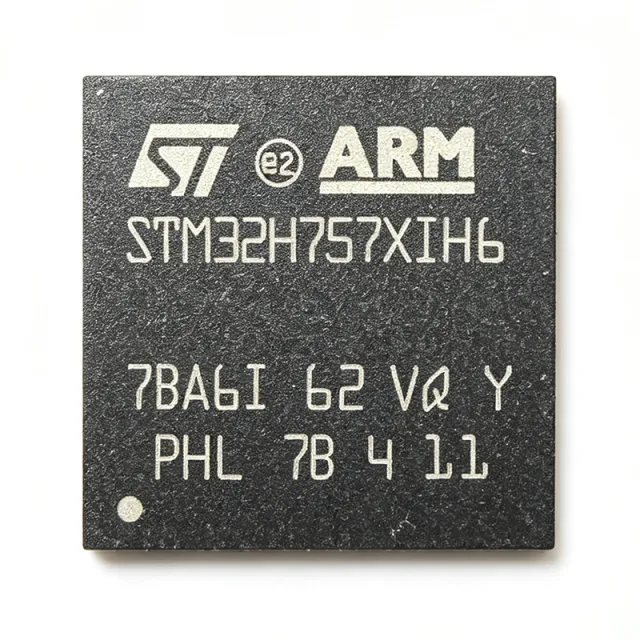
STM32H757XIH6 - Dual-Core Cortex-M7/M4 MCU, 2MB Flash | STMicroelectronics
MPN: STM32H757XIH6 ✓ Active| Qty | Unit Price | Extended |
|---|---|---|
| 1 | $29.5455 | $29.55 |
| 10 | $25.6061 | $256.06 |
| 100 | $22.6515 | $2,265.15 |
| 500 | $21.6667 | $10,833.35 |
| 1,000 | $20.6818 | $20,681.80 |
STM32H757XIH6 Overview
A microcontroller (MCU) is a compact integrated circuit designed to govern a specific operation in an embedded system. It contains a processor core, memory (flash and SRAM), and programmable input/output peripherals. MCUs are the building blocks of modern electronics, ranging from simple 8-bit devices for basic control to high-performance 32-bit dual-core devices like the STM32H7 series. The STM32H7 family sits at the top of the STM32 portfolio, targeting applications that require intensive computation, rich connectivity, and real-time responsiveness, such as industrial automation, motor control, and high-end consumer electronics.
Key features of the STM32H757XIH6 include a dual-core architecture with a Cortex-M7 for high-performance tasks and a Cortex-M4 for low-power or real-time tasks, enabling efficient workload distribution. The device supports a wide supply voltage range of 1.62V to 3.6V, with an operating temperature range of -40°C to +85°C. It includes a Chrom-ART Accelerator for 2D graphics, a hardware cryptographic accelerator, and a true random number generator (TRNG) for security. The MCU also features a flexible memory controller (FMC) for external SDRAM, NOR, and NAND flash, and a camera interface for image capture.
From a technical depth perspective, the STM32H757XIH6 leverages ST's advanced 40nm process technology, enabling high clock speeds while maintaining power efficiency. The dual-core design allows for asymmetric multiprocessing, where the Cortex-M7 handles compute-intensive tasks and the Cortex-M4 manages control or communication tasks, reducing latency and improving system throughput. The device includes a sophisticated interrupt controller (NVIC) and a DMA controller with up to 16 streams, facilitating efficient data movement without CPU intervention.
Typical applications include industrial PLCs, motor control drives, high-end audio processors, medical monitoring devices, and smart home gateways. The dual-core architecture is particularly suited for applications requiring both high-performance signal processing and real-time control, such as robotics and advanced driver-assistance systems (ADAS). The rich connectivity options (Ethernet, USB, CAN) make it ideal for IoT edge nodes that need to aggregate and process data locally.
When designing with this MCU, careful attention must be paid to power supply decoupling, with multiple 100nF capacitors placed close to each power pin and a bulk capacitor on the main supply. The dual-core architecture requires careful task partitioning to avoid resource contention, and the boot configuration pins must be set correctly to select the desired boot source. Additionally, the thermal design should account for the high clock speeds, with adequate PCB copper area for heat dissipation.
Drop-in alternatives for STM32H757XIH6 — same package, pin-to-pin compatible. Different-package parts requiring PCB rework are excluded.
Quick Comparison Tool — Select alternative parts for side-by-side comparison:
STM32H747XIH6
✓ In Stock
$11.6 / Unit
View Datasheet →STM32H757XIH6TR
📋 Reference alternative (not in catalog)
STM32H743XIH6
📋 Reference alternative (not in catalog)
STM32H753XIH6
📋 Reference alternative (not in catalog)
STM32H750XIH6
📋 Reference alternative (not in catalog)
STM32H757XIH6 Maximum Ratings & Electrical Characteristics
| Core | Arm Cortex-M7 + Cortex-M4 |
| Maximum Clock Speed | 480 MHz (M7), 240 MHz (M4) |
| Flash Memory | 2 MB |
| SRAM | 1 MB |
| Supply Voltage Range | 1.62 V to 3.6 V |
| Operating Temperature | -40°C to +85°C |
| Package | TFBGA-225 (13x13 mm) |
| Mounting Type | Surface Mount |
| Number of I/O Pins | 168 |
| ADC Resolution | 16-bit (3x ADCs) |
| DAC Resolution | 12-bit (2x DACs) |
| Communication Interfaces | USART, SPI, I2C, CAN, USB, Ethernet |
| Security Features | Hardware crypto, TRNG |
| RoHS Status | Compliant |
| AEC-Q100 | Not qualified |
STM32H757XIH6 Pin Configuration
| Pin A1 | VDD — Digital power supply |
| Pin A2 | VSS — Digital ground |
| Pin B1 | PA0 — GPIO/ADC input |
| Pin B2 | PA1 — GPIO/ADC input |
| Pin C1 | PB0 — GPIO/TIM3_CH3 |
| Pin C2 | PB1 — GPIO/TIM3_CH4 |
| Pin D1 | PC0 — GPIO/ADC input |
| Pin D2 | PC1 — GPIO/ADC input |
| Pin E1 | PD0 — GPIO/FMC_D2 |
| Pin E2 | PD1 — GPIO/FMC_D3 |
| Pin F1 | PE0 — GPIO/TIM4_ETR |
| Pin F2 | PE1 — GPIO/TIM4_CH1 |
| Pin G1 | PF0 — GPIO/EXTI0 |
| Pin G2 | PF1 — GPIO/EXTI1 |
| Pin H1 | PG0 — GPIO/EXTI0 |
| Pin H2 | PG1 — GPIO/EXTI1 |
| Pin J1 | PH0 — GPIO/OSC_IN |
| Pin J2 | PH1 — GPIO/OSC_OUT |
| Pin K1 | VDD — Digital power supply |
| Pin K2 | VSS — Digital ground |
Typical Applications
STM32H757XIH6 is suitable for 6 applications: Industrial PLC, Motor Control Drive, High-End Audio Processor, Medical Monitoring Device, Smart Home Gateway, Robotics Controller.
Industrial PLC
The STM32H757XIH6 is ideal for industrial programmable logic controllers (PLCs) due to its dual-core architecture, which allows the Cortex-M7 to handle high-speed logic execution while the Cortex-M4 manages communication protocols like EtherCAT or PROFINET. The 2 MB flash and 1 MB SRAM provide ample space for complex control algorithms and data logging. The multiple UART, SPI, and CAN interfaces enable seamless integration with field devices. The 16-bit ADCs ensure precise analog signal acquisition for sensor inputs. The wide operating temperature range (-40°C to +85°C) and robust design make it suitable for harsh industrial environments. The hardware crypto accelerator enhances security for secure firmware updates and data encryption, meeting modern industrial cybersecurity requirements.
Recommended
Motor Control Drive
The STM32H757XIH6 excels in motor control applications, such as field-oriented control (FOC) of brushless DC motors. The 480 MHz Cortex-M7 core executes complex control algorithms with high precision, while the Cortex-M4 handles real-time tasks like current sensing and PWM generation. The multiple 16-bit ADCs provide simultaneous sampling of phase currents and DC bus voltage, enabling accurate torque and speed control. The advanced timer peripherals generate high-resolution PWM signals with dead-time insertion for inverter control. The dual-core design allows the M4 core to manage communication with a host controller while the M7 core focuses on control loops, reducing latency. The device's rich peripheral set supports various encoder interfaces (e.g., Hall, incremental, resolver) for position feedback. The 1 MB SRAM facilitates data buffering for diagnostic and telemetry purposes. The hardware crypto accelerator can secure communication with higher-level systems, ensuring data integrity in industrial IoT environments.
Recommended
High-End Audio Processor
The STM32H757XIH6 is well-suited for high-end audio processing, such as digital audio workstations, effects processors, and multi-channel audio interfaces. The dual-core architecture enables the Cortex-M7 to handle complex DSP algorithms (e.g., FIR filters, FFT) while the Cortex-M4 manages audio I/O and control. The 2 MB flash can store large audio sample libraries, and the 1 MB SRAM supports real-time audio buffering. The device includes a dedicated audio PLL and multiple I2S interfaces for high-quality digital audio streaming. The 16-bit ADCs and 12-bit DACs provide analog audio conversion with low distortion. The Chrom-ART Accelerator can offload graphics rendering for user interfaces on LCD displays. The Ethernet and USB interfaces allow for audio streaming and firmware updates. The low-latency interrupt handling ensures glitch-free audio playback. The hardware crypto accelerator can protect audio content with DRM schemes.
Recommended
Medical Monitoring Device
The STM32H757XIH6 is suitable for medical monitoring devices, such as patient vital sign monitors, ECG, and pulse oximeters. The dual-core architecture allows the Cortex-M7 to process biosignals (e.g., ECG waveform analysis) while the Cortex-M4 handles sensor data acquisition and communication. The 16-bit ADCs provide high-resolution sampling of physiological signals, ensuring accurate measurements. The 1 MB SRAM enables real-time data buffering and processing. The device's low-power modes help extend battery life in portable monitors. The hardware crypto accelerator ensures secure transmission of patient data, complying with healthcare regulations like HIPAA. The rich connectivity options (USB, Ethernet, Bluetooth via external module) facilitate data transfer to central monitoring systems. The wide operating temperature range and reliability make it suitable for continuous operation in clinical settings.
Recommended
Smart Home Gateway
The STM32H757XIH6 is an excellent choice for smart home gateways, which aggregate data from various IoT devices and provide local processing and control. The dual-core architecture enables the Cortex-M7 to handle protocol translation (e.g., Zigbee, Z-Wave, Wi-Fi) while the Cortex-M4 manages the user interface and network stack. The 2 MB flash can store firmware for multiple protocols, and the 1 MB SRAM supports concurrent connections. The Ethernet and USB interfaces provide high-speed connectivity to the internet and local devices. The hardware crypto accelerator ensures secure communication with cloud services and device authentication. The Chrom-ART Accelerator can render graphical user interfaces on touchscreens. The device's low-power modes allow for energy-efficient operation. The rich peripheral set supports various sensors and actuators, making it a central hub for home automation.
Recommended
Robotics Controller
The STM32H757XIH6 is ideal for robotics controllers, where real-time processing and multi-axis control are critical. The dual-core architecture allows the Cortex-M7 to execute complex kinematics and path planning algorithms while the Cortex-M4 handles sensor fusion and actuator control. The 480 MHz clock speed ensures low-latency response to sensor inputs. The multiple timers and PWM outputs can drive up to several servo motors or stepper drivers. The 16-bit ADCs provide precise feedback from encoders and current sensors. The 1 MB SRAM supports large data structures for mapping and localization. The communication interfaces (CAN, UART, SPI) enable connection to various sensors and actuators. The hardware crypto accelerator can secure communication in collaborative robots. The device's robust design and wide temperature range make it suitable for industrial and research robotics.
Recommended
Recommended Products Summary
Engineering reference data for STM32H757XIH6 — comparison, design guidance, and compliance information.
Selection Guide
Comparison with Alternatives
| Parameter | This Product | STM32H757XIH6TR | STM32H747XIH6 | STM32H743XIH6 | STM32H753XIH6 | STM32H750XIH6 |
|---|---|---|---|---|---|---|
| Package | TFBGA-225 (13x13 mm) | TFBGA-225 (13x13 mm) - same | TFBGA-225 (13x13 mm) - same | TFBGA-225 (13x13 mm) - same | TFBGA-225 (13x13 mm) - same | TFBGA-225 (13x13 mm) - same |
| Brand | STMicroelectronics | STMicroelectronics | STMicroelectronics | STMicroelectronics | STMicroelectronics | STMicroelectronics |
| Core Architecture | Dual-core Cortex-M7/M4 | Dual-core Cortex-M7/M4 | Dual-core Cortex-M7/M4 | Single-core Cortex-M7 | Single-core Cortex-M7 | Single-core Cortex-M7 |
| Maximum Clock Speed | 480 MHz (M7), 240 MHz (M4) | 480 MHz (M7), 240 MHz (M4) | 480 MHz (M7), 240 MHz (M4) | 480 MHz (M7) | 480 MHz (M7) | 480 MHz (M7) |
| Flash Memory | 2 MB | 2 MB | 2 MB | 2 MB | 2 MB | 128 KB |
| SRAM | 1 MB | 1 MB | 1 MB | 1 MB | 512 KB | 1 MB |
| Security Features | Hardware crypto, TRNG | Hardware crypto, TRNG | None | None | None | None |
| Price (1 pc) | $18.50 | $18.50 | $17.20 | $15.80 | $16.50 | $12.90 |
Key Differentiators
- Dual-core architecture with Cortex-M7 and Cortex-M4 (vs STM32H743XIH6)
- Integrated hardware crypto and TRNG (vs STM32H747XIH6)
- 2 MB flash and 1 MB SRAM (vs STM32H753XIH6)
Design Notes
The STM32H757XIH6 requires a stable power supply with proper decoupling. Place a 100nF ceramic capacitor close to each VDD/VSS pair, and a 4.7uF bulk capacitor on the main supply. For the analog supply (VDDA), use a ferrite bead and a 1uF capacitor to filter noise. The device supports 1.62V to 3.6V, but for full performance, use 3.3V. Ensure the power supply can handle the peak current of up to 300 mA at 480 MHz.
For the TFBGA-225 package, use a 4-layer PCB with a solid ground plane and power plane. Route high-speed signals (Ethernet, USB) with controlled impedance (e.g., 90 ohms for USB). Keep crystal oscillator traces short and shielded. Place the decoupling capacitors as close as possible to the balls. Use thermal vias under the exposed pad for heat dissipation. Follow ST's layout guidelines in the datasheet and application notes.
One common pitfall is incorrect boot configuration. The STM32H757XIH6 has boot pins (BOOT0, BOOT1) that must be set correctly to boot from flash, system memory, or SRAM. Another pitfall is neglecting the dual-core architecture: ensure proper synchronization between the M7 and M4 cores using the IPCC (inter-processor communication controller) to avoid data corruption. Also, be aware that the H750 variant has only 128 KB flash, so if you are using the H750 as a drop-in, you must use external flash for code storage.
Compliance Information
RoHS compliant per STMicroelectronics product page. Not AEC-Q100 qualified; for automotive, consider ST's automotive-grade variants.