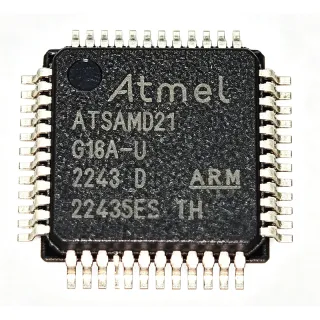
A54SX32-1CQ208B - 48K Gate FPGA 174 I/O CQFP-208 | Microchip
MPN: A54SX32-1CQ208B ✓ Active| Qty | Unit Price | Extended |
|---|---|---|
| 1 | $185 | $185.00 |
| 10 | $172.05 | $1,720.50 |
| 100 | $157.25 | $15,725.00 |
| 500 | $148 | $74,000.00 |
| 1,000 | $138.75 | $138,750.00 |
A54SX32-1CQ208B Overview
A field-programmable gate array (FPGA) is a semiconductor device containing a fabric of configurable logic blocks and programmable interconnects that engineers configure after manufacturing, sitting within the broader hierarchy of programmable logic: FPGA -> programmable logic device -> digital logic IC. The SX-A family uses Actel's antifuse programming technology, in which a one-time-programmable interconnect element is permanently set during programming, so configuration data is retained without any external configuration memory.
Key differentiators include the sea-of-modules architecture, which places dedicated combinational and sequential logic modules close together for high routing efficiency and predictable timing; antifuse interconnect, which removes configuration-cell loading for fast internal propagation; and a ceramic CQFP package with a tie bar suited to high-reliability and mil/aero socketed or soldered assemblies.
Technical depth: the 48,000-gate fabric of 2880 modules supports synchronous designs at high internal clock rates, while 174 I/O allows wide data buses. Dual-supply support (3.3 V and 5 V rails) eases integration into legacy 5 V backplanes common in defense and industrial retrofit programs.
Typical applications include military and avionics glue-logic consolidation, bus interface bridging in 5V legacy systems, industrial control, and long-lifecycle embedded systems where one-time-programmable, non-volatile configuration without external boot flash is valued.
Design consideration: antifuse FPGAs are one-time-programmable, so use thorough simulation before programming and budget for socketed or spare-device strategies during development.
This page synthesizes distributor inventory, drop-in family alternatives, and lifecycle context not found on any single datasheet or distributor page.
Drop-in alternatives for A54SX32-1CQ208B — same package, pin-to-pin compatible. Different-package parts requiring PCB rework are excluded.
Variants in this series
Same-series models that are drop-in compatible with A54SX32-1CQ208B (same form factor and footprint) — differing in Family, Package, System Gates, Logic Modules, RoHS Status.
Quick Comparison Tool — Select alternative parts for side-by-side comparison:
A54SX32-1CQ208M
✅ Drop-In✓ In Stock
$55.75 / Unit
View Datasheet →A54SX32-CQ208B
✅ Drop-In✓ In Stock
Contact for price
View Datasheet →A54SX32-CQ208
✅ Drop-In✓ In Stock
$1545.45 / Unit
View Datasheet →A54SX32-CQ208M
✅ Drop-In✓ In Stock
Contact for price
View Datasheet →A54SX32A-CQ208M
✅ Drop-In ⚠️ Specs Unverified📋 Reference alternative (not in catalog)
A54SX32-1CQ208B Maximum Ratings & Electrical Characteristics
| System Gates | 48,000 gates |
| Logic Modules | 2880 |
| Number of I/O | 174 I/O |
| Family | SX-A Series |
| Programming Technology | Antifuse (one-time programmable) |
| Architecture | Sea-of-modules |
| Operating Supply Voltage | 3.3 V (3.0 V to 3.6 V) |
| Dual Supply Option | 4.75 V to 5.25 V |
| Minimum Operating Temperature | -55 C |
| Maximum Operating Temperature | +125 C |
| Package / Case | 208-BFCQFP with tie bar (CQFP) |
| Mounting Style | SMD/SMT |
| Speed Grade | -1 |
| Configuration | Non-volatile, no external boot memory required |
| Product Category | FPGA - Field Programmable Gate Array |
A54SX32-1CQ208B 208-bfcqfp with tie bar (cqfp) Pin Configuration Guide
Pin configuration for A54SX32-1CQ208B (208-bfcqfp with tie bar (cqfp) package). This digital IC includes GPIO, communication interfaces (UART, SPI, I2C), and power pins. Refer to the manufacturer datasheet for alternate pin functions and configuration options. Essential for embedded system design and PCB layout.

No detailed pinout data available for A54SX32-1CQ208B.
Refer to the datasheet for full pin configuration.
Typical Applications
A54SX32-1CQ208B is suitable for 6 applications: Military and Avionics Glue-Logic Consolidation, Legacy 5V Backplane Interface Bridging, Bus Interface and Address Decoding, Industrial Control and Automation, Secure Embedded Systems, Test and Measurement Instrumentation.
Military and Avionics Glue-Logic Consolidation
The A54SX32-1CQ208B fits defense electronics because its hermetic ceramic BFCQFP-208 package, -55C to +125C operation, and one-time-programmable antifuse configuration provide the reliability profile avionics programs require. The 48,000-gate fabric with 2880 modules consolidates dozens of discrete PAL/GAL/counter functions into a single device, cutting board area and improving mean-time-between-failures. Because configuration is stored in antifuse links, no external boot flash exists to corrupt or be interrogated, simplifying security and failure analysis. Design the board with the 174 I/O budget mapped to address/data buses and discrete control lines, and verify timing in Libero with the -1 speed grade files before committing devices.
Recommended
Legacy 5V Backplane Interface Bridging
The SX-A family's dual-supply capability (3.3 V core operation plus a 4.75 V to 5.25 V supply range) makes the A54SX32-1CQ208B a strong fit for interfacing with legacy 5 V TTL backplanes in industrial retrofits and defense ground systems. Place the device between a modern 3.3 V microprocessor subsystem and a 5 V VME or cPCI-style backplane, using the 174 I/O to implement bus transceivers, address decoders, and interrupt logic. Antifuse I/O structure supports the voltage tolerances these systems demand without external level-shifting in many configurations, reducing parts count. Validate I/O threshold compatibility per the SX-A datasheet for the specific supply arrangement before layout freeze.
Recommended
Bus Interface and Address Decoding
With 174 user I/O and a deterministic, low-skew antifuse interconnect, the A54SX32-1CQ208B is well suited to wide bus interfacing: memory controllers, address decoders, DMA glue, and protocol adaptation between mismatching bus widths. The sea-of-modules architecture places combinational and sequential modules in a uniform sea, letting decoded addresses and registered outputs meet tight skew targets that discrete 74-series solutions cannot. Implementing this logic in the FPGA also enables later board revisions to fix decode errors by programming a new device rather than respinning the PCB. Budget the -1 speed grade timing in Libero static timing analysis, and assign power pins per the CQFP-208 datasheet pinout for clean ground returns.
Recommended
Industrial Control and Automation
Factory automation and process-control systems benefit from the A54SX32-1CQ208B's combination of wide I/O (174 pins), -55C to +125C tolerance, and non-volatile configuration that appears instantly powered-on with no configuration boot delay. Use it to implement motion-pulse counting, encoder quadrature decoding, safety interlock logic, and communication glue between PLC modules. Antifuse immutability is an asset in installations where unauthorized reprogramming is a concern, and the ceramic package survives thermally aggressive environments such as motor-drive cabinets. Design input filtering and ESD protection externally (TVS diodes, RC filters) since industrial field wiring exceeds the FPGA's silicon ratings; the FPGA handles the logic, not the surge.
Recommended
Secure Embedded Systems
The A54SX32-1CQ208B supports security-focused embedded designs because its configuration lives only in programmed antifuse links: there is no bitstream in external flash to copy, no SRAM configuration cells to dump, and no readback path to exploit, making bitstream extraction substantially harder than with SRAM FPGAs. Combine this with the hermetic ceramic package for defense and anti-tamper programs. Implement encryption wrappers, secure boot state machines, or key-handling glue logic across the 48,000-gate fabric. Note the trade-off: one-time programming means any design change requires new silicon, so freeze the security architecture carefully and maintain documented spare programmed units under configuration control for the program lifetime.
Recommended
Test and Measurement Instrumentation
Instrument designers use the A54SX32-1CQ208B for timing generators, trigger logic, and bus interfaces where deterministic antifuse routing yields repeatable propagation delays unit-to-unit, an advantage for calibration stability across production runs. The 174 I/O supports multichannel probe and stimulus interfacing, and the -55C to +125C range suits benchtop instruments in unconditioned environments. Implement counter/timer arrays, trigger state machines, and IEEE-bus glue in the 2880-module fabric. Because the configuration is permanent, apply version control to programming files and serialize devices during programming to keep instrument firmware traceable, using the Silicon Sculptor programming workflow with archived design archives.
Recommended
Recommended Products Summary
Engineering reference data for A54SX32-1CQ208B — comparison, design guidance, and compliance information.
Selection Guide
Comparison with Alternatives
| Parameter | This Product | A54SX32-1CQ208M | A54SX32-CQ208B | A54SX32-CQ208 | A54SX32-CQ208M |
|---|---|---|---|---|---|
| Package | 208-BFCQFP with tie bar (CQFP) | 208-BFCQFP with tie bar - same | 208-BFCQFP with tie bar - same | 208-BFCQFP with tie bar - same | 208-BFCQFP with tie bar - same |
| Brand | Microchip Technology | Microchip Technology | Microchip Technology | Microchip Technology | Microchip Technology |
| System Gates | 48,000 gates | 48,000 gates | 48,000 gates | 48,000 gates | 48,000 gates |
| Logic Modules | 2880 | 2880 | 2880 | 2880 | 2880 |
| Number of I/O | 174 I/O | 174 I/O | 174 I/O | 174 I/O | 174 I/O |
| Supply Voltage | 3.0 V to 3.6 V (dual option 4.75 V to 5.25 V) | 3.0 V to 3.6 V (dual option 4.75 V to 5.25 V) | 3.0 V to 3.6 V (dual option 4.75 V to 5.25 V) | 3.0 V to 3.6 V (dual option 4.75 V to 5.25 V) | 3.0 V to 3.6 V (dual option 4.75 V to 5.25 V) |
| Programming Technology | Antifuse (one-time programmable) | Antifuse (one-time programmable) | Antifuse (one-time programmable) | Antifuse (one-time programmable) | Antifuse (one-time programmable) |
Key Differentiators
- Hermetic ceramic package with military temperature range (vs A54SX32-1PQG208)
- Antifuse non-volatile configuration (vs SRAM FPGAs (e.g., Xilinx equivalents))
- Deterministic -1 speed grade timing (vs A54SX32-CQ208B)
Design Notes
Estimated: decouple each VCC pin of the 208-pin CQFP with 0.1 uF ceramic capacitors placed within 2 mm of the pin, plus at least 10 uF of bulk capacitance per supply domain. With dual-supply designs (3.3 V and 5.0 V rails), ensure both rails are within their allowed windows (3.0-3.6 V, 4.75-5.25 V) before releasing device reset, and sequence the 3.3 V rail ahead of or together with 5 V to avoid I/O latch-up during power-up, a documented pitfall for dual-supply antifuse families.
Antifuse devices are one-time-programmable. Complete full functional simulation and Libero timing closure with the -1 speed grade model before ever blowing a device, and program engineering units for validation while keeping unprogrammed spares. Archive the generated programming file and its design-source revision under configuration control; a lost programming file for a programmed board cannot be regenerated from the device. Never rely on reading back configuration from the programmed part - antifuse devices do not support bitstream readback by design.
The BFCQFP-208 with tie bar has leads on all four sides at 0.5 mm pitch; design the land pattern per the SX-A datasheet package drawing and route high-fanout clocks on inner layers with dedicated ground planes adjacent to control impedance. Connect the package tie bar as directed by the package drawing (typically to ground) for mechanical and thermal stability. For socketed mil-aero assemblies, verify socket contact rating and insertion force, and avoid repeated insertions of programmed devices to prevent lead damage.
Compliance Information
Ceramic CQFP military-orientation packages often carry RoHS exemptions for lead in ceramic package construction; verified web data does not state compliance status. Request the Microchip material declaration sheet for the A54SX32-1CQ208B before EU-regulated shipments.