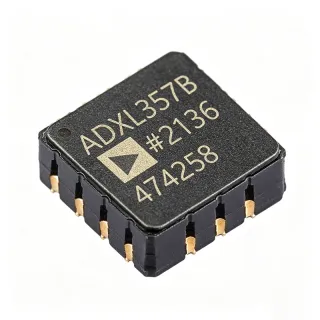
ADXL357BBEZ-RL7 - Low Noise 3-Axis MEMS Accelerometer | Analog Devices
MPN: ADXL357BBEZ-RL7 ✓ Active| Qty | Unit Price | Extended |
|---|---|---|
| 1 | $86.21 | $86.21 |
| 10 | $82.5 | $825.00 |
| 100 | $78.9 | $7,890.00 |
| 500 | $75.3 | $37,650.00 |
| 1,000 | $71.8 | $71,800.00 |
ADXL357BBEZ-RL7 Overview
An accelerometer is a sensor that measures proper acceleration, which is the rate of change of velocity of a body in its own instantaneous rest frame. MEMS (Micro-Electro-Mechanical Systems) accelerometers are micro-machined devices that detect acceleration through capacitive sensing of a proof mass. They are fundamental components in inertial measurement units (IMUs), vibration monitoring systems, and tilt sensing applications. The ADXL357 belongs to the family of low-noise, high-stability accelerometers designed for precision measurement in harsh environments.
Key features of the ADXL357BBEZ-RL7 include a noise density of 80 µg/√Hz (typical) in the ±10g range, which enables high-resolution vibration analysis. The device also features a low 0 g offset drift of ±0.75 mg over temperature, ensuring accurate long-term measurements. The selectable measurement ranges allow the user to optimize the sensor for specific applications, balancing resolution and dynamic range. The digital output simplifies system integration and reduces the need for external analog-to-digital converters.
The ADXL357B variant is specifically designed for non-automotive applications, with a temperature range of -40°C to +125°C. The device operates from a single 3.3V supply and includes an internal temperature sensor for compensation. The SPI and I2C interfaces support data rates up to 5.3 kHz for the X and Y axes and 4.8 kHz for the Z axis, enabling real-time monitoring of dynamic events.
Typical applications include structural health monitoring, industrial machinery vibration analysis, platform stabilization, and seismic sensing. The low noise and low drift characteristics make it ideal for precision inertial navigation systems and condition monitoring equipment. The device's small form factor and low power consumption (200 µA at 3.3V) allow for deployment in battery-powered wireless sensor nodes.
When designing with the ADXL357BBEZ-RL7, it is important to provide a clean power supply and proper decoupling to minimize noise. The device should be mounted with a solid mechanical connection to the vibrating structure to ensure accurate measurement. Additionally, the SPI or I2C interface should be configured correctly to avoid communication errors.
Drop-in alternatives for ADXL357BBEZ-RL7 — same package, pin-to-pin compatible. Different-package parts requiring PCB rework are excluded.
Quick Comparison Tool — Select alternative parts for side-by-side comparison:
ADXL357BBEZ-RL
✅ Drop-In📋 Reference alternative (not in catalog)
ADXL357BCPZ-RL7
⚡ Same Package ⚠️ Specs Unverified📋 Reference alternative (not in catalog)
ADXL356BEZ
⚡ Same Package ⚠️ Specs Unverified📋 Reference alternative (not in catalog)
ADXL356CEZ
⚡ Same Package ⚠️ Specs Unverified📋 Reference alternative (not in catalog)
ADXL357BBEZ-RL7 Maximum Ratings & Electrical Characteristics
| Measurement Range | ±10g, ±20g, ±40g (selectable) |
| Axis | X, Y, Z |
| Noise Density | 80 µg/√Hz (typical, ±10g range) |
| 0 g Offset Drift | ±0.75 mg (typical over temperature) |
| Output Data Rate | 5.3 kHz (X,Y), 4.8 kHz (Z) |
| Interface | SPI, I2C |
| Supply Voltage | 3.3 V (typical) |
| Supply Current | 200 µA (typical) |
| Operating Temperature | -40°C to +125°C |
| Package | 14-CLCC (6x6 mm) |
| Mounting Type | Surface Mount |
| Bandwidth | 5.3 kHz (X,Y), 4.8 kHz (Z) |
| RoHS Status | Compliant |
ADXL357BBEZ-RL7 Pin Configuration
| Pin 1 | VDD — Power supply (3.3V) |
| Pin 2 | GND — Ground |
| Pin 3 | SCLK — Serial clock for SPI |
| Pin 4 | MOSI — Master out slave in for SPI |
| Pin 5 | MISO — Master in slave out for SPI |
| Pin 6 | CS — Chip select (active low) |
| Pin 7 | INT1 — Interrupt output 1 |
| Pin 8 | INT2 — Interrupt output 2 |
| Pin 9 | NC — No connect |
| Pin 10 | NC — No connect |
| Pin 11 | NC — No connect |
| Pin 12 | NC — No connect |
| Pin 13 | NC — No connect |
| Pin 14 | NC — No connect |
Typical Applications
ADXL357BBEZ-RL7 is suitable for 6 applications: Structural Health Monitoring, Industrial Machinery Vibration Analysis, Inertial Navigation Systems, Platform Stabilization, Seismic Sensing, Tilt Sensing and Leveling.
Structural Health Monitoring
The ADXL357BBEZ-RL7's low noise density of 80 µg/√Hz and low 0 g offset drift of ±0.75 mg enable precise detection of structural vibrations and deformations. Its selectable ranges of ±10g, ±20g, and ±40g allow adaptation to different monitoring scenarios, from subtle resonance to strong seismic events. The digital SPI/I2C interface simplifies integration with data acquisition systems, and the wide temperature range of -40°C to +125°C ensures reliable operation in outdoor environments. The device's low power consumption of 200 µA supports battery-powered wireless sensor nodes for long-term deployment.
Recommended
Industrial Machinery Vibration Analysis
With a bandwidth of 5.3 kHz for X and Y axes and 4.8 kHz for Z, the ADXL357BBEZ-RL7 captures high-frequency vibration signatures essential for predictive maintenance. The low noise density ensures that small amplitude vibrations are not masked by sensor noise, enabling early detection of bearing wear or imbalance. The selectable measurement ranges allow the sensor to handle both low-level and high-impact vibrations without saturation. The digital output eliminates the need for external analog front-end, reducing system complexity and cost. The device's robust 14-CLCC package provides reliable performance in harsh industrial environments.
Recommended
Inertial Navigation Systems
The ADXL357BBEZ-RL7's low 0 g offset drift of ±0.75 mg over temperature is critical for inertial navigation, where bias stability directly affects position accuracy. The low noise density of 80 µg/√Hz allows precise acceleration measurement, enabling accurate velocity and position estimation. The selectable ranges of ±10g, ±20g, and ±40g provide flexibility for different dynamic environments, from pedestrian navigation to high-speed vehicles. The SPI/I2C interface allows easy integration with navigation processors, and the low power consumption extends battery life in portable systems. The device's small 6x6 mm package saves board space in compact IMU designs.
Recommended
Platform Stabilization
The ADXL357BBEZ-RL7 provides the low-noise, low-drift acceleration measurements needed for active stabilization of cameras, antennas, and robotic platforms. Its high bandwidth of 5.3 kHz enables fast control loops, while the low noise density ensures smooth corrections without jitter. The selectable measurement ranges allow the sensor to be tuned for the expected vibration levels, optimizing resolution. The digital interface simplifies connection to microcontrollers running stabilization algorithms. The device's wide temperature range and robust package make it suitable for outdoor and mobile applications.
Recommended
Seismic Sensing
The ADXL357BBEZ-RL7's ultra-low noise density of 80 µg/√Hz and low offset drift make it suitable for seismic monitoring applications, where detecting micro-vibrations is essential. The selectable ranges allow the sensor to handle both small tremors and large earthquakes without clipping. The digital output enables direct connection to data loggers and real-time analysis systems. The device's low power consumption is advantageous for remote seismic stations powered by batteries or solar panels. The wide temperature range ensures reliable operation in diverse geographic locations.
Recommended
Tilt Sensing and Leveling
The ADXL357BBEZ-RL7's low 0 g offset drift and low noise enable precise tilt measurement for leveling applications in construction, surveying, and industrial alignment. The selectable measurement ranges allow the sensor to be configured for the expected tilt angles, providing optimal resolution. The digital interface simplifies calibration and data processing. The device's low power consumption supports battery-operated leveling tools. The robust package and wide temperature range ensure reliable performance in field conditions.
Recommended
Recommended Products Summary
Engineering reference data for ADXL357BBEZ-RL7 — comparison, design guidance, and compliance information.
Selection Guide
Comparison with Alternatives
| Parameter | This Product | ADXL357BBEZ-RL | ADXL357BCPZ-RL7 | ADXL356BEZ |
|---|---|---|---|---|
| Package | 14-CLCC (6x6) | 14-CLCC (6x6) - same | 14-LCC (6x6) - different | 14-CLCC (6x6) - same |
| Brand | Analog Devices | Analog Devices | Analog Devices | Analog Devices |
| Measurement Range | ±10g, ±20g, ±40g | ±10g, ±20g, ±40g | ±10g, ±20g, ±40g | ±10g, ±20g, ±40g |
| Output Type | Digital (SPI/I2C) | Digital (SPI/I2C) | Digital (SPI/I2C) | Analog |
| Noise Density | 80 µg/√Hz | 80 µg/√Hz | 80 µg/√Hz | 80 µg/√Hz |
| 0 g Offset Drift | ±0.75 mg | ±0.75 mg | ±0.75 mg | ±0.75 mg |
| Supply Current | 200 µA | 200 µA | 200 µA | 200 µA |
Key Differentiators
- Low noise density of 80 µg/√Hz (vs ADXL345BCCZ-RL7)
- Low 0 g offset drift of ±0.75 mg (vs ADXL356BEZ)
- Selectable measurement ranges up to ±40g (vs ADXL356CEZ)
Design Notes
Provide a clean 3.3V supply with a 0.1 µF ceramic capacitor placed as close as possible to the VDD pin. A 10 µF bulk capacitor is recommended if the supply is shared with other components. The ADXL357BBEZ-RL7 draws 200 µA typical, so power supply noise can affect measurement accuracy. Use a low-noise LDO if the supply is noisy.
Mount the accelerometer on a solid PCB area with a direct mechanical path to the vibrating structure. Avoid placing the sensor near flexible PCB sections or large components that can introduce mechanical stress. Use multiple vias to connect the ground pad to the ground plane to reduce thermal and mechanical stress. Follow the layout guidelines in the datasheet for optimal performance.
Ensure the SPI or I2C interface is configured correctly with proper pull-up resistors for I2C. The CS pin must be tied high for I2C mode. Incorrect wiring can cause communication failures. Also, avoid exceeding the absolute maximum ratings of 3.6V on VDD. The device is sensitive to mechanical shock during soldering; use a reflow profile that minimizes stress.
Compliance Information
RoHS compliant per distributor listings. Not AEC-Q100 qualified as it is a non-automotive variant.