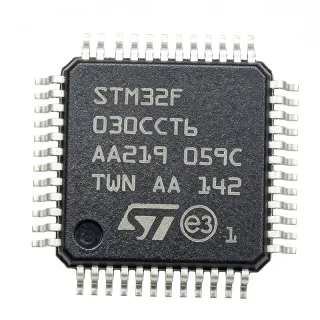
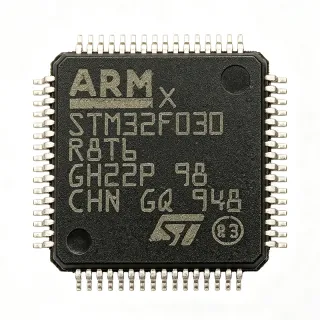
ATMEGA1280V-8CUR - 8MHz AVR MCU 128KB Flash CBGA-100 | Microchip
MPN: ATMEGA1280V-8CUR ✓ Active| Qty | Unit Price | Extended |
|---|---|---|
| 1 | $15.43 | $15.43 |
| 10 | $14.2 | $142.00 |
| 100 | $12.9 | $1,290.00 |
| 500 | $11.6 | $5,800.00 |
| 1,000 | $10.5 | $10,500.00 |
ATMEGA1280V-8CUR Overview
An 8-bit microcontroller (MCU) is an integrated circuit that combines a processor core, memory, and peripherals on a single die, sitting at the top of the embedded-control hierarchy (MCU -> microcontroller -> integrated circuit -> semiconductor). The AVR architecture executes most of its 133 powerful instructions in a single clock cycle, with 32 general-purpose working registers directly connected to the ALU, achieving throughputs close to 1 MIPS per MHz.
Key features include in-system programmable (ISP) flash, four flexible timer/counters with output-compare modulator, four programmable serial USARTs, master/slave SPI, byte-oriented 2-wire (I2C) interface, an EBI/EMI external bus interface, a programmable watchdog timer with separate on-chip oscillator, on-chip analog comparator, and interrupt and wake-up on pin change. An 8/16-channel, 10-bit ADC supports analog sensing with up to 86 general-purpose I/O lines.
Architecturally, the ATMEGA1280V belongs to the ATmega640/1280/2560 family, sharing a common die and peripheral set with different flash sizes. The AVR Harvard architecture separates program and data buses for deterministic single-cycle execution, and the JTAG/on-chip debug capability simplifies firmware development.
Typical applications include industrial automation controllers, battery-powered portable instruments (the low-voltage V grade supports energy-sensitive designs), building control, and sensor hubs that need many UARTs or abundant GPIO.
Design consideration: at 8 MHz maximum frequency, this V-grade part trades speed for low-voltage operation; verify the supply-voltage-versus-frequency safe operating region before selecting a 5V rail.
This page synthesizes distributor pricing, drop-in alternatives, and practical design notes not found in the manufacturer datasheet.
Drop-in alternatives for ATMEGA1280V-8CUR — same package, pin-to-pin compatible. Different-package parts requiring PCB rework are excluded.
Quick Comparison Tool — Select alternative parts for side-by-side comparison:
ATMEGA2560V-8CUR
✅ Drop-In📋 Reference alternative (not in catalog)
ATMEGA640V-8CUR
✅ Drop-In📋 Reference alternative (not in catalog)
ATMEGA1280V-8AUR
✅ Drop-In ⚠️ 参数待验证📋 Reference alternative (not in catalog)
ATMEGA1280V-8CUR Maximum Ratings & Electrical Characteristics
| Core | AVR 8-bit RISC |
| Max Clock Speed | 8 MHz |
| Flash Memory | 128 KB (64K x 16), ISP |
| SRAM | 8 KB |
| EEPROM | 4 KB |
| Supply Voltage | 2.7 V to 5.5 V |
| I/O Lines | 86 general purpose I/O |
| ADC | 8/16-channel, 10-bit |
| USART | 4 programmable serial USART |
| SPI | Master/Slave SPI serial interface |
| TWI (I2C) | Byte-oriented 2-wire serial interface |
| External Bus Interface | EBI/EMI |
| Timers | Four timer/counters with output compare modulator |
| Watchdog Timer | Programmable, separate on-chip oscillator |
| Analog Comparator | On-chip |
| Operating Temperature | -40C to +85C (industrial) |
| Package | 100-CBGA, 9 x 9 mm |
| Mounting Type | Surface Mount |
| Packaging | Tape & Reel (R suffix) |
| RoHS Status | Compliant (GREEN) |
| Lifecycle Stage | Active |
ATMEGA1280V-8CUR 100-cbga, 9 x 9 mm Pin Configuration Guide
Pin configuration for ATMEGA1280V-8CUR (100-cbga, 9 x 9 mm package). This digital IC includes GPIO, communication interfaces (UART, SPI, I2C), and power pins. Refer to the manufacturer datasheet for alternate pin functions and configuration options. Essential for embedded system design and PCB layout.

No detailed pinout data available for ATMEGA1280V-8CUR.
Refer to the datasheet for full pin configuration.
Typical Applications
ATMEGA1280V-8CUR is suitable for 6 applications: Industrial Automation Controllers, Battery-Powered Portable Instruments, Building Control and HVAC Panels, Sensor Hubs and Data Loggers, Robotics and Motion Control Boards, Legacy Arduino Mega-Compatible Prototyping.
Industrial Automation Controllers
The ATMEGA1280V-8CUR fits industrial automation nodes that need many serial links and I/O: four USARTs drive Modbus RTU slaves or multi-drop RS-485 networks, while 86 GPIO lines interface relays, limit switches, and status LEDs without port expanders. The EBI/EMI external bus allows memory-mapped expansion for display or FPGA-adjacent tasks. The 10-bit ADC reads 4-20 mA-derived sensor voltages with external conditioning. The 8 MHz ceiling is ample for sequential control logic; the industrial -40C to +85C rating suits factory-floor cabinets. Place TVS protection on field-facing lines and isolate RS-485 transceivers to survive noisy installations.
Recommended
Battery-Powered Portable Instruments
The V-grade low-voltage characteristic and AVR single-cycle-per-instruction efficiency make this MCU well suited to battery instruments that sleep most of the time. Pin-change interrupt wake-up and the separate-oscillator watchdog allow deep low-duty-cycle operation; running the core well below 8 MHz at a reduced supply cuts dynamic power roughly linearly with clock. The 4 KB EEPROM stores calibration constants without external nonvolatile memory, and the 10-bit, 16-channel ADC digitizes multiple sensor inputs. Designers should confirm the voltage-versus-frequency curve in the official datasheet and use the datasheet power-management sleep modes for the lowest standby current.
Recommended
Building Control and HVAC Panels
Building controllers benefit from the ATmega1280V's combination of multiple UARTs, abundant I/O, and 10-bit ADC: one USART can run BACnet-adjacent or Modbus field buses, another a service port, while dozens of GPIO drive dampers, valves, and zone relays through driver transistors. The watchdog timer provides the fault recovery required in unattended installations, and the on-chip EEPROM holds configuration and setpoints through power loss. The industrial temperature range covers rooftop and mechanical-room environments. Use optocoupled or relay-isolated outputs for line-voltage loads and RC-filter ADC inputs for NTC temperature sensing accuracy.
Recommended
Sensor Hubs and Data Loggers
As a sensor hub, the ATMEGA1280V-8CUR aggregates SPI and I2C sensors on its dedicated hardware buses while the 16-channel 10-bit ADC captures analog signals, logging to flash or an SD card over SPI. The 8 KB SRAM buffers acquisition bursts, and four USARTs stream data to radios or cellular modems. The EBI/EMI interface can attach parallel SRAM or memory-mapped peripherals when buffering demands exceed internal RAM. The AVR core's deterministic timing makes sampling loops easy to schedule with timer interrupts. Designers should budget SRAM carefully, since 8 KB must hold stack, buffers, and library state simultaneously.
Recommended
Robotics and Motion Control Boards
Robot main and servo controller boards use the ATmega1280V's four timer/counters with output-compare modulator to generate multiple simultaneous PWM channels for motor drivers and servos, while quadrature encoder inputs use pin-change interrupts. Four USARTs connect telemetry, motor controllers, and host links; 86 GPIO handles limit switches and indicator arrays. The 8 MHz clock is sufficient for kinematic loops at modest rates, and the industrial temperature range suits uncooled enclosures. Pair with gate or motor driver ICs on the PWM outputs, keep analog sensing traces away from PWM switching edges, and use the JTAG port for on-chip debugging during development.
Recommended
Legacy Arduino Mega-Compatible Prototyping
The ATmega1280 powers the original Arduino Mega, so this CBGA variant can be designed into Mega-compatible boards and programmed with the Arduino IDE, bootloader, and the MegaCore hardware package, which supports the ATmega640/1280/2560 family directly. Standard AVRISP mkII or USBasp programmers flash the ISP interface, and JTAG enables source-level debugging unavailable on smaller AVRs. Prototyping with Arduino libraries dramatically shortens firmware bring-up for sensing and control projects. Note this CBGA-100 part requires BGA assembly capability; prototype runs typically use the TQFP-100 ATMEGA1280V-8AU and move to CBGA for production.
Recommended
Recommended Products Summary
Engineering reference data for ATMEGA1280V-8CUR — comparison, design guidance, and compliance information.
Selection Guide
Comparison with Alternatives
| Parameter | This Product | ATMEGA2560V-8CUR | ATMEGA640V-8CUR | ATMEGA1280V-8AUR |
|---|---|---|---|---|
| Package | 100-CBGA (9x9 mm) | 100-CBGA (9x9 mm) - same | 100-CBGA (9x9 mm) - same | TQFP-100 - different footprint |
| Brand | Microchip Technology (Atmel) | Microchip Technology (Atmel) | Microchip Technology (Atmel) | Microchip Technology (Atmel) |
| Flash Memory | 128 KB | 256 KB | 64 KB | 128 KB |
| SRAM | 8 KB | 8 KB | 8 KB | 8 KB |
| Max Clock Speed | 8 MHz | 8 MHz | 8 MHz | 8 MHz |
| I/O Lines | 86 | 86 | 86 | 86 |
| ADC | 10-bit, 16-channel | 10-bit, 16-channel | 10-bit, 16-channel | 10-bit, 16-channel |
| Operating Temperature | -40C to +85C | -40C to +85C | -40C to +85C | -40C to +85C |
| Drop-in on Same PCB Footprint | - | Yes | Yes | No (TQFP footprint) |
Key Differentiators
- Balanced 128 KB flash size (vs ATMEGA2560V-8CUR)
- Flash headroom option without respin (vs ATMEGA640V-8CUR)
- Low-voltage V-grade operation (vs ATMEGA1280-16AUR)
Design Notes
Verify the supply-voltage-versus-frequency safe operating region before fixing the power rail. The V-grade family supports low-voltage operation, but the maximum 8 MHz rating must be validated against the operating voltage in the official ATmega640/1280/2560 datasheet tables. Decouple each VDD/VCC ball with 100 nF ceramics placed close to the CBGA vias, plus bulk 10 uF per rail. Estimated: total core I/O dynamic current scales roughly linearly with clock, so dropping from 8 MHz to 4 MHz approximately halves dynamic power for battery designs.
The 100-ball CBGA (9x9 mm) requires appropriate BGA land-pattern design per the Microchip package drawing, with via-in-pad or dog-bone escape routing on 0.8 mm-class ball grids (verify exact ball pitch in the package drawing). Plan fanout before layout: with 86 GPIO plus power and JTAG balls, a minimum of 4 signal layers is recommended. Provide a solid ground plane under the die area for signal return and thermal relief, and keep ADC analog balls grouped on a quiet region with a local analog ground island.
Do not confuse package suffixes: 'UR' is tape-and-reel CBGA, 'AU' is TQFP-100 - they are not footprint-compatible. Firmware written for the 5V ATmega1280-16AU must be re-checked for the 8 MHz maximum clock of the 8CUR grade; code assuming 16 MHz F_CPU will time out all delay-based protocols. Confirm the supply voltage range from the official datasheet for your temperature corner rather than third-party summaries, and program fuse bits (clock source, BOD) before deploying, since factory defaults run on the internal RC oscillator.
Compliance Information
FindIC listing marks the part as GREEN/RoHS compliant; Microchip AVR products are standard lead-free. REACH, halogen-free, and conflict-minerals declarations should be obtained from official Microchip environmental documentation.