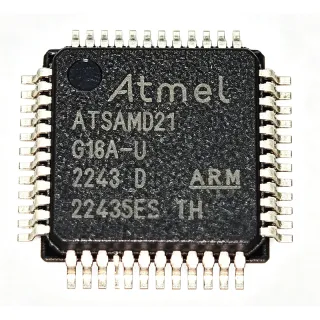
ATMXT224E-MAHR - 224-Ch 10-Touch Capacitive Touch Controller | Microchip Technology
MPN: ATMXT224E-MAHR ✓ Active| Qty | Unit Price | Extended |
|---|---|---|
| 1 | $6.2 | $6.20 |
| 10 | $5.58 | $55.80 |
| 100 | $4.96 | $496.00 |
| 500 | $4.34 | $2,170.00 |
| 1,000 | $3.72 | $3,720.00 |
ATMXT224E-MAHR Overview
A capacitive touchscreen controller is a mixed-signal IC that drives excitation signals into a sensor electrode grid and measures the mutual-capacitance changes caused by a finger or stylus. It sits at the sensor layer of the human-machine interface hierarchy (touchscreen controller -> touch sensor IC -> HMI subsystem), converting raw capacitance data into filtered touch coordinates that the host processor reads over a serial bus. The maXTouch family, originally developed by Atmel and acquired by Microchip Technology, is one of the most widely deployed projected-capacitive touch controller product lines in smartphones, tablets, and industrial HMIs.
Key differentiating features of the mXT224E include its 224-channel mutual-capacitance sensing matrix, advanced touch processing that can ignore unintentional touches from a gripping hand or resting palm while correctly interpreting genuine finger contact, and support for up to ten simultaneous touches. The device integrates the sensing analog front end and the touch-decision engine on a single die, offloading touch processing from the host CPU and reducing system-level power and software complexity.
On the technical side, the mXT224E uses the same core maXTouch technology as the mXT224 generation and is configured via the mXT224E Protocol Guide; firmware and configuration data are stored on-chip and can be updated over the communication bus, allowing tuning of sensitivity, acquisition intervals, and touch thresholds for different sensor stacks. Microchip's product page notes the recommended alternative touch controller is ATMXT336U for new designs.
Typical applications include smartphone and tablet touchscreens of up to 7 inches diagonal, portable medical devices with touch HMI panels, industrial operator interfaces, and consumer appliances requiring multi-touch gestures such as pinch-to-zoom and multi-finger tracking.
Design consideration: because maXTouch performance depends on the specific sensor stack (ITO pattern, cover lens thickness, bonding method), budget lab time for tuning the configuration using Microchip's maXTouch Studio tools before finalizing the sensor design.
This page synthesizes distributor availability data, the manufacturer product page, drop-in alternative guidance, and practical design notes not found in the manufacturer datasheet.
Drop-in alternatives for ATMXT224E-MAHR — same package, pin-to-pin compatible. Different-package parts requiring PCB rework are excluded.
Variants in this series
Same-series models that are drop-in compatible with ATMXT224E-MAHR (same form factor and footprint) — differing in Product Family.
Quick Comparison Tool — Select alternative parts for side-by-side comparison:
ATMXT224E-A
✅ Drop-In ⚠️ 参数待验证📋 Reference alternative (not in catalog)
ATMXT336U
✅ Drop-In📋 Reference alternative (not in catalog)
ATMXT225TD
✅ Drop-In📋 Reference alternative (not in catalog)
ATMXT224E-MAHR030
✅ Drop-In📋 Reference alternative (not in catalog)
ATMXT224E-MAHR Maximum Ratings & Electrical Characteristics
| Touch Technology | Mutual capacitance (projected capacitive) |
| Number of Sensing Channels | 224 |
| Maximum Simultaneous Touches | 10 |
| Maximum Screen Size | 7 inch diagonal |
| Product Family | maXTouch mXT224E |
| Mounting Type | Surface Mount |
| Palm/Grip Rejection | Yes (advanced touch processing ignores unintentional touches) |
| Configuration | In-field firmware/configuration update over communication bus |
| Packaging | Tape & Reel (R suffix) |
| Original Manufacturer Lineage | Atmel (acquired by Microchip Technology) |
ATMXT224E-MAHR standard Pin Configuration Guide
Pin configuration for ATMXT224E-MAHR (standard package). Pin numbering, functions, and connection diagrams are defined in the manufacturer datasheet. Refer to it for the exact footprint and soldering guidelines.

No detailed pinout data available for ATMXT224E-MAHR.
Refer to the datasheet for full pin configuration.
Typical Applications
ATMXT224E-MAHR is suitable for 6 applications: Smartphones and Small Tablets, Industrial Operator Interfaces, Portable Medical Devices, Point-of-Sale and Retail Terminals, Automotive Center-Stack Displays (Non-Safety), Consumer Appliance Touch Panels.
Smartphones and Small Tablets
The ATMXT224E-MAHR is designed from the ground up for mobile touchscreens up to 7 inches in diagonal. Its 224-channel mutual-capacitance matrix provides sufficient drive and sense resources for typical 4-to-7-inch ITO sensor patterns, while 10-touch tracking enables the pinch-to-zoom and multi-finger gestures users expect from modern phone interfaces. The advanced touch processing engine filters out unintentional contact caused by a gripping hand along the display edge or a resting palm, which is a common false-trigger source in edge-to-edge phone designs. Because the maXTouch architecture performs touch decision-making on-chip, the application processor is relieved of raw-capacitance signal processing, reducing host CPU load and overall system power draw in battery-constrained handheld devices.
Recommended
Industrial Operator Interfaces
Industrial HMI panels benefit from the ATMXT224E-MAHR's combination of multi-touch gesture support and robust palm/grip rejection. Operators wearing gloves or resting hands on the bezel frequently generate spurious capacitance; the mXT224E's advanced processing distinguishes these from genuine touches, reducing nuisance inputs on factory-floor equipment. The 7-inch diagonal ceiling matches the size class of many machine-control panels and test-instrument displays. Configuration is tunable per sensor stack through the maXTouch configuration registers, so engineers can adjust sensitivity and acquisition intervals to compensate for thicker protective glass or EMI from adjacent motor drives and switching power supplies common in industrial cabinets.
Recommended
Portable Medical Devices
Handheld medical diagnostic and monitoring instruments in the 4-to-7-inch display range fit the ATMXT224E-MAHR's sensing budget well. Ten-finger support lets clinicians use familiar pinch, swipe, and zoom gestures on patient-data charts, while the unintentional-touch rejection prevents accidental input changes when the device is held with fingers wrapping the bezel during bedside use. On-chip touch processing shortens touch-report latency, keeping the interface responsive during rapid interaction. Because configuration and firmware can be updated over the communication bus, medical OEMs can field-adjust sensitivity for different protective overlays or sterilization barriers without reworking hardware, an important advantage in regulated product lines with long service lives.
Recommended
Point-of-Sale and Retail Terminals
POS terminals and signature-capture displays commonly use 5-to-7-inch touchscreens, squarely within the ATMXT224E-MAHR's supported range. Multi-touch allows zoom on order-entry screens and two-finger signature flows, while palm rejection keeps sleeves and hands from corrupting inputs at crowded checkout counters. The maXTouch on-chip decision engine produces clean coordinate reports over the host bus, simplifying integration with embedded POS processors. The tape-and-reel packaging (R suffix) supports the automated high-volume assembly lines typical of retail-hardware manufacturing, and configuration tuning lets the same controller serve both glass-glass and glass-film sensor stacks used across different terminal enclosure generations.
Recommended
Automotive Center-Stack Displays (Non-Safety)
Compact infotainment and climate-control touch panels of up to 7 inches can leverage the mXT224E's mutual-capacitance sensing and its resistance to false triggers from gripping hands - a direct benefit when the driver holds the wheel-mounted or dash-adjacent bezel. Multi-touch supports two-finger map gestures in navigation displays. Note that this standard-grade part is not inherently AEC-Q100 qualified, so automotive use should target non-safety applications or verify qualification status with Microchip; the maXTouch family includes dedicated automotive variants for safety-relevant clusters. EMI robustness should be validated against vehicle bus transceivers and display backlight inverters through configuration tuning and layout optimization.
Recommended
Consumer Appliance Touch Panels
Modern refrigerators, ovens, coffee machines, and laundry appliances increasingly replace mechanical buttons with 4-to-7-inch touch HMIs. The ATMXT224E-MAHR suits these applications because its capacitive sensing works through the glass fronts typical of premium appliances, and its grip-rejection processing ignores the large hand contact area that occurs when users lean on appliance doors. Configuration updates over the bus allow the same controller design to be re-tuned across appliance models with different overlay thicknesses, consolidating the bill of materials. Designers should validate behavior with wet hands and in high-humidity kitchen environments, adjusting thresholds via the maXTouch configuration since moisture changes sensor capacitance.
Recommended
Recommended Products Summary
Engineering reference data for ATMXT224E-MAHR — comparison, design guidance, and compliance information.
Selection Guide
Comparison with Alternatives
| Parameter | This Product | ATMXT224E-A | ATMXT336U | ATMXT225TD | ATMXT224E-MAHR030 |
|---|---|---|---|---|---|
| Brand | Microchip Technology (Atmel lineage) | Microchip Technology | Microchip Technology | Microchip Technology | Microchip Technology |
| Touch Technology | Mutual capacitance | Mutual capacitance | Mutual capacitance (maXTouch) | Mutual capacitance (maXTouch) | Mutual capacitance |
| Palm/Grip Rejection | Yes | Yes | Yes (maXTouch processing) | Yes (maXTouch processing) | Yes |
| Design-In Status | Active, mature Atmel-lineage part; ATMXT336U recommended for new designs | Active; ATMXT225TD recommended as alternative | Recommended for new designs | Recommended newer-generation part | Same die as ATMXT224E-MAHR, firmware suffix variant |
Key Differentiators
- 10-touch capability with palm/grip rejection (vs ATMXT224E-A)
- On-chip touch decision engine (vs STM32-based touch solutions)
- Long-term sourcing trade-off (vs ATMXT336U)
Design Notes
Do not assume the ATMXT336U is a solder-down replacement. Although Microchip lists it as the recommended alternative touch controller for mXT224E designs, channel count, protocol, and pin map differ between maXTouch generations. Treat the 336U as a design-in migration requiring a PCB revision, sensor re-tuning, and firmware validation - not a drop-in swap. Similarly, ordering-suffix variants such as ATMXT224E-MAHR030 carry firmware/configuration codes that must match your host's expected configuration.
maXTouch performance is highly dependent on the sensor stack (ITO pattern, cover lens thickness, bonding method). Place the controller close to the sensor connector to keep high-impedance sense traces short, guard sensor routing against switching-noise sources such as display backlight inverters, and use a solid ground plane under analog sensing traces. Budget lab time with Microchip's maXTouch tuning tools to adjust sensitivity, acquisition intervals, and thresholds for your specific stack before freezing the design.
Because the mXT224E performs touch processing on-chip, host CPU load and effective system power are reduced compared to host-based touch solutions - a benefit in battery products. However, acquisition interval settings directly trade power against touch latency: faster acquisition improves responsiveness but raises average current. Tune the acquisition schedule for your use case (active use vs. always-on low-power scan) using the configuration registers, and verify actual current draw on your final sensor stack.
Compliance Information
Compliance status not explicitly stated in the verified web data retrieved for this part. Confirm RoHS/REACH/lead-free status on the official Microchip product page or certificate of conformance.