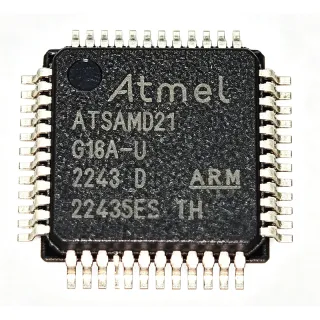
ATMXT224S-MAUR - 224-Node Capacitive Touch Controller | Microchip
MPN: ATMXT224S-MAUR ✓ Active| Qty | Unit Price | Extended |
|---|---|---|
| 1 | $6.9 | $6.90 |
| 10 | $6.21 | $62.10 |
| 100 | $5.52 | $552.00 |
| 500 | $4.97 | $2,485.00 |
| 1,000 | $4.48 | $4,480.00 |
ATMXT224S-MAUR Overview
A capacitive touchscreen controller is a mixed-signal IC that measures mutual-capacitance changes across a touch sensor grid, converts them to touch coordinates, and communicates them to a host processor. Within the signal-chain hierarchy it sits between the passive touch sensor laminate and the host MCU or application processor, forming part of the human-machine interface (HMI) subsystem of touch-enabled displays.
Key features include Microchip's patented mutual-capacitance method for unambiguous multitouch performance, optimized position filtering algorithms for smooth touch tracking, stylus detection that distinguishes stylus touches from finger touches, and suppression of unintentional touches for moisture robustness and superior noise immunity. The 224-node sensor matrix supports smartphone-class displays with high node density.
Architecturally, the mXT224S uses Atmel/Microchip's mutual capacitance sensing with on-chip acquisition hardware and embedded algorithms for position filtering, so host-side software burden is minimized. This makes it well suited to high-performance smartphone and tablet touch front-ends where latency and tracking smoothness matter.
Typical applications include smartphone touchscreens, tablet and portable media-player displays, and industrial HMI panels requiring stylus input. The 1.5 mm passive stylus support and noise immunity make it appropriate for resistive-to-capacitive migration designs.
Design consideration: moisture and unintended-touch suppression settings must be tuned to the specific sensor stack-up, so plan firmware configuration time during bring-up.
This page synthesizes distributor availability data, Microchip-recommended alternatives, and drop-in replacement guidance not found in the manufacturer datasheet alone.
Drop-in alternatives for ATMXT224S-MAUR — same package, pin-to-pin compatible. Different-package parts requiring PCB rework are excluded.
Quick Comparison Tool — Select alternative parts for side-by-side comparison:
ATMXT224T-MAU035
✅ Drop-In📋 Reference alternative (not in catalog)
ATMXT224E-MAHR
✅ Drop-In✓ In Stock
$3.72 / Unit
View Datasheet →ATMXT336U
✅ Drop-In📋 Reference alternative (not in catalog)
ATMXT224S-MAUR Maximum Ratings & Electrical Characteristics
| Product Type | Capacitive Touchscreen Controller IC |
| Product Family | maXTouch (mXT224S) |
| Sensing Nodes | 224 |
| Sensing Technology | Mutual capacitance |
| Multi-Touch Support | Yes (unambiguous multitouch) |
| Stylus Support | Passive stylus, 1.5 mm |
| Moisture Robustness | Yes (unintentional touch suppression) |
| Noise Immunity | Superior (per manufacturer) |
| Position Filtering | On-chip optimized filtering algorithms |
| Package | 56-terminal QFN no-lead (HVQCCN), square chip carrier, code MA |
| Terminal Form | No lead |
| Mounting Type | Surface Mount |
| Moisture Sensitivity Level (MSL) | 1 (per family data) |
| Category | Sensor, Capacitive Touch |
ATMXT224S-MAUR 56-terminal qfn no-lead (hvqccn), square chip carrier, code ma Pin Configuration Guide
Pin configuration for ATMXT224S-MAUR (56-terminal qfn no-lead (hvqccn), square chip carrier, code ma package). Pin numbering, functions, and connection diagrams are defined in the manufacturer datasheet. Refer to it for the exact footprint and soldering guidelines.

No detailed pinout data available for ATMXT224S-MAUR.
Refer to the datasheet for full pin configuration.
Typical Applications
ATMXT224S-MAUR is suitable for 6 applications: Smartphone Touchscreens, Industrial HMI Panels, Tablet and Portable Media Displays, Medical Device Touch Controls, Point-of-Sale and Kiosk Terminals, Automotive Center-Stack Touch Modules.
Smartphone Touchscreens
The mXT224S was purpose-built for high-performance smartphones, using Microchip's patented mutual-capacitance technology across 224 sensing nodes to deliver unambiguous multitouch performance. Its optimized position filtering algorithms produce smooth touch tracking under fast finger movement, which is critical for scrolling and gaming responsiveness. The 1.5 mm passive stylus support distinguishes stylus touches from finger touches, enabling pen features without powered styli, while unintentional-touch suppression provides moisture robustness and superior noise immunity against display EMI. Placed directly behind the sensor laminate with the host interface to the application processor, the controller offloads all acquisition and filtering from the host. The 56-terminal QFN no-lead package fits the tight board space behind smartphone display assemblies.
Recommended
Industrial HMI Panels
Industrial human-machine interface displays benefit from the ATMXT224S-MAUR's moisture robustness and superior noise immunity, which are essential in environments with washdown, condensation, or high EMI from motor drives and relays. Distributor data describes the part's operating range as typically suited for industrial applications, though the exact temperature limits should be verified in the Microchip datasheet. The 224-node mutual-capacitance grid supports medium-sized touch panels, and the 1.5 mm passive stylus support enables gloved-hand operation and precise selection on dense control screens. Firmware-level suppression of unintentional touches prevents false activations from water droplets or cable proximity. On a 4-layer PCB, place the controller close to the sensor tail connector and keep the analog sensing lines short and guarded by ground.
Recommended
Tablet and Portable Media Displays
Tablets and portable media players use mid-size mutual-capacitance panels that match the 224-node capacity of the mXT224S, with the controller handling full acquisition and filtering so the application processor only receives filtered touch reports. Unambiguous multitouch from the mutual-capacitance method supports two-finger pinch-zoom and multi-finger gestures, while position filtering delivers the smooth tracking users expect in media navigation. Passive stylus support at 1.5 mm adds annotation and drawing capability without a battery-powered stylus. The QFN no-lead package's low profile suits the thin mechanical envelope of tablet display stacks. Battery-powered operation is aided by the controller's ability to run acquisition at optimized rates; actual power figures should be taken from the Microchip datasheet during power budgeting.
Recommended
Medical Device Touch Controls
Medical diagnostic and monitoring equipment demands touch input that works reliably with disinfectant films, moisture, and gloved operators - conditions where the ATMXT224S-MAUR's moisture robustness and unintentional-touch suppression are decisive. The mutual-capacitance architecture with 224 nodes supports graphical user interfaces on patient monitors and portable diagnostic instruments, and stylus detection down to 1.5 mm allows precise input on dense clinical menus while distinguishing the stylus from accidental palm contact. Smooth position filtering reduces input error in time-critical settings. Designers should verify the qualification temperature range in the current datasheet and follow Microchip's configuration guidance to tune the moisture suppression thresholds for the specific cover-lens stack-up used on the medical enclosure.
Recommended
Point-of-Sale and Kiosk Terminals
Retail point-of-sale terminals and public kiosks face continuous public use: water films, screen protectors, and stylus-based signature capture. The ATMXT224S-MAUR addresses these with suppression of unintentional touches, moisture robustness, and 1.5 mm passive stylus support that distinguishes a signature stylus from stray finger contact - critical for accurate electronic signature capture at checkout. Its 224-node grid comfortably covers 5-10 inch signature and checkout displays, and the on-chip filtering ensures smooth menu scrolling across thousands of daily touch cycles. Noise immunity keeps touch reporting stable amid backlight inverters and payment-terminal RF electronics. The no-lead QFN package withstands the thermal cycling of always-on commercial installations when mounted on an adequate ground plane.
Recommended
Automotive Center-Stack Touch Modules
For automotive center-stack and navigation touch modules, noise immunity is the leading requirement: the mXT224S's superior noise immunity and robust filtering resist interference from switch-mode backlight drivers, antenna bursts, and charger circuits common in vehicles. The 224-node mutual-capacitance sensor supports the medium panel sizes typical of legacy center-stack displays, and unintentional-touch suppression mitigates false triggers from water spray or cleaning. The 1.5 mm passive stylus permits pen-based destination entry on navigation maps. Designers must confirm the appropriate temperature-grade variant in the current Microchip documentation for under-dash or high-soak environments, and should place the controller with short, guarded sensor routing to the laminate tail to preserve signal integrity in the electrically noisy cabin harness environment.
Recommended
Recommended Products Summary
Engineering reference data for ATMXT224S-MAUR — comparison, design guidance, and compliance information.
Selection Guide
Comparison with Alternatives
| Parameter | This Product | ATMXT224T-MAU035 | ATMXT224E-MAHR | ATMXT336U |
|---|---|---|---|---|
| Brand | Microchip Technology | Microchip Technology | Microchip Technology | Microchip Technology |
| Family Generation | mXT224S (enhanced) | mXT224T (newer generation) | mXT224E (earlier generation) | mXT336U (current generation) |
| Moisture Robustness | Yes (unintentional touch suppression) | Yes | Partial (earlier algorithms) | Yes (newer algorithms) |
| Microchip-Recommended Alternative | N/A (this part) | No | No | Yes - explicitly recommended by Microchip |
Key Differentiators
- Microchip-endorsed upgrade path with active lifecycle (vs ATMXT336U)
- 1.5 mm passive stylus support (vs ATMXT224E-MAHR)
- Moisture robustness and noise immunity (vs ATMXT224E-MAHR)
Design Notes
The ATMXT224S-MAUR comes in a 56-terminal QFN no-lead (HVQCCN) package with an exposed pad. Design the land pattern per Microchip's QFN footprint recommendation and place an array of thermal/signal vias under the exposed pad tied to ground. Because there are no protruding leads for inspection, budget for X-ray or 45-degree optical inspection in the production test plan. Keep sensor drive and sense routing short and matched, and surround the sensing traces with ground guard rings to preserve the superior noise immunity the controller is rated for.
Mutual-capacitance touch front ends are sensitive to switching noise from backlight inverters and DC-DC converters. Route the mXT224S sensing lines on an inner layer, reference them to a solid ground plane, and keep them away from high-dv/dt nodes. Use star or Pi filtering on the controller supply per the Microchip datasheet recommendation. The device's unintentional-touch suppression algorithms help, but layout-level noise control is always the first line of defense - firmware tuning cannot recover a noisy sensing trace.
Configuration is a design deliverable, not an afterthought: moisture-robustness thresholds, stylus sensitivity (1.5 mm), and position-filtering parameters must be tuned to the specific sensor stack-up, cover-lens thickness, and adhesive. An untuned mXT224S will show water false touches or missed stylus contact even though the silicon supports these features. Also, when migrating to the Microchip-recommended ATMXT336U, budget a full firmware and node-map requalification - it is not a firmware-compatible swap.
Compliance Information
RoHS/REACH/lead-free status not explicitly stated in retrieved distributor data; verify on the official Microchip product page or request the material declaration sheet before compliance-critical procurement.