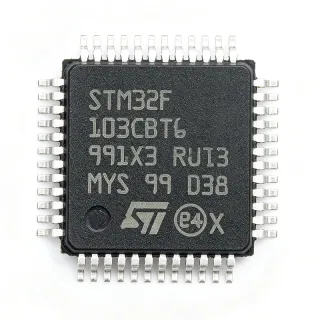
ATSAMD51P19A-CTUT-EFP - 120MHz Cortex-M4F MCU 512KB Flash | Microchip
MPN: ATSAMD51P19A-CTUT-EFP ✓ Active| Qty | Unit Price | Extended |
|---|---|---|
| 1 | $8.95 | $8.95 |
| 10 | $8.06 | $80.60 |
| 100 | $7.16 | $716.00 |
| 500 | $6.45 | $3,225.00 |
| 1,000 | $5.74 | $5,740.00 |
ATSAMD51P19A-CTUT-EFP Overview
A microcontroller (MCU) is a single-chip computer that integrates a processor core, memory (Flash for code, SRAM for data), and a rich set of peripherals onto one die. The Cortex-M4F architecture belongs to ARM's microcontroller class, adding hardware single-precision floating-point acceleration and DSP instructions on top of the Thumb-2 instruction set. Within Microchip's hierarchy, the SAM D51 sits above the SAM D21 (Cortex-M0+) and SAM D11 (Cortex-M0+) as a high-performance general-purpose family, beneath the Cortex-M7-based SAME70/SAMS70 line, and shares its D5x/E5x platform with the lower-pin-count SAM E51 variants.
Key features include up to 120 MHz CPU clock, 512 KB dual-panel Flash with ECC, 192 KB SRAM with ECC, an integrated full-speed USB 2.0 device/host interface, 99 programmable I/O lines, multiple SERCOM (serial communication) interfaces, a 12-bit ADC and 12-bit DAC, and a Cryptographic True Random Number Generator. The Cortex-M4F core delivers 1.25 DMIPS/MHz with DSP extensions, while the on-chip FPU removes the throughput penalty of software floating-point math used in motor control or sensor-fusion algorithms.
Architecturally the SAM D51 uses a multi-layer AHB bus matrix giving the CPU, DMA, and peripherals parallel access to SRAM and Flash, which removes the usual contention bottleneck seen on simpler MCUs. ECC on both Flash and SRAM targets safety-critical IEC 60730 class B firmware regimes. The Extended Flash Performance suffix indicates the variant is rated for higher endurance / industrial-grade Flash operation than the non-EFP base part.
Typical applications include industrial HMI panels, USB peripherals and human-interface devices, IoT sensor hubs, motor control with FOC, and audio processing. When designing with this part, allocate decoupling capacitance per the datasheet's recommended power-supply network and follow the 120-pin TFBGA escape routing guidelines to maintain signal integrity on the high-speed SERCOM and USB lines.
Drop-in alternatives for ATSAMD51P19A-CTUT-EFP — same package, pin-to-pin compatible. Different-package parts requiring PCB rework are excluded.
Variants in this series
Same-series models that are drop-in compatible with ATSAMD51P19A-CTUT-EFP (same form factor and footprint) — differing in ADC, Core Architecture, DAC, Package, SRAM.
Quick Comparison Tool — Select alternative parts for side-by-side comparison:
ATSAMD51P19A-CTUT
✅ Drop-In📋 Reference alternative (not in catalog)
ATSAMD51P19A-AFT
✅ Drop-In✓ In Stock
$6.18 / Unit
View Datasheet →ATSAMD51P19A-MUT-EFP
✅ Drop-In📋 Reference alternative (not in catalog)
ATSAMD51P19A-CTUT-EFP Maximum Ratings & Electrical Characteristics
| Core Architecture | ARM Cortex-M4F (32-bit) |
| Maximum CPU Clock | 120 MHz |
| FPU | Yes, single-precision hardware |
| DSP Instructions | Yes (Thumb-2 + SIMD) |
| Flash Memory | 512 KB (512K x 8) with ECC |
| SRAM | 192 KB with ECC |
| Supply Voltage | 1.71 V to 3.63 V |
| Operating Temperature | -40 C to +85 C |
| Package | 120-TFBGA (8x8 mm) |
| Programmable I/O Lines | 99 |
| ADC | 12-bit |
| DAC | 12-bit |
| USB | USB 2.0 Full-Speed Device/Host |
| Mounting Type | Surface Mount |
| RoHS Status | Compliant |
ATSAMD51P19A-CTUT-EFP 120-tfbga (8x8 mm) Pin Configuration Guide
Pin configuration for ATSAMD51P19A-CTUT-EFP (120-tfbga (8x8 mm) package). This digital IC includes GPIO, communication interfaces (UART, SPI, I2C), and power pins. Refer to the manufacturer datasheet for alternate pin functions and configuration options. Essential for embedded system design and PCB layout.

No detailed pinout data available for ATSAMD51P19A-CTUT-EFP.
Refer to the datasheet for full pin configuration.
Typical Applications
ATSAMD51P19A-CTUT-EFP is suitable for 6 applications: Industrial Human-Machine Interface (HMI), USB Audio Class Device (USB Headphone / DAC), Field-Oriented Control (FOC) Motor Drive, IoT Sensor Hub with USB-C Connectivity, Portable Medical Data Logger, Audio Effects Pedal / DSP Module.
Industrial Human-Machine Interface (HMI)
The ATSAMD51P19A-CTUT-EFP's 120 MHz Cortex-M4F with FPU drives color TFT displays up to 480x272 with smooth 60 fps touch response and on-chip USB for firmware-update HIDs. Its 192 KB SRAM holds double-buffered framebuffers and font tables without external memory. ECC-protected Flash allows reliable storage of UI assets and multilingual strings. The 1.71-3.63 V supply and -40 to +85 C range fit industrial cabinet environments, while the 99 I/O lines route capacitive-touch I2C, RGB display bus, and RS-485 fieldbus concurrently.
Recommended
USB Audio Class Device (USB Headphone / DAC)
The ATSAMD51P19A-CTUT-EFP integrates a full-speed USB 2.0 device/host PHY and 12-bit DAC, enabling USB Audio Class 1.0 headphone designs at 48 kHz / 24-bit. The Cortex-M4F hardware FPU performs biquad filtering and dynamic-range compression in real time without CPU stalls. Its 192 KB SRAM holds USB endpoint buffers plus an audio frame ring, removing the need for an external memory chip. The 120-TFBGA package keeps the PCB small for in-line dongle form factors while exposing 99 I/O for tactile-button and LED-bar interfaces.
Recommended
Field-Oriented Control (FOC) Motor Drive
FOC algorithms on PMSM and BLDC motors demand single-precision floating-point math and tight PWM-synchronization. The ATSAMD51P19A-CTUT-EFP's Cortex-M4F FPU runs Park/Clarke transforms and SVPWM at <10 us loop time, leaving headroom for speed PI and current-control loops at 20 kHz. The 12-bit ADC with hardware oversampling captures phase currents at the PWM center, while the integrated 12-bit DAC provides debug-output of internal variables. ECC Flash protects motor-parameter storage from bit-flips in 24 V industrial-bus environments.
Recommended
IoT Sensor Hub with USB-C Connectivity
USB-C-powered IoT hubs need a single-chip solution combining USB host, sensor I/O, and on-board processing. The ATSAMD51P19A-CTUT-EFP integrates full-speed USB host for HID and CDC class devices, multiple SERCOM ports for I2C/SPI sensors, and 99 I/O for relay and LED-driver expansion. Its 512 KB Flash runs MicroPython or FreeRTOS, while the FPU accelerates sensor-fusion math for IMUs. The Extended Flash Performance suffix extends Flash endurance for always-on data-logging applications typical in industrial IoT gateways.
Recommended
Portable Medical Data Logger
Battery-powered medical monitors and connected-health wearables benefit from the ATSAMD51P19A-CTUT-EFP's 1.71-3.63 V wide supply range, hardware FPU for biosignal DSP, and ECC Flash/SRAM that supports IEC 60730 class B firmware regimes. The 12-bit ADC samples ECG or pulse-oximetry signals at high sample rates, while the integrated USB Full-Speed PHY enumerates as a vendor-class device to a host PC for real-time waveform streaming. ECC memory helps catch single-bit upsets critical in patient-monitoring reliability analysis.
Recommended
Audio Effects Pedal / DSP Module
Guitar and pro-audio pedal designers benefit from the ATSAMD51P19A-CTUT-EFP's hardware single-precision FPU, which runs reverb/chorus/distortion algorithms at 48 kHz with negligible CPU overhead. The 192 KB SRAM buffers multiple audio channels simultaneously without external memory, and the 12-bit ADC/DAC are well-matched to line-level instrument signals after op-amp conditioning. USB Device-class support enables MIDI-over-USB and firmware-update workflows, while the 120-TFBGA package fits in compact stomp-box enclosures.
Recommended
Recommended Products Summary
Engineering reference data for ATSAMD51P19A-CTUT-EFP — comparison, design guidance, and compliance information.
Selection Guide
Comparison with Alternatives
| Parameter | This Product | ATSAMD51P19A-CTUT | ATSAMD51P19A-AFT | ATSAMD51P19A-MUT-EFP | ATSAMD51N19A-AUT-EFP | ATSAMD51J19A-MU |
|---|---|---|---|---|---|---|
| Package | 120-TFBGA (8x8 mm) | 120-TFBGA (8x8 mm) - same | 120-TFBGA (8x8 mm) - same | 120-TFBGA (8x8 mm) - same | 128-TQFP (14x14 mm) - different | 64-QFN - different |
| Brand | Microchip Technology | Microchip Technology | Microchip Technology | Microchip Technology | Microchip Technology | Microchip Technology |
| Core | ARM Cortex-M4F | ARM Cortex-M4F | ARM Cortex-M4F | ARM Cortex-M4F | ARM Cortex-M4F | ARM Cortex-M4F |
| Maximum Clock | 120 MHz | 120 MHz | 120 MHz | 120 MHz | 120 MHz | 120 MHz |
| Flash Memory | 512 KB with ECC | 512 KB with ECC | 512 KB with ECC | 512 KB with ECC | 512 KB with ECC | 512 KB with ECC |
| SRAM | 192 KB with ECC | 192 KB with ECC | 192 KB with ECC | 192 KB with ECC | 192 KB with ECC | 192 KB with ECC |
| I/O Pins | 99 | 99 | 99 | 99 | 99 | 51 |
| Extended Flash Performance (EFP) | Yes | No | No | Yes | Yes | No |
| Supply Voltage | 1.71 V to 3.63 V | 1.71 V to 3.63 V | 1.71 V to 3.63 V | 1.71 V to 3.63 V | 1.71 V to 3.63 V | 1.71 V to 3.63 V |
Key Differentiators
- Extended Flash Performance (EFP) for high-write-cycle industrial use (vs ATSAMD51P19A-CTUT)
- Largest I/O count in the SAM D51 family (vs ATSAMD51J19A-MU)
- BGA package optimizes PCB footprint for high-density designs (vs ATSAMD51N19A-AUT-EFP (TQFP-128))
Design Notes
Route the 120-TFBGA escape using micro-via-in-pad or dog-bone fanout with 0.4 mm pitch traces; per Microchip's SAM D51 hardware-design guidelines place 100 nF X7R decoupling on every VDD pin within 1 mm trace length, plus a single 4.7 uF bulk cap per rail. Keep the 32 kHz crystal traces short and symmetric to avoid oscillator startup failure, and isolate the integrated USB PHY D+/D- lines with 90-ohm differential impedance to meet USB 2.0 Full-Speed signal-integrity requirements.
Do not skip the NVM Security Bit fuse configuration when designing with ATSAMD51P19A-CTUT-EFP for production. According to the SAM D5X/E5X errata, certain DFP/DFLL configurations require the user's firmware to re-lock the BOCOR register after boot to prevent runaway clock failure. Also note that SERCOM pin-mux conflicts can silently break I2C transactions if multiple peripherals claim the same PAD - use ASF or MPLAB Harmony's pin-mux tool to validate before layout tape-out.
When operating ATSAMD51P19A-CTUT-EFP from a USB 5 V rail, use a 3.3 V LDO (such as the AP2112K-3.3) with at least 200 mA rating to cover the MCU's active current peaks and the USB peripheral load. The 1.71 V minimum allows direct Li-Ion operation (3.0-4.2 V) with a buck regulator. Enable the on-chip voltage regulator with a 1 uF + 100 nF decoupling network on VDDOUT to keep core rail noise below the datasheet's 30 mVpp tolerance.
Compliance Information
RoHS and lead-free compliance per Microchip product page. Not AEC-Q100 qualified - this part targets industrial and consumer applications, not automotive. JLCPCB listing confirms ROHS compliance.