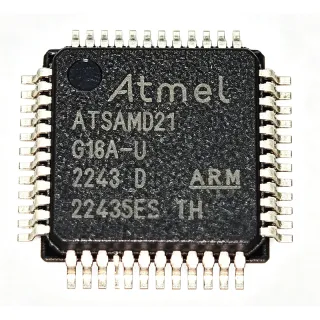
DSPIC30F2011-20E/ML - 16-bit DSC 20MIPS 12KB | Microchip
MPN: DSPIC30F2011-20E/ML ✓ Active| Qty | Unit Price | Extended |
|---|---|---|
| 1 | $4.62 | $4.62 |
| 10 | $4.2 | $42.00 |
| 100 | $3.75 | $375.00 |
| 500 | $3.4 | $1,700.00 |
| 1,000 | $3.05 | $3,050.00 |
DSPIC30F2011-20E/ML Overview
A Digital Signal Controller is a hybrid class of embedded processor that combines the computational core of a microcontroller (MCU) with the math-oriented features of a digital signal processor (DSP). In the semiconductor hierarchy, the dsPIC30F2011 sits within the broader families of 16-bit microcontrollers, embedded processors, and system-on-chip solutions, bridging the gap between general-purpose MCUs and dedicated DSPs.
Key features include 12 KB of flash program memory, 20 MIPS instruction execution, a 16-bit modified Harvard architecture with DSP multiply-accumulate instructions, motor-control PWM peripherals, and industrial temperature operation from -40C to +125C. The ML designation denotes the 28-QFN surface-mount package, and the E suffix indicates the extended temperature grade with 20 MHz-class operation.
Architecturally, the dsPIC30F2011 pairs the CPU with flash-based program storage and a rich peripheral set including high-speed ADC channels, UART, and flexible PWM outputs, enabling single-chip control of sensor-conditioning and motor-drive loops without external signal-processing ICs. According to Microchip's product page, the dsPIC30F Sensor Family provides seamless migration options to dsPIC33F, PIC24H, or PIC24F devices in similar packages, protecting software investment.
Typical applications include sensor interfacing and signal conditioning, motor control and power conversion, industrial automation nodes, and embedded systems requiring deterministic DSP math in a compact 28-QFN footprint.
A key design consideration: as a flash-based microcontroller-class device, decouple VDD and AVDD supplies carefully and verify in-circuit programming (ICSPTM) header access on dense QFN layouts.
This page synthesizes distributor listings, drop-in alternative analysis, pinout data, and practical design notes not found in the manufacturer datasheet, with pricing as of 2026-09-20.
Drop-in alternatives for DSPIC30F2011-20E/ML — same package, pin-to-pin compatible. Different-package parts requiring PCB rework are excluded.
Variants in this series
Same-series models that are drop-in compatible with DSPIC30F2011-20E/ML (same form factor and footprint) — differing in Core Architecture, Package, Program Memory, Migration Path, Operating Temperature.
Quick Comparison Tool — Select alternative parts for side-by-side comparison:
DSPIC30F2012-20E/ML
✅ Drop-In ⚠️ Specs Unverified✓ In Stock
$3.92 / Unit
View Datasheet →DSPIC30F3012-20E/ML
✅ Drop-In ⚠️ Specs Unverified✓ In Stock
$5.42 / Unit
View Datasheet →DSPIC30F3013-20E/ML
✅ Drop-In ⚠️ Specs Unverified📋 Reference alternative (not in catalog)
DSPIC30F2011-20I/ML
✅ Drop-In ⚠️ Specs Unverified✓ In Stock
$2.69 / Unit
View Datasheet →DSPIC30F2010T-20E/MM
✅ Drop-In ⚠️ Specs Unverified✓ In Stock
$3.98 / Unit
View Datasheet →DSPIC30F2011-20E/ML Maximum Ratings & Electrical Characteristics
| Core Architecture | 16-bit MCU/DSP |
| Instruction Rate | 20 MIPS |
| Program Memory (Flash) | 12 KB |
| Package | 28-QFN (ML) |
| Operating Temperature Range | -40C to +125C |
| Family | dsPIC30F Sensor Family |
| DSP Functionality | Integrated DSP engine (multiply-accumulate) |
| Communication Interfaces | UART (per 28-pin family datasheet) |
| Mounting Type | Surface Mount |
| Packaging | Tube |
| Lead Finish | Pb-free (per Jotrin listing) |
| RoHS Status | RoHS compliant (Pb-free per distributor data) |
| Migration Path | Pin-compatible migration to dsPIC33F, PIC24H, PIC24F |
DSPIC30F2011-20E/ML Pin Configuration
| Pin 1 | MCLR — Master clear (reset) input / programming voltage |
| Pin 2 | AN0/CN2/RB0 — Analog input 0 / change notification / port B bit 0 |
| Pin 3 | AN1/CN3/RB1 — Analog input 1 / change notification / port B bit 1 |
| Pin 4 | AN2/SS1/CN4/RB2 — Analog input 2 / SPI slave select / port B bit 2 |
| Pin 5 | AN3/INDX/CN5/RB3 — Analog input 3 / encoder index / port B bit 3 |
| Pin 6 | AN4/UPDN/CN6/RB4 — Analog input 4 / encoder up-down / port B bit 4 |
| Pin 7 | VSS — Ground reference |
| Pin 8 | OSC1/CLKI — Oscillator crystal input / external clock input |
| Pin 9 | OSC2/CLKO/RC15 — Oscillator crystal output / clock output / port C bit 15 |
| Pin 10 | VDD — Positive supply |
| Pin 11 | SOSCI/T2CK/CN1/RC13 — Secondary oscillator input / Timer2 clock / port C bit 13 |
| Pin 12 | SOSCO/T1CK/CN0/RC14 — Secondary oscillator output / Timer1 clock / port C bit 14 |
| Pin 13 | RF2/U1RX — UART1 receive / port F bit 2 |
| Pin 14 | RF3/U1TX — UART1 transmit / port F bit 3 |
| Pin 15 | VSS — Ground reference |
| Pin 16 | VDD — Positive supply |
| Pin 17 | AN5/QEA/IC1/RB5 — Analog input 5 / encoder phase A / input capture 1 / port B bit 5 |
| Pin 18 | AN6/QEB/IC2/RB6 — Analog input 6 / encoder phase B / input capture 2 / port B bit 6 |
| Pin 19 | AN7/IC3/RB7 — Analog input 7 / input capture 3 / port B bit 7 |
| Pin 20 | AN8/IC4/RB8 — Analog input 8 / input capture 4 / port B bit 8 |
| Pin 21 | AN9/PWM1L1/RB9 — Analog input 9 / PWM1 low output 1 / port B bit 9 |
| Pin 22 | AN10/PWM1H1/RB10 — Analog input 10 / PWM1 high output 1 / port B bit 10 |
| Pin 23 | AN11/PWM1L2/RB11 — Analog input 11 / PWM1 low output 2 / port B bit 11 |
| Pin 24 | VSS — Ground reference |
| Pin 25 | AN12/PWM1H2/RB12 — Analog input 12 / PWM1 high output 2 / port B bit 12 |
| Pin 26 | AN13/PWM1L3/RB13 — Analog input 13 / PWM1 low output 3 / port B bit 13 |
| Pin 27 | AN14/PWM1H3/RB14 — Analog input 14 / PWM1 high output 3 / port B bit 14 |
| Pin 28 | AVDD — Analog supply for ADC |
Typical Applications
DSPIC30F2011-20E/ML is suitable for 6 applications: Sensor Signal Conditioning, Motor Control and Power Conversion, Industrial Automation Nodes, Battery Chargers and Power Management, Consumer Appliance Control, Medical and Diagnostic Instrumentation.
Sensor Signal Conditioning
The DSPIC30F2011-20E/ML is purpose-built for sensor interfacing, as its dsPIC30F Sensor Family designation implies. Its integrated DSP engine with hardware multiply-accumulate executes filtering algorithms such as IIR/FIR and FFT preprocessing at 20 MIPS, while the on-chip ADC digitizes sensor outputs directly, eliminating external signal-processor ICs. The extended -40C to +125C rating allows deployment next to industrial sensors without local thermal mitigation. In a typical pressure or temperature sensing node, the DSC samples, filters, linearizes, and transmits results over UART in a single 28-QFN device. Designers should budget the 12 KB flash carefully, as compensation tables and filter coefficients consume code space quickly.
Recommended
Motor Control and Power Conversion
The DSPIC30F2011-20E/ML fits motor control because it combines motor-control PWM peripherals with a 20 MIPS DSP core capable of executing current-loop and commutation math in real time. The hardware multiply-accumulate unit accelerates field-oriented control (FOC) inner loops that a conventional 8-bit MCU cannot sustain. Its -40C to +125C industrial rating suits drive electronics mounted near motors where ambient temperatures are elevated. In a BLDC or PMSM drive, the DSC generates complementary PWM outputs, reads current via the ADC, and closes the loop entirely on-chip. With 12 KB flash, use sensorless trapezoidal schemes rather than full FOC with complex compensation, or migrate to higher-memory dsPIC30F2012 if code size becomes a constraint.
Recommended
Industrial Automation Nodes
In factory automation, the DSPIC30F2011-20E/ML serves as a compact intelligent node performing local control, actuator driving, and condition monitoring. The 20 MIPS 16-bit core handles PID loops and protocol framing concurrently, while the -40C to +125C temperature range tolerates control-cabinet and near-machine deployment without forced cooling. The UART interface links the node to RS-485 or RS-232 field buses through an external transceiver, and the PWM peripherals drive actuators, valves, or heaters directly. Its QFN footprint keeps node PCBs small for distributed I/O architectures. Because the device offers a documented seamless migration path to dsPIC33F and PIC24H devices in similar packages, automation platforms can standardize firmware architecture with an upgrade route preserved.
Recommended
Battery Chargers and Power Management
The DSPIC30F2011-20E/ML implements smart battery charging algorithms where charging profiles require computation, not just fixed thresholds. Its DSP capability supports coulomb counting, impedance estimation, and adaptive CC/CV profiling at 20 MIPS, while PWM peripherals generate the switching waveform for buck or boost charger power stages. The -40C to +125C grade is valuable in automotive-adjacent and outdoor charging enclosures. In a typical design, the DSC reads voltage and current through the ADC, executes the charge state machine, and modulates PWM duty to regulate the power stage, all within a 28-QFN footprint. The 12 KB flash accommodates multi-chemistry profiles (Li-ion, lead-acid, NiMH), though extensive logging features should be offloaded to external memory.
Recommended
Consumer Appliance Control
Appliances such as blenders, fans, pumps, and small HVAC units benefit from the DSPIC30F2011-20E/ML's blend of DSP math for speed control and MCU peripherals for user interfaces. The 20 MIPS core executes sensorless motor commutation algorithms while simultaneously scanning buttons and driving indicators. The extended -40C to +125C temperature rating provides margin against enclosed, heat-trapping appliance housings, and the compact 28-QFN package keeps control-board size minimal for cost-driven designs. With 12 KB of flash, a complete application including speed profiles, fault handling, and a simple UI fits comfortably. Designers should apply Microchip's motor-control application notes, which provide reference firmware directly compatible with the dsPIC30F peripheral set.
Recommended
Medical and Diagnostic Instrumentation
Portable and benchtop medical devices use the DSPIC30F2011-20E/ML where sensor data requires DSP-grade processing in a small, power-efficient controller. The 16-bit core with multiply-accumulate acceleration handles biopotential filtering, pressure-wave analysis, and calibration math at 20 MIPS, while the on-chip ADC acquires sensor channels directly. The industrial -40C to +125C rating exceeds medical ambient requirements, giving wide design margin, and the QFN package suits compact handheld enclosures. In a typical instrument, the DSC conditions signals, runs detection algorithms, and reports over UART to a display or host controller. The 12 KB flash constrains algorithm complexity; partition code so that heavy filtering executes in DSP routines and higher-level logic stays lean.
Recommended
Recommended Products Summary
Engineering reference data for DSPIC30F2011-20E/ML — comparison, design guidance, and compliance information.
Selection Guide
Comparison with Alternatives
| Parameter | This Product | DSPIC30F2012-20E/ML | DSPIC30F3012-20E/ML | DSPIC30F3013-20E/ML |
|---|---|---|---|---|
| Package | 28-QFN (ML) | 28-QFN (ML) - same | 28-QFN (ML) - same | 28-QFN (ML) - same |
| Brand | Microchip Technology | Microchip Technology | Microchip Technology | Microchip Technology |
| Instruction Rate | 20 MIPS | 20 MIPS | 20 MIPS | 20 MIPS |
| Operating Temperature | -40C to +125C | -40C to +125C (E grade) | -40C to +125C (E grade) | -40C to +125C (E grade) |
| Family | dsPIC30F Sensor Family | dsPIC30F Sensor Family | dsPIC30F (shared DS70139 datasheet) | dsPIC30F (shared DS70139 datasheet) |
| Migration Path | dsPIC33F / PIC24H / PIC24F | dsPIC33F / PIC24H / PIC24F | dsPIC33F / PIC24H / PIC24F | dsPIC33F / PIC24H / PIC24F |
Key Differentiators
- Lowest flash density in the 28-QFN dsPIC30F family (vs DSPIC30F2012-20E/ML)
- Extended -40C to +125C E-grade operation (vs DSPIC30F2011-20I/ML)
- Sensor-family peripheral focus with encoder inputs (vs DSPIC30F2010T-20E/MM)
Design Notes
The 28-QFN (ML) package requires a well-designed exposed-pad footprint for reliable grounding. Place an array of thermal vias under the center pad connecting to the ground plane, and verify paste segmentation (typically 60-70% coverage) to prevent paddle voiding during reflow. For the QFN lead geometry, follow Microchip's recommended land pattern in the family datasheet (DS70139) rather than generic QFN patterns, since lead coplanarity tolerances on QFN packages make pad geometry the primary determinant of first-pass yield.
Decouple VDD with a 0.1 uF ceramic capacitor placed within 3 mm of each VDD pin, plus 4.7-10 uF of bulk capacitance near the device. AVDD (pin 28) powers the ADC analog domain and must be filtered separately - a ferrite bead feeding AVDD from VDD with its own 0.1 uF and 1 uF capacitors substantially improves ADC noise performance. During flash programming, the device draws additional current on VDD, so ensure the supply can support ICSP programming without brownout.
Three recurring pitfalls with this device: (1) MCLR must not be driven directly from a push-pull source if ICSP programming is needed - use a 10k pull-up and expose MCLR, VDD, VSS, PGD, and PGC on a 5-pin header. (2) The E temperature grade (-40C to +125C) requires verifying that oscillator selection remains valid across the full range; internal RC options drift at high temperature. (3) The 12 KB flash includes configuration words - confirm flash budget after adding bootloader code, as bootloaders commonly consume 1-2 KB.
Compliance Information
Pb-free (lead-free) per Jotrin Electronics listing. RoHS compliance inferred from Pb-free catalog status on distributor listings; formal certificate of conformance should be requested from the distributor. REACH and conflict-minerals status not stated in retrieved data.