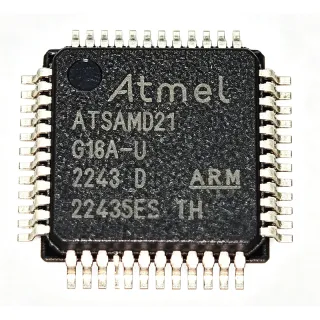
DSPIC33EP128MU506-E/PT - 16-bit DSC 128KB Flash 70 MIPS | Microchip
MPN: DSPIC33EP128MU506-E/PT ✓ Active| Qty | Unit Price | Extended |
|---|---|---|
| 1 | $6.2 | $6.20 |
| 10 | $5.65 | $56.50 |
| 100 | $5.1 | $510.00 |
| 500 | $4.7 | $2,350.00 |
| 1,000 | $4.3 | $4,300.00 |
DSPIC33EP128MU506-E/PT Overview
A digital signal controller combines the compute architecture of a microcontroller with the DSP capability of a digital signal processor. Within the power-management hierarchy of embedded systems, a DSC such as the dsPIC33EP family sits above basic MCUs and below application processors, providing real-time control loops, fast math (MAC/DSP engine), and rich peripheral integration in a single chip. The dsPIC33EP family is Microchip's 70 MIPS generation built on a 16-bit modified Harvard architecture core.
Key features of the DSPIC33EP128MU506 include its 128KB self-programmable flash, integrated USB 2.0 device support, multiple UART/SPI/I2C communication modules, high-speed PWM with dead-time control for power conversion and motor drive, and dual ADC modules for simultaneous sampling. The -E suffix denotes the extended industrial temperature grade, and the /PT suffix denotes a 64-pin TQFP in tray packaging.
Technically, the device executes from flash at up to 70 MIPS with a hardware DSP engine supporting single-cycle multiply-accumulate, essential for digital filtering, transform-based algorithms, and field-oriented motor control. Its operating voltage range of 3.0V to 3.6V supports standard single-supply designs with an internal regulator and PLL clocking options for flexible timing.
Typical applications include digital power supplies and LED drivers, brushless DC and PMSM motor control, USB-connected industrial instruments, and audio or sensor signal-processing nodes where DSP throughput and deterministic control loops are required.
Design consideration: budget flash and SRAM carefully - the 128KB flash is non-upgradeable in this MPN; if code growth is expected, consider the pin-compatible 256KB DSPIC33EP256MU506 variant.
This page synthesizes distributor inventory data, drop-in alternative cross-references, and practical design guidance not consolidated in the manufacturer datasheet.
Drop-in alternatives for DSPIC33EP128MU506-E/PT — same package, pin-to-pin compatible. Different-package parts requiring PCB rework are excluded.
Variants in this series
Same-series models that are drop-in compatible with DSPIC33EP128MU506-E/PT (same form factor and footprint) — differing in Operating Temperature, Package, ADC Resolution, Connectivity, Core.
Quick Comparison Tool — Select alternative parts for side-by-side comparison:
DSPIC33EP128MU506-I/PT
✅ Drop-In✓ In Stock
$4.65 / Unit
View Datasheet →DSPIC33EP256MU506-E/PT
✅ Drop-In ⚠️ Specs Unverified📋 Reference alternative (not in catalog)
DSPIC33EP128MU504-H/PT
✅ Drop-In✓ In Stock
$4.48 / Unit
View Datasheet →DSPIC33EP128GM306-E/PT
✅ Drop-In✓ In Stock
$6.15 / Unit
View Datasheet →DSPIC33EP128MC506-E/PT
✅ Drop-In ⚠️ Specs Unverified📋 Reference alternative (not in catalog)
DSPIC33EP128MU506-E/PT Maximum Ratings & Electrical Characteristics
| Core | 16-bit dsPIC33E DSC core |
| Program Memory (Flash) | 128 KB |
| Data Bus Width | 16 bit |
| Core Performance | Up to 70 MIPS |
| Product Type | Digital Signal Controller (DSC/MCU) |
| Operating Supply Voltage | 3 V to 3.6 V |
| Operating Temperature | -40C to +125C (E grade) |
| Package | 64-pin TQFP (PT) |
| Mounting Type | Surface Mount |
| Packaging | Tray |
| Connectivity Peripherals | USB, UART, SPI, I2C |
| Timers / PWM | High-speed PWM, timers (per datasheet) |
| Series | dsPIC33EP128MU506 |
| RoHS Status | Compliant |
DSPIC33EP128MU506-E/PT 64-pin tqfp (pt) Pin Configuration Guide
Pin configuration for DSPIC33EP128MU506-E/PT (64-pin tqfp (pt) package). This digital IC includes GPIO, communication interfaces (UART, SPI, I2C), and power pins. Refer to the manufacturer datasheet for alternate pin functions and configuration options. Essential for embedded system design and PCB layout.

No detailed pinout data available for DSPIC33EP128MU506-E/PT.
Refer to the datasheet for full pin configuration.
Typical Applications
DSPIC33EP128MU506-E/PT is suitable for 6 applications: Digital Power Supplies, Brushless Motor Control (BLDC/PMSM), USB-Connected Industrial Instruments, Automotive-Adjacent and High-Temperature Industrial Nodes, Audio and Sensor Signal Processing, LED Lighting and Smart Lighting Control.
Digital Power Supplies
The DSPIC33EP128MU506-E/PT fits digital power supply control because its high-speed PWM module supports phase-shifted, complementary, and push-pull outputs with hardware dead-time insertion, while the 70 MIPS DSP core executes control-loop compensation algorithms in single-cycle MAC instructions. In a digitally controlled LLC or buck converter, the DSC closes the voltage loop at tens of kHz update rates, far faster than software-only MCU implementations. The -40C to +125C temperature grade of the -E variant suits power supplies with hot internal ambients near switching stages. Unlike analog controllers, digital control with this DSC enables adaptive gain scheduling, telemetry over UART/USB, and non-linear startup profiles, at the cost of firmware development effort and careful PWM-ADC timing synchronization.
Recommended
Brushless Motor Control (BLDC/PMSM)
For motor control, the DSPIC33EP128MU506-E/PT provides field-oriented control capability: single-cycle multiply-accumulate accelerates Clarke/Park transforms and PI current loops, while high-resolution PWM with dead-time drives three-phase inverters. The dual ADC architecture allows simultaneous sampling of phase currents, essential for FOC accuracy at high electrical speeds. Running at 70 MIPS, the device executes full FOC loops in well under 100 us. The extended -40C to +125C rating tolerates drive enclosures near hot power stages. The main design consideration is careful ADC-trigger-to-PWM-update timing to avoid sampling during switch transients. Compared to the MC sub-family, the MU adds USB for drive commissioning and field firmware updates without a separate communication chip.
Recommended
USB-Connected Industrial Instruments
The integrated full-speed USB 2.0 device module makes the DSPIC33EP128MU506-E/PT a single-chip solution for instruments that must stream data or receive commands from a PC: data loggers, test fixtures, and lab controllers. The DSC acquires signals via its ADCs, applies digital filtering with the DSP engine, and reports over USB CDC/HID class protocols without an external USB-interface chip, reducing BOM cost and board area. The 128KB flash accommodates USB stacks plus application logic. The extended temperature grade supports fanless instruments. Design consideration: USB requires a precise 48 MHz clock derived from the internal PLL with an external crystal, so clock layout and crystal selection deserve attention. Compared with a separate MCU plus USB-UART bridge, this integration cuts component count significantly.
Recommended
Automotive-Adjacent and High-Temperature Industrial Nodes
With its -40C to +125C operating range, the DSPIC33EP128MU506-E/PT addresses underhood-adjacent, lighting-ballast, and industrial nodes where consumer-grade parts lose margin. The 70 MIPS core runs sensor fusion, protocol bridging (UART/SPI/I2C/CAN via family variants), and closed-loop actuator control concurrently. In a high-temperature sensor node, the DSC conditions analog inputs, executes averaging and FFT-based diagnostics with the DSP engine, and reports over serial links. Design consideration: at 125C ambient, junction margin is small, so switch-mode loads on I/O pins should be minimized and thermal resistance of the TQFP-64 layout verified with copper pour estimates. Note this part is not AEC-Q100 qualified; for formal automotive programs, evaluate Microchip automotive-grade family members instead.
Recommended
Audio and Sensor Signal Processing
The DSP engine of the DSPIC33EP128MU506-E/PT performs single-cycle MAC operations, making it practical for FIR/IIR filtering, FFT-based spectral analysis, and audio effects at moderate sample rates. The high-speed ADCs digitize microphone or sensor inputs while the 70 MIPS core processes streams in real time; a 256-point FFT completes within milliseconds. The USB device module enables direct streaming to a host for analysis or configuration, and the extended temperature rating suits outdoor acoustic or vibration monitoring hardware. Compared with a general-purpose MCU, the DSC reduces filter overhead roughly proportionally to MAC acceleration; compared with a dedicated DSP, it adds integrated flash, peripherals, and industrial temperature grades. Memory is the limiting factor - 128KB flash constrains long filter banks, where the 256KB sibling helps.
Recommended
LED Lighting and Smart Lighting Control
The DSPIC33EP128MU506-E/PT serves advanced LED drivers and smart luminaires where high-resolution PWM dimming, power-factor correction, and communication are combined. Its PWM module supports high-frequency converter control for PFC stages and precise multi-channel dimming, while 70 MIPS handles digital compensation of both stages in one device. USB or UART links enable DALI/DMX gateway bridging and firmware field updates. The -40C to +125C grade suits sealed, passively cooled fixtures where internal temperatures approach 100C. Design consideration: ensure PWM resolution at the chosen switching frequency meets dimming-depth targets, and verify flash headroom for lighting protocol stacks. Against analog LED controllers, this DSC adds programmability and telemetry; the trade-off is firmware complexity and 3.0-3.6V supply rail requirements.
Recommended
Recommended Products Summary
Engineering reference data for DSPIC33EP128MU506-E/PT — comparison, design guidance, and compliance information.
Selection Guide
Comparison with Alternatives
| Parameter | This Product | DSPIC33EP128MU506-I/PT | DSPIC33EP256MU506-E/PT | DSPIC33EP128MU504-H/PT | DSPIC33EP128GM306-E/PT | DSPIC33EP128MC506-E/PT |
|---|---|---|---|---|---|---|
| Package | 64-pin TQFP (PT) | 64-pin TQFP (PT) - same | 64-pin TQFP (PT) - same | 64-pin TQFP (PT) - same | 64-pin TQFP (PT) - same | 64-pin TQFP (PT) - same |
| Brand | Microchip Technology | Microchip Technology | Microchip Technology | Microchip Technology | Microchip Technology | Microchip Technology |
| Flash Memory | 128 KB | 128 KB | 256 KB | 128 KB | 128 KB | 128 KB |
| USB Device Module | Yes | Yes | Yes | Yes | No (dual CAN instead) | No |
| Core Performance | Up to 70 MIPS | Up to 70 MIPS | Up to 70 MIPS | Up to 70 MIPS | Up to 70 MIPS | Up to 70 MIPS |
| Primary Peripheral Differentiator | USB 2.0 device | USB 2.0 device | USB 2.0 device | USB 2.0 device | Dual CAN 2.0B | Motor-control peripherals |
Key Differentiators
- Extended temperature grade in stock volume (vs DSPIC33EP128MU506-I/PT)
- Integrated USB device module (vs DSPIC33EP128MC506-E/PT)
- Memory headroom option without redesign (vs DSPIC33EP256MU506-E/PT)
Design Notes
The DSPIC33EP128MU506 operates from a single 3.0V to 3.6V rail with an internal regulator for the core. Provide a 3.3V LDO or buck with at least 100mA headroom for core plus I/O, and decouple every VDD/VSS pin pair with 0.1uF ceramic capacitors placed within 2mm of the pins, plus bulk 10uF near the supply entry. Follow the Microchip dsPIC33EP hardware design guidelines for the internal voltage regulator capacitor sizing - this external regulator capacitor is mandatory and its value must match the datasheet recommendation.
For in-circuit programming and debugging, reserve MCLR plus PGD/PGC access on the 64-pin TQFP layout, ideally through a standard 5-pin ICSP header or Tag-Connect footprint. Keep the USB D+/D- pair as a 90-ohm differential routed tightly with a series resistor matching the datasheet recommendation, and keep the crystal traces short with ground guarding for stable PLL operation. The TQFP-64 thermal pad is not exposed, so dissipation relies on pin heat spreading - use generous copper pour on VDD/VSS pins.
Three common mistakes: (1) substituting the -I grade where the -E grade is specified - the -40C to +85C rating of DSPIC33EP128MU506-I/PT will not survive 105C fixture ambients intended for the -E part; (2) forgetting the peripheral pin-select (PPS) configuration - many digital pins must be remapped in software before UART/SPI functions appear; (3) exceeding flash - the 128KB budget must cover USB stack plus application, so estimate code size before committing to this MPN rather than the 256KB variant.
Compliance Information
RoHS compliant and lead-free per standard Microchip TQFP tray product offerings. Not AEC-Q100 qualified - this is an extended-industrial grade (-E), not an automotive-qualified part.