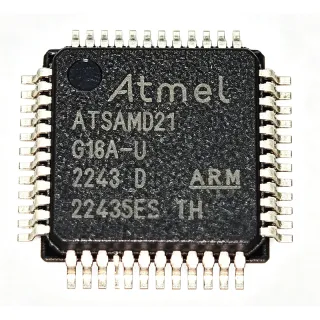
DSPIC33EP512GM710-E/BG - 70 MIPS DSC 512KB TFBGA-121 | Microchip
MPN: DSPIC33EP512GM710-E/BG ✓ Active| Qty | Unit Price | Extended |
|---|---|---|
| 1 | $9.42 | $9.42 |
| 10 | $8.55 | $85.50 |
| 100 | $7.68 | $768.00 |
| 500 | $6.95 | $3,475.00 |
| 1,000 | $6.3 | $6,300.00 |
DSPIC33EP512GM710-E/BG Overview
A digital signal controller combines the compute power of a microcontroller with the arithmetic throughput of a DSP. In the power-management hierarchy, the dsPIC33E family sits between general-purpose MCUs (such as the PIC24) and dedicated DSPs, offering a 16-bit Harvard architecture with DSP instructions, making it a popular choice for embedded control systems that need both deterministic control loops and math-heavy signal processing.
Key features include the 70 MIPS dsPIC33E core with DSP and enhanced on-chip peripherals, 512KB (170K x 24) of flash program memory, up to 48KB of RAM, integrated op-amps (8) plus 2 comparators, 8 input capture / output compare channels, 4 quadrature encoder interfaces, CAN, I2C, SPI, UART/USART and IrDA connectivity, and an extended -40C to +125C operating range suited to harsh automotive and industrial environments.
Technically, the device operates from a 60 MHz clock (per Newark listing) that yields the 70 MIPS rated performance through the dsPIC33E pipelined core. The analog subsystem with on-chip operational amplifiers can offload external signal conditioning, while the motor-control PWM and quadrature encoder interfaces allow closed-loop motor control without external gate drivers or encoder decoders. Code protection features are implemented per Microchip datasheet specifications.
Typical applications include single and dual motor control (Microchip's MA330035 PIM uses this exact device with the Explorer 16 board for motor-control development), digital power supplies and solar inverters, automotive body and powertrain control modules, and industrial sensor signal conditioning where the on-chip op-amps reduce BOM cost.
Design consideration: the 121-ball TFBGA package requires careful BGA-landing-pattern PCB design and X-ray-capable assembly; verify ball-map routing before layout. Place 0.1uF decoupling capacitors under or immediately adjacent to each VDD/VSS ball pair.
This page synthesizes distributor pricing, drop-in alternatives, pinout guidance, and practical design notes not found in the manufacturer datasheet alone.
Drop-in alternatives for DSPIC33EP512GM710-E/BG — same package, pin-to-pin compatible. Different-package parts requiring PCB rework are excluded.
Variants in this series
Same-series models that are drop-in compatible with DSPIC33EP512GM710-E/BG (same form factor and footprint) — differing in Package, Mounting Type, Supply Voltage, Operating Temperature, Core.
Quick Comparison Tool — Select alternative parts for side-by-side comparison:
DSPIC33EP512GM710-I/BG
✅ Drop-In✓ In Stock
$6.35 / Unit
View Datasheet →DSPIC33EP512GM310-E/BG
✅ Drop-In✓ In Stock
$5.95 / Unit
View Datasheet →DSPIC33EP512GM610-E/BG
✅ Drop-In ⚠️ Specs Unverified📋 Reference alternative (not in catalog)
DSPIC33EP256GM710-E/BG
✅ Drop-In ⚠️ Specs Unverified📋 Reference alternative (not in catalog)
DSPIC33EP512GM710-E/BG Maximum Ratings & Electrical Characteristics
| Core Architecture | 16-bit dsPIC33E (Harvard, DSP-enhanced) |
| Max CPU Speed | 70 MIPS |
| Clock Frequency | 60 MHz |
| Program Memory (Flash) | 512 KB (170K x 24) |
| SRAM | 48 KB |
| Supply Voltage | 3.3 V |
| Operating Temperature | -40C to +125C (E grade) |
| Package | 121-ball TFBGA (10x10 mm) |
| Mounting Type | Surface Mount (BGA) |
| Communication Interfaces | CAN, I2C, SPI, UART/USART, IrDA |
| Input Capture / Output Compare | 8 / 8 |
| Quadrature Encoder Interfaces | 4 (QEI) |
| On-chip Op Amps | 8 (with 2 comparators) |
| Qualification | AEC-Q100 / TS 16949 (per distributor listing) |
| RoHS Status | Compliant |
| Packaging | Tray |
| Series | dsPIC33EP512GM710 |
DSPIC33EP512GM710-E/BG 121-ball tfbga (10x10 mm) Pin Configuration Guide
Pin configuration for DSPIC33EP512GM710-E/BG (121-ball tfbga (10x10 mm) package). This digital IC includes GPIO, communication interfaces (UART, SPI, I2C), and power pins. Refer to the manufacturer datasheet for alternate pin functions and configuration options. Essential for embedded system design and PCB layout.

No detailed pinout data available for DSPIC33EP512GM710-E/BG.
Refer to the datasheet for full pin configuration.
Typical Applications
DSPIC33EP512GM710-E/BG is suitable for 6 applications: Dual Motor Control, Automotive Body and Powertrain Electronics, Digital Power Supplies and Inverters, Industrial Automation and Robotics, Sensor Signal Conditioning and Data Acquisition, Embedded Control with CAN Networking.
Dual Motor Control
The DSPIC33EP512GM710-E/BG is purpose-built for single and dual motor control: Microchip's PIM information sheet (document 50002216a) documents driving one or two motors using the device's internal and external op-amps configured with on-board passives. Its 4 quadrature encoder interfaces read two position feedback channels simultaneously, while 8 capture/compare channels and motor-control PWM generate complementary gated drive signals. The 70 MIPS DSP core executes field-oriented control (FOC) loops at high carrier frequencies with headroom for diagnostics. The 512KB flash accommodates FOC libraries for two axes plus communication stacks (CAN, UART). Running from 3.3V with the -40C to +125C E-grade rating, it survives drive-enclosure thermal environments without derating.
Recommended
Automotive Body and Powertrain Electronics
Distributor listings (Microchip USA, Jotrin) identify the DSPIC33EP512GM710-E/BG as AEC-Q100 and TS 16949 aligned with a -40C to +125C operating range, matching the harshest under-hood ambient requirements. The on-chip CAN interface connects directly to vehicle networks for gateway or node-level communication, while the 8 integrated op-amps and 2 comparators condition analog sensors (current shunts, position pots, thermistors) without external amplifier ICs, reducing BOM count. The 70 MIPS DSP core handles sensor fusion and filtering tasks that standard automotive MCUs offload. Designers should validate the current Microchip qualification report for the specific PPAP level required, and use the extended-temperature -E suffix, not the -I variant, in engine-bay and brake-zone placements.
Recommended
Digital Power Supplies and Inverters
High-frequency digital power control demands fast, deterministic math: the dsPIC33E DSP engine's MAC and divide instructions execute PI and resonant controller updates inside each PWM period at 70 MIPS. The 8 output-compare/PWM channels drive phase legs with complementary outputs and dead-time control, while 8 on-chip op-amps amplify shunt-current signals ahead of the ADC for cycle-by-cycle current limiting - eliminating external amplifier stages. The 512KB flash stores compensation tables, soft-start state machines and communication firmware (CAN/I2C/SPI) concurrently. In solar micro-inverters and telecom rectifiers, the 3.3V supply simplifies interfacing with gate-driver logic, and the -40C to +125C range tolerates power-stage proximity heating.
Recommended
Industrial Automation and Robotics
Robot joints and multi-axis conveyors need coordinated multi-axis sensing and control - exactly the resource set of the GM710: 4 QEI modules read up to four encoders, 8 capture channels timestamp position events, and the 70 MIPS DSP core runs coordinated motion profiles plus fieldbus stacks. The 8 op-amps digitize motor-phase and bus-voltage feedback internally. Factory-floor temperature swings from cold storage docks to hot panels fall inside the -40C to +125C rating, and the CAN interface daisy-chains multiple DSC nodes on one twisted pair. The 512KB flash allows a full motion-sequencing firmware, diagnostics, and OTA-update loader to coexist, avoiding external flash chips.
Recommended
Sensor Signal Conditioning and Data Acquisition
The integrated analog subsystem makes this DSC a compact acquisition front-end: 8 op-amps can be configured as programmable-gain amplifiers for bridge sensors (load cells, RTDs, pressure elements), and the comparators implement window alarms without CPU intervention. The DSP core then applies FIR/IIR filtering on the sampled streams at 70 MIPS, an order of magnitude above typical MCU filtering throughput. 512KB of flash buffers calibration tables per-sensor. In industrial condition-monitoring nodes, one DSPIC33EP512GM710-E/BG replaces a discrete amplifier array plus MCU, cutting board area in the dense TFBGA-121 (10x10 mm) footprint; the 3.3V rail matches common MEMS sensor supply levels directly.
Recommended
Embedded Control with CAN Networking
Any distributed system - building controls, agricultural implements, marine electronics - benefits from this device's integration: on-chip CAN plus dual UART/IrDA, SPI and I2C lets one DSC bridge fieldbus to local sensors and actuators. The 70 MIPS core runs protocol stacks (CANopen/J1939-class) with margin for the application, and the 48KB RAM buffers network traffic and logging data. The extended -40C to +125C rating covers unconditioned outdoor enclosures. Because the TFBGA-121 exposes a rich peripheral mux, designers can repurpose balls per variant without PCB respins across product families - the same footprint hosts GM310/GM610/GM710 memory points for tiered SKUs.
Recommended
Recommended Products Summary
Engineering reference data for DSPIC33EP512GM710-E/BG — comparison, design guidance, and compliance information.
Selection Guide
Comparison with Alternatives
| Parameter | This Product | DSPIC33EP512GM710-I/BG | DSPIC33EP512GM310-E/BG | DSPIC33EP512GM610-E/BG | DSPIC33EP256GM710-E/BG |
|---|---|---|---|---|---|
| Package | 121-TFBGA (10x10 mm) | 121-TFBGA (10x10 mm) - same | 121-TFBGA (10x10 mm) - same | 121-TFBGA (10x10 mm) - same | 121-TFBGA (10x10 mm) - same |
| Brand | Microchip Technology | Microchip Technology | Microchip Technology | Microchip Technology | Microchip Technology |
| Flash Memory | 512 KB | 512 KB | 128 KB-class | 256 KB | 256 KB |
| CPU Performance | 70 MIPS | 70 MIPS | 70 MIPS | 70 MIPS | 70 MIPS |
| Operating Temperature | -40C to +125C (E) | -40C to +85C (I) | -40C to +125C (E) | -40C to +125C (E) | -40C to +125C (E) |
| Supply Voltage | 3.3 V | 3.3 V | 3.3 V | 3.3 V | 3.3 V |
| On-chip Op Amps / QEI | 8 / 4 | 8 / 4 | 8 / 4 | 8 / 4 | 8 / 4 |
Key Differentiators
- Extended temperature rating for automotive placement (vs DSPIC33EP512GM710-I/BG)
- Maximum flash capacity in the pin-compatible family (vs DSPIC33EP512GM310-E/BG)
- Integrated analog front-end reduces BOM (vs DSPIC33EP256GM710-E/BG)
Design Notes
The 121-ball TFBGA (10x10 mm) uses a ~0.8 mm ball pitch requiring an 11x11 via-in-pad or dog-bone breakout strategy on standard PCB processes. Verify the exact ball map from the family datasheet pin diagrams - it differs substantially from the 100-pin TQFP sibling used on the MA330035 PIM. Plan power (VDD/VSS) and reference balls first, fan out analog op-amp balls away from CAN/PWM switching signals, and confirm your assembler supports BGA X-ray inspection before releasing the design.
Estimated: at 60 MHz/70 MIPS with all analog blocks enabled, core current is on the order of tens of mA at 3.3 V (datasheet-typical). Budget a low-noise 3.3 V rail and decouple each VDD ball with 0.1 uF plus bulk 10 uF near the package. Because the part drives motor PWM gates through external drivers, separate the DSC ground island from power-stage ground and join at a single point to keep ADC references clean.
Do not confuse the -E (extended, -40C to +125C) and -I (industrial, -40C to +85C) suffixes - automotive and under-hood designs must use -E. Second, firmware validated on the MA330035 TQFP PIM must be re-checked against the TFBGA ball mux configuration in the production schematic; peripheral-pin-select assignments differ. Finally, Microchip notes in its documents that methods to defeat code protection operate outside datasheet specifications - do not rely on flash readback as a security feature.
Compliance Information
RoHS Compliant per OnlineComponents listing. Microchip USA and Jotrin listings state adherence to AEC-Q100 and TS 16949 standards for this part. REACH and halogen-free status not stated in the provided data.