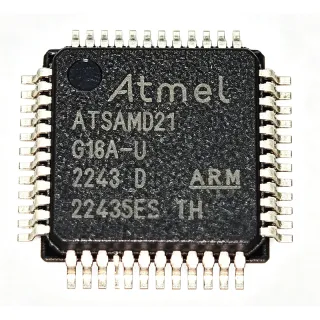
DSPIC33EV128GM104-I/PT - 5V 70MIPS 128KB DSC | Microchip
MPN: DSPIC33EV128GM104-I/PT ✓ Active| Qty | Unit Price | Extended |
|---|---|---|
| 1 | $5.117 | $5.12 |
| 10 | $4.86 | $48.60 |
| 100 | $4.42 | $442.00 |
| 500 | $4.08 | $2,040.00 |
| 1,000 | $3.75 | $3,750.00 |
DSPIC33EV128GM104-I/PT Overview
A digital signal controller is a hybrid device that combines the computational throughput of a digital signal processor (DSP) with the peripheral integration and control architecture of a microcontroller (MCU). Within the power management IC and embedded control hierarchy, the dsPIC33EV family sits in the 16-bit DSC class, positioned for deterministic real-time control loops such as motor commutation and power conversion where both multiply-accumulate DSP throughput and robust I/O are required in a single chip.
Key features include the 5V-tolerant dsPIC DSC core operating at 70 MIPS, which allows direct interfacing with 5V industrial sensors and automotive signals without level shifting. The 128 KB program memory includes ECC Flash for functional safety support, and the family integrates CAN, advanced PWM, SENT, and on-chip op amp peripherals as stated in the Microchip datasheet. The -40C to +85C industrial temperature rating (I suffix) suits harsh environments.
The enhanced on-chip feature set targets applications with electrical noise and vibration: the ECC Flash detects and corrects single-bit memory errors, while the 5V core provides wider noise margins than 3.3V competitors. The integrated op amps reduce external component count in current-sense circuits, and the CAN module supports automotive and industrial network topologies directly.
Typical applications include motor control (BLDC, PMSM, stepper) using the dedicated PWM modules, automotive sensors and control units, appliances operating on noisy mains power, and industrial automation nodes requiring CAN connectivity.
Design consideration: the device operates from a single 5V supply; multiple VDD/VSS pairs must all be decoupled with 0.1 uF ceramics, and all PGECx/PGEDx pairs must be kept paired for ICSP programming.
This page synthesizes distributor pricing, drop-in same-family alternatives, and practical design notes not found in the manufacturer datasheet.
Drop-in alternatives for DSPIC33EV128GM104-I/PT — same package, pin-to-pin compatible. Different-package parts requiring PCB rework are excluded.
Variants in this series
Same-series models that are drop-in compatible with DSPIC33EV128GM104-I/PT (same form factor and footprint) — differing in Package, Core Architecture, Functional Safety Support, CTMU, Core.
Quick Comparison Tool — Select alternative parts for side-by-side comparison:
DSPIC33EV128GM104-E/PT
✅ Drop-In📋 Reference alternative (not in catalog)
DSPIC33EV128GM104-E/PTVAO
✅ Drop-In📋 Reference alternative (not in catalog)
DSPIC33EV256GM104-I/PT
✅ Drop-In ⚠️ Specs Unverified✓ In Stock
$4.85 / Unit
View Datasheet →DSPIC33EV64GM104-I/PT
✅ Drop-In ⚠️ Specs Unverified📋 Reference alternative (not in catalog)
DSPIC33EV128GM002-I/PT
✅ Drop-In ⚠️ Specs Unverified📋 Reference alternative (not in catalog)
DSPIC33EV128GM104-I/PT Maximum Ratings & Electrical Characteristics
| Core | dsPIC33EV 16-bit DSC core |
| Instruction Class | 16-bit Digital Signal Controller |
| Maximum Execution Speed | 70 MIPS |
| Supply Voltage Class | 5 V |
| Program Memory Size | 128 KB (43K x 24) ECC Flash |
| RAM Size | 8 KB |
| Package | 44-pin TQFP (10x10 mm, 0.8 mm pitch) |
| Mounting Type | Surface Mount |
| Operating Temperature | -40C to +85C (I grade) |
| Technology | CMOS |
| Key Peripherals | CAN, PWM, SENT, on-chip op amps |
| Functional Safety Support | Yes (ECC Flash, FuSa qualified family) |
| Programming Interface | ICSP via PGECx/PGEDx pairs |
DSPIC33EV128GM104-I/PT 44-pin tqfp (10x10 mm, 0.8 mm pitch) Pin Configuration Guide
Pin configuration for DSPIC33EV128GM104-I/PT (44-pin tqfp (10x10 mm, 0.8 mm pitch) package). This digital IC includes GPIO, communication interfaces (UART, SPI, I2C), and power pins. Refer to the manufacturer datasheet for alternate pin functions and configuration options. Essential for embedded system design and PCB layout.

No detailed pinout data available for DSPIC33EV128GM104-I/PT.
Refer to the datasheet for full pin configuration.
Typical Applications
DSPIC33EV128GM104-I/PT is suitable for 6 applications: BLDC/PMSM Motor Control, Automotive Sensors and Control Units, Home Appliance Control, Industrial Automation and CAN Nodes, Digital Power Conversion, Functional Safety Systems.
BLDC/PMSM Motor Control
The DSPIC33EV128GM104-I/PT fits motor control because its 70 MIPS 16-bit DSP core executes field-oriented control (FOC) inner current loops deterministically at PWM frequencies typical of industrial drives, while dedicated advanced PWM hardware generates complementary outputs with hardware dead-time insertion. The on-chip op amps condition low-side shunt current signals directly, reducing external analog component count and board area in the inverter stage. The 128 KB ECC Flash holds the control algorithm plus a bootloader with margin, and ECC protects the control code against single-bit upsets in noisy switching environments. Placed as the single controller on the inverter PCB with CAN available for networked drive communication, it delivers 5V noise-margin robustness that 3.3V controllers cannot match near high dV/dt switching nodes.
Recommended
Automotive Sensors and Control Units
The dsPIC33EV family is explicitly targeted by Microchip at automotive sensors, touch, and control units designed to operate reliably in harsh environments with noise and vibration. The 5V core provides wide noise margins against automotive load-dump transients and switching noise, and the SENT (Single Edge Nibble Transmission) interface natively connects to SENT-output automotive sensors per the SAE J2716 signal convention without external protocol ICs. The CAN module integrates the node into in-vehicle networks, and ECC Flash supports functional safety requirements for control units. The 44-pin TQFP (10x10 mm) suits compact sensor-body PCBs, and the same footprint is available in -40C to +125C E-grade ordering codes, allowing one PCB layout to serve both industrial and automotive-temperature builds.
Recommended
Home Appliance Control
Appliances such as washing machines, refrigerators, and dishwashers combine noisy mains environments with motor and heater control - exactly the harsh-environment profile Microchip cites for the dsPIC33EV family. The 5V operation lets the DSPIC33EV128GM104-I/PT directly sense zero-crossing from mains-derived supplies and drive 5V triac/opto-isolated circuitry without level shifting, while 70 MIPS covers compressor and BLDC motor FOC algorithms. The on-chip op amps handle motor current sensing, PWM drives inverter or PSC motor stages, and ECC Flash maintains firmware integrity across years of vibration and electrical stress. The 128 KB program space comfortably holds application firmware plus communication stacks, and the industrial -40C to +85C rating covers unconditioned appliance interiors.
Recommended
Industrial Automation and CAN Nodes
In factory automation, the DSPIC33EV128GM104-I/PT serves as an intelligent sensor/actuator node: its integrated CAN module connects to industrial CAN/CANopen networks, the 5V core interfaces directly with legacy 24V-buffered industrial signals through simple dividers, and 70 MIPS executes local control loops such as valve positioning or conveyor synchronization without host intervention. ECC Flash supports uptime-critical installations where uncorrected memory faults are unacceptable, and the industrial temperature rating covers cabinet and field-mount environments. The on-chip op amps can close analog control loops (e.g., 4-20 mA transmitter conditioning) internally. Using the same 44-TQFP footprint with the 256 KB variant allows a scalable node platform where a single PCB supports feature-tiered SKUs.
Recommended
Digital Power Conversion
Switch-mode power supplies, solar micro-inverters, and battery chargers benefit from the DSPIC33EV128GM104-I/PT's combination of DSP throughput and power-specific peripherals. The 70 MIPS core runs digital compensation loops for voltage-mode or current-mode control at switching frequencies in the hundreds of kHz, while the advanced PWM module provides complementary outputs, dead-time control, and phase-shifted topologies needed for LLC or full-bridge converters. The 5V noise margin is valuable in power environments with high dV/dt and di/dt, and ECC Flash protects control firmware in electrically stressful conditions. The on-chip op amps condition current-shunt feedback, trimming BOM cost. The 44-pin TQFP provides enough PWM-capable I/O for multi-phase converters within a compact footprint.
Recommended
Functional Safety Systems
The dsPIC33EV family is a Functional Safety (FuSa) qualified product line per Microchip, and the DSPIC33EV128GM104-I/PT supports safety-oriented designs through hardware that simplifies diagnostics: ECC Flash detects and corrects single-bit memory errors autonomously, the clock monitoring and watchdog facilities detect timing faults, and paired PGECx/PGEDx pins plus self-test libraries support built-in diagnostics at startup and runtime. This makes the part appropriate for safety-related industrial drives, appliance controllers, and automotive control units where IEC 61508-style development flows are applied. The 70 MIPS budget leaves headroom for diagnostic code alongside the primary control function, and the 5V I/O levels support direct connection to discrete safety-limit switches common in machine-safety chains.
Recommended
Recommended Products Summary
Engineering reference data for DSPIC33EV128GM104-I/PT — comparison, design guidance, and compliance information.
Selection Guide
Comparison with Alternatives
| Parameter | This Product | DSPIC33EV128GM104-E/PT | DSPIC33EV256GM104-I/PT | DSPIC33EV64GM104-I/PT | DSPIC33EV128GM002-I/PT |
|---|---|---|---|---|---|
| Package | 44-TQFP (10x10 mm, 0.8 mm pitch) | 44-TQFP - same | 44-TQFP - same | 44-TQFP - same | 44-TQFP - same |
| Brand | Microchip Technology | Microchip Technology | Microchip Technology | Microchip Technology | Microchip Technology |
| Core Speed | 70 MIPS | 70 MIPS | 70 MIPS | 70 MIPS | 70 MIPS |
| Program Memory | 128 KB ECC Flash (43K x 24) | 128 KB ECC Flash | 256 KB ECC Flash | 64 KB ECC Flash | 128 KB ECC Flash |
| Supply Voltage | 5 V class | 5 V class | 5 V class | 5 V class | 5 V class |
| Operating Temperature | -40C to +85C | -40C to +125C | -40C to +85C | -40C to +85C | -40C to +85C |
| Key Peripherals | CAN, PWM, SENT, op amps | CAN, PWM, SENT, op amps | CAN, PWM, SENT, op amps | CAN, PWM, SENT, op amps | reduced peripheral set - verify pin map |
Key Differentiators
- 5V core with wide noise margin (vs 3.3V 16-bit DSC competitors)
- ECC Flash for functional safety (vs DSPIC33EV64GM104-I/PT (cost-down variant))
- Extended-temperature drop-in available (vs DSPIC33EV128GM104-E/PT)
- Integrated analog and connectivity (vs DSPIC33EV128GM002-I/PT)
Design Notes
Decouple every VDD/VSS pair on the 44-pin TQFP with a 0.1 uF ceramic placed within 2 mm of each pin pair, plus one bulk 4.7-10 uF per supply domain. The dsPIC33EV 5V core draws dynamic current at 70 MIPS, and the TQFP's 0.8 mm pitch leaves limited routing space - place the decoupling network on the component side directly under the package. Use a solid ground plane rather than ground traces; per Microchip programming guidance, ALL VSS and VDD pins must be connected during both operation and ICSP.
The device has multiple PGECx/PGEDx programming pairs, and per Microchip tooling documentation you may use any pair but must keep the pair matched: ICSPCLK on PGEC2 requires ICSPDAT on PGED2. Do not load the shared PGD pins with heavy pull-downs or LEDs, or programming will fail. Additionally, choose the ordering suffix carefully - the 'PT' suffix is the 44-TQFP; MM-suffix parts (QFN) have different footprints and are NOT pin-compatible on the same PCB.
Exploit the 5V I/O noise margin: keep high-dV/dt nodes (motor phase outputs, MOSFET gate drive) on the PCB side away from the TQFP, and route analog inputs (op amp, ADC channels) away from PWM lines. For SENT and CAN interfaces, route CAN_H/CAN_L as a matched pair to the transceiver with a stub under 20 mm. Estimated: with 70 MIPS core current in the tens-of-mA range, the 44-TQFP thermal resistance (~60-80 C/W theta_JA for a 10x10 TQFP on a 2-layer board, typical value) keeps junction rise below 10 C at full load - no heatsink needed, but verify with Microchip's thermal data for your stack-up.
Compliance Information
Verified web data does not include explicit compliance certificates for this exact ordering code. The dsPIC33EV family is referenced in relation to AEC-Q100 and TS 16949 standards per Microchip USA product descriptions; request Microchip material declarations for formal compliance documentation.