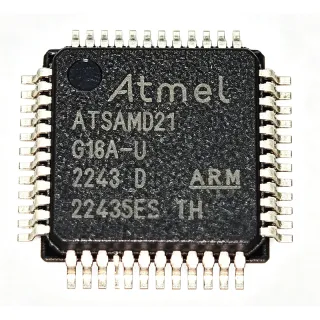
DSPIC33FJ128GP306-I/PT - 16-bit DSC 40MIPS 128KB Flash | Microchip
MPN: DSPIC33FJ128GP306-I/PT ✓ Active| Qty | Unit Price | Extended |
|---|---|---|
| 1 | $6.62 | $6.62 |
| 10 | $5.98 | $59.80 |
| 100 | $5.42 | $542.00 |
| 500 | $4.97 | $2,485.00 |
| 1,000 | $4.55 | $4,550.00 |
DSPIC33FJ128GP306-I/PT Overview
A Digital Signal Controller blends the architecture of a microcontroller (MCU) with the computational engines of a Digital Signal Processor (DSP). In the embedded systems hierarchy, the DSC sits between a general-purpose MCU and a dedicated DSP: it retains MCU peripherals, interrupts, and ease of use while adding a DSP engine with hardware multiply-accumulate, dual operands, and modulo addressing. The dsPIC33F family succeeds the 30 MIPS dsPIC30F and is pin-compatible with PIC24H microcontrollers, giving designers a migration path within one code-compatible ecosystem.
Key features of the DSPIC33FJ128GP306 include 128 KB (128K x 8) of Flash program memory operating at 2.5V to 3.6V, an internal modified Harvard architecture executing most instructions in a single cycle at 40 MIPS, and a rich General Purpose (GP) peripheral set. According to Microchip product literature, the GP variants integrate high-speed ADC, UART, SPI, I2C, input capture, output compare, and motor-free general-purpose peripherals suited to digital signal processing tasks.
Architecturally, the device combines a 16-bit CPU with a 17-bit x 17-bit single-cycle hardware multiplier, dual 40-bit accumulators, and 40-stage barrel shifter. The Flash Programming Specification for this device is published separately by Microchip (an 80-page programming document is available), while the main family datasheet covers electrical characteristics and pin functions. Programming is supported through multiple PGECx/PGEDx pin pairs for In-Circuit Serial Programming (ICSP) - any pair can be used, but PGECx and PGEDx must be used as a matched pair.
Typical applications include embedded control with digital filtering, sensor signal conditioning, audio processing, power monitoring, and general industrial automation. The 40 MIPS throughput and DSP engine make it well suited where a standard 16-bit MCU lacks arithmetic headroom.
When designing with the DSPIC33FJ128GP306, connect all VDD and VSS pins - per Microchip documentation, omitting even one supply pin can cause programming to fail. Choose PGEC2/PGED2 deliberately and route ICSPCLK/ICSPDAT cleanly.
This page synthesizes distributor pricing, drop-in alternatives, and practical design notes not found in the manufacturer datasheet.
Drop-in alternatives for DSPIC33FJ128GP306-I/PT — same package, pin-to-pin compatible. Different-package parts requiring PCB rework are excluded.
Variants in this series
Same-series models that are drop-in compatible with DSPIC33FJ128GP306-I/PT (same form factor and footprint) — differing in Package.
Quick Comparison Tool — Select alternative parts for side-by-side comparison:
DSPIC33FJ128GP306A-I/PT
✅ Drop-In ⚠️ Specs Unverified📋 Reference alternative (not in catalog)
DSPIC33FJ128GP306A-E/PT
✅ Drop-In📋 Reference alternative (not in catalog)
DSPIC33FJ64GP306-I/PT
✅ Drop-In📋 Reference alternative (not in catalog)
DSPIC33FJ128GP206AT-I/PT
✅ Drop-In✓ In Stock
$4.6 / Unit
View Datasheet →DSPIC33FJ256GP506-I/PT
✅ Drop-In ⚠️ Specs Unverified✓ In Stock
$5.33 / Unit
View Datasheet →DSPIC33FJ128GP306-I/PT Maximum Ratings & Electrical Characteristics
| Core Architecture | 16-bit dsPIC33F DSC |
| Maximum Operating Speed | 40 MIPS |
| Program Memory Size | 128 KB (128K x 8) Flash |
| Supply Voltage Range | 2.5 V to 3.6 V |
| Operating Temperature | -40C to +85C (Industrial) |
| Package | 64-TQFP (10x10 mm), PT suffix |
| Mounting Type | Surface Mount |
| Terminal Form | Gull Wing |
| Product Family | dsPIC33F General Purpose (GP) |
| Migration Path | Pin-compatible with PIC24H MCUs and dsPIC30F DSCs in similar packages |
| Programming Interface | ICSP via PGECx/PGEDx pin pairs (multiple pairs, must be used as pairs) |
| Peripheral Type | General Purpose (GP) peripherals |
| RoHS Status | Compliant |
DSPIC33FJ128GP306-I/PT 64-tqfp (10x10 mm), pt suffix Pin Configuration Guide
Pin configuration for DSPIC33FJ128GP306-I/PT (64-tqfp (10x10 mm), pt suffix package). This digital IC includes GPIO, communication interfaces (UART, SPI, I2C), and power pins. Refer to the manufacturer datasheet for alternate pin functions and configuration options. Essential for embedded system design and PCB layout.

No detailed pinout data available for DSPIC33FJ128GP306-I/PT.
Refer to the datasheet for full pin configuration.
Typical Applications
DSPIC33FJ128GP306-I/PT is suitable for 6 applications: Industrial Automation and Control, Sensor Signal Conditioning and Digital Filtering, Embedded Systems Development and Education, Portable and Battery-Powered Instruments, Audio and Voice Signal Processing, Automotive-Adjacent and Rugged Embedded Control.
Industrial Automation and Control
The DSPIC33FJ128GP306-I/PT fits industrial automation nodes that combine control loops with signal-conditioning math. Its 40 MIPS 16-bit core executes PID and digital filter routines single-cycle, while 128 KB Flash accommodates bootloaders plus feature-rich application code. The industrial -40C to +85C rating matches factory-floor environments, and the 2.5V-3.6V supply simplifies 3.3V rail designs. In a typical deployment the DSC reads analog sensors through its ADC, runs compensation math in the DSP engine, and reports over UART/SPI to a supervisory PLC - delivering DSP-class arithmetic without a separate processor or board redesign.
Recommended
Sensor Signal Conditioning and Digital Filtering
Sensor front-ends benefit directly from the DSP engine of the DSPIC33FJ128GP306: single-cycle 17x17-bit multiply-accumulate operations implement FIR and IIR filters that would stall a conventional 16-bit MCU. The GP peripheral variant provides ADC, UART, SPI and I2C for digitizing and offloading conditioned data. With 40 MIPS throughput, oversampling and decimation pipelines run in real time, while 128 KB Flash stores calibration tables and multi-order coefficient sets. The 64-TQFP pin count leaves adequate I/O for multiplexed sensor arrays in medical, weigh-scale, and vibration-monitoring instruments.
Recommended
Embedded Systems Development and Education
The DSPIC33FJ128GP306-I/PT is a strong teaching and prototyping platform: Microchip documents seamless migration among PIC24 MCUs, dsPIC30F and dsPIC33F DSCs sharing pinouts, software and development tools, so one Explorer 16/32 development board supports the whole 16-bit portfolio. Multiple PGECx/PGEDx ICSP pairs allow flexible debugger connections (pairs must be used matched, e.g. PGEC2 with PGED2). The 40 MIPS core lets students observe real-time DSP concepts - filtering, FFT - on low-cost hardware, and the 64-TQFP 10x10 mm package is hand-solderable on simple two-layer prototype boards.
Recommended
Portable and Battery-Powered Instruments
Handheld instruments exploit the 2.5V-3.6V single-supply operation of the DSPIC33FJ128GP306, allowing direct powering from a single lithium cell via a small LDO. The 40 MIPS DSP engine performs real-time spectral analysis or logging math, while low-power idle modes conserve battery between measurements. 128 KB Flash retains logged data structures, fonts, and multi-language UI code without external memory. The industrial temperature grade covers outdoor handheld use, and the 64-TQFP's 0.5 mm pitch balances density with inspectability for compact instrument PCBs where signal integrity at moderate clock rates is easily managed.
Recommended
Audio and Voice Signal Processing
Voice-band and general audio processing map naturally onto the dsPIC33F DSP engine: at 40 MIPS, the DSPIC33FJ128GP306 sustains real-time sample rates for echo cancellation, AGC, and band filtering using single-cycle MAC operations. UART and SPI interfaces stream PCM data to codecs, while 128 KB Flash stores codebooks and double-buffered coefficient tables. The 3.3V GP variant avoids motor-control peripherals that add cost in audio-only designs. Designers should budget the DSP core load carefully - at 40 MIPS total throughput, sustained filter chains must be profiled against interrupt overhead in MPLAB simulation before committing the architecture.
Recommended
Automotive-Adjacent and Rugged Embedded Control
Although the -I grade targets industrial rather than AEC-Q100 automotive qualification, the DSPIC33FJ128GP306-I/PT serves rugged non-safety control modules - pumps, chargers, telemetry boxes - where -40C to +85C operation and DSP arithmetic are required. The DSP engine handles sensor fusion and control math at 40 MIPS, and 128 KB Flash supports field-updatable firmware via a bootloader using the documented ICSP flash programming flow. For designs that later require extended temperature or automotive screening, Microchip's -E (extended) temperature variants in the same 64-TQFP footprint provide a drop-in upgrade path without PCB changes.
Recommended
Recommended Products Summary
Engineering reference data for DSPIC33FJ128GP306-I/PT — comparison, design guidance, and compliance information.
Selection Guide
Comparison with Alternatives
| Parameter | This Product | DSPIC33FJ128GP306A-I/PT | DSPIC33FJ128GP306A-E/PT | DSPIC33FJ64GP306-I/PT | DSPIC33FJ128GP206AT-I/PT | DSPIC33FJ256GP506-I/PT |
|---|---|---|---|---|---|---|
| Package | TQFP-64 (10x10 mm) | TQFP-64 (10x10 mm) - same | TQFP-64 (10x10 mm) - same | TQFP-64 (10x10 mm) - same | TQFP-64 (10x10 mm) - same | TQFP-64 (10x10 mm) - same |
| Brand | Microchip Technology | Microchip Technology | Microchip Technology | Microchip Technology | Microchip Technology | Microchip Technology |
| Program Memory (Flash) | 128 KB | 128 KB | 128 KB | 64 KB | 128 KB | 256 KB |
| Maximum Speed | 40 MIPS | 40 MIPS | 40 MIPS | 40 MIPS | 40 MIPS | 40 MIPS |
| Operating Temperature | -40C to +85C (Industrial) | -40C to +85C (Industrial) | -40C to +125C (Extended) | -40C to +85C (Industrial) | -40C to +85C (Industrial) | -40C to +85C (Industrial) |
| Supply Voltage | 2.5 V to 3.6 V | 2.5 V to 3.6 V | 2.5 V to 3.6 V | 2.5 V to 3.6 V | 2.5 V to 3.6 V | 2.5 V to 3.6 V |
| Die Revision / Errata Risk | Original FJ revision | A revision - new errata set | A revision - new errata set | Original FJ revision | AT revision - check pin mux | GP506 peripheral set differs |
| Drop-in Fit for GP306 Board | Reference part | Yes - closest swap | Yes - extended temp upgrade | Yes - if 64 KB suffices | Verify peripheral mapping | Verify peripheral mapping |
Key Differentiators
- Double the Flash of the 64 KB sibling (vs DSPIC33FJ64GP306-I/PT)
- Extended-temperature upgrade path without redesign (vs DSPIC33FJ128GP306A-E/PT)
- General Purpose peripherals avoid paying for motor-control features (vs DSPIC33FJ256GP506-I/PT)
Design Notes
Connect ALL VDD and VSS pins on the 64-TQFP. Per Microchip's own documentation (northernsoftware.com dsPIC33FJ128GP306 notes), even one unconnected supply pin can cause ICSP programming to fail - a fault that looks like a bad chip or bad programmer but is purely a layout omission. Add a 100 nF ceramic decoupling capacitor at every VDD/VSS pair, placed within 2 mm of the pins, plus bulk 10 uF near the regulator.
Use PGECx/PGEDx pairs as matched sets for ICSP: if PGEC2 carries ICSPCLK, ICSPDAT must route to PGED2. The device offers more than one pair, which is convenient for routing but a classic source of bring-up failures when clock and data are taken from different pairs. Place a 2x3 ICSP header on the board with series 100 ohm resistors on PGEDx and pull nothing else onto those traces during programming.
The 2.5V-3.6V range means a 3.3V LDO or buck is the standard supply. Estimated: at 40 MIPS the dsPIC33F core current is on the order of tens of milliamps (consult the family datasheet electrical characteristics table for exact figures); size the regulator for peak current including all peripheral loads plus 30% margin. If 5V sensors share the board, level-shift I/O lines - dsPIC33F pins are not 5V tolerant.
Compliance Information
RoHS-compliant lead-free offering per standard Microchip commercial listings on DigiKey/Mouser. Extended automotive/temperature requirements are covered by -E grade variants. REACH/halogen declarations should be confirmed via Microchip environmental documentation.