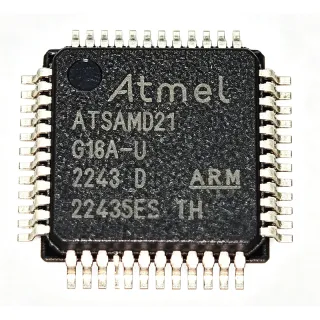
DSPIC33FJ128GP804-I/ML - 16-bit DSC 128KB 40MIPS | Microchip
MPN: DSPIC33FJ128GP804-I/ML ✓ Active| Qty | Unit Price | Extended |
|---|---|---|
| 1 | $11.12 | $11.12 |
| 10 | $10.57 | $105.70 |
| 25 | $10.01 | $250.25 |
| 100 | $9.45 | $945.00 |
| 1,000 | $8.9 | $8,900.00 |
DSPIC33FJ128GP804-I/ML Overview
A digital signal controller blends the peripheral set and deterministic interrupt behavior of a microcontroller with the multiply-accumulate horsepower of a DSP core. Within Microchip's portfolio, the dsPIC33F family sits above PIC18 8-bit MCUs and below 32-bit PIC32/dsPIC33C parts, targeting mixed signal-and-control workloads such as motor control, digital power, and audio processing where a single chip must close control loops and process sampled data streams.
Key features of this device include a 16-bit modified Harvard architecture core executing up to 40 MIPS at 3.3 V, 128 KB of self-programmable flash program memory, 16 KB of SRAM, and a DMA controller that offloads the CPU during intensive data transfers. Peripheral Pin Select (PPS) allows most digital peripherals to be remapped to nearly any pin, easing PCB layout. The Data Conversion Interface (DCI) supports I2S/AC97 audio codecs, and the General Purpose (GP) variant carries advanced analog peripherals and multiple UART, SPI, and I2C modules.
Architecturally, the dsPIC33FJ128GP804 provides DSP engine instructions (MAC, DSP multiply), hardware looping, and a flexible interrupt vector table with per-interrupt priority. Flash endurance supports in-field firmware updates through self-programming. Automotive AEC-Q100 qualification of the -I temperature grade (per distributor listings) supports e-mobility applications, from e-bikes and scooters to electric vehicles, alongside industrial drives and digital audio platforms.
Typical applications include sensorless BLDC and PMSM motor control, digital power supplies and inverters, audio effect and codec processing via the DCI, and industrial automation nodes requiring deterministic control with math acceleration.
Design considerations: the 44-pin QFN exposed pad should be soldered to a ground plane for thermal and signal-integrity performance, and Peripheral Pin Select must be configured in code before any remapped peripheral becomes functional.
This page synthesizes distributor pricing, pin-compatible drop-in alternatives, and practical design notes not found in the manufacturer datasheet.
Drop-in alternatives for DSPIC33FJ128GP804-I/ML — same package, pin-to-pin compatible. Different-package parts requiring PCB rework are excluded.
Variants in this series
Same-series models that are drop-in compatible with DSPIC33FJ128GP804-I/ML (same form factor and footprint) — differing in Package, Operating Temperature, Core Architecture, DMA Channels, SRAM.
Quick Comparison Tool — Select alternative parts for side-by-side comparison:
DSPIC33FJ64GP804-I/ML
✅ Drop-In ⚠️ Specs Unverified📋 Reference alternative (not in catalog)
DSPIC33FJ32GP304-I/ML
✅ Drop-In ⚠️ Specs Unverified✓ In Stock
$3.49 / Unit
View Datasheet →DSPIC33FJ128GP804-E/ML
✅ Drop-In ⚠️ Specs Unverified✓ In Stock
Contact for price
View Datasheet →DSPIC33FJ128MC804-I/ML
✅ Drop-In ⚠️ Specs Unverified✓ In Stock
$5.95 / Unit
View Datasheet →DSPIC33FJ128GP804-I/ML Maximum Ratings & Electrical Characteristics
| Core Architecture | 16-bit dsPIC33F modified Harvard |
| Program Flash Memory | 128 KB |
| SRAM | 16 KB |
| Max CPU Speed | 40 MIPS (40 MHz) |
| Operating Voltage | 3.3 V |
| Package | 44-pin QFN with exposed pad (ML) |
| Operating Temperature | -40C to +85C (I grade) |
| Digital I/O Pins | 35 |
| DMA Controller | Yes |
| Peripheral Pin Select (PPS) | Yes |
| Audio Interface | DCI (I2S/AC97) |
| Qualification | AEC-Q100 (automotive, per distributor listing) |
| Mounting Type | Surface Mount |
| Series | dsPIC33FJ128GPX02/X04 |
DSPIC33FJ128GP804-I/ML 44-pin qfn with exposed pad (ml) Pin Configuration Guide
Pin configuration for DSPIC33FJ128GP804-I/ML (44-pin qfn with exposed pad (ml) package). This digital IC includes GPIO, communication interfaces (UART, SPI, I2C), and power pins. Refer to the manufacturer datasheet for alternate pin functions and configuration options. Essential for embedded system design and PCB layout.

No detailed pinout data available for DSPIC33FJ128GP804-I/ML.
Refer to the datasheet for full pin configuration.
Typical Applications
DSPIC33FJ128GP804-I/ML is suitable for 6 applications: Sensorless BLDC / PMSM Motor Control, Digital Power Supplies and Inverters, Audio Processing and Codec Systems, E-Mobility and Electric Vehicles, Industrial Automation and Sensing Nodes, Medical and Portable Instrumentation.
Sensorless BLDC / PMSM Motor Control
The DSPIC33FJ128GP804-I/ML fits motor control because its 40 MIPS DSP engine executes field-oriented control loops with MAC instructions at deterministic interrupt latency, while 128 KB flash holds FOC code, compensation tables, and communications stacks simultaneously. Motor-control firmware typically uses the ADC with simultaneous sampling of phase currents, PWM output compare channels, and Peripheral Pin Select to route capture inputs for speed feedback. Running the current loop at 10-20 kHz leaves ample CPU margin for field weakening and protection routines. The DMA controller offloads ADC results so the CPU is not stalled during multi-channel sampling, a quantified benefit for control-loop jitter.
Recommended
Digital Power Supplies and Inverters
Digital SMPS and solar/battery inverters demand fast, deterministic control loops - precisely what the DSPIC33FJ128GP804-I/ML delivers with its 40 MIPS core, high-speed ADC, and hardware PWM with fine edge control. The DSP engine computes PID or predictive control terms each switching cycle (typically 50-500 kHz for power stages), and the 128 KB flash supports multiple operating profiles, soft-start routines, and firmware-updatable compensation. Digital implementations avoid analog drift over temperature, and the I-grade -40C to +85C rating with AEC-Q100 qualification (per distributor data) suits telecom rectifiers and on-board charger sub-systems where reliability documentation is required.
Recommended
Audio Processing and Codec Systems
The Data Conversion Interface (DCI) on the DSPIC33FJ128GP804-I/ML supports I2S and AC97 framing, connecting directly to external audio codecs, while the DSP engine performs biquad filters, dynamics processing, and mixing at 40 MIPS. The DMA controller streams sample buffers between the DCI and 16 KB SRAM without CPU intervention, cutting interrupt overhead during continuous audio throughput. Typical products include mixers, guitar effects, conferencing endpoints, and intercom systems. The constraint to respect is SRAM: 16 KB bounds delay lines and buffer depth, so designs needing long reverb tails or multi-channel buffering should verify their memory budget before layout.
Recommended
E-Mobility and Electric Vehicles
Microchip positions the dsPIC33 DSC family explicitly for e-mobility - e-bikes, scooters, and electric cars and trucks - and the DSPIC33FJ128GP804-I/ML contributes AEC-Q100 qualification (per Arrow listing) plus an industrial -40C to +85C range. In e-bike and light-EV controllers it closes motor current loops, monitors battery voltage and temperature through its ADC, and speaks CAN or UART to the vehicle network, all from one 44-pin QFN. The 128 KB flash accommodates safety routines, multi-mode riding profiles, and field updates. Peripheral Pin Select lets one board design serve several SKU variants by remapping peripherals in firmware rather than respinning hardware.
Recommended
Industrial Automation and Sensing Nodes
Factory equipment requires deterministic control plus robust communications - the DSPIC33FJ128GP804-I/ML provides multiple UART, SPI, and I2C modules alongside the DSP core, so a single chip handles sensor conditioning, actuator control, and Modbus or proprietary serial links. The 35 I/O pins and Peripheral Pin Select allow a PCB to be routed for manufacturing convenience and then functionalized in firmware, shortening layout iterations. Advanced analog integration reduces external component count in transducer front ends. Running control and communications at 40 MIPS with hardware interrupt priorities keeps real-time response within microseconds even while service protocols execute in background loops.
Recommended
Medical and Portable Instrumentation
Portable medical devices benefit from the DSPIC33FJ128GP804-I/ML's combination of signal processing and low system cost: the DSP engine applies digital filtering to biopotential or pressure-sensor signals, while the 3.3 V, 44-pin QFN implementation keeps board area small for handheld enclosures. The I-grade temperature rating and stable flash retention support device calibration storage in code space. Typical uses include blood-pressure monitors, infusion pump control boards, and diagnostic sensor hubs where 40 MIPS executes FFT or wavelet analysis on sampled data. Verify the applicable regulatory qualification path for the end product, as AEC-Q100 automotive grading does not itself constitute medical device certification.
Recommended
Recommended Products Summary
Engineering reference data for DSPIC33FJ128GP804-I/ML — comparison, design guidance, and compliance information.
Selection Guide
Comparison with Alternatives
| Parameter | This Product | DSPIC33FJ64GP804-I/ML | DSPIC33FJ32GP304-I/ML | DSPIC33FJ128GP804-E/ML | DSPIC33FJ128MC804-I/ML |
|---|---|---|---|---|---|
| Package | 44-pin QFN-EP (ML) | 44-pin QFN-EP (ML) - same | 44-pin QFN-EP (ML) - same | 44-pin QFN-EP (ML) - same | 44-pin QFN-EP (ML) - same |
| Brand | Microchip Technology | Microchip Technology | Microchip Technology | Microchip Technology | Microchip Technology |
| Program Flash | 128 KB | 64 KB | 32 KB | 128 KB | 128 KB |
| CPU Speed | 40 MIPS | 40 MIPS | 40 MIPS | 40 MIPS | 40 MIPS |
| Operating Temperature | -40C to +85C (I grade) | -40C to +85C (I grade) | -40C to +85C (I grade) | -40C to +125C (E grade) | -40C to +85C (I grade) |
| Peripheral Family Focus | GP (general purpose / audio DCI) | GP (identical peripheral set) | GP (identical peripheral set) | GP (identical peripheral set) | MC (motor-control ADC/peripheral mix) |
Key Differentiators
- Maximum flash in the 44-pin GP family (vs DSPIC33FJ64GP804-I/ML)
- Extended temperature option on identical die (vs DSPIC33FJ128GP804-E/ML)
- Audio/general-purpose peripheral mix with DCI (vs DSPIC33FJ128MC804-I/ML)
Design Notes
The 44-pin QFN exposed pad (ML package) must be soldered to a solid ground pour. Use a via array (3x3 or larger, 0.3 mm vias) under the pad to tie the internal ground plane and dissipate die heat - estimated: with total dissipation around 200-300 mW at 40 MIPS, a well-soldered exposed pad keeps junction temperature rise under roughly 15-25 C above ambient at typical board conditions. Follow Microchip QFN soldering application notes for stencil aperture design; insufficient paste on the center pad causes floating die and intermittent ground.
Peripheral Pin Select (PPS) is not enabled by default: remapped peripherals (UART, SPI, OC, IC) do nothing until RPINR/RPOR registers are configured with the unlock sequence. Also reserve PGC/PGD programming pins and any analog-designated pins - they cannot be remapped. Teams migrating from non-PPS PIC devices frequently lose days debugging 'dead' UARTs that are simply un-routed in PPS. Configure PPS immediately after oscillator setup and before enabling any peripheral, per Microchip's dsPIC33FJ family datasheet (document 70292G).
The device operates at a single 3.3 V rail. Decouple each VDD pin with 100 nF ceramic capacitors placed within 2 mm of the pin, plus one bulk 10 uF per device. If your PCB derives 3.3 V from a 5 V rail, budget the regulator dropout and dsPIC33 core current spikes during flash programming (estimated: allow 50-100% margin over the average run current for erase/write transients). For battery-powered e-mobility products, exploit doze and idle low-power modes; evaluate the datasheet current tables per mode rather than assuming a single sleep figure.
Compliance Information
AEC-Q100 automotive qualification per Arrow product listing ('Tube Automotive AEC-Q100'). RoHS/REACH/lead-free status not stated in the provided web data - verify on the Microchip product page before export documentation.