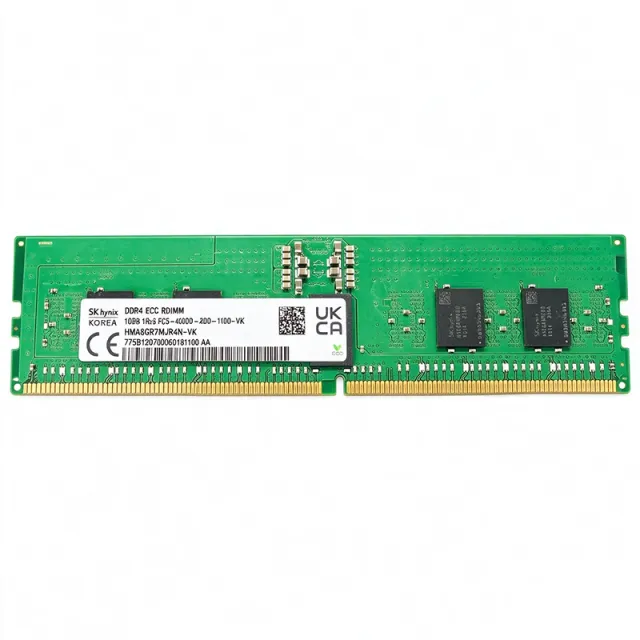
HMCG78AEBRA115N - 16GB DDR5-4800 ECC RDIMM | SK hynix
MPN: HMCG78AEBRA115N ✓ Active| Qty | Unit Price | Extended |
|---|---|---|
| 1 | $928.125 | $928.13 |
| 10 | $670.3125 | $6,703.13 |
| 100 | $592.9688 | $59,296.88 |
| 500 | $567.1875 | $283,593.75 |
| 1,000 | $541.4063 | $541,406.30 |
HMCG78AEBRA115N Overview
A registered DIMM (RDIMM) is a server memory module that buffers the address and command signals through a register chip between the memory controller and the DRAM devices. In the memory-system hierarchy, DDR5 SDRAM is the fifth generation of double-data-rate synchronous dynamic random-access memory; the RDIMM variant reduces electrical loading on the controller, allowing more DIMMs per channel than unbuffered UDIMMs, and on-die ECC (ODECC) within the DDR5 DRAM devices improves data integrity for enterprise platforms.
Key features of this module include the 16GB single-rank 1Rx8 organization, the DDR5-4800 data rate (PC5-38400 bandwidth class), the CAS latency CL40 rating, and 1.1V low-voltage operation that reduces power per bit versus DDR4-3200 RDIMMs, which typically require 1.2V. The 288-pin registered form factor is electrically keyed to prevent installation in desktop UDIMM sockets.
Architecturally, the module integrates DDR5 DRAM devices with on-die ECC, a register for command/address buffering, and a Serial Presence Detect (SPD) hub that stores module timing and configuration data read by the server BIOS at power-up. The 1Rx8 configuration minimizes rank interleave complexity and lowers controller load for entry-level platforms.
Typical applications include entry-level virtualization hosts, edge compute nodes, and small-scale servers and workstations from vendors such as Dell and HPE that require JEDEC-standard DDR5-4800 registered memory.
Design consideration: always verify the platform supports DDR5-4800 RDIMM at 1Rx8 population in the intended slot rules; mixing ranks or speeds may force the bus to a lower data rate.
This page synthesizes distributor pricing context, drop-in alternatives within the SK hynix HMCG78 family, and practical design notes not found on a single manufacturer datasheet.
Drop-in alternatives for HMCG78AEBRA115N — same package, pin-to-pin compatible. Different-package parts requiring PCB rework are excluded.
Variants in this series
Same-series models that are drop-in compatible with HMCG78AEBRA115N (same form factor and footprint) — differing in Data Rate, Module Type, CAS Latency, Form Factor, Capacity.
Quick Comparison Tool — Select alternative parts for side-by-side comparison:
HMCG78AEBRA168N
✓ In Stock
$74 / Unit
View Datasheet →HMCG78AEBRA107N
✓ In Stock
$399 / Unit
View Datasheet →HMCG78MEBRA113N
✓ In Stock
$94 / Unit
View Datasheet →HMCG78AHBRA289N
✓ In Stock
$68 / Unit
View Datasheet →HMCG78AHBRA471N
✓ In Stock
$649 / Unit
View Datasheet →HMCG78AHBWA315N
✓ In Stock
$116 / Unit
View Datasheet →HMCG78AEBRA115N Maximum Ratings & Electrical Characteristics
| Manufacturer | SK hynix |
| MPN | HMCG78AEBRA115N |
| Total Capacity | 16 GB |
| Memory Class | DDR5 SDRAM |
| Module Type | ECC Registered DIMM (RDIMM) |
| Data Rate | 4800 MHz (PC5-38400) |
| CAS Latency | CL40 |
| Organization | 1Rx8 (single rank, x8) |
| Operating Voltage | 1.1 V |
| Form Factor | 288-pin RDIMM |
| ECC | Yes (registered with DDR5 on-die ECC) |
| Compatible Platform | Server & Workstation |
| Ranks | 1 (Single Rank) |
| Module Configuration | 1 x 16GB |
| Standards | JEDEC DDR5 RDIMM standard |
HMCG78AEBRA115N standard Pin Configuration Guide
Pin configuration for HMCG78AEBRA115N (standard package). This digital IC includes GPIO, communication interfaces (UART, SPI, I2C), and power pins. Refer to the manufacturer datasheet for alternate pin functions and configuration options. Essential for embedded system design and PCB layout.

No detailed pinout data available for HMCG78AEBRA115N.
Refer to the datasheet for full pin configuration.
Typical Applications
HMCG78AEBRA115N is suitable for 6 applications: Entry-Level Virtualization Hosts, Edge Compute Nodes, Small-Scale Servers, Workstation Memory Upgrades, OEM Server Integration, Memory Replacement and Service.
Entry-Level Virtualization Hosts
The HMCG78AEBRA115N fits entry-level virtualization platforms because its 16GB DDR5-4800 capacity per DIMM and PC5-38400 bandwidth provide sufficient memory throughput for multiple lightweight virtual machines at low cost per gigabyte. Registered ECC operation with DDR5 on-die ECC protects hypervisor and guest memory from uncorrected errors, a mandatory feature for hosting persistent workloads. In a typical dual-channel or multi-channel EPYC/Xeon entry server, populating channels with single-rank 1Rx8 modules such as this one minimizes controller electrical load and preserves headroom for 4800 MT/s operation. Compared with dual-rank 32GB RDIMMs, single-rank 16GB modules populate more channels at the same total capacity, improving interleaving. Registered buffering means more DIMMs per channel than UDIMMs allow, scaling host RAM as VM density grows.
Recommended
Edge Compute Nodes
Edge compute appliances benefit from the HMCG78AEBRA115N's 1.1V DDR5 operation, which cuts memory subsystem power versus 1.2V DDR4 RDIMMs - critical in passively cooled or power-constrained edge enclosures with limited thermal budgets. The 4800 MT/s data rate supplies the bandwidth needed for local inference, protocol processing, and data aggregation workloads while the 16GB single-rank 1Rx8 configuration balances capacity against cost. Registered ECC operation ensures data integrity in installations that run unattended for months, where an uncorrected memory error could force a remote-site reboot or service call. Because the module is JEDEC-standard 288-pin DDR5 RDIMM, it integrates into standard edge server motherboards from Dell, HPE, and Supermicro without platform customization. Populate channels uniformly with identical modules to maintain rated speed.
Recommended
Small-Scale Servers
Small business and departmental servers use the HMCG78AEBRA115N as a cost-efficient base memory population: 16GB per DIMM at DDR5-4800 gives 64GB or 128GB total from four to eight modules, matching typical file, database, and application server needs. The registered ECC architecture is required on these platforms - consumer UDIMMs will not operate - and DDR5 on-die ECC plus link-level RAS features deliver the error handling expected in 24/7 operation. At CL40 and 1.1V, memory power stays low enough for compact tower or 1U chassis airflow designs. SK hynix brand qualification means the part appears on OEM memory lists for entry Dell and HPE platforms per Corewave Labs compatibility data, simplifying procurement. Install identical modules in matched channel sets to guarantee 4800 MT/s bus operation.
Recommended
Workstation Memory Upgrades
Professional workstations from vendors supporting DDR5 RDIMM platforms accept the HMCG78AEBRA115N for CAD, rendering, and simulation workloads. The 4800 MT/s (PC5-38400) data rate accelerates memory-bandwidth-bound tasks such as large assembly loading, texture streaming, and solver passes, while the 16GB single-rank configuration allows incremental, budget-aligned upgrades - add one module per channel as project sizes grow. ECC protection matters for multi-hour rendering and simulation runs where a memory error would waste compute time. Note the workstation platform must explicitly support registered DDR5; most consumer desktop boards do not, and the 288-pin RDIMM keying physically prevents incorrect installation. Mixing this module with dual-rank parts may downclock the bus, so populate with matching single-rank 1Rx8 modules for rated performance.
Recommended
OEM Server Integration
System integrators building white-box or OEM servers specify the HMCG78AEBRA115N because it is a JEDEC-standard DDR5-4800 RDIMM from a tier-one DRAM supplier, simplifying platform qualification. The Serial Presence Detect hub presents standardized timing data so server BIOS code from AMD EPYC and Intel Xeon platforms auto-configures the bus at 4800 MT/s without manual tuning. The 1Rx8 organization presents a single rank per channel, easing slot population rules in entry platforms that restrict dual-rank modules to certain slots. ECC Registered class supports the platform's RAS features required for enterprise certification. For BOM stability, pair this module with SK hynix family variants to keep a single-qualified-vendor memory strategy. Verify each build against the motherboard vendor's qualified memory list before volume production.
Recommended
Memory Replacement and Service
Field service and IT maintenance teams use the HMCG78AEBRA115N as a direct replacement module for failed or defective 16GB DDR5-4800 RDIMMs in servers and workstations. Because it matches the original SK hynix part number family, capacity, rank, speed, and voltage exactly, swapping it in restores the platform to its qualified configuration without BIOS requalification or population-rule changes. Distributors including Win Source, Microchip USA, and DirectMacro list the part for replacement purchases, and Newegg cross-references third-party equivalents for legacy service stock. Best practice: replace with the identical part number where possible; if unavailable, use HMCG78AEBRA168N or HMCG78AEBRA107N from the same family. After replacement, run a full memory diagnostic (POST ECC training plus OS-level memtest) to confirm stability at 4800 MT/s.
Recommended
Recommended Products Summary
Engineering reference data for HMCG78AEBRA115N — comparison, design guidance, and compliance information.
Selection Guide
Comparison with Alternatives
| Parameter | This Product | HMCG78AEBRA168N | HMCG78AEBRA107N | HMCG78MEBRA113N | HMCG78AHBRA289N | HMCG78AHBRA471N | HMCG78AHBWA315N |
|---|---|---|---|---|---|---|---|
| Package | 288-pin DDR5 RDIMM | 288-pin DDR5 RDIMM - same | 288-pin DDR5 RDIMM - same | 288-pin DDR5 RDIMM - same | 288-pin DDR5 RDIMM - same | 288-pin DDR5 RDIMM - same | 288-pin DDR5 RDIMM - same |
| Brand | SK hynix | SK hynix | SK hynix | SK hynix | SK hynix | SK hynix | SK hynix |
| Capacity | 16 GB | 16 GB | 16 GB | 16 GB | 16 GB | 16 GB | 16 GB |
| Data Rate | 4800 MT/s (PC5-38400) | 4800 MT/s | 4800 MT/s | 4800 MT/s | 4800 MT/s | 4800 MT/s | 4800 MT/s |
| Operating Voltage | 1.1 V | 1.1 V | 1.1 V | 1.1 V | 1.1 V | 1.1 V | 1.1 V |
| ECC | Yes (Registered, DDR5 ODECC) | Yes (Registered) | Yes (Registered) | Yes (Registered) | Yes (Registered) | Yes (Registered) | Yes (Registered) |
Key Differentiators
- Explicit third-party replacement cross-reference (vs HMCG78AEBRA168N)
- Single-rank 1Rx8 organization (vs Dual-rank 16GB RDIMMs)
- 1.1V DDR5 efficiency (vs HMA84GR7CJR4N DDR4 1.2V RDIMM)
Design Notes
RDIMM and UDIMM are not interchangeable: the 288-pin DDR5 RDIMM keying and registered interface mean the HMCG78AEBRA115N will not operate in consumer desktop boards, and UDIMMs will not operate in RDIMM-only server slots. Always confirm the platform BIOS lists registered DDR5-4800 support, and check the server vendor's qualified vendor list (QVL) before substitution with HMCG78 family variants, as OEMs qualify specific SPD suffixes per platform.
To maintain the rated 4800 MT/s bus speed, populate memory channels with identical modules - same MPN family, rank count, and capacity. Mixing single-rank 1Rx8 modules with dual-rank modules, or mixing HMCG78AEBRA and HMCG78AHBRA branches, may force the memory controller to train the bus at a lower data rate. Follow the motherboard's population order table (typically starting with the slot farthest from the CPU) when installing fewer than the maximum number of DIMMs.
At 1.1V, DDR5 RDIMMs dissipate noticeably less power than DDR4 modules at 1.2V, but total platform memory power scales with the number of populated DIMMs. Estimated: a server with 16 populated 16GB RDIMMs drawing roughly 4-6 W each (estimate, verify against SK hynix module power figures) contributes 64-96 W to chassis thermal load. Ensure chassis airflow across DIMM slots meets the JEDEC module thermal environment expectations for the ambient temperature of your installation.
After any module replacement or mixed-population change, run full POST memory training plus an OS-level memory diagnostic (e.g., memtest86 or vendor diagnostics) to confirm ECC operation and stability at 4800 MT/s. Do not ignore ECC error counts in IPMI/BMC logs - a rising corrected-error rate on one DIMM channel usually indicates a marginal module or seating issue before uncorrected failure occurs.
Compliance Information
Compliance data not present in the retrieved web data. Tier-one DRAM modules of this class are typically RoHS compliant, but this must be confirmed via SK hynix official documentation - not asserted here.