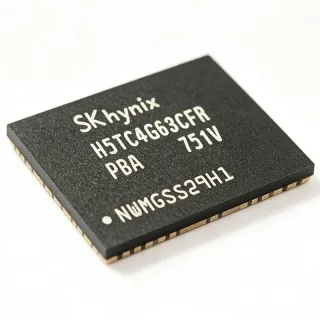
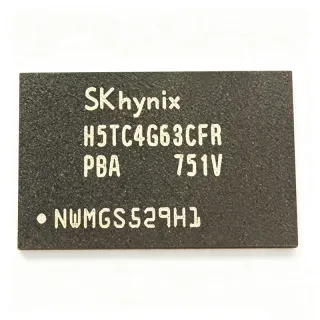
HMCG84AHBRA - 32GB DDR5-6400 ECC RDIMM 1Rx4 1.1V | SK Hynix
MPN: HMCG84AHBRA ✓ Active| Qty | Unit Price | Extended |
|---|---|---|
| 1 | $502.2 | $502.20 |
| 10 | $478 | $4,780.00 |
| 50 | $455 | $22,750.00 |
| 100 | $430 | $43,000.00 |
| 500 | $410 | $205,000.00 |
HMCG84AHBRA Overview
A DDR5 RDIMM (Registered DIMM) is a server-class memory module that buffers the command, address, and control signals through a register clock driver (RCD) on the module itself, enabling higher densities, better signal integrity at high speeds, and larger channel capacities than unbuffered DIMMs. Within the memory hierarchy, DDR5 sits at the top of the system memory tier - below the CPU cache and above storage (SSDs/HDDs), part of the broader DRAM family under the volatile semiconductor memory category.
Key features of the HMCG84AHBRA include 32 GB module capacity, 1Rx4 rank/organization, ECC support for single-bit error correction and multi-bit error detection, on-module voltage regulation (DDR5 PMIC), and a 1.1 V operating voltage that improves performance-per-watt versus DDR4. The PC5-51200 bandwidth and 6400 MT/s data rate enable modern server CPUs to feed multi-core workloads without becoming memory-bound, while 1Rx4 topology supports platforms that prefer single-rank modules for compatibility or specific rank-interleaving schemes.
Technically, the module complies with the DDR5 RDIMM standard, integrating an on-board PMIC for voltage regulation, a temperature sensor for thermal management, and ECC (error-correcting code) capability via the JEDEC-defined DRAM features. The x4 organization indicates four-bit-wide DRAM devices on the module, which provides a balance of capacity, parallelism, and error-detection granularity commonly used in server workloads.
Typical applications include 1P/2P server platforms running virtualization, enterprise databases, edge compute nodes, low-VM-density compute hosts, AI inference at the edge, and general-purpose data-center workloads where 32 GB per module is the sweet spot for cost-per-gigabyte. It is also used in workstation-class systems requiring ECC memory reliability.
When designing or qualifying with HMCG84AHBRA, verify the CPU memory controller's supported DIMM population rules and DDR5-6400 speed bin (some platforms require BIOS updates to enable 6400 MT/s, and 1Rx4 may not be supported on all channels). Always match module ranks per channel per the OEM's memory population guide to avoid downclocking.
This page synthesizes distributor pricing snapshots from multiple vendors, JEDEC-compliant drop-in equivalent RDIMMs from competing DRAM manufacturers, and practical population/qualification notes - information not consolidated on the manufacturer product page.
Drop-in alternatives for HMCG84AHBRA — same package, pin-to-pin compatible. Different-package parts requiring PCB rework are excluded.
Quick Comparison Tool — Select alternative parts for side-by-side comparison:
HMCG84AHBRA292N
✅ Drop-In📋 Reference alternative (not in catalog)
HMCG84AGRBRA
✅ Drop-In ⚠️ Specs Unverified📋 Reference alternative (not in catalog)
M321R4GA3BB6-CWM
✅ Drop-In📋 Reference alternative (not in catalog)
MTC20F2085S1RC56BD2
✅ Drop-In📋 Reference alternative (not in catalog)
KSM64RBD4-32MM
✅ Drop-In📋 Reference alternative (not in catalog)
HMCG84AHBRA Maximum Ratings & Electrical Characteristics
| Memory Type | DDR5 SDRAM |
| Module Type | RDIMM (Registered DIMM) |
| Module Capacity | 32 GB |
| Speed Grade | DDR5-6400 (PC5-51200) |
| Data Rate | 6400 MT/s |
| Rank Configuration | 1Rx4 (Single Rank, x4) |
| CAS Latency | CL52 |
| Operating Voltage | 1.1 V |
| Pin Count | 288-pin |
| ECC Support | Yes (ECC Registered) |
| Form Factor | DIMM |
| On-module PMIC | Yes (DDR5 PMIC) |
| Temperature Sensor | Yes (on-module) |
| JEDEC Compliance | DDR5 RDIMM Standard |
| Intended Use | Server / Workstation / Edge Compute |
HMCG84AHBRA standard Pin Configuration Guide
Pin configuration for HMCG84AHBRA (standard package). This digital IC includes GPIO, communication interfaces (UART, SPI, I2C), and power pins. Refer to the manufacturer datasheet for alternate pin functions and configuration options. Essential for embedded system design and PCB layout.

No detailed pinout data available for HMCG84AHBRA.
Refer to the datasheet for full pin configuration.
Typical Applications
HMCG84AHBRA is suitable for 6 applications: Enterprise Server Virtualization, Edge Compute Nodes, Database and In-Memory Workloads, AI Inference Servers, Workstation-Class Systems, General-Purpose Data Center Compute.
Enterprise Server Virtualization
The HMCG84AHBRA's 32 GB capacity per module and DDR5-6400 bandwidth make it ideal for virtualization hosts running 20-80 VMs per server. The ECC-Registered topology ensures bit-error resilience critical for multi-tenant cloud workloads, while 1Rx4 single-rank design simplifies memory channel population across dual-socket platforms. ECC single-bit correction prevents silent data corruption across hundreds of simultaneous VM memory pages. Compared to UDIMMs, the RDIMM register buffer enables higher channel densities at DDR5 speeds without signal-integrity degradation, a critical advantage when populating 8-16 DIMM slots per CPU socket.
Recommended
Edge Compute Nodes
For edge compute appliances with constrained thermal envelopes, the HMCG84AHBRA's 1.1V operating voltage reduces module power consumption versus DDR4 1.2V, improving performance-per-watt in fan-limited chassis. The on-module PMIC simplifies motherboard power design for compact edge platforms. At 6400 MT/s with CL52, latency remains acceptable for inference workloads where edge GPUs or CPUs benefit from fast host-to-PCIe data staging. The 288-pin RDIMM form factor is supported on most embedded server-class motherboards including those from Dell PowerEdge and HPE ProLiant edge lines.
Recommended
Database and In-Memory Workloads
The HMCG84AHBRA delivers the bandwidth needed for database engines (e.g., Microsoft SQL Server, PostgreSQL, Oracle) where memory-resident working sets are common. 6400 MT/s provides 51.2 GB/s peak per module, reducing buffer pool miss penalties during large query operations. ECC capability is essential for database integrity - silent bit flips can cause inconsistent transaction results. The 1Rx4 rank configuration delivers predictable latency across memory channels, which database engines exploit through NUMA-aware memory allocation. Deploy in pairs or quads per channel to maximize parallelism on modern server CPUs.
Recommended
AI Inference Servers
For AI inference workloads (vision, NLP, recommendation models), the HMCG84AHBRA provides the host memory capacity needed to stage model weights before GPU ingestion. While the GPU VRAM holds the active model, the host DDR5-6400 memory bandwidth determines pre-processing and batch assembly throughput. ECC prevents bit errors that could silently corrupt model weights during long inference sessions. The 1Rx4 organization balances capacity and channel parallelism, allowing 8-16 modules per CPU for aggregate bandwidth of 400-800 GB/s to feed multi-GPU systems.
Recommended
Workstation-Class Systems
The HMCG84AHBRA fits workstation-class motherboards requiring ECC memory for CAD, EDA, and professional content creation workloads. The 32 GB capacity supports multi-monitor design environments with large in-memory datasets, while DDR5-6400 bandwidth reduces compile and simulation times. ECC corrects memory errors that could cause silent corruption in long-running simulations (e.g., SPICE, FEA) - critical for engineering data integrity. Single-rank 1Rx4 is preferred on workstations because it maximizes compatibility with consumer-derived workstation chipsets.
Recommended
General-Purpose Data Center Compute
The HMCG84AHBRA serves as the standard building block for general-purpose 1P/2P compute nodes where 32 GB per DIMM hits the sweet spot for cost-per-GB versus 16 GB or 64 GB alternatives. DDR5-6400 enables modern server CPUs (Intel Xeon 6, AMD EPYC 9005) to operate at their rated memory speeds without downclocking. ECC and the register buffer are mandatory for cloud-grade reliability SLAs. The module integrates a thermal sensor enabling platform-level DIMM temperature monitoring via standard IPMI interfaces, supporting data-center thermal management workflows.
Recommended
Recommended Products Summary
Engineering reference data for HMCG84AHBRA — comparison, design guidance, and compliance information.
Selection Guide
Comparison with Alternatives
| Parameter | This Product | HMCG84AHBRA292N | HMCG84AGRBRA | M321R4GA3BB6-CWM | MTC20F2085S1RC56BD2 | KSM64RBD4-32MM |
|---|---|---|---|---|---|---|
| Brand | SK Hynix | SK Hynix | SK Hynix | Samsung | Micron | Kingston |
| Package | 288-pin RDIMM | 288-pin RDIMM - same | 288-pin RDIMM - same | 288-pin RDIMM - same | 288-pin RDIMM - same | 288-pin RDIMM - same |
| Capacity | 32 GB | 32 GB | 32 GB | 32 GB | 32 GB | 32 GB |
| Speed Grade | DDR5-6400 (PC5-51200) | DDR5-6400 | DDR5-6400 | DDR5-6400 | DDR5-6400 | DDR5-6400 |
| Rank Configuration | 1Rx4 | 1Rx4 | 1Rx4 | 1Rx4 | 1Rx4 | 1Rx4 |
| CAS Latency | CL52 | CL52 | CL52 | CL52 | CL52 | CL52 |
| Operating Voltage | 1.1 V | 1.1 V | 1.1 V | 1.1 V | 1.1 V | 1.1 V |
| ECC Support | Yes (RDIMM) | Yes | Yes | Yes | Yes | Yes |
Key Differentiators
- Single-rank 1Rx4 design for predictable channel population (vs 2Rx8 equivalent modules)
- SK Hynix authorized channel availability (vs Refurbished market alternatives)
- DDR5-6400 JEDEC standard speed bin (vs Lower-speed DDR5-4800 modules)
Design Notes
DDR5-6400 speed bin is not universally supported by older server CPUs. Verify the platform BIOS/CPU memory controller supports the 6400 MT/s JEDEC speed bin - some platforms require BIOS updates or may downclock to a lower speed (e.g., 4800 MT/s) if the bin is unrecognized. The 1Rx4 rank organization must also be supported; some entry-level server platforms restrict 1Rx4 module use to specific channel slots.
DDR5 RDIMMs integrate a PMIC directly on the module - the motherboard must supply the 5V auxiliary rail that the on-module PMIC converts to the required VDD, VPP, and VDDQ voltages. Ensure the server motherboard's 5V aux rail can deliver sufficient current when fully populated (e.g., 16 DIMMs may require 80-120A on the 5V rail). Motherboards without proper 5V aux routing will not power DDR5 RDIMMs.
DDR5 signal integrity at 6400 MT/s is more sensitive to DIMM slot population order than DDR4 was. Populate DIMM slots in the order specified by the OEM motherboard manual - typically slot 0 (CPU-affinity nearest) first, then slot 1, etc. Mixing 1Rx4 and 2Rx4 modules in the same channel can force downclocking and is not recommended. Maintain matched rank configuration across all populated channels for optimal performance.
DDR5 RDIMMs include an on-module thermal sensor readable via the platform's BMC over I2C/IPMI. Configure thermal alarms in the server management software to alert on DIMM temperatures exceeding 85C - sustained operation above this threshold accelerates wear. Airflow direction must follow the OEM chassis design; reversed airflow can cause DIMM temperatures to rise 10-15C.
Compliance Information
RoHS compliant per DDR5 RDIMM JEDEC environmental standards. AEC-Q100 not applicable - this is a server memory module, not an automotive-grade IC. Conflict minerals reporting compliant per SK Hynix corporate policy.