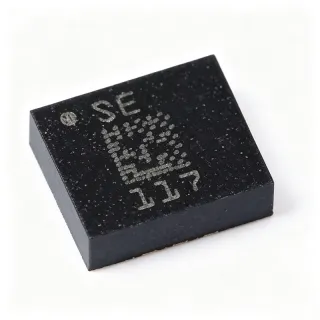
LSM6DS3HTR - 3D Accelerometer & 3D Gyroscope iNEMO IMU | STMicroelectronics
MPN: LSM6DS3HTR ✓ Active| Qty | Unit Price | Extended |
|---|---|---|
| 1 | $3.5356 | $3.54 |
LSM6DS3HTR Overview
An inertial measurement unit (IMU) is a device that combines accelerometers and gyroscopes to measure linear acceleration and angular velocity, enabling orientation and motion tracking. IMUs are fundamental components in motion sensing systems, providing data for applications such as gesture recognition, dead reckoning, and stabilization. The LSM6DS3HTR belongs to the category of motion sensors, which are part of the broader sensor family used in IoT, wearable, and automotive systems. Its integration of both sensors in one package reduces board space and simplifies design compared to discrete solutions.
Key features of the LSM6DS3HTR include a low power consumption of 0.9 mA in normal mode and 0.45 mA in low-power mode, making it suitable for battery-powered devices. It offers a 4 KB FIFO buffer to store sensor data, reducing host processor wake-up time. The device supports I2C and SPI interfaces, with a maximum I2C clock of 400 kHz and SPI clock of 10 MHz. It also includes an embedded temperature sensor, programmable interrupts, and a 6D orientation detection feature. The LGA-14 package is lead-free and RoHS compliant, with an operating temperature range of -40°C to +85°C.
Technically, the LSM6DS3HTR uses a MEMS (Micro-Electro-Mechanical Systems) capacitive sensing element for both accelerometer and gyroscope, with a dedicated ASIC for signal conditioning and digital output. The device features a 16-bit ADC for each channel, providing high resolution and low noise. The embedded DMP offloads motion processing from the host, enabling features like step counting and tilt detection without host intervention. The device also includes a programmable finite state machine (FSM) for advanced motion recognition, such as activity classification.
Typical applications include wearable devices (fitness trackers, smartwatches), smartphones for screen rotation and gaming, IoT nodes for motion-based wake-up, and industrial equipment for vibration monitoring. Its low power and small size make it ideal for battery-operated devices, while the high resolution and wide range support precise motion tracking in robotics and drones.
When designing with the LSM6DS3HTR, ensure proper decoupling of the power supply with a 100 nF capacitor close to the VDD pin, and route the I2C/SPI lines with minimal parasitic capacitance. The device's interrupt pins can be configured to wake the host only when motion is detected, saving power. For optimal performance, place the sensor away from high-frequency noise sources and follow the layout guidelines in the datasheet.
Drop-in alternatives for LSM6DS3HTR — same package, pin-to-pin compatible. Different-package parts requiring PCB rework are excluded.
Variants in this series
Same-series models that are drop-in compatible with LSM6DS3HTR (same form factor and footprint) — differing in Interface, Package.
Quick Comparison Tool — Select alternative parts for side-by-side comparison:
LSM6DS3TR
✅ Drop-In ⚠️ Specs Unverified✓ In Stock
$1.05 / Unit
View Datasheet →LSM6DS3H
✅ Drop-In ⚠️ Specs Unverified📋 Reference alternative (not in catalog)
LSM6DSO
✅ Drop-In ⚠️ Specs Unverified📋 Reference alternative (not in catalog)
BMI160
✅ Drop-In ⚠️ Specs Unverified📋 Reference alternative (not in catalog)
LSM6DS3HTR Maximum Ratings & Electrical Characteristics
| Sensor Type | 3D Accelerometer + 3D Gyroscope |
| Acceleration Full-Scale Range | ±2/±4/±8/±16 g |
| Gyroscope Full-Scale Range | ±125/±245/±500/±1000/±2000 dps |
| Output Data Rate (ODR) | 1.6 Hz to 6.66 kHz (accel), 12.5 Hz to 6.66 kHz (gyro) |
| Supply Voltage | 1.71 V to 3.6 V |
| Current Consumption (Normal Mode) | 0.9 mA |
| Current Consumption (Low-Power Mode) | 0.45 mA |
| Interface | I2C (400 kHz) / SPI (10 MHz) |
| FIFO Buffer | 4 KB |
| Resolution | 16-bit |
| Operating Temperature | -40°C to +85°C |
| Package | LGA-14 (2.5 x 3 x 0.83 mm) |
| Mounting Type | Surface Mount |
| RoHS Status | Compliant |
| Embedded Features | DMP, FSM, 6D orientation, temperature sensor |
LSM6DS3HTR Pin Configuration
| Pin 1 | VDD — Power supply (1.71 V to 3.6 V) |
| Pin 2 | GND — Ground |
| Pin 3 | SCL/SPC — I2C clock / SPI clock |
| Pin 4 | SDA/SDI — I2C data / SPI data input |
| Pin 5 | SDO/SA0 — SPI data output / I2C address select |
| Pin 6 | CS — Chip select (active low) |
| Pin 7 | INT1 — Interrupt 1 (programmable) |
| Pin 8 | INT2 — Interrupt 2 (programmable) |
| Pin 9 | RES — Reserved (do not connect) |
| Pin 10 | RES — Reserved (do not connect) |
| Pin 11 | RES — Reserved (do not connect) |
| Pin 12 | RES — Reserved (do not connect) |
| Pin 13 | GND — Ground |
| Pin 14 | VDD — Power supply (1.71 V to 3.6 V) |
Typical Applications
LSM6DS3HTR is suitable for 6 applications: Wearable Fitness Trackers, Smartphones and Tablets, IoT Motion Detection Nodes, Industrial Vibration Monitoring, Robotics and Drones, Gaming and VR Controllers.
Wearable Fitness Trackers
The LSM6DS3HTR is ideal for wearable fitness trackers due to its low power consumption (0.9 mA normal, 0.45 mA low-power) and compact LGA-14 package (2.5x3x0.83 mm). It enables accurate step counting, activity recognition, and gesture detection. The embedded DMP offloads motion processing from the host MCU, reducing system power. The 4 KB FIFO allows the host to stay in sleep mode longer, extending battery life. With a wide supply voltage range of 1.71-3.6 V, it can be powered directly from a coin cell or Li-Po battery. The 16-bit resolution ensures precise motion tracking for fitness metrics like distance and calories. The device's interrupt pins can wake the host only on motion events, further saving power. In a typical design, the LSM6DS3HTR is placed on a small PCB near the center of the device, with I2C or SPI connections to the MCU. The accelerometer and gyroscope data are fused to provide orientation and activity information. The low noise performance (e.g., 90 µg/√Hz for accelerometer) ensures accurate step detection even during slow movements. The device's robustness to vibration and shock makes it suitable for daily wear. Overall, the LSM6DS3HTR provides a balance of performance, power, and size that is critical for wearable devices.
Recommended
Smartphones and Tablets
In smartphones and tablets, the LSM6DS3HTR enables screen rotation, gaming, and gesture-based controls. Its high ODR (up to 6.66 kHz) supports fast motion detection for augmented reality (AR) and virtual reality (VR) applications. The 16-bit resolution and low noise provide smooth and accurate orientation tracking. The device's small size allows integration into thin devices. The I2C interface (up to 400 kHz) connects directly to the application processor. The embedded FSM can detect specific gestures like double-tap or shake, reducing the need for host processing. The 6D orientation detection enables automatic screen rotation with low power. The device's wide full-scale ranges (±16 g, ±2000 dps) accommodate various use cases, from gentle tilts to rapid shakes. The LSM6DS3HTR also includes a temperature sensor for thermal compensation. In a typical smartphone, the sensor is mounted near the center of the device to minimize rotational effects. The FIFO buffer helps manage data bursts during high-motion scenarios. The device's low power consumption is crucial for battery life, especially when the screen is off but motion sensing is active. Overall, the LSM6DS3HTR provides the performance and features required for modern mobile devices.
Recommended
IoT Motion Detection Nodes
The LSM6DS3HTR is well-suited for IoT nodes that require motion detection for security, asset tracking, or environmental monitoring. Its low power consumption (0.45 mA in low-power mode) allows battery-powered operation for years. The device can be configured to wake the host only when motion exceeds a threshold, reducing system power. The 4 KB FIFO stores motion data for later retrieval, enabling event-driven reporting. The I2C/SPI interfaces connect to low-power MCUs like the STM32L0 or Nordic nRF52. The device's wide operating temperature range (-40°C to +85°C) ensures reliable operation in outdoor environments. The embedded DMP can perform basic motion classification, such as stationary vs moving, without host intervention. The small package size facilitates integration into compact IoT modules. In a typical IoT node, the LSM6DS3HTR is powered by a coin cell battery, with the MCU in sleep mode most of the time. When motion is detected, the sensor wakes the MCU via an interrupt, and the MCU reads the FIFO data and transmits it over a wireless link. The device's low noise and high resolution ensure accurate motion detection even for subtle movements. Overall, the LSM6DS3HTR is an excellent choice for power-constrained IoT applications.
Recommended
Industrial Vibration Monitoring
The LSM6DS3HTR can be used for industrial vibration monitoring to detect equipment faults and predict maintenance needs. Its wide accelerometer full-scale range (±16 g) and high ODR (up to 6.66 kHz) capture high-frequency vibrations. The 16-bit resolution provides detailed vibration signatures for analysis. The device's industrial temperature range (-40°C to +85°C) ensures reliable operation in factory environments. The SPI interface (up to 10 MHz) allows high-speed data streaming to a host processor for real-time analysis. The embedded FSM can be programmed to detect specific vibration patterns, triggering alarms. The device's low power consumption is beneficial for battery-powered wireless sensors. In a typical application, the LSM6DS3HTR is mounted on machinery, and vibration data is collected and analyzed to detect anomalies. The FIFO buffer can store data during high-vibration events for later analysis. The device's robustness to shock and vibration ensures long-term reliability. The small package size allows easy integration into existing equipment. Overall, the LSM6DS3HTR provides the performance and durability needed for industrial condition monitoring.
Recommended
Robotics and Drones
The LSM6DS3HTR is used in robotics and drones for attitude estimation and stabilization. Its gyroscope full-scale range of ±2000 dps handles fast rotations, while the accelerometer range of ±16 g captures linear accelerations. The 16-bit resolution and low noise enable precise orientation tracking. The device's high ODR (up to 6.66 kHz) supports real-time control loops. The I2C/SPI interfaces connect to flight controllers or robot MCUs. The embedded DMP can perform sensor fusion, reducing the computational load on the host. The device's small size and low weight are critical for drones. In a typical drone, the LSM6DS3HTR is part of an inertial navigation system, providing data for stabilization and autonomous flight. The device's wide temperature range ensures operation in various weather conditions. The FIFO buffer helps manage data flow during high-maneuver scenarios. The device's robustness to vibration is essential for drone applications. Overall, the LSM6DS3HTR offers the performance and reliability required for demanding motion control applications.
Recommended
Gaming and VR Controllers
The LSM6DS3HTR enhances gaming and VR controllers with accurate motion tracking. Its high ODR and low latency provide responsive control. The 16-bit resolution ensures smooth and precise movements. The device's small size allows integration into compact controllers. The I2C/SPI interfaces connect to the controller's MCU. The embedded FSM can detect gestures like flicks or shakes, enabling intuitive controls. The device's low power consumption is important for wireless controllers. In a typical VR controller, the LSM6DS3HTR tracks the controller's orientation and acceleration, which is used to render virtual objects. The device's wide full-scale ranges accommodate fast movements. The FIFO buffer helps manage data bursts during rapid motion. The device's robustness ensures durability in gaming environments. Overall, the LSM6DS3HTR provides the performance needed for immersive gaming experiences.
Recommended
Recommended Products Summary
Engineering reference data for LSM6DS3HTR — comparison, design guidance, and compliance information.
Selection Guide
Comparison with Alternatives
| Parameter | This Product | LSM6DS3TR | LSM6DS3H | LSM6DSO | BMI160 |
|---|---|---|---|---|---|
| Package | LGA-14 (2.5x3x0.83 mm) | LGA-14 (same) | LGA-14 (same) | LGA-14 (same) | LGA-14 (same) |
| Brand | STMicroelectronics | STMicroelectronics | STMicroelectronics | STMicroelectronics | Bosch Sensortec |
| Accelerometer Full-Scale Range | ±2/±4/±8/±16 g | ±2/±4/±8/±16 g | ±2/±4/±8/±16 g | ±2/±4/±8/±16 g | ±2/±4/±8/±16 g |
| Gyroscope Full-Scale Range | ±125/±245/±500/±1000/±2000 dps | ±125/±245/±500/±1000/±2000 dps | ±125/±245/±500/±1000/±2000 dps | ±125/±245/±500/±1000/±2000 dps | ±125/±250/±500/±1000/±2000 dps |
| Output Data Rate (Max) | 6.66 kHz (accel), 6.66 kHz (gyro) | 1.6 kHz (accel), 6.66 kHz (gyro) | 6.66 kHz (accel), 6.66 kHz (gyro) | 6.66 kHz (accel), 6.66 kHz (gyro) | 1.6 kHz (accel), 3.2 kHz (gyro) |
| Supply Voltage | 1.71 V to 3.6 V | 1.71 V to 3.6 V | 1.71 V to 3.6 V | 1.71 V to 3.6 V | 1.71 V to 3.6 V |
| Current Consumption (Normal) | 0.9 mA | 0.9 mA | 0.9 mA | 0.55 mA | 0.95 mA |
| FIFO Size | 4 KB | 4 KB | 4 KB | 3 KB | 1 KB |
| Interface | I2C (400 kHz) / SPI (10 MHz) | I2C (400 kHz) / SPI (10 MHz) | I2C (400 kHz) / SPI (10 MHz) | I2C (400 kHz) / SPI (10 MHz) | I2C (400 kHz) / SPI (10 MHz) |
Key Differentiators
- Wider gyroscope full-scale range (±2000 dps) compared to LSM6DS3TR (vs LSM6DS3TR)
- Higher accelerometer ODR (6.66 kHz) vs BMI160 (1.6 kHz) (vs BMI160)
- Larger FIFO (4 KB) vs BMI160 (1 KB) (vs BMI160)
Design Notes
Place a 100 nF decoupling capacitor as close as possible to the VDD pin (pin 1 and 14) and a 1 µF capacitor in parallel for bulk decoupling. The supply voltage range is 1.71 V to 3.6 V, and the device draws 0.9 mA in normal mode. Ensure the power supply is clean and stable to avoid noise coupling into the sensor output.
Route the I2C/SPI lines with minimal length and avoid crossing high-speed digital traces. Use pull-up resistors (typically 4.7 kΩ) on the I2C lines. The CS pin must be tied high for I2C mode or low for SPI mode. Keep the sensor away from high-frequency noise sources like switching regulators and antennas. Follow the layout guidelines in the ST application note AN5040.
Do not leave the interrupt pins (INT1, INT2) floating; configure them as push-pull outputs and connect to the MCU with appropriate pull-ups if needed. The reserved pins (RES) should not be connected to any trace. Ensure the I2C address is correctly set via the SA0 pin to avoid address conflicts. When using the FIFO, configure the FIFO mode correctly to avoid data overflow.
Compliance Information
RoHS compliant per ST product page. Not AEC-Q100 qualified (consumer/industrial grade).