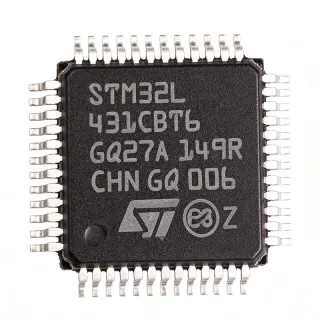
M95256-DWDW4TP/K - 256Kbit SPI EEPROM | STMicroelectronics
MPN: M95256-DWDW4TP/K ✓ Active| Qty | Unit Price | Extended |
|---|---|---|
| 1 | $0.85 | $0.85 |
| 10 | $0.76 | $7.60 |
| 100 | $0.68 | $68.00 |
| 500 | $0.61 | $305.00 |
| 1,000 | $0.55 | $550.00 |
M95256-DWDW4TP/K Overview
An EEPROM (Electrically Erasable Programmable Read-Only Memory) is a non-volatile memory that retains data when power is removed, and can be electrically erased and reprogrammed. It is a type of non-volatile memory (NVM) that sits within the broader memory hierarchy, bridging the gap between volatile RAM and permanent storage like flash. EEPROMs are used for storing small amounts of configuration data, calibration constants, and device parameters that require occasional updates.
Key features include a wide voltage range (1.8V to 5.5V), 20 MHz SPI clock, byte and page write modes (up to 64-byte page), write protection via hardware pins, and a status register for write-in-progress and write-enable latch. The device also offers a high endurance of 4 million write cycles and data retention of 200 years, ensuring reliable long-term operation. The TSSOP-8 package provides a small footprint with a thermal resistance of approximately 150 C/W, suitable for moderate temperature environments.
The M95256-DWDW4TP/K uses a standard SPI interface with four signals: Serial Clock (SCLK), Serial Data In (SDI), Serial Data Out (SDO), and Chip Select (CS). It supports both read and write operations with a simple command set, including READ, WRITE, WREN, WRDI, RDSR, and WRSR. The device includes a write-protect (W) pin and a hold (HOLD) pin for additional control, allowing the host to pause communication without losing data.
Typical applications include industrial automation for parameter storage, smart meters for calibration data, automotive electronics for configuration settings, and IoT devices for device identity and network credentials. The wide voltage range and high endurance make it ideal for applications requiring frequent updates and long service life.
When designing with this device, ensure proper decoupling with a 100nF capacitor near the VCC pin and connect all ground pins to a solid ground plane. The HOLD pin should be tied high if not used, and the W pin should be controlled to prevent accidental writes. For high-reliability systems, consider using the write-disable command to protect critical data.
Drop-in alternatives for M95256-DWDW4TP/K — same package, pin-to-pin compatible. Different-package parts requiring PCB rework are excluded.
Quick Comparison Tool — Select alternative parts for side-by-side comparison:
M95256-DWDW4TP/K
✅ Drop-In✓ In Stock
$0.55 / Unit
View Datasheet →AT25HP256
✅ Drop-In ⚠️ Specs Unverified📋 Reference alternative (not in catalog)
CAT25C256
✅ Drop-In ⚠️ Specs Unverified📋 Reference alternative (not in catalog)
M95256-DWDW4TP/K Specifications
| Memory Size | 256 Kbit (32K x 8) |
| Interface Type | SPI |
| Supply Voltage Range | 1.8 V to 5.5 V |
| Maximum Clock Frequency | 20 MHz |
| Page Size | 64 bytes |
| Write Cycle Time | 5 ms (typical) |
| Endurance | 4 million write cycles |
| Data Retention | 200 years |
| Operating Temperature Range | -40C to +85C |
| Package | TSSOP-8 |
| Mounting Type | Surface Mount |
| RoHS Status | Compliant |
| Write Protection | Hardware (W pin) and Software (Status Register) |
| Hold Pin | Yes (HOLD) |
| Organization | 32K x 8 bits |
M95256-DWDW4TP/K Pin Configuration
| Pin 1 | CS — Chip Select (active low) |
| Pin 2 | SCLK — Serial Clock |
| Pin 3 | SDI — Serial Data In |
| Pin 4 | SDO — Serial Data Out |
| Pin 5 | GND — Ground |
| Pin 6 | VCC — Power Supply |
| Pin 7 | W — Write Protect (active low) |
| Pin 8 | HOLD — Hold (active low) |
Typical Applications
M95256-DWDW4TP/K is suitable for 6 applications: Industrial Automation, Smart Meters, Automotive Electronics, IoT Devices, Medical Devices, Networking Equipment.
Industrial Automation
The M95256-DWDW4TP/K is used in industrial automation for storing configuration parameters, calibration data, and device settings. Its wide voltage range (1.8V to 5.5V) and high endurance (4 million write cycles) ensure reliable operation in harsh environments. The SPI interface allows fast data transfer, and the small TSSOP-8 package fits compact PLC modules and sensors. The device's 200-year data retention guarantees long-term data integrity, critical for industrial equipment that operates for decades. In a typical PLC, the EEPROM stores ladder logic parameters and network settings, with the host microcontroller reading and writing via SPI. The write-protect pin prevents accidental corruption during firmware updates, and the HOLD pin allows the host to pause communication without losing data. Compared to flash memory, EEPROM offers byte-level write granularity, making it ideal for frequent small updates. The M95256's 20 MHz clock speed enables quick parameter loading at startup, reducing downtime. For industrial applications, the -40C to +85C temperature range covers most factory environments, and the RoHS compliance meets environmental regulations.
Recommended
Smart Meters
Smart meters require non-volatile memory to store calibration constants, consumption data, and firmware updates. The M95256-DWDW4TP/K provides 256Kbit of storage, sufficient for these tasks. Its low power consumption and wide voltage range (1.8V to 5.5V) make it suitable for battery-powered meters. The SPI interface enables fast data logging, and the high endurance (4 million cycles) supports frequent updates. The device's 200-year data retention ensures that billing data is preserved over the meter's lifetime. In a smart meter, the EEPROM stores calibration coefficients and tariff tables, with the metering IC communicating via SPI. The write-protect pin prevents unauthorized writes, enhancing security. The HOLD pin allows the metering IC to pause communication during high-priority tasks. The TSSOP-8 package is ideal for the compact PCB of a smart meter, and the -40C to +85C range covers outdoor installations. Compared to FRAM, EEPROM offers higher density at lower cost, making it a cost-effective choice for mass deployment.
Recommended
Automotive Electronics
In automotive electronics, the M95256-DWDW4TP/K is used for storing configuration data, VIN codes, and calibration parameters. Its wide voltage range (1.8V to 5.5V) accommodates varying battery voltages, and the high endurance (4 million cycles) supports frequent updates. The device operates from -40C to +85C, covering most automotive environments. The SPI interface allows fast data transfer, and the small TSSOP-8 package fits in engine control units (ECUs) and infotainment systems. The 200-year data retention ensures that critical data is preserved for the vehicle's lifetime. In an ECU, the EEPROM stores engine mapping and diagnostic data, with the microcontroller reading and writing via SPI. The write-protect pin prevents accidental corruption during maintenance, and the HOLD pin allows the ECU to pause communication during high-priority tasks. Compared to flash, EEPROM offers byte-level write granularity, essential for updating individual parameters. The device's RoHS compliance meets automotive environmental standards, and its reliability is proven in demanding conditions.
Recommended
IoT Devices
IoT devices require non-volatile memory to store device credentials, network configuration, and sensor calibration data. The M95256-DWDW4TP/K provides 256Kbit of storage, sufficient for these tasks. Its low power consumption and wide voltage range (1.8V to 5.5V) make it suitable for battery-powered sensors. The SPI interface enables fast data transfer, and the high endurance (4 million cycles) supports frequent updates. The device's 200-year data retention ensures that credentials are preserved over the device's lifetime. In an IoT sensor node, the EEPROM stores Wi-Fi credentials and sensor calibration, with the microcontroller reading and writing via SPI. The write-protect pin prevents unauthorized writes, enhancing security. The HOLD pin allows the MCU to pause communication during low-power modes. The TSSOP-8 package is ideal for compact IoT modules, and the -40C to +85C range covers various deployment environments. Compared to flash, EEPROM offers byte-level write granularity, essential for updating individual parameters without wear-leveling.
Recommended
Medical Devices
Medical devices require reliable non-volatile memory to store patient data, device settings, and calibration constants. The M95256-DWDW4TP/K provides 256Kbit of storage, sufficient for these tasks. Its wide voltage range (1.8V to 5.5V) accommodates battery-powered devices, and the high endurance (4 million cycles) supports frequent updates. The device operates from -40C to +85C, covering clinical environments. The SPI interface enables fast data transfer, and the small TSSOP-8 package fits in portable monitors and infusion pumps. The 200-year data retention ensures that patient data is preserved for the device's lifetime. In a patient monitor, the EEPROM stores alarm thresholds and patient history, with the microcontroller reading and writing via SPI. The write-protect pin prevents accidental corruption, and the HOLD pin allows the MCU to pause communication during critical measurements. Compared to flash, EEPROM offers byte-level write granularity, essential for updating individual parameters. The device's RoHS compliance meets medical environmental standards, and its reliability is critical for patient safety.
Recommended
Networking Equipment
Networking equipment such as routers and switches use EEPROM to store MAC addresses, configuration settings, and firmware version information. The M95256-DWDW4TP/K provides 256Kbit of storage, sufficient for these tasks. Its wide voltage range (1.8V to 5.5V) accommodates various logic levels, and the high endurance (4 million cycles) supports frequent updates. The device operates from -40C to +85C, covering data center environments. The SPI interface enables fast data transfer, and the small TSSOP-8 package fits in compact network modules. The 200-year data retention ensures that configuration data is preserved over the equipment's lifetime. In a router, the EEPROM stores MAC addresses and boot parameters, with the network processor reading and writing via SPI. The write-protect pin prevents accidental corruption during firmware updates, and the HOLD pin allows the processor to pause communication during high-traffic periods. Compared to flash, EEPROM offers byte-level write granularity, essential for updating individual parameters. The device's RoHS compliance meets environmental regulations, and its reliability is critical for network uptime.
Recommended
Recommended Products Summary
Engineering reference data for M95256-DWDW4TP/K — comparison, design guidance, and compliance information.
Selection Guide
Comparison with Alternatives
| Parameter | This Product | M95256-DWDW4TP/K | M95256-DR | AT25HP256 | CAT25C256 |
|---|---|---|---|---|---|
| Package | TSSOP-8 | TSSOP-8 | SO-8 | TSSOP-8 | TSSOP-8 |
| Brand | STMicroelectronics | STMicroelectronics | STMicroelectronics | Microchip Technology | onsemi |
| Memory Size | 256 Kbit | 256 Kbit | 256 Kbit | 256 Kbit | 256 Kbit |
| Interface | SPI | SPI | SPI | SPI | SPI |
| Supply Voltage Range | 1.8V to 5.5V | 1.8V to 5.5V | 1.8V to 5.5V | 2.7V to 5.5V | 1.8V to 5.5V |
| Max Clock Frequency | 20 MHz | 20 MHz | 20 MHz | 20 MHz | 20 MHz |
| Endurance | 4 million cycles | 4 million cycles | 4 million cycles | 1 million cycles | 1 million cycles |
| Data Retention | 200 years | 200 years | 200 years | 100 years | 100 years |
Key Differentiators
- Higher endurance (4 million cycles) compared to many competitors (vs AT25HP256)
- Wider supply voltage range (1.8V to 5.5V) (vs AT25HP256)
- Longer data retention (200 years) (vs CAT25C256)
Design Notes
Place a 100nF decoupling capacitor as close as possible to the VCC pin (pin 6) and connect it to a solid ground plane. This helps filter high-frequency noise and ensures stable operation. Additionally, keep the SPI traces short and avoid routing them near high-current or high-voltage lines to minimize crosstalk.
Ensure the HOLD pin (pin 8) is tied high if not used, as leaving it floating can cause unintended hold states. Similarly, the W pin (pin 7) should be controlled to prevent accidental writes. Use the WREN command before each write operation, and check the WIP bit in the status register before initiating a new write to avoid data corruption.
For high-speed SPI operation at 20 MHz, consider adding series resistors (e.g., 22 ohms) on the SCLK, SDI, and CS lines to reduce ringing and overshoot. Also, ensure that the SDO line has a pull-up resistor if the host's input is not push-pull. Proper termination improves signal integrity and reduces EMI.
Compliance Information
RoHS compliant per STMicroelectronics product page. Not AEC-Q100 qualified; for automotive-grade, consider M95256-DWDW4TP/K's automotive variants.