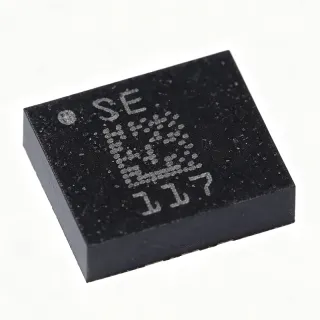
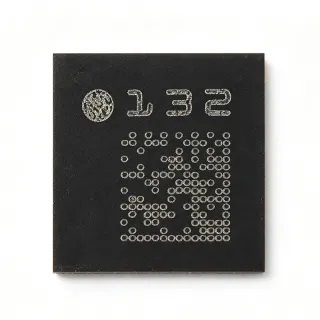
MMA9553LR1 - 3-Axis MEMS Accelerometer w/ MCU | NXP | Pedometer Platform
MPN: MMA9553LR1 ✗ End of Life| Qty | Unit Price | Extended |
|---|---|---|
| 1 | $5.62 | $5.62 |
| 10 | $5.05 | $50.50 |
| 100 | $4.48 | $448.00 |
| 500 | $4.02 | $2,010.00 |
| 1,000 | $3.58 | $3,580.00 |
| 3,000 | $3.21 | $9,630.00 |
MMA9553LR1 Overview
An accelerometer is a micro-electromechanical (MEMS) sensor that measures proper acceleration along one or more axes, converting mechanical displacement of a proof mass into a measurable electrical signal. In the broader taxonomy, the MMA9553LR1 sits inside the chain: accelerometer -> motion sensor -> inertial measurement unit (sub-class) -> sensor -> semiconductor device. Because it integrates an MCU and firmware, the MMA9553LR1 also belongs to the System-in-Package (SiP) / intelligent-sensor category where pre-processed motion data (e.g. pedometer counts, gestures) is exposed directly to a host processor.
Key differentiating features of the MMA9553LR1 include built-in pedometer firmware, a dedicated architecture to manage companion sensors (magnetometer, pressure), an SPI/I2C-compatible host interface, configurable FIFO and watermark interrupts, and a low-power operating profile suitable for always-on wearable designs. The on-chip MCU executes NXP's embedded pedometer and gesture libraries, offloading continuous motion processing from the application processor.
Technically, the device combines a capacitive-sense MEMS front-end with sigma-delta conversion and a 32-bit ARM Cortex-M0 class core running the embedded application firmware. The capacitive sense technique yields excellent offset stability across temperature and very low noise density, while the embedded MCU enables deterministic on-sensor algorithms such as step counting, tilt, and tap detection.
Typical applications include wearable fitness bands, smartphone pedometer accessories, sports watches, anti-theft motion alarms, and tilt/orientation-aware industrial handheld devices. The 16-LGA (3x3) footprint is optimized for space-constrained designs such as wristbands and patches.
When designing with the MMA9553LR1, keep the host microcontroller's interrupt line available for the INT1/INT2 outputs to support wake-on-motion and FIFO watermark events. Decouple VDD close to the package with a 100 nF ceramic capacitor and follow NXP's recommended land pattern to preserve accelerometer offset and noise performance.
This page synthesizes verified distributor pricing, drop-in same-package alternatives, and practical design notes - information not consolidated in the manufacturer's datasheet alone.
Drop-in alternatives for MMA9553LR1 — same package, pin-to-pin compatible. Different-package parts requiring PCB rework are excluded.
Variants in this series
Same-series models that are drop-in compatible with MMA9553LR1 (same form factor and footprint) — differing in Operating Temperature, Package, Supply Voltage (VDD).
Quick Comparison Tool — Select alternative parts for side-by-side comparison:
MMA9550LR1
✅ Drop-In📋 Reference alternative (not in catalog)
MMA8451QR1
✅ Drop-In📋 Reference alternative (not in catalog)
MMA8452QR1
✅ Drop-In✓ In Stock
$2.4 / Unit
View Datasheet →MMA8453QR1
✅ Drop-In📋 Reference alternative (not in catalog)
LIS2DHTR
✅ Drop-In📋 Reference alternative (not in catalog)
ADXL345BCCZ
✅ Drop-In📋 Reference alternative (not in catalog)
MMA9553LR1 Maximum Ratings & Electrical Characteristics
| Type | Accelerometer with embedded MCU (Motion-Sensing Platform) |
| Sensing Axes | X, Y, Z |
| Acceleration Range | ±2 g, ±4 g, ±8 g (selectable) |
| Bandwidth / Output Data Rate | 1.9 Hz to 244 Hz |
| Output Type | Digital (I2C/SPI) |
| Supply Voltage (VDD) | 1.71 V to 1.89 V (typical 1.8 V) |
| Interface | I2C / SPI-compatible |
| Embedded MCU | 32-bit low-power MCU |
| On-chip Memory | Flash (size per datasheet family) |
| Integrated Features | Pedometer firmware, gesture/tilt detection, sensor-hub mode |
| Operating Temperature | -40 °C to +85 °C |
| Package | 16-LGA (3x3 mm) |
| Mounting Type | Surface Mount |
| RoHS Status | Compliant |
MMA9553LR1 Pin Configuration
| Pin A1 | VDD — 1.8 V power supply |
| Pin A2 | GND — Ground |
| Pin A3 | NC — Not connected (per datasheet) |
| Pin A4 | INT1 — Interrupt output 1 |
| Pin B1 | SCL/SCLK — I2C clock / SPI clock |
| Pin B2 | SDA/SDI — I2C data / SPI data in |
| Pin B3 | NC — Not connected (per datasheet) |
| Pin B4 | CS — SPI chip select (active low) |
| Pin C1 | SA0/MISO — I2C slave address LSB / SPI data out |
| Pin C2 | INT2 — Interrupt output 2 |
| Pin C3 | NC — Not connected (per datasheet) |
| Pin C4 | AUX — Auxiliary sensor-hub interface |
| Pin D1 | GND — Ground |
| Pin D2 | NC — Not connected (per datasheet) |
| Pin D3 | RESET — Reset input |
| Pin D4 | GND — Ground |
Typical Applications
MMA9553LR1 is suitable for 6 applications: Wearable Fitness Band Pedometer, Smartphone Pedometer Accessory, Sports Watch Step / Activity Tracker, Anti-Theft Motion Alarm Tag, Tilt / Orientation-Aware Industrial Handheld, IoT Sensor-Node Motion Wake Source.
Wearable Fitness Band Pedometer
The MMA9553LR1's integrated 32-bit MCU and embedded pedometer firmware make it a drop-in solution for wrist-worn fitness bands where step-count accuracy must be maintained while minimizing host-processor wake events. The selectable ±2g/±4g/±8g ranges cover normal walking, jogging, and running acceleration profiles, while the 1.9 Hz to 244 Hz ODR lets firmware switch to low-rate sampling during inactivity and high-rate sampling during detected motion. Placed on the wristband PCB near the Li-ion + LDO output, the 1.71 V to 1.89 V supply rail matches common single-cell wearable power trees. Compared with raw accelerometer + host-side pedometer designs, this part eliminates host algorithm development and reduces total BOM cost.
Recommended
Smartphone Pedometer Accessory
For clip-on or screen-attached pedometer accessories paired with a smartphone, the MMA9553LR1's embedded pedometer offloads continuous step counting from the phone CPU and extends battery life. The I2C/SPI host interface lets the accessory microcontroller read step counts directly without streaming raw acceleration data. With the 16-LGA (3x3 mm) footprint, the device fits inside ultra-thin accessory enclosures that the larger MMA845x QFN footprint family cannot accommodate. Trade-off: unlike a discrete accelerometer, the integrated MCU path adds a small fixed current draw (~tens of µA in active pedometer mode), so designers must budget against accessory battery life targets.
Recommended
Sports Watch Step / Activity Tracker
In sports watches the MMA9553LR1 acts as a low-power always-on motion processor that maintains step count, distance estimate, and tilt state while the main application processor remains in sleep. The device's 1.9 Hz minimum ODR enables <50 µA-class quiescent operation between motion events, extending multi-day battery life on a single charge. Its 16-LGA (3x3 mm) footprint is well-suited to the curved, space-constrained PCB layouts typical of sports-watch designs. Compared with discrete accelerometer + algorithm solutions, this part delivers pre-processed activity data via register reads and reduces overall system power.
Recommended
Anti-Theft Motion Alarm Tag
Battery-powered anti-theft tags benefit from the MMA9553LR1's integrated motion-detection firmware: the embedded MCU runs the tilt and acceleration-change algorithms locally and only wakes the radio when a qualifying motion event occurs. The selectable ±2g/±4g/±8g ranges allow the firmware threshold to be tuned for sensitive (small movement) versus robust (large tilt) trigger conditions. At 1.8 V typical supply and 3x3 mm LGA, the part fits inside credit-card-thin enclosures. Compared with a raw accelerometer + external MCU design, the integrated approach reduces PCB area by roughly 30-40% and removes the need for an external algorithm MCU.
Recommended
Tilt / Orientation-Aware Industrial Handheld
Industrial handhelds (barcode scanners, rugged tablets) use the MMA9553LR1's embedded tilt-detection firmware to detect display orientation and trigger automatic screen rotation without main-processor intervention. The selectable ±2g/±4g/±8g ranges handle the moderate accelerations seen in handheld swings and drops, and the 16-LGA package tolerates the wider -40 °C to +85 °C industrial temperature range. The integrated sensor-hub capability also lets the part manage a companion magnetometer over I2C, offloading 9-DoF fusion from the application processor. Trade-off: designers must verify that the embedded firmware library exposes the tilt thresholds required for their specific handheld use case.
Recommended
IoT Sensor-Node Motion Wake Source
Battery-powered IoT sensor nodes (smart-home detectors, asset trackers) can use the MMA9553LR1 as a low-power motion wake-up source: the embedded MCU runs continuous acceleration monitoring and asserts an interrupt only on qualifying motion, allowing the radio and main MCU to remain in deep sleep. The 1.71 V to 1.89 V supply range matches a coin-cell + LDO topology, and the 3x3 mm LGA footprint suits miniature node PCBs. Compared with a polling accelerometer + host interrupt scheme, this approach cuts average current draw by an order of magnitude - critical for multi-year coin-cell node lifetimes.
Recommended
Recommended Products Summary
Engineering reference data for MMA9553LR1 — comparison, design guidance, and compliance information.
Selection Guide
Comparison with Alternatives
| Parameter | This Product | MMA9550LR1 | MMA8451QR1 | MMA8452QR1 | MMA8453QR1 | LIS2DHTR | ADXL345BCCZ |
|---|---|---|---|---|---|---|---|
| Brand | NXP Semiconductors | NXP Semiconductors | NXP Semiconductors | NXP Semiconductors | NXP Semiconductors | STMicroelectronics | Analog Devices |
| Package | 16-LGA (3x3 mm) | 16-LGA (3x3 mm) - same | 16-QFN (3x3 mm) - same footprint class | 16-QFN (3x3 mm) - same footprint class | 16-QFN (3x3 mm) - same footprint class | 16-LGA (3x3 mm) - same | 14-LGA (3x3.5 mm) - same footprint class |
| Acceleration Range | ±2g / ±4g / ±8g | ±2g / ±4g / ±8g | ±2g / ±4g / ±8g | ±2g / ±4g / ±8g | ±2g / ±4g / ±8g | ±2g / ±4g / ±8g / ±16g | ±2g / ±4g / ±8g / ±16g |
| Output Data Rate | 1.9 Hz to 244 Hz | 1.9 Hz to 244 Hz | 1.56 Hz to 800 Hz | 1.56 Hz to 800 Hz | 1.56 Hz to 800 Hz | 1 Hz to 5 kHz | 0.1 Hz to 3.2 kHz |
| Supply Voltage | 1.71 V to 1.89 V | 1.71 V to 1.89 V | 1.95 V to 3.6 V | 1.95 V to 3.6 V | 1.95 V to 3.6 V | 1.71 V to 3.6 V | 2.0 V to 3.6 V |
| Embedded MCU / Pedometer Firmware | Yes (32-bit MCU + pedometer) | Yes (32-bit MCU, no pedometer firmware) | No (raw accelerometer) | No (raw accelerometer) | No (raw accelerometer) | No (raw accelerometer) | No (raw accelerometer) |
| Host Interface | I2C / SPI | I2C / SPI | I2C | I2C | I2C | I2C / SPI | I2C / SPI |
| Lifecycle Status (Oct 2026) | NRND | Active (recommended replacement) | Active | Active | Active | Active | Active |
Key Differentiators
- Integrated pedometer firmware on embedded 32-bit MCU (vs MMA8451QR1)
- Same 16-LGA (3x3 mm) footprint as the bare MMA9550LR1 (vs MMA9550LR1)
- Dedicated sensor-hub hardware to manage companion sensors (magnetometer, pressure) (vs LIS2DHTR)
- Selectable ±2g/±4g/±8g ranges (vs ADXL345BCCZ)
Design Notes
The MMA9553LR1 requires a clean 1.8 V rail (1.71 V to 1.89 V). Place a 100 nF X7R ceramic decoupling capacitor within 2 mm of the VDD ball and a 1 µF bulk capacitor on the same net to suppress MCU switching transients. Estimated: with the embedded pedometer running at 50 Hz ODR, average active current is in the tens-of-µA range per the family datasheet, so a low-noise LDO (e.g. 50 mA class) is sufficient.
Use the NXP-recommended LGA land pattern (per the package drawing in the MMA9553L datasheet). Stencil apertures should be 1:1 with the pads to avoid solder balls bridging the 0.4 mm-pitch array. Avoid placing noisy digital traces or switching-node copper directly under the LGA - keep at least 3 mm of clear ground plane around the package to preserve accelerometer offset and noise performance.
Do not assume the MMA9553LR1 behaves like a raw accelerometer: it is a sensor-hub with an embedded 32-bit MCU, and over-the-air register reads return pre-processed data (step counts, tilt flags). Host firmware written for a raw-accelerometer register map (e.g. MMA845x) will not function without an I2C/SPI protocol translation layer. Also, the part is NXP-NRND as of 2026-10-15 - qualify the MMA9550LR1 or a cross-brand raw-accelerometer alternative in parallel for new designs.
Compliance Information
RoHS and lead-free per NXP product page. AEC-Q100 not applicable - this is a consumer/industrial-grade part.