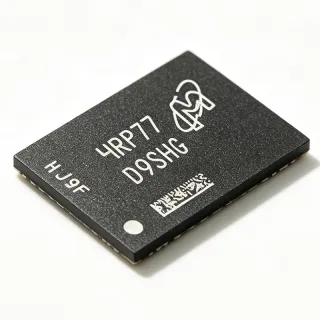
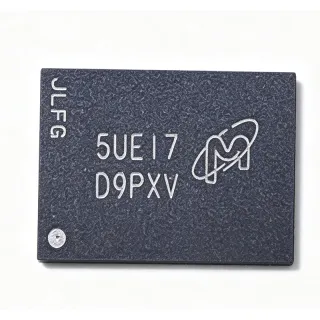
MT25QL256BBB8E12-CAUT - 256Mb SPI Quad I/O NOR Flash | Micron
MPN: MT25QL256BBB8E12-CAUT ✓ Active| Qty | Unit Price | Extended |
|---|---|---|
| 1 | $8.1 | $8.10 |
| 10 | $7.69 | $76.90 |
| 100 | $7.29 | $729.00 |
| 500 | $6.93 | $3,465.00 |
| 1,000 | $6.58 | $6,580.00 |
MT25QL256BBB8E12-CAUT Overview
Serial NOR flash is a non-volatile memory category within the broader memory IC hierarchy (semiconductor -> non-volatile memory -> flash -> NOR flash -> serial/QSPI NOR flash). It stores code and data that must be execute-in-place (XIP) capable, offering byte-level random access and superior reliability compared to NAND flash, at the cost of lower density and higher cost per bit. QSPI NOR flash is the de facto boot memory for most embedded processors.
Key features of the MT25Q family include x1, x2, and x4 (Quad) I/O data widths for up to 532 MB/s effective read throughput in Quad mode, an operating temperature range of -40C to +125C for industrial and automotive-adjacent environments, and a dedicated 64-byte OTP area outside the main memory array. Selected part numbers in the family provide an additional dedicated reset pin for improved system robustness.
The MT25QL256 device architecture is based on Micron's advanced NOR process, with a uniform 64 KB (sector) / 4 KB (subsector) erase organization supporting fast in-field firmware updates. The BGA package delivers excellent electrical performance for high-speed signal integrity at 133 MHz clock rates and a compact 6x8 mm footprint for space-constrained designs such as FPGA configuration storage and embedded processors.
Typical applications include FPGA and microcontroller boot/code storage (notably Xilinx and other FPGA bitstream storage), automotive infotainment and telematics code memory, industrial PLC and networking equipment firmware storage, and set-top box / display panel boot flash.
Design consideration: because the 24-ball BGA footprint is not field-replaceable, verify reflow profile and PCB pad geometry against the Micron package data sheet, and reserve a reset/hold strategy to avoid bus contention during power sequencing.
This page synthesizes distributor pricing, drop-in same-family alternatives, and practical design notes not found in the manufacturer datasheet.
Drop-in alternatives for MT25QL256BBB8E12-CAUT — same package, pin-to-pin compatible. Different-package parts requiring PCB rework are excluded.
Variants in this series
Same-series models that are drop-in compatible with MT25QL256BBB8E12-CAUT (same form factor and footprint) — differing in Package, Supply Voltage, Interface, Memory Type, Mounting Type.
Quick Comparison Tool — Select alternative parts for side-by-side comparison:
MT25QL256ABB8E12-CAUT
✅ Drop-In ⚠️ Specs Unverified📋 Reference alternative (not in catalog)
MT25QL128ABB1EW7-CAUT
✅ Drop-In✓ In Stock
$1.8 / Unit
View Datasheet →MT25QL256BBB8E12-CAUT-TR
✅ Drop-In📋 Reference alternative (not in catalog)
MT25QL256BBB8E12-CAUT Specifications
| Density | 256 Mb (32 MB) |
| Memory Type | NOR Flash (Serial SPI) |
| Interface | SPI - Multiple I/O (x1/x2/x4 Quad) |
| Max Clock Frequency | 133 MHz |
| Clock Cycle Time | 5 ns |
| Supply Voltage | 2.7 V to 3.6 V |
| Operating Temperature | -40C to +125C |
| Package | 24-T-PBGA / TBGA (6x8 mm) |
| FBGA Code | RW346 |
| Data Width (Organization) | x1/x2/x4 |
| OTP Area | 64-byte dedicated OTP outside main array |
| Reset Pin | Available on selected part numbers |
| Chipset Validation | N/A |
| Product Longevity Program | No |
| Mounting Type | Surface Mount (BGA) |
| Automotive Authentication | AUT (authentication suffix per listing) |
| Packaging Option | Tray; Tape & Reel for -TR suffix |
MT25QL256BBB8E12-CAUT 24-t-pbga / tbga (6x8 mm) Pin Configuration Guide
Pin configuration for MT25QL256BBB8E12-CAUT (24-t-pbga / tbga (6x8 mm) package). Pin numbering, functions, and connection diagrams are defined in the manufacturer datasheet. Refer to it for the exact footprint and soldering guidelines.

No detailed pinout data available for MT25QL256BBB8E12-CAUT.
Refer to the datasheet for full pin configuration.
Typical Applications
MT25QL256BBB8E12-CAUT is suitable for 6 applications: FPGA Configuration and Boot Storage, Industrial PLC and Automation Firmware Storage, Networking and Telecom Equipment Boot Flash, Automotive Infotainment and Telematics, Consumer Set-Top Box and Smart Display Boot Memory, Test and Measurement Instrumentation.
FPGA Configuration and Boot Storage
The MT25QL256BBB8E12-CAUT is a strong fit for FPGA bitstream and boot storage because 256Mb (32 MB) density covers large mid-range FPGA images, while the x4 Quad SPI interface at 133 MHz delivers roughly 66 MB/s effective read throughput, cutting configuration load time versus x1 serial parts. Placed on the FPGA's dedicated configuration QSPI bus with 10K pull-ups on CS# and hold management during power-up, it supports both master-serial and XIP boot flows. The -40C to +125C operating range also makes it suitable for industrial field equipment. The main trade-off versus parallel flash is the need to confirm that the configuration engine supports the MT25Q command set and Quad-mode entry (QE status bit) behavior.
Recommended
Industrial PLC and Automation Firmware Storage
Industrial controllers require non-volatile code storage that survives wide ambient swings, and this part's -40C to +125C range directly addresses panel and motor-drive thermal environments. The 64-byte OTP area securely stores board serial numbers or calibration constants outside the main array, and uniform 64 KB sectors with 4 KB subsectors enable efficient parameter logging and incremental firmware updates in the field. In Quad I/O mode at 133 MHz, the roughly 66 MB/s read bandwidth supports fast boot of Linux-based HMIs and gateways. Designers should implement a write-protect strategy using the block protection bits so firmware regions are not corrupted during brown-out events.
Recommended
Networking and Telecom Equipment Boot Flash
Routers, switches, and base-station line cards use serial NOR flash for bootloaders and golden firmware because NOR offers reliable, low-latency random access for XIP boot code before the OS loads from NAND or eMMC. The MT25QL256BBB8E12-CAUT's 256Mb capacity holds redundant boot images for A/B fail-safe updates, and the 133 MHz Quad SPI interface minimizes boot latency in systems with aggressive link-up time requirements. The 2.7V-3.6V supply connects directly to standard 3.3V card rails. The 64-byte OTP area can store MAC addresses and board manufacturing data, replacing a separate serial EEPROM and reducing BOM count.
Recommended
Automotive Infotainment and Telematics
Infotainment head units, cluster displays, and telematics control units need rugged non-volatile storage for boot code that tolerates -40C to +125C cabin and under-hood-adjacent temperatures. The MT25QL256BBB8E12-CAUT meets the temperature envelope and provides 32 MB of Quad SPI code storage, sufficient for multi-image boot schemes required by ASIL-adjacent fail-safe designs. Note that this specific part is not enrolled in Micron's Product Longevity Program and shows no AEC-Q100 claim in the verified data, so automotive OEMs should confirm qualification status with Micron or select a certified automotive variant of the MT25Q family for strict automotive programs.
Recommended
Consumer Set-Top Box and Smart Display Boot Memory
Set-top boxes, smart TVs, and display modules use QSPI NOR as the first-stage boot device for SoCs such as media processors. The MT25QL256BBB8E12-CAUT provides 32 MB for bootloader, device tree, and recovery images, while 133 MHz Quad SPI reads keep power-on-to-logo boot times short. The 24-ball 6x8 mm TBGA footprint conserves PCB area in slim form factors where SOIC-16 parts would not fit, and BGA mounting improves vibration tolerance versus leaded packages. Consumer cost sensitivity makes the tiered pricing structure attractive at volume; engineers should confirm the SoC boot ROM supports MT25Q Quad-mode exit/entry commands during development.
Recommended
Test and Measurement Instrumentation
Oscilloscopes, signal generators, and data acquisition systems store calibration tables, instrument firmware, and configuration snapshots in serial NOR flash. The MT25QL256BBB8E12-CAUT's 64-byte OTP area isolates factory calibration constants from field-reflashable firmware, protecting traceable calibration data from accidental overwrite, while 256Mb capacity holds multiple firmware revisions for rollback during qualification. The -40C to +125C rating suits portable instruments used outdoors, and the 5 ns clock cycle supports fast cold-boot of the instrument UI. Designers should schedule erase/program operations outside of acquisition windows, as write operations can add bus loading on shared SPI lines.
Recommended
Recommended Products Summary
Engineering reference data for MT25QL256BBB8E12-CAUT — comparison, design guidance, and compliance information.
Selection Guide
Comparison with Alternatives
| Parameter | This Product | MT25QL256ABB8E12-CAUT | MT25QL128ABB1EW7-CAUT | MT25QL256BBB8E12-CAUT-TR |
|---|---|---|---|---|
| Package | 24-T-PBGA / TBGA (6x8 mm, FBGA RW346) | 24-T-PBGA (6x8 mm) - same footprint | 24-TFBGA (6x8 mm) - same footprint | 24-T-PBGA (6x8 mm) - same footprint |
| Brand | Micron Technology | Micron Technology | Micron Technology | Micron Technology |
| Density | 256 Mb (32 MB) | 256 Mb (32 MB) | 128 Mb (16 MB) | 256 Mb (32 MB) |
| Max Clock Frequency | 133 MHz | 133 MHz | 133 MHz | 133 MHz |
| I/O Width | x1/x2/x4 (Quad SPI) | x1/x2/x4 (Quad SPI) | x1/x2/x4 (Quad SPI) | x1/x2/x4 (Quad SPI) |
| Supply Voltage | 2.7 V to 3.6 V | 2.7 V to 3.6 V | 2.7 V to 3.6 V | 2.7 V to 3.6 V |
| Operating Temperature | -40C to +125C | -40C to +125C | -40C to +85C (per standard industrial suffix; verify) | -40C to +125C |
Key Differentiators
- Second-generation (B-suffix) MT25Q silicon (vs MT25QL256ABB8E12-CAUT)
- Double the density at the same footprint vs 128Mb option (vs MT25QL128ABB1EW7-CAUT)
- Wide industrial temperature rating (vs MT25QL256BBB8E12-CAUT-TR)
Design Notes
At 133 MHz in Quad I/O mode, the four data lines toggle at the clock rate, so keep the QSPI bus short (ideally under 100 mm) and length-match the SCK/SIO lines within 10-15 mm. Add 22-33 ohm series resistors near the driver on SCK and SIO0-3 to damp reflections if trace stubs exceed 50 mm. The BGA ball pitch minimizes lead inductance, which helps edge quality, but under-board routing with vias adds stub inductance - prefer direct escape routing in the first inner layer.
Provide one 100 nF ceramic capacitor within 2 mm of the VCC supply ball plus a 4.7-10 uF bulk capacitor per device. Program and erase operations draw current pulses; supply droop during write/erase can corrupt data or fail the internal programming voltage generator, so low-ESR bulk decoupling is essential, especially if the flash shares a rail with other switching loads. The 2.7V floor must hold at the ball under worst-case load - verify with rail droop analysis, not just regulator datasheet numbers.
Three frequent mistakes with MT25Q BGA parts: (1) assuming Quad mode without verifying the QE (Quad Enable) status bit - many controllers expect it set for 4-I/O commands; (2) omitting hold/reset management during power sequencing, which can leave the device in an indeterminate state if VCC ramps too slowly - use a supervisor or ensure the documented power-up timing is met; (3) treating the part as field-replaceable - BGA rework requires dedicated tooling, so validate the reflow profile against the Micron RW346 package drawing before production.
Compliance Information
Verified data shows Chipset Validation: N/A and Product Longevity Program: No. No explicit RoHS/REACH/lead-free statements appear in the retrieved data; consult the Micron product page and material declarations for current compliance status.