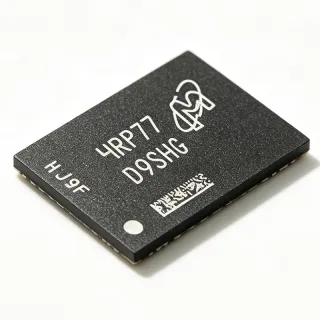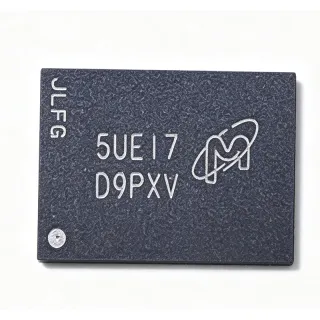
MT53E2G64D8TN-046 - 128Gbit LPDDR4X SDRAM 556-Ball | Micron
MPN: MT53E2G64D8TN-046 ✓ Active| Qty | Unit Price | Extended |
|---|---|---|
| 1 | $0 | $0.00 |
| 10 | $0 | $0.00 |
| 100 | $0 | $0.00 |
| 500 | $0 | $0.00 |
| 1,000 | $0 | $0.00 |
MT53E2G64D8TN-046 Overview
LPDDR4X (Low Power Double Data Rate 4X) SDRAM is a class of mobile DRAM within the broader memory hierarchy of SDRAM devices, optimized for high bandwidth and low power in battery-powered and thermally constrained systems. Compared to standard DDR4, LPDDR4X lowers the I/O termination voltage, cutting interface power substantially while sustaining multi-gigabit per-pin data rates.
Key features include the 128Gbit (16 GB) density in a single monolithic package, a 64-bit wide data bus, parallel interface operation up to 2.133 GHz, and JEDEC-standard LPDDR4 protocol operation. The -046 speed bin supports 4266 Mbps/pin, enabling aggregate peak bandwidth in the tens of GB/s range for a single 64-bit channel. Micron fabrication on advanced DRAM process nodes keeps per-bit power low, and on-die termination plus low-voltage signaling reduce EMI and power consumption.
Architecturally, the device is organized into banks supporting burst, refresh, and self-refresh operations per the JEDEC LPDDR4 specification. Power-down, deep power-down, and per-bank refresh modes allow aggressive power management in portable designs. DQS strobe-based source-synchronous signaling maintains signal integrity at 4266 Mbps.
Typical applications include smartphone and tablet main memory, automotive infotainment and ADAS platforms, edge AI and vision modules, networking appliances, and embedded compute modules where 16 GB of low-power DRAM is required.
Design considerations: LPDDR4X routing demands tightly length-matched fly-by or point-to-point topologies, careful VDDQ decoupling, and controller-initiated ZQ calibration for reliable operation at 4266 Mbps.
This page synthesizes distributor pricing context, drop-in same-family alternatives, and practical design notes not consolidated in the manufacturer datasheet.
Drop-in alternatives for MT53E2G64D8TN-046 — same package, pin-to-pin compatible. Different-package parts requiring PCB rework are excluded.
Variants in this series
Same-series models that are drop-in compatible with MT53E2G64D8TN-046 (same form factor and footprint) — differing in Memory Type, Organization, Package, Density, Interface.
Quick Comparison Tool — Select alternative parts for side-by-side comparison:
MT53E2G64D8TN-046 AIT:C
✅ Drop-In📋 Reference alternative (not in catalog)
MT53E2G64D8TN-046 AUT:C
✅ Drop-In📋 Reference alternative (not in catalog)
MT53E2G64D8TN-046 AAT:A
✅ Drop-In📋 Reference alternative (not in catalog)
MT53E2G64D8TN-046 AIT:A
✅ Drop-In📋 Reference alternative (not in catalog)
MT53E2G64D8TN-046 WT:C
✅ Drop-In📋 Reference alternative (not in catalog)
MT53E2G64D8TN-046 Maximum Ratings & Electrical Characteristics
| Memory Type | Mobile LPDDR4X SDRAM |
| Memory Size | 128 Gbit (16 GB) |
| Organization | 2G x 64 |
| Interface | Parallel |
| Clock Frequency | 2.133 GHz |
| Access Time | 3.5 ns |
| Speed Grade | -046 (4266 Mbps/pin) |
| Supply Voltage (VDD) | 1.1 V / 1.8 V (per variant) |
| Package | 556-ball LFBGA (12.4 mm x 12.4 mm) |
| Mounting Type | Surface Mount |
| Operating Temperature (AAT:C) | 0C to +95C |
| Operating Temperature (AIT:C) | -40C to +95C |
| Operating Temperature (AUT:C) | -40C to +105C |
| Automotive Qualification (AUT variant) | AEC-Q100 qualified |
| Data Bus Width | 64 bit |
| Write Cycle Time | 18 ns |
MT53E2G64D8TN-046 556-ball lfbga (12.4 mm x 12.4 mm) Pin Configuration Guide
Pin configuration for MT53E2G64D8TN-046 (556-ball lfbga (12.4 mm x 12.4 mm) package). This digital IC includes GPIO, communication interfaces (UART, SPI, I2C), and power pins. Refer to the manufacturer datasheet for alternate pin functions and configuration options. Essential for embedded system design and PCB layout.

No detailed pinout data available for MT53E2G64D8TN-046.
Refer to the datasheet for full pin configuration.
Typical Applications
MT53E2G64D8TN-046 is suitable for 6 applications: Smartphone and Tablet Main Memory, Automotive ADAS and Infotainment, Edge AI and Vision Modules, Networking and Communication Equipment, Embedded Compute Modules (SOM), Industrial Gateways and HMI.
Smartphone and Tablet Main Memory
The MT53E2G64D8TN-046 provides 16 GB of LPDDR4X main memory in a single 556-ball LFBGA, a density class typical of flagship mobile SoC platforms. Its 4266 Mbps/pin data rate and 64-bit bus deliver roughly 34 GB/s peak bandwidth, sufficient for multi-camera pipelines and on-device AI inference. The LPDDR4X low-VDDQ (0.6V) I/O signaling cuts interface power versus LPDDR4, extending battery life in standby and active states. Deep power-down and per-bank refresh modes let the power management IC gate the memory during idle. Place the DRAM within a few centimeters of the application processor with length-matched DQ/DQS routing to sustain the full speed grade on a mobile-class 8-10 layer PCB.
Recommended
Automotive ADAS and Infotainment
The AUT:C variant is AEC-Q100 qualified for -40C to +105C, making it suitable for ADAS sensor-fusion ECUs and automotive infotainment head units that need 16 GB of working memory for camera, radar, and neural-network workloads. The 34 GB/s peak bandwidth feeds high-resolution surround-view and driver-monitoring pipelines, while industrial-grade reliability supports ISO 26262-adjacent system designs (memory itself is QM-grade unless otherwise qualified). Designers should use the Micron automotive LPDDR4 design guides, derate timing across the full temperature range, and enable controller periodic read-training to compensate for drift. The -046 speed grade holds 4266 Mbps at high temperature per Micron binning tables.
Recommended
Edge AI and Vision Modules
Edge AI accelerators and smart-camera SoCs frequently require 8-16 GB of low-power DRAM to hold quantized neural network models and multi-frame video buffers. The MT53E2G64D8TN-046's 128Gbit density and 64-bit wide bus deliver the ~34 GB/s bandwidth needed by NPU engines streaming activations, while LPDDR4X self-refresh keeps model weights resident at minimal standby current. The 12.4 mm x 12.4 mm LFBGA fits within SOM and camera-module footprints where DDR4 discrete DIMMs cannot. For vision pipelines, configure write-leveling and read-DBI to manage eye closure at 4266 Mbps, and budget refresh (tRFC) into latency-sensitive frame deadlines.
Recommended
Networking and Communication Equipment
Enterprise access points, 5G small-cell units, and network appliances use LPDDR4X as main system memory where power budgets exclude standard DDR4. The MT53E2G64D8TN-046 offers 16 GB in one package, allowing single-chip memory subsystems on control cards that would otherwise need four DDR4 components. Its 1.1V core and low-VDDQ I/O reduce system-level power and thermal load in fanless enclosures. Packet-buffer and deep-packet-inspection workloads benefit from the 34 GB/s peak bandwidth. Ensure the network SoC memory controller supports JEDEC LPDDR4X at 4266 Mbps and verify signal integrity with eye scans over the industrial temperature range before release.
Recommended
Embedded Compute Modules (SOM)
System-on-Module vendors populate computer-on-modules with LPDDR4X to deliver desktop-class memory capacity in Raspberry Pi CM4- or SMARC-form-factor designs. The MT53E2G64D8TN-046's 16 GB capacity supports industrial gateways, medical portables, and test instruments running Linux with heavy userspace workloads. The single-package BGA solution simplifies SOM assembly versus soldered DDR4, and self-refresh preserves state during module suspend. Layout on 10-14 layer SOM substrates requires careful fly-by address routing and VDDQ plane integrity; use Micron's footprint and IBIS models for pre-layout simulation. The AIT industrial grade covers -40C to +95C for most embedded environments.
Recommended
Industrial Gateways and HMI
Industrial IoT gateways, panel PCs, and HMI terminals benefit from the MT53E2G64D8TN-046 AIT industrial grade (-40C to +95C), which sustains LPDDR4X operation on unconditioned factory floors and outdoor cabinets. The 16 GB capacity accommodates containerized edge workloads and local databases, while low LPDDR4X power reduces heatsinking requirements in sealed enclosures. Because industrial environments see sustained high temperature, derate the -046 speed grade or enable controller temperature-compensated refresh (TCR) as specified in the Micron LPDDR4X datasheet. Pair with wide-temperature power stages and conformal-coated PCBs; the BGA package has no high-aspect components to trap contaminants.
Recommended
Recommended Products Summary
Engineering reference data for MT53E2G64D8TN-046 — comparison, design guidance, and compliance information.
Selection Guide
Comparison with Alternatives
| Parameter | This Product | MT53E2G64D8TN-046 AIT:C | MT53E2G64D8TN-046 AUT:C | MT53E2G64D8TN-046 WT:C |
|---|---|---|---|---|
| Package | 556-ball LFBGA (12.4 x 12.4 mm) | 556-ball LFBGA - same | 556-ball LFBGA - same | 556-ball LFBGA - same |
| Brand | Micron Technology | Micron Technology | Micron Technology | Micron Technology |
| Density | 128 Gbit (16 GB) | 128 Gbit | 128 Gbit | 128 Gbit |
| Organization | 2G x 64 | 2G x 64 | 2G x 64 | 2G x 64 |
| Speed Grade | -046 (4266 Mbps/pin, 2.133 GHz) | -046 (4266 Mbps/pin) | -046 (4266 Mbps/pin) | -046 (4266 Mbps/pin, ES) |
| AEC-Q100 Qualification | No (commercial grade) | No (industrial grade) | Yes (automotive) | No (engineering sample) |
| Qualification Status | Production (fab revision C) | Production (fab C) | Production (fab C) | Engineering sample - not for production |
Key Differentiators
- AEC-Q100 automotive qualification (vs MT53E2G64D8TN-046 AAT:C)
- Highest density in a single 64-bit LPDDR4X package (vs MT53E512M64D2HJ-046)
- LPDDR4X low-VDDQ power reduction (vs MT40A512M8RH-083E (DDR4))
Design Notes
At the -046 speed grade (4266 Mbps/pin), LPDDR4X eye margins are tight. Route DQ/DQS/DM byte lanes point-to-point with intra-byte-length matching within +/-1 mm and control single-ended impedance at 40-50 ohms. Simulate with Micron-provided IBIS models before fab, enable write leveling, and plan controller read-training at every temperature corner. Avoid stubs in the fly-by clock/C/A/CS tree and terminate per the controller's on-die termination settings.
Provide separate, star-connected VDD1 (1.1V), VDDQ (0.6V for LPDDR4X or 1.1V for LPDDR4 mode), and VDD2 (1.8V) rails with proper power-up sequencing per the Micron LPDDR4X datasheet. Place bulk and high-frequency ceramic decoupling directly under the 556-ball array on the opposite PCB side. The ZQ calibration pin requires a precision 240 ohm 1% resistor to VSSQ, routed as a quiet analog trace. Do not share the ZQ resistor with other DRAM loads.
Verify the suffix letters on your purchase order: AAT (commercial), AIT (industrial), AUT (AEC-Q100 automotive), WT (engineering sample, not production-qualified). Using a WT ES part in production hardware is a common sourcing error. Also confirm your SoC memory controller supports 16 GB in a single x64 rank configuration and that boot firmware initializes the correct device geometry (2G x 64) - some controllers assume x32 organizations and will mis-configure refresh and addressing.
The 12.4 mm x 12.4 mm, 0.78 mm-pitch 556-ball package needs via-in-pad or dog-bone fanout and at least 6 PCB layers (8-10 recommended at 4266 Mbps). Reserve a solid reference plane adjacent to the DQ/DQS layers with no splits under memory traces. Follow Micron's LPDDR4x hardware design application note for layer stackup and topology templates.
Compliance Information
The AUT:C variant is AEC-Q100 qualified per datasheets.com distributor data; the base AAT/AIT grades are not automotive-qualified. RoHS/REACH/lead-free status must be confirmed via Micron product environmental declarations - not stated in the verified web data.