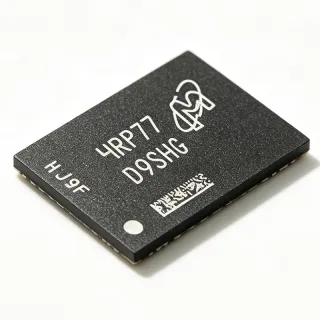
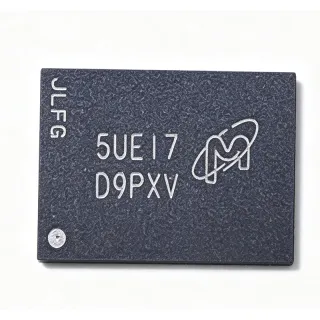
MT53E768M32D4DT-046 - 24Gb LPDDR4 SDRAM x32 | Micron
MPN: MT53E768M32D4DT-046 ✓ Active| Qty | Unit Price | Extended |
|---|---|---|
| 1 | $24.5 | $24.50 |
| 10 | $22.85 | $228.50 |
| 100 | $20.9 | $2,090.00 |
| 500 | $19.6 | $9,800.00 |
| 1,000 | $18.25 | $18,250.00 |
MT53E768M32D4DT-046 Overview
Mobile LPDDR4 SDRAM is a low-power double-data-rate synchronous DRAM variant defined for battery-powered and thermally constrained systems. Within the memory hierarchy it sits under DRAM -> synchronous DRAM -> mobile LPDDR family, prioritizing low operating voltage and low standby power over the absolute bandwidth of desktop DDR4. LPDDR4 achieves this through reduced I/O swing, bank-group architecture, and deep power-down states.
Key features of the MT53E768M32D4DT include a 24 Gbit total density (768 M x 32), a wide x32 data interface that simplifies 32-bit memory controller interconnects, and the -046 speed grade supporting 2133 MT/s operation. The VFBGA (Very Fine Pitch Ball Grid Array) 200-ball package saves board area versus discrete-drain packages and is standard for stacked mobile memory placement.
Architecturally, the device uses the LPDDR4 bank-group structure, allowing back-to-back data access across bank groups to sustain the 2133 MT/s bus rate. Command/address and data interfaces run at point-to-point connections typical of LPDDR4 systems, with terminating on-die termination (ODT) schemes to preserve signal integrity at high data rates.
Typical applications include i.MX8-class application processor memory subsystems (NXP community reports 8 GB configurations with MT53E768M32D4DT passing stress tests on i.MX8QM), mobile and wearable devices, industrial HMIs, and automotive infotainment platforms using the AAT:E automotive variant.
A key design consideration: LPDDR4 requires controller tuning of read/write preamble, ODT values, and drive strength during memory training; migrating from an older MT53B LPDDR4 part at 1600 MT/s to this -046 grade requires raising the DDR PLL from 800 MHz to 1066 MHz in firmware.
This page adds value beyond the datasheet by synthesizing distributor pricing and stock, pin/package cross-references, firmware migration notes, and practical alternatives in one place.
Drop-in alternatives for MT53E768M32D4DT-046 — same package, pin-to-pin compatible. Different-package parts requiring PCB rework are excluded.
Variants in this series
Same-series models that are drop-in compatible with MT53E768M32D4DT-046 (same form factor and footprint) — differing in Memory Type, Organization, Mounting Type, Package, Speed Grade.
Quick Comparison Tool — Select alternative parts for side-by-side comparison:
MT53E768M32D4DT-046 AAT:E
✅ Drop-In📋 Reference alternative (not in catalog)
MT53E768M32D4DT-046 AIT:E
✅ Drop-In📋 Reference alternative (not in catalog)
MT53E768M32D4DT-046 AUT:E
✅ Drop-In📋 Reference alternative (not in catalog)
MT53E768M32D4DT-053 AIT:E
✅ Drop-In📋 Reference alternative (not in catalog)
MT53D1024M32D4DT-046 AUT:D
✅ Drop-In✓ In Stock
$29.75 / Unit
View Datasheet →MT53E768M32D4DT-046 Maximum Ratings & Electrical Characteristics
| Memory Type | Mobile LPDDR4 SDRAM |
| Total Density | 24 Gbit |
| Organization | 768M x 32 |
| Interface Width | 32-bit |
| Data Rate | 2133 MT/s (2.133 GHz) |
| Speed Grade | -046 |
| Package | 200-VFBGA (10 x 14.5 mm) |
| Mounting Type | Surface Mount (BGA) |
| Supply Voltage Class | LPDDR4 low-voltage I/O |
MT53E768M32D4DT-046 200-vfbga (10 x 14.5 mm) Pin Configuration Guide
Pin configuration for MT53E768M32D4DT-046 (200-vfbga (10 x 14.5 mm) package). This digital IC includes GPIO, communication interfaces (UART, SPI, I2C), and power pins. Refer to the manufacturer datasheet for alternate pin functions and configuration options. Essential for embedded system design and PCB layout.

No detailed pinout data available for MT53E768M32D4DT-046.
Refer to the datasheet for full pin configuration.
Typical Applications
MT53E768M32D4DT-046 is suitable for 6 applications: Application Processor Main Memory (NXP i.MX8QM), Automotive Infotainment and Cluster, Industrial HMI and Edge Compute, Mobile and Wearable Devices, Networking and Edge Routers, Medical Portable Diagnostics.
Application Processor Main Memory (NXP i.MX8QM)
The MT53E768M32D4DT-046 is a validated main-memory DRAM for NXP i.MX8QM application processors: NXP community threads from December 2025 document 8 GB configurations built from this exact part passing stress tests, because its 2133 MT/s rate matches the i.MX8QM DDR controller's maximum DDR clock of 1066 MHz. In this role the x32 organization provides a wide single-die bus, simplifying routing versus x16 stacking. DDR controller firmware must be generated for the -046 speed grade, with the LPDDR PLL set to 1066 MHz and read/write training re-run for the specific die. ODT and drive-strength settings from the Micron datasheet should be used as the starting point for signal-integrity tuning.
Recommended
Automotive Infotainment and Cluster
For automotive infotainment, digital clusters, and ADAS display controllers, the MT53E768M32D4DT-046 AAT:E and AUT:E automotive-grade suffixes provide Micron's automotive qualification flow on the same 24Gbit x32 2133 MT/s die, in the same 200-VFBGA (10 x 14.5 mm) footprint used on commercial variants. This lets a single PCB design scale across consumer and automotive programs with only a suffix change. At 2133 MT/s, the die supplies enough bandwidth for 1080p-class instrument clusters and navigation stacks. Designers must budget LPDDR4 power-rail sequencing and thermal dissipation within the automotive ambient envelope, and verify the specific grade's datasheet temperature ratings rather than assuming equivalence from the shared die.
Recommended
Industrial HMI and Edge Compute
Industrial human-machine interfaces, gateways, and edge-compute modules benefit from the MT53E768M32D4DT-046 AIT:E industrial-grade variant, which carries the identical 24Gbit x32 2133 MT/s die and 200-VFBGA (10 x 14.5 mm) package but with extended industrial temperature screening. The 24 Gbit density comfortably hosts Linux-based HMI stacks with frame buffers, while the low LPDDR4 power profile reduces enclosed-cabinet thermal load - a real constraint in fanless panel PCs. Firmware migration from older 1600 MT/s LPDDR4 parts (e.g., MT53B768M32D4NQ-062) requires raising the DDR PLL from 800 MHz to 1066 MHz and re-running controller training, per NXP community guidance.
Recommended
Mobile and Wearable Devices
The MT53E768M32D4DT-046's native habitat is mobile: LPDDR4 was defined for smartphones, tablets, and wearables where battery life and board area dominate. The 200-ball VFBGA (10 x 14.5 mm) package minimizes footprint, and LPDDR4's low-voltage I/O and deep power-down states cut standby current - critical for always-on wearables. The 24Gbit (3 GB) x32 density suits mid-range smartphone tiers and connected wearables running RTOS or lightweight Android builds. PCB designers should follow Micron's mobile reference layouts for the 200-ball x32 footprint, keeping the differential DQS pairs length-matched and observing the CA bus routing rules in the Production Data Sheet to sustain 2133 MT/s signaling.
Recommended
Networking and Edge Routers
Edge routers, Wi-Fi access points, and IoT gateways use LPDDR4 as packet-buffer and control-plane memory. The MT53E768M32D4DT-046's 2133 MT/s x32 interface delivers 8.5 GB/s of theoretical peak bandwidth, which absorbs bursty packet traffic before it reaches slower storage, while 24 Gbit on-die buffering avoids external SRAM cost. On SoCs such as the i.MX8M family, the part drops into reference designs validated by the NXP community (users report successful stress-tested 8 GB builds from MT53E768M32D4DT-046 dies). Because network equipment runs continuously, the LPDDR4 refresh architecture and thermal behavior at sustained load should be verified in enclosure-level thermal testing, not just bench conditions.
Recommended
Medical Portable Diagnostics
Portable ultrasound, patient monitors, and handheld diagnostic instruments use LPDDR4 for image buffering and GUI rendering, where the MT53E768M32D4DT-046's 24Gbit density and 2133 MT/s bandwidth support real-time scan conversion on application processors. LPDDR4's low operating power extends battery runtime in patient-worn and ambulance equipment, and the single-package x32 organization simplifies certification-heavy designs by reducing BOM complexity versus multi-x16 stacking. Battery-powered medical designs should characterize refresh current across temperature, since elevated skin-contact temperatures change LPDDR4 refresh requirements; consult the Production Data Sheet's extended-temperature refresh tables before finalizing power budgets for the AIT:E or AAT:E industrial/automotive suffixes.
Recommended
Recommended Products Summary
Engineering reference data for MT53E768M32D4DT-046 — comparison, design guidance, and compliance information.
Selection Guide
Comparison with Alternatives
| Parameter | This Product | MT53E768M32D4DT-046 AAT:E | MT53E768M32D4DT-046 AIT:E | MT53E768M32D4DT-053 AIT:E | MT53D1024M32D4DT-046 AUT:D |
|---|---|---|---|---|---|
| Package | 200-VFBGA (10 x 14.5 mm) | 200-VFBGA (10 x 14.5 mm) - same | 200-VFBGA (10 x 14.5 mm) - same | 200-VFBGA (10 x 14.5 mm) - same | 200-ball VFBGA x32 - same class |
| Brand | Micron Technology | Micron Technology | Micron Technology | Micron Technology | Micron Technology |
| Density | 24 Gbit | 24 Gbit | 24 Gbit | 24 Gbit | 32 Gbit |
| Organization | 768M x 32 | 768M x 32 | 768M x 32 | 768M x 32 | 1G x 32 |
| Data Rate | 2133 MT/s (2.133 GHz) | 2133 MT/s | 2133 MT/s | 1866 MT/s (-053 grade) | 2133 MT/s |
| Memory Generation | MT53E (current LPDDR4) | MT53E (current) | MT53E (current) | MT53E (current) | MT53D (obsolete - migration source) |
| Temperature / Qualification Grade | Commercial (WT) | Automotive (AAT) | Industrial (AIT) | Industrial (AIT) | Automotive (AUT) |
| Lifecycle Status | Active | Active | Active | Active | Obsolete (per MT53D migration guide) |
Key Differentiators
- Full 2133 MT/s speed grade (vs MT53E768M32D4DT-053 AIT:E)
- Current-generation MT53E die with long-term availability (vs MT53D1024M32D4DT-046 AUT:D)
- Single-die x32 wide bus (vs MT53E1G32D2FW-046 AUT:B)
Design Notes
At 2133 MT/s, LPDDR4 routing tolerances are tight: keep differential DQS/DQS# pairs intra-pair matched within the length rule stated in the Micron Production Data Sheet, length-match CA bus lines to the DQS reference, and follow the reference-design stackup for the 200-ball VFBGA (10 x 14.5 mm) footprint. Use on-die termination (ODT) values from the datasheet as the starting point and refine through read/write eye training on the SoC. Point-to-point LPDDR4 topology means no multi-drop stubs are tolerated on data lines.
LPDDR4 uses separate core and I/O supply rails with defined sequencing; VDDQ must be valid before controller training begins. Decouple each rail with the capacitor network recommended in the Production Data Sheet, placing bulk capacitance near the ball-field power rings and 0201/0402 ceramics at the VDDQ balls. Firmware migration from a 1600 MT/s part (e.g., MT53B768M32D4NQ-062) requires raising the DDR PLL from 800 MHz to 1066 MHz - as documented in NXP community threads - and re-running full memory training for the -046 die.
Grade suffixes matter: WT:E (commercial), AIT:E (industrial), and AAT:E/AUT:E (automotive) share the same 24Gbit x32 die and 200-VFBGA footprint, but differ in qualification and temperature screening - never substitute a WT part into an automotive build. Also, when migrating from the obsolete MT53D generation (e.g., MT53D1024M32D4DT-046 AAT:D), do not assume footprint identity without comparing both ball maps; controller training parameters must be regenerated regardless, and lifetime-supply strategies should target MT53E parts.
Compliance Information
RoHS/REACH certificates must be confirmed per exact suffix on Micron's part-detail page and material declaration system. The AAT:E / AUT:E automotive suffixes follow Micron's automotive qualification flow (not AEC-Q100 as such - verify via Micron).