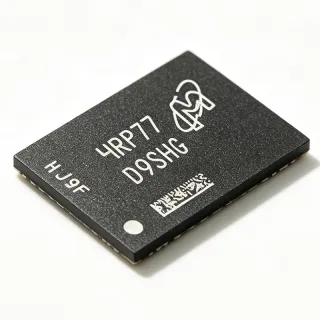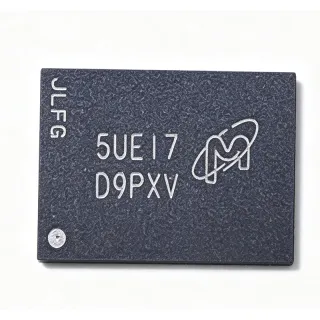
MT53D1024M32D4DT-046 AUT:D - 32Gbit LPDDR4 DRAM | Micron
MPN: MT53D1024M32D4DT-046 AUT:D ✓ Active| Qty | Unit Price | Extended |
|---|---|---|
| 1 | $32.61 | $32.61 |
| 10 | $31.98 | $319.80 |
| 100 | $31.3 | $3,130.00 |
| 500 | $30.5 | $15,250.00 |
| 1,000 | $29.75 | $29,750.00 |
MT53D1024M32D4DT-046 AUT:D Overview
LPDDR4 (Low Power Double Data Rate 4) is a mobile DRAM standard of the SDRAM family of volatile memory ICs. It uses a low-voltage interface (1.10 V VDDQ for LPDDR4, 0.60 V VDDQ for LPDDR4X) to deliver high bandwidth with very low standby power, which is why it dominates smartphones, tablets, ADAS domains, and infotainment systems. It sits in the memory hierarchy between high-bandwidth DDR SDRAM and low-capacity SRAM.
Key features of this Micron automotive variant include the 32 Gbit density in a single package, 32-bit wide data bus, the unified LPDDR4/LPDDR4X die architecture from Micron's 200b datasheet, speed grade -046, and the AUT:D automotive suffix denoting the -40 C to +125 C operating range and automotive quality flow.
The unified die supports both LPDDR4 (1.10 V VDDQ) and LPDDR4X (0.60 V VDDQ) operation, letting designers trade interface power against existing controller support. VDDQ power can be reduced significantly in LPDDR4X mode, cutting interface power - a major benefit in battery-fed or thermally constrained automotive camera and sensor-fusion systems.
Typical applications include ADAS front-camera and radar sensor fusion buffers, automotive infotainment and cluster displays, telematics and gateway modules, and industrial edge vision systems where extended temperature range is mandatory.
Design consideration: the ball-grid-array WFBGA package requires a high-precision SMT process; verify signal-integrity routing of the fly-by CK/CA bus and verify termination per the platform memory controller guidelines.
This page synthesizes distributor pricing, automotive LPDDR4 alternatives, and practical design notes not found in the manufacturer datasheet.
Drop-in alternatives for MT53D1024M32D4DT-046 AUT:D — same package, pin-to-pin compatible. Different-package parts requiring PCB rework are excluded.
Variants in this series
Same-series models that are drop-in compatible with MT53D1024M32D4DT-046 AUT:D (same form factor and footprint) — differing in Organization, Package, Memory Type, Interface, Clock Frequency.
Quick Comparison Tool — Select alternative parts for side-by-side comparison:
MT53D512M32D2DS-053 AUT:D
✅ Drop-In📋 Reference alternative (not in catalog)
MT53D512M32D2DS-046 AUT:D TR
✅ Drop-In📋 Reference alternative (not in catalog)
MT53E1G32D2FW-046 AUT:B
✅ Drop-In✓ In Stock
$273.51 / Unit
View Datasheet →MT53E2G32D4DE-046 AUT:C
✅ Drop-In✓ In Stock
$31.5 / Unit
View Datasheet →MT62F2G32D4DS-020AUT:D
✅ Drop-In📋 Reference alternative (not in catalog)
MT53B256M32D1DS-062
✅ Drop-In✓ In Stock
$7.35 / Unit
View Datasheet →MT53D1024M32D4DT-046 AUT:D Specifications
| Memory Type | Mobile LPDDR4/LPDDR4X SDRAM |
| Density | 32 Gbit |
| Organization | 1 Gbit x 32 |
| VDDQ Voltage (LPDDR4) | 1.10 V |
| VDDQ Voltage (LPDDR4X) | 0.60 V |
| Package | 200-WFBGA |
| Operating Temperature | -40 C to +125 C |
| Automotive Grade | Yes (AUT:D suffix, automotive flow) |
| Mounting Type | Surface Mount |
| Speed Grade | -046 |
| Interface | LPDDR4/LPDDR4X unified (per 200b datasheet) |
MT53D1024M32D4DT-046 AUT:D 200-wfbga Pin Configuration Guide
Pin configuration for MT53D1024M32D4DT-046 AUT:D (200-wfbga package). Pin numbering, functions, and connection diagrams are defined in the manufacturer datasheet. Refer to it for the exact footprint and soldering guidelines.

No detailed pinout data available for MT53D1024M32D4DT-046 AUT:D.
Refer to the datasheet for full pin configuration.
Typical Applications
MT53D1024M32D4DT-046 AUT:D is suitable for 6 applications: ADAS Camera Sensor Fusion, Automotive Infotainment and Cluster, Telematics and Gateway Modules, Industrial Edge Vision and Machine Vision, Automotive Domain Controllers, Medical Imaging and Diagnostics.
ADAS Camera Sensor Fusion
The MT53D1024M32D4DT-046 AUT:D is well suited to ADAS front-camera and radar sensor-fusion modules because its 32 Gbit capacity buffers multiple simultaneous sensor streams while the AUT:D -40 C to +125 C rating survives the harsh thermal environment of windshield-mounted or engine-bay-adjacent ECUs. The unified LPDDR4/LPDDR4X die lets designers run 0.60 V VDDQ LPDDR4X signaling to cut interface power in sealed, passively cooled camera housings where every watt matters for thermal reliability. In the circuit, the memory hangs off the SoC's LPDDR4 controller with a fly-by CK/CA command-address bus and per-byte DQS strobes; the 32-bit data path provides high frame-buffer bandwidth for 8 MP camera pipelines at 30 fps or higher. The main trade-off is the 200-ball WFBGA assembly cost and the need for careful length-matched routing and impedance control per the platform memory-controller design guide.
Recommended
Automotive Infotainment and Cluster
Digital cockpit and instrument-cluster SoCs demand large, fast frame buffers for high-resolution displays plus HMI layers, and the 32 Gbit density of the MT53D1024M32D4DT-046 AUT:D covers multi-display scenarios (cluster plus center-stack) without a second memory device. The automotive AUT:D flow and -40 C to +125 C rating match the environmental qualification expectations of cockpit modules, and the -046 speed grade provides headroom for 3D-cluster rendering workloads. Architecturally, the memory connects to the infotainment SoC's 32-bit LPDDR4/LPDDR4X channel; running LPDDR4X mode at 0.60 V VDDQ reduces interface power significantly versus LPDDR4's 1.10 V, easing the thermal budget in sealed head units. Designers should budget for the WFBGA footprint and confirm the SoC supports the density map of the 1G x 32 organization before layout freeze.
Recommended
Telematics and Gateway Modules
Vehicle telematics boxes and domain gateways juggle modem stacks, V2X payloads, OTA buffers, and cybersecurity logging, all of which benefit from the 32 Gbit capacity of the MT53D1024M32D4DT-046 AUT:D. Its automotive temperature rating covers engine-compartment gateway placements, and LPDDR4X 0.60 V VDDQ operation keeps standby power low - critical for modules that must remain partially active when the vehicle is parked, protecting the battery from excess drain. The memory attaches to the gateway SoC's LPDDR4 controller over a 32-bit bus; the -046 speed grade supplies ample bandwidth for concurrent LTE/5G modem data paths and CAN/Ethernet bridging. The key consideration is power-rail sequencing between VDD, VDDQ, and VDD2 rails per Micron's datasheet power-up sequence, and preserving deep-power-down mode entry in the firmware to minimize quiescent drain.
Recommended
Industrial Edge Vision and Machine Vision
Industrial machine-vision and robotic inspection systems use the MT53D1024M32D4DT-046 AUT:D where extended-temperature memory is required even outside automotive programs - factory floors, outdoor inspection cells, and thermally stressed robot arms all benefit from the -40 C to +125 C rating. The 32 Gbit capacity supports multi-megapixel line-scan and area-scan buffering with on-the-fly defect classification, while the 32-bit LPDDR4X interface at 0.60 V VDDQ keeps overall system power manageable in fanless edge boxes. The device sits on the vision processor's LPDDR4 channel; because industrial controllers frequently support both LPDDR4 and LPDDR4X, the unified die permits late-stage power optimization without a PCB respin. Engineers should validate controller timing closure at the -046 speed grade and follow the datasheet's LPDDR4 1.10 V VDDQ section when LPDDR4X signaling is not supported.
Recommended
Automotive Domain Controllers
Zonal and body-domain controllers are consolidating functions that historically needed only a few hundred megabits, so the 32 Gbit MT53D1024M32D4DT-046 AUT:D provides growth headroom for Linux-based or hypervisor-run software stacks in the same footprint. The AUT:D automotive flow satisfies the quality expectations of domain-controller platforms, and the wide -40 C to +125 C range covers underfloor and engine-bay mounting positions that consumer LPDDR4 cannot address. In the system, the memory connects to the domain MCU/SoC LPDDR4 interface; the 1G x 32 organization maximizes bandwidth per channel on controllers with a single 32-bit port. Designers should verify refresh behavior (tREFI) configuration and thermal-refresh multiplier settings against the Micron 200b datasheet when operating at sustained high ambient temperatures near +125 C, where refresh rate doubling is typically required.
Recommended
Medical Imaging and Diagnostics
Portable diagnostic and bedside imaging equipment benefits from the high density and low power of the MT53D1024M32D4DT-046 AUT:D. The 32 Gbit capacity supports frame buffering for ultrasound or endoscopic video pipelines, and the extended temperature rating provides margin against the elevated internal temperatures of fanless, sealed medical enclosures - a reliability requirement that standard 0 C to 85 C mobile DRAM cannot guarantee. The device attaches to the imaging SoC's LPDDR4/LPDDR4X controller; selecting LPDDR4X 0.60 V VDDQ mode reduces total platform power, extending battery runtime in portable ultrasound units and reducing thermal load on patient-contact surfaces. The trade-off is that the AUT:D automotive suffix carries automotive qualification documentation rather than medical-specific certification, so system-level medical validation remains the OEM's responsibility per IEC 60601 platform practice.
Recommended
Recommended Products Summary
Engineering reference data for MT53D1024M32D4DT-046 AUT:D — comparison, design guidance, and compliance information.
Selection Guide
Comparison with Alternatives
| Parameter | This Product | MT53D512M32D2DS-053 AUT:D | MT53E1G32D2FW-046 AUT:B | MT53E2G32D4DE-046 AUT:C | MT62F2G32D4DS-020AUT:D |
|---|---|---|---|---|---|
| Package | 200-WFBGA | 200-WFBGA | 200-WFBGA (FBGA) | 200-WFBGA (FBGA) | TFBGA |
| Brand | Micron Technology | Micron Technology | Micron Technology | Micron Technology | Micron Technology |
| Memory Standard | LPDDR4/LPDDR4X | LPDDR4/LPDDR4X | LPDDR4X | LPDDR4X | LPDDR5 |
| Speed Grade | -046 | -053 | -046 | -046 | -020 |
| Automotive Suffix | AUT:D | AUT:D | AUT:B | AUT:C | AUT:D |
Key Differentiators
- 32 Gbit density in a single automotive package (vs MT53D512M32D2DS-053 AUT:D)
- Extended -046 speed grade headroom (vs MT53D512M32D2DS-053 AUT:D)
- Unified LPDDR4/LPDDR4X die for late power optimization (vs MT53E1G32D2FW-046 AUT:B)
Design Notes
The unified LPDDR4/LPDDR4X die supports two VDDQ settings per Micron's 200b automotive datasheet: 1.10 V for LPDDR4 mode and 0.60 V for LPDDR4X mode. Design the VDDQ rail with a programmable or selectable regulator if you want to preserve both modes for late-stage power optimization. Observe the datasheet power-up sequence across VDD, VDDQ, and VDD2 rails, and implement controller-level deep-power-down entry to minimize standby current in always-on automotive nodes.
The -40 C to +125 C rating assumes adequate thermal path from the WFBGA balls into the PCB. At elevated ambients near +125 C, DRAM typically requires an increased refresh rate (temperature-compensated refresh or 2x refresh multiplier) - configure the memory controller accordingly and verify junction temperatures with the platform's thermal simulation before finalizing enclosure design. Estimate power dissipation from the datasheet IDD currents at your actual data rate; do not rely on worst-case IDD alone.
Route the fly-by CK/CA bus with matched lengths and 40-ohm-class on-die-termination assumptions per the platform design guide. Keep DQS/DQ length matching within controller skew budget, and reference impedance-controlled layers to solid ground. Because the 200-ball WFBGA offers limited escape routing, plan fanout early: via-in-pad or HDI stackups are commonly required for 0.5 mm-class ball pitch on dense automotive boards.
Verify the memory controller supports the 1 Gbit x 32 density map and address topology before layout freeze - substituting the 16 Gbit MT53D512 variants later changes capacity and timing configuration. Do not assume cross-density LPDDR4 parts are pin-identical: always check the ball-out table in the applicable Micron datasheet. Also confirm LPDDR4X 0.60 V VDDQ support in the SoC before committing to the lower-power mode.
Compliance Information
Automotive flow indicated by AUT:D suffix; formal AEC-Q100 qualification status and RoHS/REACH declarations were not present in the provided web data. Consult Micron's product page or request certificates of conformance.