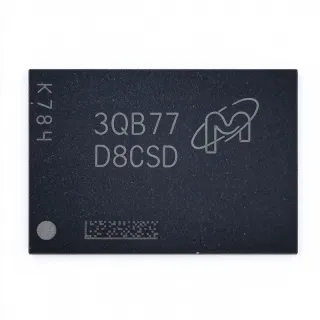
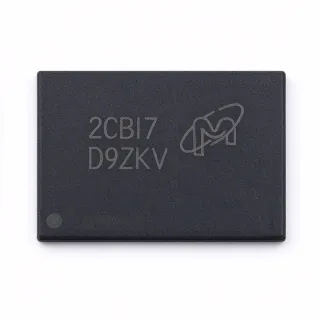
MT53E2G32D4DE-046 AUT:C - 64Gbit LPDDR4X DRAM | Micron
MPN: MT53E2G32D4DE-046 AUT:C ✓ Active| Qty | Unit Price | Extended |
|---|---|---|
| 1 | $42.5 | $42.50 |
| 10 | $39.8 | $398.00 |
| 100 | $36.2 | $3,620.00 |
| 500 | $33.9 | $16,950.00 |
| 1,000 | $31.5 | $31,500.00 |
MT53E2G32D4DE-046 AUT:C Overview
Mobile LPDDR4X (Low Power Double Data Rate 4X) is a type of SDRAM optimized for low power consumption, using a pseudo-dynamic core that reduces standby and deep-power-down current compared with conventional LPDDR4. In the system memory hierarchy, it sits below DDR5/SSD storage but above embedded SRAM, serving as the main working memory for application processors, SoCs, and graphics engines in power-constrained platforms.
Key differentiating features include the high 64 Gbit density in a single package, the wide 32-bit parallel interface that raises peak bandwidth to approximately 17 GB/s at full data rate, the low-voltage LPDDR4X VDDQ domain that cuts I/O power versus LPDDR4, and deep power-down modes suited to battery-operated and always-on systems.
Technically, the device is organized to deliver 2 G x 32 bits per channel access, using the JEDEC-standard LPDDR4X ball map on a fine-pitch 200-ball TFBGA (10 x 14.5 mm) substrate. Micron fabricates the die on an advanced DRAM process and screens AUT-suffixed parts to automotive temperature and reliability requirements, including extended thermal operating range and AEC-oriented quality flows.
Typical applications include automotive infotainment head units, digital cockpit processors, ADAS sensor-fusion platforms, and high-end mobile or embedded computing where 8 GB-class DRAM density with low power is required. The 32-bit bus also allows dual-device 64-bit configurations for bandwidth-hungry SoCs.
A key design consideration is signal integrity: LPDDR4X fly-by routing demands length-matched traces, careful Vref training, and reference design compliance for the host memory controller.
This page synthesizes verified distributor listings, drop-in alternatives, and practical design notes not found in the manufacturer datasheet. Pricing shown is an estimate as of 2026-09-02; confirm current quotes with your distributor.
Drop-in alternatives for MT53E2G32D4DE-046 AUT:C — same package, pin-to-pin compatible. Different-package parts requiring PCB rework are excluded.
Variants in this series
Same-series models that are drop-in compatible with MT53E2G32D4DE-046 AUT:C (same form factor and footprint) — differing in Memory Type, Organization, Package, Interface, Clock Frequency.
Quick Comparison Tool — Select alternative parts for side-by-side comparison:
MT53E2G32D4DE-046 AUT:E
✅ Drop-In ⚠️ Specs Unverified📋 Reference alternative (not in catalog)
MT53E2G32D4DE-046 AUT:B
✅ Drop-In ⚠️ Specs Unverified📋 Reference alternative (not in catalog)
MT53E1G32D2NP-046 AUT:B
✅ Drop-In ⚠️ Specs Unverified📋 Reference alternative (not in catalog)
MT53D384M32D2DS-053 AUT:C
✅ Drop-In📋 Reference alternative (not in catalog)
MT53B256M32D1NP-062 AUT:C
✅ Drop-In📋 Reference alternative (not in catalog)
MT53E2G32D4DE-046 AUT:C Maximum Ratings & Electrical Characteristics
| Memory Type | SDRAM - Mobile LPDDR4X |
| Memory Size | 64 Gbit |
| Organization | 2G x 32 |
| Interface | Parallel |
| Clock Frequency | 2.133 GHz |
| Access Time | 3.5 ns |
| Package | 200-TFBGA (10 x 14.5 mm) |
| Mounting Type | Surface Mount |
| Bus Width | 32 bit |
| Grade | Automotive (AUT) |
| Die Revision | C |
| RoHS Status | Compliant |
MT53E2G32D4DE-046 AUT:C 200-tfbga (10 x 14.5 mm) Pin Configuration Guide
Pin configuration for MT53E2G32D4DE-046 AUT:C (200-tfbga (10 x 14.5 mm) package). This digital IC includes GPIO, communication interfaces (UART, SPI, I2C), and power pins. Refer to the manufacturer datasheet for alternate pin functions and configuration options. Essential for embedded system design and PCB layout.

No detailed pinout data available for MT53E2G32D4DE-046 AUT:C.
Refer to the datasheet for full pin configuration.
Typical Applications
MT53E2G32D4DE-046 AUT:C is suitable for 6 applications: Automotive Infotainment Head Units, ADAS Sensor Fusion Platforms, Digital Cockpit and Cluster Displays, High-End Mobile and Tablet Computing, Embedded and Industrial Computing, Networking and Edge AI Appliances.
Automotive Infotainment Head Units
The MT53E2G32D4DE-046 AUT:C fits infotainment systems because its 64 Gbit density supports map rendering, media buffering, and multi-display graphics stacks, while the LPDDR4X low VDDQ reduces I/O power in thermally constrained dashboards. Placed as the main memory of an automotive SoC on the 200-ball TFBGA footprint, it delivers about 17 GB/s peak bandwidth at the 2.133 GHz data rate, enough for smooth UI animation and video decode. Its AUT automotive screening and revision-C die support the qualification requirements of tier-one head-unit platforms.
Recommended
ADAS Sensor Fusion Platforms
ADAS domain controllers aggregate camera, radar, and lidar streams that must be buffered at high sustained bandwidth; the MT53E2G32D4DE-046 AUT:C's 32-bit LPDDR4X interface at 2.133 GHz provides the necessary throughput, and its automotive grade qualification aligns with AEC-oriented quality flows required in front-camera and sensor-fusion modules. Designers typically populate two devices in a 64-bit interleaved configuration, doubling bandwidth while the 64 Gbit density supports neural-network working sets. Signal-integrity care - length matching and Vref training per the SoC reference design - is essential to meet eye-diagram margins.
Recommended
Digital Cockpit and Cluster Displays
Digital instrument clusters demand memory that survives extended automotive temperatures while powering always-on graphics; the MT53E2G32D4DE-046 AUT:C's LPDDR4X architecture lowers I/O power versus standard LPDDR4, easing thermal budgets behind the cluster, and its 64 Gbit capacity accommodates rich 3D cluster animations plus safety-relevant rendering buffers. The 200-ball TFBGA (10 x 14.5 mm) footprint suits the dense PCBs of cluster SoC modules. Self-refresh and deep power-down modes preserve state across ignition-off conditions, an important automotive requirement.
Recommended
High-End Mobile and Tablet Computing
Flagship smartphones and tablets use LPDDR4X main memory for its best-in-class power efficiency; the MT53E2G32D4DE-046 AUT:C's 8 GB-class 64 Gbit density in a single 200-ball package minimizes board area, and the 32-bit bus supports 64-bit dual-device configurations for peak bandwidth. LPDDR4X's reduced VDDQ directly extends battery life in standby and active use. Though the AUT suffix targets automotive, the die itself serves commercial mobile designs via corresponding commercial suffixes in the same family.
Recommended
Embedded and Industrial Computing
Industrial gateways, medical imaging modules, and vision systems built around mobile SoCs adopt LPDDR4X for its power and bandwidth balance. The MT53E2G32D4DE-046 AUT:C offers 64 Gbit on the JEDEC LPDDR4X ball map, letting embedded designers reuse validated controller support packages from Qualcomm, NXP, and similar vendors. The 2.133 GHz data rate supports video analytics workloads, while deep power-down current suits battery-backed and always-on nodes. Confirm conduction-cooling and derating requirements for extended industrial ambient temperatures.
Recommended
Networking and Edge AI Appliances
Edge AI boxes and network appliances process inference workloads whose model weights exceed on-chip SRAM; the MT53E2G32D4DE-046 AUT:C provides 8 GB-class capacity and roughly 17 GB/s peak bandwidth over its 32-bit LPDDR4X bus, sufficient for compact CNN inference and packet buffering when paired with a mobile-derived edge SoC. LPDDR4X power efficiency suits fanless enclosures, and the 200-ball TFBGA footprint keeps the memory subsystem compact. Dual-device 64-bit configurations are common where model latency is critical.
Recommended
Recommended Products Summary
Engineering reference data for MT53E2G32D4DE-046 AUT:C — comparison, design guidance, and compliance information.
Selection Guide
Comparison with Alternatives
| Parameter | This Product | MT53E2G32D4DE-046 AUT:E | MT53E2G32D4DE-046 AUT:B | MT53D384M32D2DS-053 AUT:C | MT53B256M32D1NP-062 AUT:C |
|---|---|---|---|---|---|
| Package | 200-TFBGA (10 x 14.5 mm) | 200-TFBGA (10 x 14.5 mm) - same | 200-TFBGA (10 x 14.5 mm) - same | 200-TFBGA - same footprint family | 200-FBGA - same footprint family |
| Brand | Micron Technology | Micron Technology | Micron Technology | Micron Technology | Micron Technology |
| Memory Type | LPDDR4X | LPDDR4X | LPDDR4X | LPDDR4 | LPDDR4 |
| Density | 64 Gbit | 64 Gbit | 64 Gbit | 12 Gbit | 8 Gbit |
| Bus Width | 32 bit | 32 bit | 32 bit | 32 bit | 32 bit |
| Die Revision | C | E | B | C | C |
| Automotive Grade | Yes (AUT) | Yes (AUT) | Yes (AUT) | Yes (AUT) | Yes (AUT) |
Key Differentiators
- Highest density in its 200-ball package class (vs MT53B256M32D1NP-062 AUT:C)
- Lower I/O power than LPDDR4 generation (vs MT53D384M32D2DS-053 AUT:C)
- Automotive qualification with current die revision (vs MT53E2G32D4DE-046 AUT:B)
Design Notes
LPDDR4X fly-by routing on a 200-ball TFBGA requires length-matched command/address traces and per-byte data-line matching within the tolerances defined by your SoC's memory design guideline. Follow the Micron LPDDR4X reference design and the host controller layout guide: keep data traces matched within 25 mils class spacing, reference solid planes, and perform Vref/DRAM training during boot. Estimated: at 2.133 GHz data rate, trace skew budget shrinks below 20 ps, so autorouting without SI review is not recommended.
LPDDR4X separates VDD (core) and VDDQ (I/O) supplies; the X part family lowers VDDQ versus LPDDR4, reducing I/O power. Estimated: a single 64 Gbit device drawing typical LPDDR4X active currents on 32-bit I/O can dissipate on the order of 0.5-1 W under sustained bandwidth; use a PMIC with dedicated LPDDR4X VDDQ rails (e.g., 0.6 V class) and verify sequencing order against the Micron datasheet power-up sequence to avoid latch-up. Deep power-down should be used during idle periods to cut standby current.
Do not mix die revisions (B/C/E) of the MT53E series on the same bus without confirming controller support - each revision can carry updated timing point definitions. Also, AUT-graded devices must not be substituted with commercial-grade suffixes in automotive builds, as this voids qualification. Place 0.1 uF decoupling at each VDD/VDDQ ball group close to the package, and reserve DQS training margin when extending trace lengths above the reference design limits.
Compliance Information
DigiKey listing shows RoHS compliant. AUT suffix denotes Micron automotive qualification flow; exact AEC-Q100 mapping is governed by Micron automotive documentation, not stated in retrieved data.