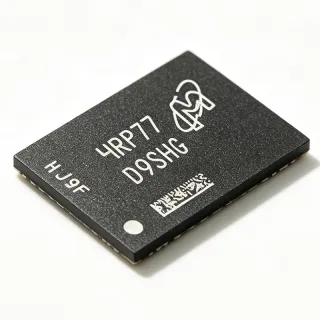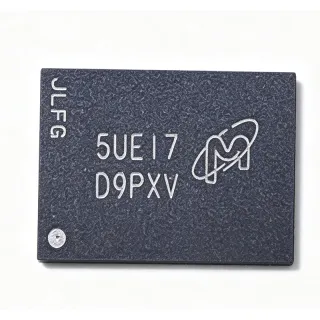
MT53B128M32D1DS-062 - 4Gbit LPDDR4 SDRAM 1.6GHz | Micron
MPN: MT53B128M32D1DS-062 ✓ Active| Qty | Unit Price | Extended |
|---|---|---|
| 1 | $7.12 | $7.12 |
| 10 | $6.75 | $67.50 |
| 100 | $6.2 | $620.00 |
| 500 | $5.8 | $2,900.00 |
| 1,000 | $5.45 | $5,450.00 |
MT53B128M32D1DS-062 Overview
LPDDR4 (Low Power Double Data Rate 4) is a JEDEC-defined synchronous DRAM interface standard optimized for mobile and battery-powered systems. Compared with standard DDR4 SDRAM, LPDDR4 lowers the core voltage to 1.1V, uses a point-to-point channel architecture, and introduces features such as deep power-down, per-bank refresh, and low-power idle states that reduce standby current. In the memory hierarchy, it sits within the SDRAM family of volatile semiconductor memories, falling under the broader categories of DRAM and memory ICs.
Key features of this device include the 4Gbit density in a x32-wide organization that simplifies 32-bit bus designs, the -062 speed grade supporting a 1600 MHz clock for high memory bandwidth, and a compact 200-ball fine-pitch BGA footprint suited to space-constrained boards. Micron speed-grade and temperature suffixes define operating ranges across commercial and industrial conditions.
Architecturally, the die implements LPDDR4 bank groups, burst lengths of 8 and 16, and programmable refresh schemes that balance bandwidth against power. The 1.1V VDD core, combined with VDDQ I/O termination optimization, minimizes dynamic power during burst transfers, while DPD (deep power down) allows microamp-level standby in always-on mobile designs.
Typical applications include smartphone and tablet application-processor memory, embedded Linux gateways and routers, automotive infotainment and ADAS compute modules (using the AUT variant), and industrial edge-AI vision modules where 4Gbit capacity and LPDDR4 bandwidth are required.
Design consideration: LPDDR4 requires careful length-matched routing and controller training for read/write leveling; verify the controller supports x32 LPDDR4 and confirm the speed-grade suffix matches your thermal environment before finalizing the BOM.
This page synthesizes distributor pricing, same-family drop-in variants, and practical design notes not found in the manufacturer datasheet. Pricing references are as of 2026-09-02.
Drop-in alternatives for MT53B128M32D1DS-062 — same package, pin-to-pin compatible. Different-package parts requiring PCB rework are excluded.
Variants in this series
Same-series models that are drop-in compatible with MT53B128M32D1DS-062 (same form factor and footprint) — differing in Clock Frequency, Interface, Memory Type, Package, Speed Grade.
Quick Comparison Tool — Select alternative parts for side-by-side comparison:
MT53B128M32D1DS-062 AIT:A
✅ Drop-In📋 Reference alternative (not in catalog)
MT53B128M32D1DS-062 AUT:A
✅ Drop-In📋 Reference alternative (not in catalog)
MT53B128M32D1DS-062 AAT:A
✅ Drop-In📋 Reference alternative (not in catalog)
MT53B128M32D1DS-062 IT:A
✅ Drop-In📋 Reference alternative (not in catalog)
MT53B128M32D1DS-062 AUT:A TR
✅ Drop-In📋 Reference alternative (not in catalog)
MT53B128M32D1DS-062 Maximum Ratings & Electrical Characteristics
| Memory Type | SDRAM - Mobile LPDDR4 |
| Memory Size | 4 Gbit |
| Organization | 128M x 32 |
| Clock Frequency | 1600 MHz |
| Data Rate | DDR-3200 (3200 MT/s class) |
| Core Supply Voltage (VDD) | 1.1 V |
| I/O Supply Voltage (VDDQ) | 1.1 V |
| Interface | LPDDR4 (JEDEC low-power DDR) |
| Package | 200-WFBGA (10 x 14.5 mm) |
| Mounting Type | Surface Mount |
| Speed Grade | -062 |
| RoHS Status | RoHS compliant (per JLCPCB listing) |
| Memory Format | Volatile DRAM |
| Package Case Size | 10 mm x 14.5 mm |
MT53B128M32D1DS-062 10 mm x 14.5 mm Pin Configuration Guide
Pin configuration for MT53B128M32D1DS-062 (10 mm x 14.5 mm package). This digital IC includes GPIO, communication interfaces (UART, SPI, I2C), and power pins. Refer to the manufacturer datasheet for alternate pin functions and configuration options. Essential for embedded system design and PCB layout.

No detailed pinout data available for MT53B128M32D1DS-062.
Refer to the datasheet for full pin configuration.
Typical Applications
MT53B128M32D1DS-062 is suitable for 6 applications: Smartphone and Tablet Main Memory, Automotive Infotainment and ADAS Compute, Embedded Linux Gateways and Routers, Industrial Edge-AI Vision Modules, Medical Portable Diagnostic Devices, Test and Measurement Instrumentation.
Smartphone and Tablet Main Memory
The MT53B128M32D1DS-062 provides 4Gbit of application memory in a 10 x 14.5 mm 200-WFBGA footprint, which is the classic main-memory building block for smartphone and tablet SoCs. Its 1600 MHz clock supports the DDR-3200-class bandwidth that application processors require for multitasking, and the x32 organization allows a single package to fill a 32-bit LPDDR4 channel without bus width adaptation. The 1.1V VDD core reduces dynamic power, extending battery life versus DDR3L-class alternatives, while LPDDR4 deep power-down achieves microamp-level standby in always-on devices. Designers should route length-matched fly-by address/command lines and verify controller training for read/write leveling before tape-out.
Recommended
Automotive Infotainment and ADAS Compute
For automotive head units, digital clusters, and ADAS camera/sensor fusion modules, the AUT:A suffix of this family is rated from -40C to +125C per LCSC and Micron catalog data, matching under-dash and engine-bay-adjacent ambient conditions. The 4Gbit x32 organization supplies the working set for navigation, HMI rendering, and multi-camera processing, while the 1600 MHz clock sustains the streaming bandwidth ADAS pipelines demand. LPDDR4's low 1.1V core keeps total board power within automotive power-budget constraints. Designers should confirm AEC-Q100 qualification status with Micron for safety-relevant programs and derate speed grades at the top of the temperature range.
Recommended
Embedded Linux Gateways and Routers
Industrial gateways, edge routers, and IoT concentrators running embedded Linux benefit from the 4Gbit capacity of the MT53B128M32D1DS-062, which comfortably holds kernel, rootfs-in-RAM, and packet buffers for multi-gigabit routing workloads. The 128M x 32 organization fills a 32-bit LPDDR4 channel from one package, simplifying BOM compared with stacking multiple x16 devices. The AIT:A suffix extends operation to +95C, covering sealed fanless enclosures in factory and outdoor deployments. Its 1.1V supply reduces system heat versus DDR3L. Layout should respect fly-by routing rules and use ODT calibration during controller training for stable operation across temperature.
Recommended
Industrial Edge-AI Vision Modules
Edge-AI camera modules and machine-vision controllers use the MT53B128M32D1DS-062 as frame-buffer and neural-network activation memory. The 4Gbit density holds multiple high-resolution frames plus inference tensor buffers, while the DDR-3200-class bandwidth at 1600 MHz keeps CNN layer streaming within real-time budgets. The industrial temperature suffixes ensure -40C to +95C operation on factory floors, and the compact 200-WFBGA footprint fits camera-module carrier boards. LPDDR4's low-power idle states matter for always-on vision analytics where the DRAM is duty-cycled between capture bursts. Verify SoC memory-controller support for x32 LPDDR4 and budget for temperature-aware refresh modes in sustained thermal soak conditions.
Recommended
Medical Portable Diagnostic Devices
Portable patient monitors, handheld ultrasound, and point-of-care analyzers require responsive UI and signal-processing memory within a strict thermal envelope; the MT53B128M32D1DS-062 delivers 4Gbit at 1.1V, minimizing both heat and battery drain. The x32 LPDDR4 interface sustains the DMA streams needed for continuous sensor sampling and display rendering, and the 1600 MHz clock supports real-time image reconstruction in portable ultrasound. Micron industrial-suffix variants cover the sterilization-adjacent ambient temperatures these devices experience. Designers should implement LPDDR4 self-refresh for low-power retention during standby and validate memory retention behavior across the full discharge curve of the medical battery pack.
Recommended
Test and Measurement Instrumentation
Bench instruments, logic analyzers, and data-acquisition systems use the MT53B128M32D1DS-062 as high-throughput capture memory: 4Gbit at DDR-3200-class bandwidth absorbs multi-channel sample streams that would overflow FIFO-based designs. The x32 organization shortens the capture path for 32-bit bus instruments, and Micron industrial temperature suffixes handle rack environments with limited airflow. LPDDR4 burst and bank-group parallelism support sustained streaming to slower storage backends, while 1.1V operation keeps instrument internal power manageable. Implementation should use burst lengths and refresh tuning matched to the acquisition clock, and engineers should reserve headroom on the address/command bus for length-matched fly-by topology on 10-14 layer boards.
Recommended
Recommended Products Summary
Engineering reference data for MT53B128M32D1DS-062 — comparison, design guidance, and compliance information.
Selection Guide
Comparison with Alternatives
| Parameter | This Product | MT53B128M32D1DS-062 AIT:A | MT53B128M32D1DS-062 AUT:A | MT53B128M32D1DS-062 AAT:A | MT53B128M32D1DS-062 IT:A | MT53B128M32D1DS-062 AUT:A TR |
|---|---|---|---|---|---|---|
| Package | 200-WFBGA (10x14.5 mm) | 200-WFBGA (10x14.5 mm) - same | 200-WFBGA (10x14.5 mm) - same | 200-WFBGA (10x14.5 mm) - same | 200-WFBGA (10x14.5 mm) - same | 200-WFBGA (10x14.5 mm) - same |
| Brand | Micron Technology | Micron Technology | Micron Technology | Micron Technology | Micron Technology | Micron Technology |
| Memory Size | 4 Gbit | 4 Gbit | 4 Gbit | 4 Gbit | 4 Gbit | 4 Gbit |
| Organization | 128M x 32 | 128M x 32 | 128M x 32 | 128M x 32 | 128M x 32 | 128M x 32 |
| Clock Frequency | 1600 MHz | 1600 MHz | 1600 MHz | 1600 MHz | 1600 MHz | 1600 MHz |
| Supply Voltage | 1.1 V | 1.1 V | 1.1 V | 1.1 V | 1.1 V | 1.1 V |
| Delivery Format | Tray | Tray | Tray | Tray / Tape & Reel | Tray | Tape & Reel |
Key Differentiators
- Automotive wide-temperature availability (vs MT53B128M32D1DS-062 AAT:A)
- Extended industrial temperature on the same die (vs MT53B128M32D1DS-062 AIT:A)
- Production-line reel delivery (vs MT53B128M32D1DS-062 AUT:A (tray))
Design Notes
LPDDR4 uses fly-by address/command routing with on-die termination (ODT) and requires read/write training in the memory controller. Keep length matching within datasheet skew budgets, use reference planes uninterrupted under the data bus, and plan for VREF training. At 1600 MHz, crosstalk on the 32-bit data bus is the dominant risk: maintain 3W spacing on DQ lines where board space allows and simulate the first article. Use the Micron LPDDR4 design guide for topology examples before committing layer stack-up.
Provide separate, low-impedance 1.1V rails for VDD and VDDQ with local decoupling (mix of 100 nF and 10 uF ceramics per Micron reference designs). Estimated: dynamic power scales with V^2, so a 1.1V LPDDR4 dissipates roughly (1.1/1.35)^2 = 66% of the dynamic power of an equivalent DDR3L device at the same bandwidth. Budget PDN impedance at the target frequency and verify regulator transient response during burst traffic; LPDDR4 load current changes abruptly between deep power-down and full-rate bursts.
Selecting the wrong temperature suffix is the most common BOM error on this family: the AAT:A variant is not rated to +125C, while the AUT:A is. Verify the suffix matches your thermal analysis, then lock the MPN in the AVL. Also confirm your SoC controller supports x32 LPDDR4 devices - many mobile SoCs assume x16 channels, requiring two packages instead of one. Finally, re-run controller training across the full temperature range during qualification, as timing margins shift at temperature extremes.
Compliance Information
RoHS compliant per JLCPCB listing. REACH, halogen-free, and conflict-minerals status not stated in provided web data - request official Micron compliance certificate.