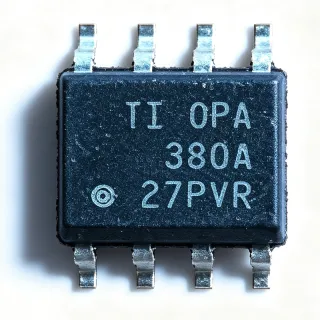
OPA698 - 450MHz Voltage Limiting Amplifier | Texas Instruments
MPN: OPA698 ✓ Active| Qty | Unit Price | Extended |
|---|---|---|
| 1 | $6.2 | $6.20 |
| 10 | $5.58 | $55.80 |
| 100 | $4.96 | $496.00 |
| 500 | $4.46 | $2,230.00 |
| 1,000 | $4.02 | $4,020.00 |
OPA698 Overview
A voltage-limiting amplifier is a special class of operational amplifier in the broader amplifier IC hierarchy (amplifier -> op amp -> voltage-feedback amplifier -> voltage-limiting amplifier). Unlike a standard op amp, the OPA698 uses two buffered limiting voltage inputs that take control of the output whenever the output attempts to drive beyond these programmed limits, protecting downstream components such as high-speed ADCs from overvoltage.
Key features include high linearity near the limiting threshold, extremely fast overdrive recovery (1ns) that eliminates the long settling tails typical of conventional op amps driven into saturation, and precise ±10mV limiting accuracy. Because it is unity-gain stable, the OPA698 can be used at any gain from +1 upward without external compensation, simplifying design of wideband signal chains.
Architecture-wise, the voltage-feedback topology with the bipolar limiting stage delivers an accurate, hard clipping characteristic that is independent of gain-setting resistors. The limiting thresholds are set by buffered external voltages, so the clip level can be adjusted dynamically in-circuit, unlike diode clamps which add distortion and leakage.
Typical applications include protection of high-speed analog-to-digital converter inputs in communications receivers, limiting amplifiers in IF/RF signal chains, test and measurement front ends, and video or instrumentation paths where output excursion must be tightly bounded. As of 2026-08-30 the OPA698IDR is listed on DigiKey as an active, in-stock part.
Design tip: keep the limiting input source impedance low and the threshold voltages within the recommended range to preserve the ±10mV limiting accuracy; use short, direct feedback traces and solid ground plane for the 450MHz bandwidth operation.
Drop-in alternatives for OPA698 — same package, pin-to-pin compatible. Different-package parts requiring PCB rework are excluded.
Quick Comparison Tool — Select alternative parts for side-by-side comparison:
OPA699IDR
⚡ Same Package📋 Reference alternative (not in catalog)
OPA692IDR
⚡ Same Package📋 Reference alternative (not in catalog)
OPA698 Maximum Ratings & Electrical Characteristics
| Amplifier Type | Voltage-feedback, voltage-limiting operational amplifier |
| Number of Channels | 1 |
| -3dB Bandwidth (Gain of +1) | 450 MHz |
| Gain Bandwidth Product | 250 MHz |
| Overdrive Recovery Time | 1 ns |
| Limiting Voltage Accuracy | ±10 mV |
| Unity-Gain Stable | Yes |
| Output Limiting | Bipolar, two buffered limiting voltage inputs |
| Operating Temperature Range | -40C to +85C |
| Package | 8-SOIC (D) |
| Mounting Type | Surface Mount |
| Lifecycle Status | Active |
OPA698 Pin Configuration
| Pin 1 | V+L — Positive limiting voltage input (upper clip threshold) |
| Pin 2 | IN- — Inverting input |
| Pin 3 | IN+ — Non-inverting input |
| Pin 4 | V- — Negative supply |
| Pin 5 | V-L — Negative limiting voltage input (lower clip threshold) |
| Pin 6 | OUT — Amplifier output |
| Pin 7 | V+ — Positive supply |
| Pin 8 | NC/DISABLE — [DATA_NEEDED: pin 8 function per datasheet] |
Typical Applications
OPA698 is suitable for 6 applications: High-Speed ADC Input Protection, IF/RF Limiting Amplifier Chains, Test and Measurement Front Ends, Video and Instrumentation Signal Paths, Communications Receivers, Overvoltage Protection Clamps for Sensitive Nodes.
High-Speed ADC Input Protection
The OPA698 is designed specifically to protect high-speed analog-to-digital converter inputs from overvoltage. Its two buffered limiting voltages hard-clip the output at precisely programmed levels with ±10mV accuracy, preventing fault conditions from damaging the ADC sample-and-hold network. The 1ns overdrive recovery means the signal path returns to linear operation essentially immediately after a fault clears, and high linearity near the limiting threshold preserves signal integrity during normal operation below the clip level.
Recommended
IF/RF Limiting Amplifier Chains
In IF and RF receiver signal chains, the OPA698 acts as an accurate limiter that bounds signal amplitude before detection or digitization. Its 450MHz bandwidth at gain +1 and 250MHz gain bandwidth product cover common IF frequencies, while bipolar limiting via buffered threshold inputs allows the clip level to be adjusted dynamically in-circuit. Unlike diode clamps, the active limiting stage adds no leakage or capacitive distortion, and the unity-gain stable topology permits flexible gain planning around the limiter.
Recommended
Test and Measurement Front Ends
Oscilloscope front ends and automated test equipment require circuits that survive unexpected input excursions while maintaining precise calibrated gain. The OPA698 fits this role: its ±10mV limiting accuracy defines a hard, repeatable input boundary, and 1ns recovery from overdrive eliminates the settling tails of saturated conventional op amps, so measurements resume immediately after overrange events. The 450MHz bandwidth supports high-speed probing applications, and unity-gain stability allows front-end attenuation/gain stages to be configured freely.
Recommended
Video and Instrumentation Signal Paths
Video distribution and instrumentation circuits need tightly bounded output excursion to prevent downstream damage and distortion. The OPA698's bipolar hard limiting sets exact white/black or upper/lower bounds with ±10mV precision, while its wideband 450MHz response preserves fast video edges without slew-induced distortion. Because the limiting thresholds are voltage-programmable, standards with different swing requirements can share one board design, with clip levels set by DACs or reference dividers.
Recommended
Communications Receivers
In communications receiver analog baseband sections, strong out-of-band interferers can overload sensitive downstream circuitry. Placing the OPA698 ahead of mixers, log amplifiers, or ADCs bounds the worst-case signal amplitude using its ±10mV-accurate bipolar limiting, and the 1ns overdrive recovery ensures small desired signals are amplified normally the instant the interferer disappears. The unity-gain stable voltage-feedback design supports AGC gain configurations from +1 upward with a single uncompensated device.
Recommended
Overvoltage Protection Clamps for Sensitive Nodes
The OPA698 serves as an active, precise clamp replacing discrete diode-resistor clamp networks on sensitive analog nodes. Its buffered limiting inputs replicate a stiff, temperature-stable voltage reference at the clip point, whereas diode clamps suffer leakage, capacitance, and threshold drift with temperature. With ±10mV limiting accuracy and 1ns recovery, the OPA698 provides deterministic protection with minimal added distortion, at the cost of supply current and headroom compared to passive solutions.
Recommended
Recommended Products Summary
Engineering reference data for OPA698 — comparison, design guidance, and compliance information.
Selection Guide
Comparison with Alternatives
| Parameter | This Product | OPA699IDR | OPA692IDR |
|---|---|---|---|
| Package | 8-SOIC (D) | 8-SOIC (D) - same | 8-SOIC (D) - same |
| Brand | Texas Instruments | Texas Instruments | Texas Instruments |
| Unity-Gain Stable | Yes | No (min gain +2) | Yes |
| Output Limiting | Yes, bipolar, ±10mV accuracy | Yes, bipolar | No |
| Overdrive Recovery | 1 ns | Fast (limiting architecture) | Standard op amp recovery |
| Gain Bandwidth Product | 250 MHz | Higher (min gain +2) | 500 MHz buffer |
| Primary Use Case | Limiting/ADC protection at any gain >= +1 | Limiting at gain >= +2 | Wideband buffering, no limiting |
| Lifecycle Status | Active | Active | Active |
Key Differentiators
- Unity-gain stability at 450MHz bandwidth (vs OPA699IDR)
- Integrated bipolar output limiting with ±10mV accuracy (vs OPA692IDR)
- Dynamically programmable clip level (vs Discrete diode clamps)
Design Notes
For 450MHz bandwidth operation, keep the feedback loop as physically small as possible: use low-value gain resistors (hundreds of ohms) so parasitic trace capacitance does not create an unintended pole, route the feedback trace directly on the component side over an unbroken ground plane, and place a 0.1uF ceramic decoupling capacitor within 2mm of each supply pin. Avoid sockets; their inductance destroys stability margins at this bandwidth.
The limiting accuracy is ±10mV only when the limiting voltage inputs are driven from a low-impedance source. High-impedance resistor dividers alone will degrade accuracy; buffer the threshold dividers or drive V+L/V-L from a reference IC or DAC output. Also ensure threshold voltages stay within the datasheet recommended input range, and remember that unlike diode clamps the OPA698 requires supply headroom around the clip levels.
A wideband amplifier driving a load at high frequency dissipates significant dynamic power in addition to quiescent current. Verify the SOIC-8 thermal capability for your supply voltage and load: with low-impedance loads and fast edges, peak supply transients require local bulk bypass (e.g., 4.7uF ceramic alongside the 0.1uF HF caps). Review TI application circuits in the OPA698 datasheet for recommended supply filtering in ADC protection designs.
Compliance Information
Compliance data not present in provided web data; verify on TI product page or DigiKey listing.