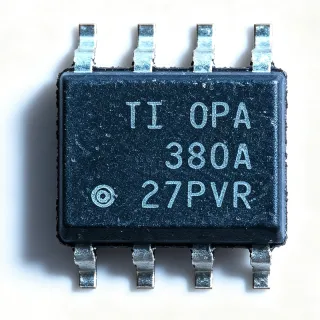
OPA2172 - Dual 36V 10MHz Low-Noise Op Amp | Texas Instruments
MPN: OPA2172ID ✓ Active| Qty | Unit Price | Extended |
|---|---|---|
| 1 | $1.85 | $1.85 |
| 10 | $1.66 | $16.60 |
| 100 | $1.32 | $132.00 |
| 500 | $1.12 | $560.00 |
| 1,000 | $0.94 | $940.00 |
OPA2172ID Overview
An operational amplifier (op amp) is a high-gain voltage amplifier with differential inputs and a single-ended output, and is a fundamental building block of analog signal conditioning, filtering, and amplification. The OPA2172 sits in the hierarchy of amplifiers -> operational amplifiers -> precision, rail-to-rail output amplifiers, balancing bandwidth, noise, and power in one general-purpose part.
Key specifications include ±0.2 mV offset voltage, ±0.3 uV/C offset drift, 10 MHz gain-bandwidth product, ±8 pA input bias current, 1.6 mA quiescent current per amplifier, and 7 nV/√Hz broadband noise. The rail-to-rail output stage maximizes dynamic range in low-voltage designs, while the wide supply range supports industrial 24 V buses directly.
The CMOS input stage provides high input impedance and picoampere bias currents suitable for high-impedance sensors and photodiode circuits. The output stage swings to within millivolts of the rails at light load and is stable with substantial capacitive loads, simplifying buffer designs. Low quiescent current permits use in battery-powered and thermally constrained equipment.
Typical applications include motor-control current sensing, solar inverters, power-supply feedback loops, active filters, and audio signal chains, where low noise and high slew rate preserve signal fidelity. The dual channel saves board space versus two singles.
Design tip: decouple supply pins with 0.1 uF ceramics close to the device, keep feedback resistors low-valued for best noise, and verify output swing headroom under heavy load.
Drop-in alternatives for OPA2172ID — same package, pin-to-pin compatible. Different-package parts requiring PCB rework are excluded.
Variants in this series
Same-series models that are drop-in compatible with OPA2172ID (same form factor and footprint) — differing in Amplifier Type, Gain Bandwidth Product, Package, Supply Voltage Range.
Quick Comparison Tool — Select alternative parts for side-by-side comparison:
OPA2172AID
✅ Drop-In ⚠️ Specs Unverified📋 Reference alternative (not in catalog)
OPA2172QDDFRQ1
✅ Drop-In📋 Reference alternative (not in catalog)
OPA2171AID
✅ Drop-In ⚠️ Specs Unverified📋 Reference alternative (not in catalog)
OPA2170AID
✅ Drop-In ⚠️ Specs Unverified📋 Reference alternative (not in catalog)
OPA1688ID
⚡ Same Package✓ In Stock
$0.82 / Unit
View Datasheet →LM358QDRQ1
⚡ Same Package ⚠️ Specs Unverified✓ In Stock
$0.18 / Unit
View Datasheet →OPA2172ID Maximum Ratings & Electrical Characteristics
| Channels | 2 |
| Supply Voltage Range | +4.5 V to +36 V (±2.25 V to ±18 V) |
| Gain Bandwidth Product | 10 MHz |
| Input Offset Voltage | ±0.2 mV |
| Offset Voltage Drift | ±0.3 uV/C |
| Input Bias Current | ±8 pA |
| Quiescent Current | 1.6 mA per amplifier |
| Noise Density | 7 nV/√Hz |
| Output Type | Rail-to-Rail Output |
| Operating Temperature | -40C to +125C |
| Package | 8-SOIC (D) |
| Mounting Type | Surface Mount |
| Amplifier Type | General Purpose / Precision |
| RoHS Status | Compliant |
OPA2172ID Pin Configuration
| Pin 1 | OUT A — Output of amplifier A |
| Pin 2 | IN A- — Inverting input A |
| Pin 3 | IN A+ — Non-inverting input A |
| Pin 4 | V- — Negative supply (or GND in single supply) |
| Pin 5 | IN B+ — Non-inverting input B |
| Pin 6 | IN B- — Inverting input B |
| Pin 7 | OUT B — Output of amplifier B |
| Pin 8 | V+ — Positive supply |
Typical Applications
OPA2172ID is suitable for 6 applications: Motor Control Current Sensing, Solar Inverter Power Stages, Audio Signal Processing, Power Supply Feedback Loops, Industrial Process Control Sensing, Automotive Signal Conditioning.
Motor Control Current Sensing
The OPA2172 amplifies small current-sense signals in 24 V or 48 V motor drives, where its ±0.2 mV offset and ±0.3 uV/C drift preserve accuracy across temperature. The 10 MHz bandwidth supports fast feedback loops for torque control, while the 36 V supply range allows direct connection to industrial rail-derived supplies. Rail-to-rail output maximizes ADC input range, improving measurement resolution in FOC motor controllers paired with TI C2000 MCUs such as the TMS320F28034-Q1.
Recommended
Solar Inverter Power Stages
In solar inverters, the OPA2172 conditions voltage and current feedback signals for MPPT and grid-synchronization control. Its wide +4.5 V to +36 V supply range tolerates industrial supply variation, and 7 nV/√Hz noise keeps small-signal sensing clean in electrically noisy switching environments. The rail-to-rail output fully utilizes low-voltage ADC input ranges, and the low 1.6 mA per amplifier quiescent current reduces standby losses in energy-harvesting equipment where every milliwatt counts.
Recommended
Audio Signal Processing
The OPA2172 serves as a low-noise preamp, active filter, and DAC output buffer in professional and consumer audio. Its 7 nV/√Hz voltage noise and 10 MHz bandwidth preserve transient fidelity, and the high slew rate prevents slew-induced distortion on high-amplitude line-level signals. Audio synth designers commonly substitute it for the noisier TL072 (as noted in the O_C module community). Its rail-to-rail output maximizes headroom on single-supply audio rails without large coupling capacitors.
Recommended
Power Supply Feedback Loops
The OPA2172 implements error amplifiers and loop compensation in AC-DC and DC-DC power supplies. With a 36 V supply rating, it can monitor high-voltage rails directly through dividers, while the ±0.2 mV offset tightens output regulation accuracy. The 10 MHz bandwidth supports fast transient-response loops in designs using TI UCC and TPS controllers. Rail-to-rail output lets the error amp swing fully across the controller reference range for precise duty-cycle control.
Recommended
Industrial Process Control Sensing
In factory instrumentation, the OPA2172 amplifies signals from pressure, temperature, and pH sensors. The ±8 pA CMOS bias current suits high-impedance piezo and glass-electrode sources, and ±0.3 uV/C drift keeps calibration stable across -40C to +125C industrial ranges. The 4.5 V minimum supply works with 5 V logic rails, while the 36 V maximum tolerates 24 V industrial buses. Its dual channel allows a sense amplifier plus an active anti-aliasing filter in a single SOIC-8 footprint.
Recommended
Automotive Signal Conditioning
Using the AEC-Q100 qualified OPA2172-Q1 variant, this op amp conditions battery-voltage, current, and position-sensor signals in automotive ECUs. The 36 V rating covers load-dump and 12 V battery transients with margin, and the -40C to +125C temperature range meets underhood requirements. Low offset drift ensures long-term accuracy in safety-relevant monitoring. Pairs with TI automotive ADCs and isolated amplifiers for battery-management and traction-invertor sensing chains.
Recommended
Recommended Products Summary
Engineering reference data for OPA2172ID — comparison, design guidance, and compliance information.
Selection Guide
Comparison with Alternatives
| Parameter | This Product | OPA2172AID | OPA2171AID | OPA1688 | LM358QDRQ1 |
|---|---|---|---|---|---|
| Package | 8-SOIC (D) | 8-SOIC (D) - same | 8-SOIC (D) - same | 8-SOIC (D) - same | 8-SOIC (D) - same |
| Brand | Texas Instruments | Texas Instruments | Texas Instruments | Texas Instruments | Texas Instruments |
| Supply Voltage Max | 36 V | 36 V | 36 V | 24 V | 32 V |
| Gain Bandwidth | 10 MHz | 10 MHz | 3 MHz | 10 MHz | ~1 MHz |
| Offset Voltage | ±0.2 mV | ±0.2 mV (tighter A-grade limit) | ±0.025 mV | ±0.3 mV | ±3 mV |
| Noise Density | 7 nV/√Hz | 7 nV/√Hz | 18 nV/√Hz | 10.5 nV/√Hz | 40 nV/√Hz |
| Quiescent Current | 1.6 mA per amp | 1.6 mA per amp | 0.475 mA per amp | 0.5 mA per amp | 0.5 mA per amp |
| Output Type | Rail-to-Rail Output | RRO | RRO | RRO | Not RRO |
| Automotive Grade | No (Q1 variant available) | No | Q1 available | No | Yes (Q1) |
Key Differentiators
- 36 V supply with 10 MHz bandwidth combination (vs LM358QDRQ1)
- Much lower offset than budget precision parts (vs LM358QDRQ1)
- Higher supply headroom than OPA1688 (vs OPA1688)
Design Notes
Place 0.1 uF ceramic decoupling capacitors directly across the V+ (pin 8) and V- (pin 4) pins with short, low-inductance returns. At 10 MHz bandwidth, long supply traces can resonate with parasitic inductance and cause peaking. A small (10-22 ohm) series resistor or ferrite bead in the supply line plus local capacitance improves noise isolation in mixed-signal boards.
For best noise performance in transimpedance and precision gain stages, keep feedback resistor values low; the OPA2172's 7 nV/√Hz noise is only realized when resistor thermal noise is below amplifier noise (e.g., use <10 kohm feedback in low-gain stages). The CMOS ±8 pA bias current permits large input resistors without DC error, but verify stability with input capacitance.
The rail-to-rail output swing degrades under heavy load - check output swing versus load curves in the TI OPAx172 datasheet when driving low-impedance loads near the rails. Do not exceed 36 V absolute maximum supply, and note input common-mode range does not include the positive rail, so non-inverting gain configurations must keep input voltages below approximately (V+) - 2 V.
Compliance Information
RoHS compliant per TI product page. AEC-Q100 grade available via OPA2172-Q1 variant.