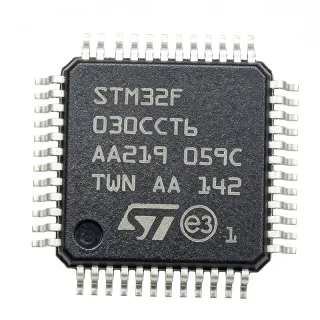
PIC12LF1572T-I/SN - 8-Bit MCU, 3.5KB Flash, 32MHz, 8-SOIC | Microchip
MPN: PIC12LF1572T-I/SN ✓ Active| Qty | Unit Price | Extended |
|---|---|---|
| 1 | $1.21 | $1.21 |
| 10 | $1.08 | $10.80 |
| 100 | $0.94 | $94.00 |
| 500 | $0.83 | $415.00 |
| 1,000 | $0.72 | $720.00 |
PIC12LF1572T-I/SN Overview
A microcontroller (MCU) is a single-chip computer that contains a processor core, volatile and non-volatile memory, and configurable peripheral blocks. The PIC12LF1572 belongs to Microchip's enhanced mid-range PIC12 family, which targets cost-sensitive, low-pin-count embedded applications. In the broader taxonomy, it sits under 8-bit microcontroller -> microcontroller -> embedded processor -> semiconductor, occupying the smallest-footprint tier alongside PIC10, PIC12, and PIC16 families.
Key differentiating features of the PIC12LF1572 include three independent 16-bit PWMs (vs. the 10-bit PWM blocks found on older PIC12F parts), a 10-bit ADC with selectable conversion modes, a 5-bit DAC, an Enhanced Universal Synchronous Asynchronous Receiver Transceiver (EUSART), and an inter-module crossbar supporting flexible signal routing between peripherals. The 32MHz internal oscillator eliminates the need for an external crystal in many designs, reducing BOM cost and board area.
Architecturally, the PIC12LF1572 uses a Harvard RISC core with a 14-bit instruction word, allowing most instructions to execute in a single instruction cycle (125 ns at 32 MHz FOSC). The on-chip debug logic (ICD) and the in-circuit serial programming (ICSP) interface support Microchip's MPLAB X IDE and PICkit programmers, accelerating firmware bring-up.
Typical applications include LED lighting and color-mixing controllers, household appliance user interfaces, battery-powered sensor nodes, simple motor and fan control loops, and general-purpose logic replacement where designers need more flexibility than a discrete 555 timer but fewer resources than a 32-bit MCU. The 16-bit PWM resolution makes the part especially well suited to high-resolution dimming and motor torque control.
Designers should pay particular attention to the 1.8V to 3.6V supply range. When migrating from the 5V-tolerant PIC12F1572, note that the 'LF' variant is the low-voltage part - do not power it from a 5V rail or the device will be damaged. Decoupling should follow Microchip's recommended 0.1uF + 10uF capacitor arrangement.
This page consolidates distributor pricing, drop-in SOIC-8 alternatives, and practical design notes that go beyond the manufacturer datasheet to help procurement and embedded engineers make a fast, well-informed decision.
Drop-in alternatives for PIC12LF1572T-I/SN — same package, pin-to-pin compatible. Different-package parts requiring PCB rework are excluded.
Variants in this series
Same-series models that are drop-in compatible with PIC12LF1572T-I/SN (same form factor and footprint) — differing in ADC, DAC, Operating Temperature, PWM Channels, Package.
Quick Comparison Tool — Select alternative parts for side-by-side comparison:
PIC12LF1572-I/SN
✅ Drop-In📋 Reference alternative (not in catalog)
PIC12LF1572T-I/MF
✅ Drop-In📋 Reference alternative (not in catalog)
PIC12F1572T-I/SN
✅ Drop-In📋 Reference alternative (not in catalog)
PIC12LF1571T-I/SN
✅ Drop-In📋 Reference alternative (not in catalog)
PIC12F1501T-I/SN
✅ Drop-In📋 Reference alternative (not in catalog)
PIC12LF1572T-I/SN Maximum Ratings & Electrical Characteristics
| Core Architecture | PIC 8-bit RISC (enhanced mid-range) |
| Program Memory (Flash) | 3.5 KB (2K x 14 words) |
| Data SRAM | 256 bytes |
| EEPROM | None (no on-chip data EEPROM) |
| Maximum CPU Clock | 32 MHz |
| Instruction Cycle | 125 ns at 32 MHz |
| Supply Voltage (VDD) | 1.8 V to 3.6 V |
| I/O Pins | 6 |
| ADC | 10-bit, 4 channels |
| DAC | 5-bit, 1 channel |
| PWM Channels | 3 x 16-bit with independent timers |
| Comparators | 1 |
| Communication | EUSART, MSSP (I2C/SPI) |
| Timers | 4 (Timer0, Timer1, Timer2, WDT) |
| Package | 8-SOIC (0.154 inch / 3.90 mm body width) |
| Operating Temperature | -40C to +85C (industrial, I grade) |
| Mounting Type | Surface Mount |
| RoHS Status | Compliant |
PIC12LF1572T-I/SN Pin Configuration
| Pin 1 | VDD — Positive supply voltage (1.8V to 3.6V) |
| Pin 2 | RA5 — Bidirectional I/O / analog input / PWM output |
| Pin 3 | RA4 — Bidirectional I/O / analog input / PWM output |
| Pin 4 | RA3/MCLR — Input only / Master Clear reset (active low) |
| Pin 5 | RC5 — Bidirectional I/O / PWM output / EUSART RX |
| Pin 6 | RC4 — Bidirectional I/O / PWM output / EUSART TX |
| Pin 7 | RC3 — Bidirectional I/O / analog input |
| Pin 8 | VSS — Ground reference |
Typical Applications
PIC12LF1572T-I/SN is suitable for 6 applications: LED Lighting and Color-Mixing Controllers, Battery-Powered Sensor Nodes, Small DC Motor and Fan Speed Control, Household Appliance User Interfaces, General-Purpose Logic Replacement, Toys and Hobby Electronics.
LED Lighting and Color-Mixing Controllers
The PIC12LF1572's three independent 16-bit PWMs make it a strong fit for high-resolution RGB LED color mixing and architectural dimming controllers. Each PWM channel provides 65536 duty-cycle steps, enabling smooth fades and precise chromaticity control at low duty cycles where 8-bit or 10-bit PWMs exhibit visible stair-stepping. The 10-bit ADC allows closed-loop feedback from an optional ambient light sensor or thermistor, while the 1.8V to 3.6V supply range supports direct Li-ion or 2x AA alkaline battery operation. The internal 32MHz HFINTOSC eliminates an external crystal, keeping the BOM minimal for cost-sensitive consumer lighting SKUs.
Recommended
Battery-Powered Sensor Nodes
With 1.8V to 3.6V operation and low sleep currents, the PIC12LF1572T-I/SN fits wireless sensor endpoints such as temperature loggers, door/window contact sensors, and remote-control units. The 256-byte SRAM is sufficient for short sensor buffers, and the 3.5KB Flash can hold BLE/beacon frame templates or simple LoRa preamble code. The 10-bit ADC reads thermistors, photodiodes, or PIR motion sensors directly. The EUSART pairs with sub-GHz transceivers like the MRF89XA or with an ESP-style Wi-Fi co-processor when higher throughput is required, while the LFINTOSC keeps wake-from-sleep power low.
Recommended
Small DC Motor and Fan Speed Control
The PIC12LF1572's 16-bit PWMs and integrated analog peripherals support closed-loop brushed DC motor or small fan RPM control. The 10-bit ADC samples back-EMF or Hall sensor feedback, while the comparator enables overcurrent shutdown without external glue logic. With 32MHz CPU and 125ns instruction cycle, PID loops update every few microseconds for smooth torque response. The wide 1.8V to 3.6V supply accommodates direct MOSFET gate driving through 3.3V-compatible drivers, while the EUSART exposes a diagnostics or command bus for host MCU integration.
Recommended
Household Appliance User Interfaces
The PIC12LF1572T-I/SN drives capacitive or resistive touch keypads, LED status indicators, and 7-segment display multiplexing in appliances such as coffee makers, microwave ovens, and washing machines. The three 16-bit PWMs handle backlight brightness, buzzer tones, and triac-based heater phase control. The 10-bit ADC reads NTC temperature sensors for safety cut-off and the 5-bit DAC sets trim levels. The 6 I/O pins are adequate for up to 6 button inputs plus display logic, and the 1.8V minimum supply supports 3.3V designs with low-voltage brownout protection.
Recommended
General-Purpose Logic Replacement
When discrete 555 timers, logic gates, or small state machines become too inflexible, the PIC12LF1572T-I/SN delivers 32MHz processing in an 8-SOIC package to consolidate multiple timing and sequencing functions into a single MCU. Designers benefit from software-defined delays, programmable thresholds via the comparator, and easy firmware updates versus rework of discrete components. The ICSP interface allows last-minute logic changes without PCB respins, accelerating prototypes and small-batch production. Internal peripherals like PWM and EUSART enable integration of motor control and diagnostics with no additional ICs.
Recommended
Toys and Hobby Electronics
The PIC12LF1572T-I/SN drives animatronic toys, model train controllers, RC accessories, and educational electronics kits where cost, simplicity, and low power are paramount. The 16-bit PWMs produce smooth servo control signals (50Hz, 1-2ms pulse width), while the 10-bit ADC reads joystick potentiometers or battery voltage. The 1.8V minimum supply supports single-cell Li-ion packs common in hobby projects. The 8-SOIC package is hand-solderable and breadboard-friendly through SOIC-to-DIP adapters, making the device a popular teaching platform for embedded programming courses.
Recommended
Recommended Products Summary
Engineering reference data for PIC12LF1572T-I/SN — comparison, design guidance, and compliance information.
Selection Guide
Comparison with Alternatives
| Parameter | This Product | PIC12LF1572-I/SN | PIC12F1572T-I/SN | PIC12LF1571T-I/SN | PIC12F1501T-I/SN | PIC12LF1572T-I/MF |
|---|---|---|---|---|---|---|
| Package | 8-SOIC (0.154 inch) | 8-SOIC (0.154 inch) - same | 8-SOIC (0.154 inch) - same | 8-SOIC (0.154 inch) - same | 8-SOIC (0.154 inch) - same | 8-DFN (3x3 mm) - different footprint |
| Brand | Microchip Technology | Microchip Technology | Microchip Technology | Microchip Technology | Microchip Technology | Microchip Technology |
| Core | 8-bit PIC RISC (enhanced mid-range) | 8-bit PIC RISC - same | 8-bit PIC RISC - same | 8-bit PIC RISC - same | 8-bit PIC RISC - same | 8-bit PIC RISC - same |
| Maximum Clock | 32 MHz | 32 MHz | 32 MHz | 32 MHz | 20 MHz | 32 MHz |
| Flash Memory | 3.5 KB | 3.5 KB | 3.5 KB | 1.75 KB | 1.75 KB | 3.5 KB |
| SRAM | 256 bytes | 256 bytes | 256 bytes | 128 bytes | 64 bytes | 256 bytes |
| Supply Voltage | 1.8 V to 3.6 V | 1.8 V to 3.6 V | 2.3 V to 5.5 V | 1.8 V to 3.6 V | 1.8 V to 3.6 V | 1.8 V to 3.6 V |
| 16-bit PWM | 3 channels | 3 channels | 3 channels | 2 channels | 0 (10-bit PWM only) | 3 channels |
| 5-bit DAC | Yes (1 channel) | Yes | Yes | No | Yes | Yes |
Key Differentiators
- Three independent 16-bit PWMs versus single 10-bit PWM (vs PIC12F1501T-I/SN)
- Low-voltage operation down to 1.8V (vs PIC12F1572T-I/SN)
- Higher 3.5 KB Flash versus 1.75 KB (vs PIC12LF1571T-I/SN)
Design Notes
Decouple VDD (pin 1) with a 0.1uF ceramic capacitor placed within 5 mm of the supply pin, and add a bulk 10uF ceramic or tantalum capacitor on the same rail. According to the Microchip PIC12(L)F1572 datasheet (DS40001673G), the device includes internal power-on reset and brown-out reset; configure BOR via configuration bits to prevent code execution below the minimum 1.8V supply. For battery-powered designs, the LFINTOSC (~31 kHz) reduces active current to the datasheet's low-uA range during sleep.
Keep the ICSP signals (ICSPCLK/ICSPDAT) and the MCLR pin accessible for in-circuit programming. Per Microchip layout guidelines, the ICSP connector should be a 6-pin header with VDD, VSS, ICSPCLK, ICSPDAT, MCLR, and AUX. Avoid routing noisy switching signals near the analog ADC inputs (RA2/RA4/RC3) to prevent digital coupling; if unavoidable, add a guard ground trace between the digital and analog sections.
Do not confuse the PIC12LF1572 (1.8V to 3.6V) with the PIC12F1572 (2.3V to 5.5V) - connecting 5V to the LF part will permanently damage it. Ensure the MCLR pin (RA3) has a 10k pull-up to VDD and a 100nF cap to ground for reliable reset; do not leave MCLR floating. Always verify the configuration bits match the application (clock source, watchdog, code protection, BOR threshold) before locking the device, as some bits are not recoverable without a bulk erase.
Compliance Information
RoHS compliant per Microchip product page; industrial temperature grade -40C to +85C; not AEC-Q100 qualified - see PIC16F families for automotive-grade alternatives.