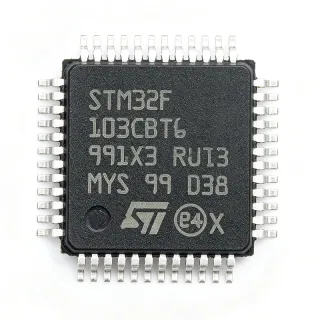
PIC16F1782-E/ML - 8-bit MCU 3.5KB Flash 28-QFN | Microchip
MPN: PIC16F1782-E/ML ✓ Active| Qty | Unit Price | Extended |
|---|---|---|
| 1 | $3.2 | $3.20 |
| 10 | $2.85 | $28.50 |
| 100 | $2.45 | $245.00 |
| 500 | $2.1 | $1,050.00 |
| 1,000 | $1.82 | $1,820.00 |
PIC16F1782-E/ML Overview
An 8-bit PIC microcontroller is a RISC-based, flash-programmable CMOS device from Microchip's PIC16 family that executes most instructions in a single 200 ns cycle. PIC MCUs sit within the broader hierarchy of microcontrollers, which themselves belong to embedded processors and finally to the semiconductor IC category. Enhanced mid-range PIC16 parts such as the PIC16F1782 add peripherals such as 12-bit ADCs, op-amps, and configurable logic that are absent from baseline PIC10/12/16F parts.
Key features include a 20 MHz clock speed (50 ns instruction cycle), 2.5V to 5.5V supply voltage, low-power XLP (eXtreme Low Power) technology, and an extended operating temperature range of -40C to +125C (the -E suffix indicates the industrial/automotive temperature grade). The integrated op-amp and fast comparator enable analog signal conditioning directly on-chip, while PSMC supports advanced timer/PWM/Signal Measurement control with high-resolution edge placement.
The PIC16F1782 uses Microchip's enhanced mid-range core with 49 instructions and a 14-bit instruction word, providing predictable interrupt response and deterministic timing suitable for real-time embedded designs. The 28-QFN package is well suited to compact layouts, and the device is supported by MPLAB X IDE, XC8 compilers, and the PICkit/SNAP debugger family.
Typical applications include LED lighting and dimming control, sensor signal conditioning with on-chip op-amp, low-power battery-powered IoT nodes, small motor and fan control using PSMC, automotive interior modules, and industrial control loops where the integrated 12-bit ADC and 8-bit DAC minimize external component count.
When designing with this part, reserve adequate decoupling (100 nF + bulk) near VDD, route the analog AVSS/AVDD pair separately, and avoid sharing the OPAMP output pin with digital traffic. XLP sleep currents in the nanoampere range make this part particularly suitable for always-on, battery-powered sensor nodes.
This page synthesizes verified distributor pricing, structured drop-in alternatives drawn from the same QFN package family, and practical design notes that extend beyond the manufacturer datasheet.
Drop-in alternatives for PIC16F1782-E/ML — same package, pin-to-pin compatible. Different-package parts requiring PCB rework are excluded.
Variants in this series
Same-series models that are drop-in compatible with PIC16F1782-E/ML (same form factor and footprint) — differing in ADC, DAC, Package, Program Memory (Flash), Core Architecture.
Quick Comparison Tool — Select alternative parts for side-by-side comparison:
PIC16F1782T-E/ML
✅ Drop-In📋 Reference alternative (not in catalog)
PIC16F1782-I/ML
✅ Drop-In✓ In Stock
$1.78 / Unit
View Datasheet →PIC16F1783-I/ML
✅ Drop-In✓ In Stock
$1.78 / Unit
View Datasheet →PIC16F1768-I/ML
✅ Drop-In ⚠️ 参数待验证✓ In Stock
$1.55 / Unit
View Datasheet →PIC16F1708-I/ML
✅ Drop-In ⚠️ 参数待验证📋 Reference alternative (not in catalog)
PIC16F1716-I/ML
✅ Drop-In ⚠️ 参数待验证✓ In Stock
$0.98 / Unit
View Datasheet →PIC16F1575-I/ML
✅ Drop-In ⚠️ 参数待验证📋 Reference alternative (not in catalog)
PIC16F1782-E/ML Maximum Ratings & Electrical Characteristics
| Program Memory (Flash) | 3.5 KB |
| Data Memory (SRAM) | 256 B |
| EEPROM | 256 B |
| CPU Core | PIC16 Enhanced Mid-Range 8-bit |
| Maximum Clock Speed | 20 MHz (200 ns instruction cycle) |
| Operating Voltage (VDD) | 2.5 V to 5.5 V |
| I/O Pins | 12 |
| ADC | 12-bit |
| DAC | 8-bit |
| On-chip Op-Amp | Yes (1x) |
| Comparator | Fast Comparator |
| PWM / PSMC | PSMC + CCP |
| Communication | I2C, SPI, EUSART |
| Package | QFN-28 (ML) 3x3 mm, 0.90 mm height |
| Operating Temperature | -40 C to +125 C (E grade) |
| Low-Power Technology | XLP (eXtreme Low Power) |
| Mounting Type | Surface Mount |
| RoHS Status | Compliant |
PIC16F1782-E/ML Pin Configuration
| Pin 1 | VDD — Positive supply voltage |
| Pin 2 | RA5 — GPIO / analog input |
| Pin 3 | RA4 — GPIO / analog input |
| Pin 4 | RA3 — GPIO / MCLR |
| Pin 5 | RC5 — GPIO / analog input |
| Pin 6 | RC4 — GPIO / analog input |
| Pin 7 | RC3 — GPIO / analog input / SCL |
| Pin 8 | RC2 — GPIO / analog input / SDA |
| Pin 9 | RC1 — GPIO / analog input |
| Pin 10 | RC0 — GPIO / analog input |
| Pin 11 | RA2 — GPIO / analog input / OPAOUT |
| Pin 12 | RA1 — GPIO / analog input / OPAIN- |
| Pin 13 | RA0 — GPIO / analog input / OPAIN+ |
| Pin 14 | VSS — Ground reference |
| Pin 15 | RA7 — GPIO / OSC1 |
| Pin 16 | RA6 — GPIO / OSC2 |
| Pin 17 | AVSS — Analog ground |
| Pin 18 | AVDD — Analog supply voltage |
| Pin 19 | RB7 — GPIO / ICSPDAT |
| Pin 20 | RB6 — GPIO / ICSPCLK |
| Pin 21 | RB5 — GPIO / analog input |
| Pin 22 | RB4 — GPIO / analog input |
| Pin 23 | RB3 — GPIO / analog input |
| Pin 24 | RB2 — GPIO / analog input |
| Pin 25 | RB1 — GPIO / analog input |
| Pin 26 | RB0 — GPIO / analog input / interrupt |
| Pin 27 | RC7 — GPIO / RX |
| Pin 28 | RC6 — GPIO / TX |
Typical Applications
PIC16F1782-E/ML is suitable for 6 applications: LED Lighting and Dimming Control, Sensor Signal Conditioning with On-chip Op-Amp, Low-Power Battery-Powered IoT Node, Small Motor and Fan Control using PSMC, Automotive Interior Module, Industrial Process Control Loop.
LED Lighting and Dimming Control
The PIC16F1782-E/ML's PSMC (Peripheral Signal Measurement Timer) and CCP modules provide high-resolution PWM with fine-edge placement, ideal for constant-current LED dimming and color-mixing. The 12-bit ADC samples photodiode or current-sense feedback, while the on-chip op-amp closes a low-offset transimpedance loop. Verified Web Data lists PSMC + 12-bit ADC + op-amp as integrated features. Compared with software PWM, hardware PSMC frees the CPU to handle the I2C/SPI lighting control bus, and XLP nanoamp sleep extends battery life in portable luminaires.
Recommended
Sensor Signal Conditioning with On-chip Op-Amp
The PIC16F1782-E/ML integrates a 12-bit ADC, an 8-bit DAC, an op-amp, and a fast comparator - the four building blocks needed to condition a bridge sensor or thermistor front-end. The op-amp drives the ADC input directly, removing external instrumentation amplifiers; the fast comparator supports hardware over-current or threshold detection without software latency. Verified Web Data confirms 12-bit ADC + op-amp + fast comparator. Compared to a discrete op-amp + MCU design, this single-chip integration cuts BOM count and PCB area, while XLP sleep enables multi-year battery life on sensor nodes.
Recommended
Low-Power Battery-Powered IoT Node
The PIC16F1782-E/ML features Microchip's XLP (eXtreme Low Power) technology with nanoamp sleep current, plus 2.5 V to 5.5 V supply supporting a single Li-ion or 3x AA battery stack. Verified Web Data lists XLP and 2.5 V to 5.5 V operation. The 20 MHz maximum clock and 12-bit ADC provide enough throughput for periodic sensor reads and low-rate RF/BLE wake-up signaling. Compared to a Cortex-M0+ node, this PIC16 part delivers lower sleep current and lower BOM cost, though it has less RAM for protocol stacks - so it is best suited for sensor-end nodes rather than full BLE gateways.
Recommended
Small Motor and Fan Control using PSMC
The PIC16F1782-E/ML's PSMC supports high-resolution PWM with programmable dead-band, fault inputs, and current-triggered ADC sampling - the right peripheral set for small BLDC, brushed, or fan motor control. The fast comparator detects back-EMF zero-cross for sensorless commutation, while the 8-bit DAC sets the reference for current-mode control loops. Verified Web Data confirms PSMC + fast comparator. Compared to a generic timer-PWM MCU, this part's PSMC implements center-aligned PWM, dead-band, and ADC-trigger in hardware, offloading the CPU and reducing firmware complexity.
Recommended
Automotive Interior Module
The PIC16F1782-E/ML's -E (extended) temperature grade of -40 C to +125 C, plus 12-bit ADC and PWM capability, suits interior lighting, ambient lighting, and HVAC actuator modules. Verified Web Data lists -40C to +125C and 12 I/O. The 28-QFN (3x3 mm) footprint fits behind instrument clusters and door trim PCBAs. Compared to a non-automotive-grade MCU, the E-rated part gives margin under automotive thermal stress. For CAN/LIN connectivity, an external transceiver such as MCP2515 or TJA1027 is typically added - the MCU's SPI/EUSART drives these directly.
Recommended
Industrial Process Control Loop
The PIC16F1782-E/ML integrates the ADC, DAC, op-amp, and PWM needed for a closed-loop PID controller driving a valve or heater. Verified Web Data lists 12-bit ADC + 8-bit DAC + PSMC + op-amp + CCP. The op-amp conditions the sensor signal, the ADC samples it, the firmware computes PID, and the CCP/PSMC outputs the actuator drive. The 2.5 V to 5.5 V supply aligns with 24 V industrial rails after a buck converter. Compared to a PLC, this single-chip approach reduces panel space and cost for simple control loops.
Recommended
Recommended Products Summary
Engineering reference data for PIC16F1782-E/ML — comparison, design guidance, and compliance information.
Selection Guide
Comparison with Alternatives
| Parameter | This Product | PIC16F1782T-E/ML | PIC16F1782-I/ML | PIC16F1783-I/ML | PIC16F1768-I/ML | PIC16F1708-I/ML |
|---|---|---|---|---|---|---|
| Package | QFN-28 (ML) 3x3 mm | QFN-28 (ML) 3x3 mm - same | QFN-28 (ML) 3x3 mm - same | QFN-28 (ML) 3x3 mm - same | QFN-28 (ML) 3x3 mm - same | QFN-28 (ML) 3x3 mm - same |
| Brand | Microchip Technology | Microchip Technology | Microchip Technology | Microchip Technology | Microchip Technology | Microchip Technology |
| Program Flash | 3.5 KB | 3.5 KB | 3.5 KB | 3.5 KB | 3.5 KB | 7 KB |
| RAM / EEPROM | 256 B / 256 B | 256 B / 256 B | 256 B / 256 B | 256 B / 256 B | 256 B / 256 B | 512 B / 256 B |
| Max Clock | 20 MHz | 20 MHz | 20 MHz | 20 MHz | 20 MHz | 20 MHz |
| ADC / DAC | 12-bit / 8-bit | 12-bit / 8-bit | 12-bit / 8-bit | 11-channel 12-bit / 8-bit | 12-bit / 8-bit | 10-bit / 8-bit |
| Op-Amp / Comp | Yes / FastComp | Yes / FastComp | Yes / FastComp | Yes / FastComp | Yes / FastComp | 2x / Comp |
| Operating Voltage | 2.5 V to 5.5 V | 2.5 V to 5.5 V | 2.5 V to 5.5 V | 2.5 V to 5.5 V | 2.5 V to 5.5 V | 2.3 V to 5.5 V |
| Temperature Grade | -40 C to +125 C (E) | -40 C to +125 C (E) | -40 C to +85 C (I) | -40 C to +85 C (I) | -40 C to +85 C (I) | -40 C to +125 C (E) |
Key Differentiators
- Integrated op-amp + fast comparator + PSMC + 12-bit ADC (vs PIC16F1708-I/ML)
- Extended temperature grade -40C to +125C on 28-QFN (vs PIC16F1782-I/ML)
- Tape-and-reel assembly option at same die (vs PIC16F1782T-E/ML)
Design Notes
Place a 100 nF ceramic decoupling capacitor as close as possible to the VDD pin (pin 1), and a 10 uF bulk capacitor on the same supply trace. For the analog AVDD/AVSS pair (pins 17/18), use a separate ferrite bead or pi-filter to isolate analog noise from digital VDD. Verified Web Data confirms 2.5 V to 5.5 V operation; using a ferrite reduces ADC noise and improves ENOB. For battery-powered designs, switch to XLP Sleep mode between samples for nanoamp-level quiescent current.
Route the OPAOUT pin (RA2) directly to the ADC input channel with a short, guarded trace. The op-amp output impedance is low but the ADC sampling capacitor injects charge - keep traces short to minimize settling time. Avoid routing digital signals (EUSART TX, SPI CLK) parallel to the OPAIN+ / OPAIN- traces. Place the QFN exposed pad (EP) on the PCB with at least 4 thermal vias to a ground plane to keep theta_JA within Microchip's specification under extended-temperature operation.
Do not exceed the absolute maximum VDD of 5.5 V or the QFN will latch-up. Always configure the unused I/O pins as outputs (low) or inputs with internal weak pull-ups to minimize sleep current. The on-chip op-amp requires the OPAEN bit set in firmware before use; attempting to read the OPAOUT ADC channel without enabling the op-amp will read a floating value. PPS (Peripheral Pin Select) mappings must be unlocked via the PPSLOCK register sequence; skipping the unlock locks out subsequent peripheral remapping.
Compliance Information
RoHS and REACH compliant per Microchip product environmental data. Lead-free and halogen-free terminations standard. AEC-Q100 not explicitly qualified per public datasheet; -E temperature grade supports automotive interior modules but not full automotive AEC-Q100 verification.